Varni Kilim: A Persian Handmade Treasure
Los Angeles Home of Rugs on May 1st 2024
Among the remarkable diversity of Persian flatweave traditions, one of the least known and most culturally distinctive is Varni - also called Gelim Sozani - a unique form of Sumak weaving produced by the women and girls of the nomadic tribes of the Arasbaran region in northwestern Persia. Rich in cultural heritage, deeply rooted in the natural world of the Arasbaran highlands, and displaying a design vocabulary of extraordinary visual power, Varni kilims represent one of the most complete and coherent expressions of nomadic tribal textile art in the entire Persian weaving tradition - and one whose existence remains virtually unknown outside specialist circles despite its antiquity, its beauty, and its continuing vitality as a living craft practiced by more than 20,000 artisans in the Ahar region today.
This guide explores the complete story of Varni weaving: its historical origins and geographic context, its distinctive technical construction that sets it apart from conventional kilim weaving, its extraordinary design vocabulary drawn from the natural world and tribal symbolic tradition of the Arasbaran nomads, its primary production centers and cultural significance, and what makes it a uniquely compelling object for collectors and lovers of authentic Persian textile art.
1 Arasbaran - The Land That Gave Birth to Varni
The Arasbaran region - a mountainous, heavily forested area in the East Azerbaijan Province of northwestern Persia, bordered by the Aras River to the north and the Alborz mountain ranges to the south - is one of the most ecologically distinctive and culturally rich landscapes in the entire Persian plateau. Known historically as Qaradagh (Black Mountain) for the dark forested ridges that characterize its highland terrain, Arasbaran has been home to nomadic and semi-nomadic Turkic-speaking tribal communities for centuries - communities whose seasonal migrations between mountain summer pastures and lowland winter quarters shaped a material culture of extraordinary richness and specificity.
The antiquity of Varni weaving in this region is attested not only by oral tradition but by physical archaeological evidence preserved in the landscape itself. Historical stone tombs scattered across the Arasbaran highland villages - particularly those in the village of Anjerd in Ahar County and Aas in Kalibar County - bear carved decorative motifs that correspond closely to the design vocabulary of Varni textiles, suggesting that the symbolic language of this weaving tradition has roots reaching back centuries before the earliest surviving textile examples. These stone carvings constitute one of the most remarkable pieces of evidence for the deep historical continuity of a living craft tradition anywhere in the Persian weaving world.
The city of Ahar and its surrounding plains have emerged as the primary contemporary production hub for Varni, earning Ahar the prestigious official designation as the national Varni city of Persia - a recognition of both the quantitative scale and the qualitative excellence of Ahar's Varni production within the broader national craft landscape. The Shamakhi region - particularly the city of Shamaakhi - has also played a crucial historical role, with cultural exchanges, tribal connections, and trade routes along the Aras River facilitating the spread of Varni weaving techniques and design traditions among the Arasbaran tribes and into neighboring cultural territories.
Today, more than 20,000 individuals in the Ahar region derive their livelihoods from Varni production - a figure that speaks to the continuing economic and cultural vitality of a craft tradition that has survived and thrived through centuries of political change, cultural transformation, and the general pressures of modernization that have diminished or eliminated so many comparable regional weaving traditions across Persia and the broader Middle East.
2 What Is Varni - Technical Construction and Distinction from Kilim
Varni is frequently described as a kilim, and while it shares the fundamental characteristic of flatweave construction - produced without any pile knotting - it is technically distinct from conventional kilim weaving in ways that give it a completely different surface appearance, a different structural character, and a different set of design possibilities. Understanding this technical distinction is essential for appreciating what makes Varni a unique textile category rather than merely a regional variant of the kilim tradition.
Varni vs. Conventional Kilim - The Key Technical Difference
• Conventional kilim construction - in a standard slit-weave kilim, the design is created by weaving different-colored weft threads in discontinuous sections across the warp - each colored section ending at the boundary of its design area, leaving a slit at color junctions. In this construction, the warp threads are visible on both faces of the textile and contribute to the overall visual character of the surface. The design is formed by the colored weft sections meeting and separating at diagonal or vertical lines that define the boundaries between color areas.
• Varni construction - weft wrapping (Sumak technique) - Varni is produced using a fundamentally different technical approach: the weft wrapping technique characteristic of the Sumak weave family. In Varni, the pattern weft threads are not simply woven across the warp in a plain or twill interlacement but are wrapped around the warp threads in a specific pattern that results in both warp and weft threads being completely covered by the pattern wefts on the face of the textile. This weft-wrapping technique creates a surface of much greater visual density and textural complexity than conventional kilim construction - a surface in which the design appears to be built up from the texture of the wrapping rather than revealed through the juxtaposition of colored weft sections.
• Twill weave foundation - the ground structure of Varni is a twill weave - a diagonal interlacement of warp and weft threads that creates a characteristic diagonal ribbing visible on the back of the textile and that provides a stable, dense foundation for the pattern weft wrapping applied on the face. The twill foundation distinguishes Varni from plain-weave Sumak textiles and contributes to the specific handle and drape that experienced handlers associate with authentic Arasbaran Varni production.
• Surface character - the combined effect of the twill foundation and the weft-wrapping technique gives Varni a surface character quite different from either conventional kilim or pile rug production. The surface has a characteristic slight relief quality - the wrapped weft threads creating a slightly raised texture that catches light at oblique angles and gives the design motifs a visual solidity and presence that flat-woven kilim construction cannot achieve. This surface quality, combined with the bold geometric design vocabulary of the Arasbaran tradition, makes Varni immediately distinguishable from all other Persian flatweave types.
3 Design Vocabulary - The Visual World of the Arasbaran Nomads
The design vocabulary of Varni kilims is one of the most distinctive and visually compelling in the entire Persian tribal textile tradition - a comprehensive visual language that draws equally on the geometric abstraction characteristic of nomadic weaving and the specific natural world of the Arasbaran highland landscape, encoding within its intricate patterns a complete picture of the cultural world that produced them.
The Three Structural Elements
• Border (hashiye) - the outer frame of the Varni composition, typically consisting of one or more geometric repeat elements that define the boundaries of the textile and provide a visual containment for the more complex field and gol compositions within. Varni borders are typically narrower and more geometrically restrained than those of pile rug traditions, serving primarily as a framing device rather than as a major design element in their own right.
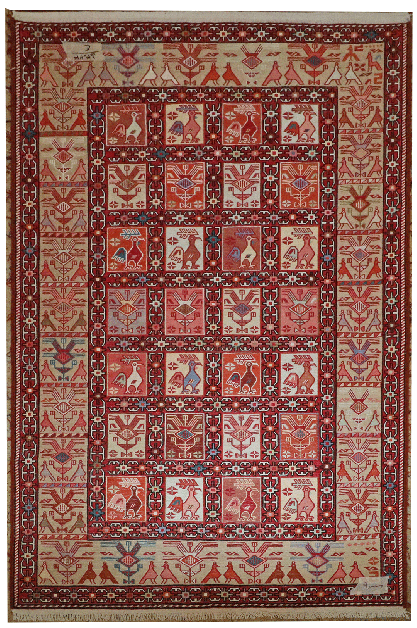
• Field (zemin) - the main body of the Varni composition, typically filled with repeating geometric motifs, animal figures, or combinations of both arranged in horizontal rows or diagonal lattice networks across the ground. The field of a Varni kilim is rarely empty - it is typically packed with the small-scale secondary motifs that characterize the tradition's approach to visual density and surface richness.
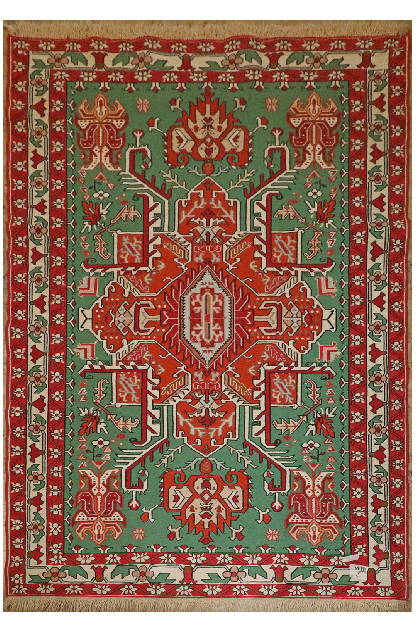
• Gol (basin or pond) - the most distinctive and culturally significant structural element of Varni composition, the gol (literally meaning basin or pond in Azerbaijani Turkish) is the primary large-scale compositional unit of the Varni field - a bold geometric form, typically octagonal, hexagonal, or diamond-shaped, that serves as the organizing focal element around which the field composition is structured. The gol in Varni weaving is conceptually analogous to the medallion (toranj) in Persian city rug composition - the dominant visual element that organizes the surrounding field - but expressed in the bold, angular language of nomadic geometric weaving rather than the refined curvilinear language of city production.
The S-Shaped Dragon Motif - Varni's Signature Element
The most distinctive and immediately recognizable decorative element of Varni weaving is the S-shaped motif - a sinuous, bilateral serpentine form that recurs throughout the design vocabulary of the tradition in contexts ranging from primary field compositional elements to small-scale border decorations. In the cultural tradition of the Arasbaran nomadic tribes, this S-shaped form is understood as a representation of the dragon - a powerful protective and cosmological symbol whose presence in the design carries specific apotropaic and symbolic meaning beyond its purely decorative function.
The dragon motif in the Arasbaran Varni tradition connects this northwestern Persian craft to a much broader cultural sphere of dragon symbolism that extends across Central Asia, the Caucasus, and the broader Turkic cultural world - a visual tradition in which the dragon represents primordial cosmic power, the connection between the earthly and the supernatural, and the protective force that guards the household and its members from malevolent influences. The persistence of this motif across centuries of Varni production - and its presence in the stone tomb carvings that predate surviving textile examples - speaks to the deep cultural roots of the symbolic vocabulary that Varni weaving encodes.
Animal Motifs - Nature Woven Into Thread
Beyond the S-shaped dragon motif, Varni design draws extensively on the animal world of the Arasbaran highland environment - incorporating geometric representations of the specific fauna that the nomadic weavers encountered in their seasonal migrations through mountain and plain landscapes. These animal motifs are rendered in the angular, geometric style characteristic of nomadic weaving - simplified and abstracted into forms that fit naturally within the grid of the weft-wrapped construction while retaining the essential silhouette and character of the animals they represent.
• Deer and gazelles - the most commonly depicted large animals in Varni design, deer and gazelles appear throughout the field compositions as symbols of grace, speed, and the vital energy of the natural world. Their angular geometric rendering - typically in profile, with stylized antlers or horns indicated by stepped geometric projections - gives them a characteristic boldness and vitality that is immediately recognizable even in highly abstracted form.
• Wolves - the wolf appears in Arasbaran Varni as a symbol of strength, cunning, and the wild power of the mountain landscape. As the primary predator of the sheep and goats that were the economic foundation of the nomadic community's livelihood, the wolf occupied a complex position in Arasbaran culture - both feared as a threat and respected as an expression of natural power. Its representation in weaving reflects this ambivalent cultural relationship.
• Sheepdogs - the Arasbaran sheepdog - the large, powerful guardian breeds that protected the nomadic community's flocks from wolves and other predators - appears in Varni design as a symbol of protection, loyalty, and the domestic order that the community's dogs both embodied and defended. The sheepdog's presence in the weaving vocabulary connects the textile directly to the daily life and practical concerns of the nomadic household that produced it.
• Ostriches and birds - various bird forms - including the stylized representation of ostriches (likely a design element inherited from earlier Central Asian textile traditions rather than a direct observation of local fauna) and the numerous bird species of the Arasbaran highland environment - appear throughout Varni design as symbols of freedom, spiritual aspiration, and the beauty of the natural world above the human settlement.
• Other indigenous animals - beyond these specific types, the Varni design vocabulary includes geometric representations of various other animals native to the Arasbaran landscape - bears, foxes, hares, and various ungulates - each rendered in the characteristic angular, simplified style of nomadic geometric weaving and each carrying specific cultural associations within the symbolic tradition of the Arasbaran tribes.
4 Materials, Colors, and Formats
Materials
• Wool pile and foundation - authentic Arasbaran Varni is woven with wool for both the pattern weft wrapping and the foundation structure. The specific wool used in traditional Varni production comes from the fat-tailed sheep of the Arasbaran highlands - breeds whose lanolin-rich fleece produces fibers of exceptional natural luster, tensile strength, and durability. The combination of highland grazing conditions and traditional hand-spinning techniques produces a yarn of characteristic quality that is immediately distinguishable from commercially processed wool in the handle and sheen of the finished textile.
• Natural dyes - traditional Varni production uses natural plant-based and mineral dye sources whose color characteristics are specific to the Arasbaran regional dye tradition. The characteristic Varni palette - dominated by warm reds, deep blues, warm ochres, and rich greens - reflects the natural dye sources available in and traded into the Arasbaran highland environment. Like all naturally dyed Persian textiles, antique and vintage Varni pieces develop a characteristic patination with age that enhances rather than diminishes their visual beauty.
Color Palette
• Warm red and terracotta - the dominant ground color of most Varni compositions, derived from madder root and related red dye sources, providing the characteristic warmth and visual richness that defines the Arasbaran textile aesthetic.
• Deep indigo blue - the primary contrasting color to the warm reds, providing visual anchoring and compositional structure through its cool, deep character.
• Warm ochre and gold - accent tones that provide luminosity and warmth within compositions anchored in deeper primary colors.
• Green and ivory - secondary colors used for specific motif elements and background areas, providing visual variety and compositional balance within the overall chromatic scheme.
• Dark brown and black - outline and detail colors derived from oak gall and walnut hull sources, providing the strong visual definition of individual motifs that gives Varni its characteristic graphic clarity.
Standard Formats and Applications
Varni kilims are typically produced in two standard formats that reflect the practical domestic needs of the nomadic communities that created them:
• Standard sizes - 1.3 x 1 meters and 1.5 x 1 meters are the most common Varni formats - compact, relatively square proportions that reflect the specific practical applications for which these textiles were originally produced in the nomadic household context. These sizes make Varni kilims ideal as accent rugs, as decorative wall pieces, and as versatile domestic textiles that can serve multiple functions in both traditional and contemporary interior settings.
• Floor coverings - in the nomadic household, Varni kilims served as primary floor coverings - laid directly on the ground inside the black felt tent to provide insulation, cushioning, and the visual warmth that transforms a functional shelter into a domestic space of beauty and cultural identity.
• Bedspreads and decorative covers - the relatively compact proportions and sturdy flatweave construction of Varni kilims make them ideal as bed covers and decorative throws - applications in which their visual complexity and natural fiber warmth are both appreciated and practically useful.
• Decorative wall hangings - in contemporary interior design contexts, Varni kilims are increasingly appreciated as wall textiles - displayed as framed textile art where their bold geometric compositions, vivid natural colors, and extraordinary cultural specificity make them uniquely compelling decorative objects.
5 The Weavers - Women as Guardians of Cultural Memory
Varni weaving is exclusively the work of women and girls - a gendered craft practice that reflects the broader pattern of nomadic textile production across the Persian plateau, in which weaving is understood as a specifically female domain of knowledge, creativity, and cultural transmission. The Varni weaver is not merely a producer of functional objects; she is a carrier of cultural memory - a living link in the chain of transmission that connects the contemporary textile to the stone-carved decorative programs of medieval Arasbaran tombs and, through them, to the deepest historical roots of the tribal tradition.
The transmission of Varni weaving knowledge from mother to daughter - the teaching of specific weft-wrapping techniques, the internalized design vocabulary of the gol and the S-shaped dragon motif, the color combinations that identify specific tribal affiliations and personal aesthetic sensibilities - is itself one of the most important forms of cultural continuity practiced in the Arasbaran community. Every Varni kilim produced today is simultaneously a functional textile object and an act of cultural preservation - a contribution to the living transmission chain that keeps this extraordinary tradition alive and evolving.
The women of the Arasbaran tribes who weave Varni kilims draw their design inspiration directly from the natural world surrounding their seasonal encampments - the deer on the mountain slopes, the birds in the highland meadows, the wolves in the forest margins, the geometric patterns of the stone tomb carvings that mark the sacred sites of their ancestral landscape. In weaving these observations into their textiles, they create objects that are simultaneously records of the world they inhabit and expressions of the cultural values through which they understand that world.
6 Varni as Collectible Art - What Makes It Distinctive and Valuable
For collectors and lovers of authentic Persian textile art, Varni kilims occupy a position of particular interest precisely because of their combination of qualities that are rarely found together in any single textile tradition: technical distinctiveness, design originality, deep cultural specificity, living production vitality, and relative rarity in the international market.
• Technical uniqueness - the weft-wrapping Sumak technique on a twill foundation is not found in any other major Persian regional textile tradition. Varni is technically sui generis - a unique construction method that produces a surface quality unlike any other Persian flatweave, and that requires specific technical knowledge unavailable in any other regional context.
• Design originality - the combination of the S-shaped dragon motif, the gol compositional structure, and the rich animal vocabulary drawn from the Arasbaran highland fauna creates a design language found nowhere else in the Persian textile world. Varni is not a regional variant of a more widely distributed tradition - it is an entirely original textile art form with its own specific vocabulary, symbolic system, and compositional logic.
• Cultural depth and archaeological continuity - the documented continuity between Varni design motifs and the stone tomb carvings of the medieval Arasbaran landscape gives Varni textiles a historical depth rarely found in living craft traditions. Collecting a Varni kilim is acquiring not just a beautiful object but a tangible link to a cultural tradition of genuinely ancient roots.
• Market rarity - despite the significant scale of Varni production within Persia and the more than 20,000 artisans involved in its creation, Varni kilims remain virtually unknown in the international decorative arts market. This market rarity creates a significant opportunity for collectors with the knowledge and taste to recognize the extraordinary quality of the finest traditional examples.
Varni - Centuries of Tradition Woven Into Every Thread
Varni kilims bear witness to centuries of tradition and artistry - woven into the very fabric of Persian culture by the skilled hands of the women and girls of the Arasbaran nomadic tribes. They are extraordinary objects: technically unique, visually powerful, culturally specific, and historically deep in ways that few other Persian textile traditions can claim. From the dragon motifs that connect them to ancient stone carvings in the highland landscape, to the deer and gazelles and wolves that bring the living world of the Arasbaran mountains into the domestic space of the nomadic tent, every element of a fine Varni kilim tells a story of remarkable cultural continuity and creative vitality.
At Los Angeles Home of Rugs, we celebrate the full extraordinary diversity of the Persian textile heritage - from the supreme court productions of the great Safavid city workshops to the regionally distinctive tribal weaving traditions of communities like the Arasbaran nomads, each expressing a unique and irreplaceable facet of Persia's creative cultural legacy.