


The Hamadan region of western Persia has more weaving villages than almost any other part of the country. Hundreds of villages, each with its own habits of design and color, send their rugs to the bazaar of Hamadan. In the market, most of these rugs are sold under the broad name Hamadan. A few villages, however, are known well enough to have their names used on labels. Bibikabad is one of them.
This guide explains what a village name like Bibikabad tells you, how such rugs are built and designed, how to judge their quality, and how to choose and place a small village rug in a modern home. For the city of Hamadan and the region as a whole, see our article on weaving in Hamadan.
1
What a Village Name Tells You
When a rug from the Hamadan region is sold under a village name, it usually means that a dealer recognizes features typical of that village: a particular design, a color scheme, a structure, or simply the source from which the rug came. Village names are therefore more specific than the regional name, but they are not strict standards. Different dealers may use the same name slightly differently.
In the Hamadan region, village names that appear on labels include Bibikabad, Borchelu, Mehraban, Hosseinabad, Kabutarahang, Tuyserkan, Nahavand, Malayer, Josan, and many others. Some of these are large villages or towns; others are small. Each name points to a family of rugs with shared traits.
For a buyer, the village name is a useful clue, but the rug itself matters more. A well-made Bibikabad and a well-made unnamed Hamadan village rug may be equally good. Look first at the wool, the weave, the colors, and the condition.
A village name such as Bibikabad tells you that a dealer recognizes the rug's style and source within the Hamadan region. It is a clue to the rug's character, not a guarantee of quality.
2
The Hamadan Weaving Region
The city of Hamadan lies on a high plain at the foot of Mount Alvand, in western Persia. Around it, in every direction, lie farming villages that have woven rugs for generations. The region stretches toward Kabutarahang in the north, Tuyserkan and Nahavand in the south, and Malayer in the south-east, and it includes a large number of Turkic-speaking villages as well as Persian, Kurdish, and Lur communities.
Research on Hamadan weaving, such as a study of more than three hundred Hamadan rugs published in a Persian academic journal, describes two main village traditions. In the villages around Hamadan, Tuyserkan, and Nahavand, rugs are mostly single-wefted, coarse, and thick-piled, with geometric designs. In villages along the road from Malayer toward Arak, such as Josan, rugs are more often double-wefted and finer, with curvilinear designs. In both traditions, the symmetric (Turkish) knot dominates, with cotton warps and wefts and a wool pile.
Bibikabad rugs belong to the first, single-wefted family: robust, thick, and boldly patterned.
3
How to Recognize a Bibikabad Rug
•
Dense design - Fields are often tightly filled with motifs, leaving little open ground.
•
Allover patterns - Herati networks, rows of boteh, and geometric repeats are common.
•
Medallion rugs - Smaller rugs often have a central medallion with corners, on a dense field.
•
Bold colors - Madder red and rust, navy and blue, ivory and cream, with green, gold, and brown accents.
•
Single weft - A single weft between rows of knots, giving a characteristic back.
•
Thick pile - Resilient Hamadan wool, often clipped to a medium height.
Compared with rugs from Malayer and other nearby villages, Bibikabad rugs are often described as denser and more tightly patterned, with less open space and a more regular rhythm of motifs.
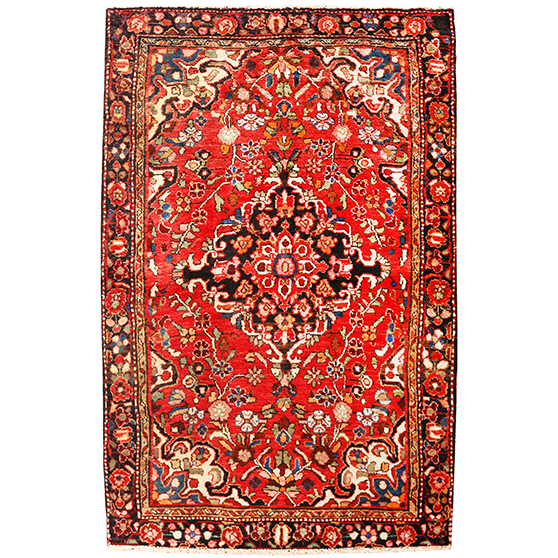
A small Bibikabad rug of about 5 by 3 feet with a medallion on a madder red field, framed by cream and navy - Bibikabad Persian Rug 5x3 ft - Medallion Semi Antique Wool Hand Knotted
4
Designs of Bibikabad
Herati networks
The Herati pattern, a diamond with a rosette and four curling leaves, is one of the most common Hamadan village designs. In Bibikabad rugs it is drawn in an angular, geometric way and often repeated across the whole field, creating a dense, even texture. See our Herati designs.
Rows of boteh
The boteh, a teardrop or paisley form, is repeated in rows, sometimes with small hooks, sometimes in alternating colors. Boteh fields give a lively rhythm. Read more in our article on the boteh.
Medallion and corners
Smaller Bibikabad rugs often have a central medallion, usually a diamond or a lobed shape, with corners and a field filled with small motifs. This layout gives a strong focal point, ideal for an entry or a bedside.
Geometric and tile-like layouts
Some rugs use a grid or lattice of small compartments, each with a motif, creating a tile-like pattern.
5
How Bibikabad Rugs Are Built
•
Knot - Symmetric (Turkish) knot.
•
Foundation - Cotton warps and wefts.
•
Wefts - A single weft between each row of knots, typical of Hamadan village rugs.
•
Pile - Thick, resilient local wool.
•
Density - Coarse to medium.
•
Sides - Overcast in wool, often dark.
•
Ends - Cotton fringes, sometimes with a small woven band.
On the back of a single-wefted rug, each row of knots is separated by one weft, and the knots appear slightly offset from row to row, giving a characteristic look. The rug is flexible and lies flat, and its thick pile makes it comfortable underfoot.
6
Single-Wefted Rugs: What to Know
Single-wefted rugs are a long tradition in the Hamadan villages, and they have real advantages: they are quick to weave, which keeps prices accessible, and their thick pile is warm and comfortable. They do need a little understanding.
•
They can be slightly less stiff - A single-wefted rug is more flexible than a double-wefted one. This is normal.
•
The back shows the structure - On the back, you can usually see the weft clearly between rows.
•
Sides need attention - The overcasting on the sides protects the rug. Keep it in good repair.
•
They are durable - With good wool and sensible care, single-wefted village rugs last for generations.
Read more about how structure affects strength in our article on Bijar iron rugs, which explains the opposite approach: very dense, heavily beaten wefts.
7
Bibikabad and Its Neighbors
Bibikabad and Hamadan
Bibikabad is part of the Hamadan family. A rug labeled simply Hamadan may be very similar; the village name gives a more specific attribution. See our Hamadan collection.
Bibikabad and Malayer
Malayer rugs are often finer and double-wefted, with more open fields and more varied spacing. Bibikabad rugs are denser and more tightly patterned. See our Malayer collection.
Bibikabad and Borchelu
Borchelu rugs, also from the Hamadan region, are known for floral medallions and a more curvilinear style. Bibikabad rugs are more geometric. See our Borchelu collection.
Bibikabad and Hosseinabad
Hosseinabad rugs often have Herati fields in red and navy and a characteristic dense look, close in spirit to Bibikabad. See our Hosseinabad collection.
8
Colors of Bibikabad
The Bibikabad palette is warm and bold. Madder red and brick red fill fields and medallions, navy and blue outline motifs and fill borders, and ivory and cream bring light. Green, gold, brown, and black appear in smaller amounts.
In semi-antique rugs, these colors have mellowed. Reds have softened toward rust and rose, and blues have deepened. The result is a warm, harmonious rug that sits easily in a room.
9
Small Village Rugs: The Zaronim and Other Formats
Persian rug sizes were traditionally measured in zar, a unit of about one meter. A rug of about 1.5 by 1 meters, roughly 5 by 3 feet, is called a zaronim, meaning "a zar and a half." This is one of the most common sizes for village rugs from the Hamadan region, including Bibikabad.
Other common small sizes include the dozar, about 2 by 1.3 meters or 6.5 by 4 feet, and the smaller poshti, about 2 by 3 feet, originally used as a cushion cover or bag face.
Larger Bibikabad rugs, including room-size carpets and long gallery formats, are also found in the market, especially among older pieces. Their dense allover designs make them practical for living and dining rooms, where furniture covers part of the field.
Small rugs are easy to place and easy to move. They let you enjoy a genuine hand-knotted village rug without committing to a large piece.
10
Where to Place a Small Bibikabad Rug
•
Entry - A 5 by 3 foot rug in front of the door welcomes guests and protects the floor.
•
Bedside - A small rug beside the bed gives a warm first step in the morning.
•
Bathroom - In a dry, well-ventilated bathroom, a wool rug adds warmth. Avoid areas where it will stay wet.
•
Kitchen - In front of the sink or stove, a small village rug adds color and comfort. Its dense design hides small spills.
•
Study or home office - Under a desk or in front of a bookcase.
•
Layered - On top of a larger neutral rug, a small Bibikabad becomes a focal point.
11
From Village Loom to Bazaar
A village rug like a Bibikabad follows a long path before it reaches a home far away. It begins on an upright loom in a village house, where a woman, often helped by a daughter or a neighbor, ties the knots through the winter months. Village weavers of the Hamadan region traditionally worked from memory or from a small sample rug rather than from a full paper cartoon, which is one reason no two village rugs are exactly alike.
When the rug is finished, it is cut from the loom and sold, either to a local dealer who travels from village to village or directly in a nearby market town. From there it travels to the bazaar of Hamadan, where it is washed, clipped, sorted, and sold to wholesalers. Wholesalers group rugs by size, quality, and village style, and it is at this stage that names such as Bibikabad are attached. Finally the rug is exported, often through Tehran, to dealers abroad.
Each step adds care and knowledge. The washing brings out the colors, the clipping evens the pile, and the sorting matches rugs to buyers. Read more about the people in this chain in our article on the craft from shepherd to dealer.
12
Reading the Back of a Village Rug
The back of a village rug is the best place to learn about it. Turn a corner over and look closely.
•
Knots - Each symmetric knot shows as two small bumps side by side. Count them along an inch to get a sense of density.
•
Wefts - In a single-wefted rug, a thin line of weft shows between each row of knots.
•
Design clarity - The design should be visible on the back, a little blurred but recognizable.
•
Irregularities - Small changes in knot size or row height are normal in village rugs and show the hand of the weaver.
•
Repairs - Areas with different knots, colors, or stiffness may be repairs. Good repairs are fine; you should simply know about them.
A machine-made rug looks very different on the back: perfectly regular, often with a stiff backing or a grid of lines, and with the design printed or tufted rather than knotted. A hand-knotted rug's back always shows the knots themselves.
13
Hand-Knotted or Machine-Made?
Because Hamadan village designs are so popular, many machine-made rugs copy them. A few simple checks help you tell the difference:
•
Fringe - On a hand-knotted rug, the fringe is the continuation of the warp threads. On many machine rugs, the fringe is sewn on.
•
Back - A hand-knotted rug shows individual knots; a machine rug shows perfect regularity or a backing.
•
Irregularity - Small variations in design and shape are signs of handwork.
•
Feel - Hand-knotted village rugs are flexible and drape; many machine rugs feel stiff.
All rugs in our collection are genuine hand-knotted Persian rugs, inspected before they are listed. Read more in our article on how to buy a Persian rug.
14
Building a Collection of Small Village Rugs
Small village rugs are a wonderful way to start a collection. They are affordable, easy to display, and each one represents a different village and tradition. Some collectors focus on one region, such as Hamadan, collecting rugs from different villages to compare their designs and colors. Others collect by design, such as boteh or Herati, across regions.
A small collection can be rotated through the home: one rug in the entry this season, another next season. Rugs not in use should be rolled, wrapped in breathable fabric, and stored in a dry place, checked regularly for moths.
15
Small Rugs as Gifts
A small Persian village rug makes a thoughtful gift for a new home, a wedding, or a graduation. It is personal, practical, and lasting. Many families keep such rugs for generations, and they often become treasured heirlooms.
16
How to Judge a Bibikabad Rug
•
Wool - Springy, lustrous wool is the best sign of quality.
•
Design - Look for a well-balanced composition and clear motifs.
•
Color - Clear, harmonious colors without bleeding.
•
Sides and ends - Intact overcasting and secure fringes.
•
Shape - Small irregularities are normal in village rugs.
•
Condition - Even pile without bald spots or moth damage.
17
Combining a Bibikabad with Other Rugs
A small Bibikabad works well alongside larger rugs from the same region. In a living room with a large Hamadan, Heriz, or Bakhtiari rug, a Bibikabad in the entry or hallway can repeat the main reds and blues. In a bedroom with a neutral wall-to-wall carpet or a plain modern rug, a Bibikabad laid at the bedside adds a spot of color and pattern.
When you combine several village rugs, keep one or two colors in common, and vary the scale of the patterns. A dense Bibikabad sits happily next to a rug with a large, open medallion, because the two patterns do not compete. Avoid placing several very busy rugs side by side in a small space.
18
Questions to Ask Before You Buy
•
What are the exact measurements? - Village rugs vary, so check the size in both directions.
•
Is it single or double-wefted? - This tells you about structure and village tradition.
•
Has it been repaired or reduced? - Ask whether the ends or sides have been restored.
•
Has it been washed? - A freshly washed rug shows its true colors.
•
How old is it? - Semi-antique rugs have softer colors and more settled wool.
19
Semi-Antique Bibikabad Rugs
Our Bibikabad rugs are semi-antique, woven roughly forty to sixty years ago. They combine the bold character of Hamadan village weaving with settled colors and good condition, and they have many years of life ahead. See our semi-antique rugs.
20
Caring for a Bibikabad Rug
Vacuum regularly without a beater bar. Shake small rugs outdoors from time to time. Rotate the rug every few months. Blot spills at once. Use a non-slip pad, especially on smooth floors. Have the rug professionally washed every few years. See our care instructions and our guide to washing a rug at home.
21
Common Buying Mistakes
•
Expecting city-rug fineness - Bibikabad rugs are village rugs; their charm lies in bold drawing and thick wool.
•
Ignoring the pad - Small rugs slip easily without a pad.
•
Placing in wet areas - Wool rugs should not stay wet.
•
Overlooking the sides - Keep the overcasting in good repair.
22
Frequently Asked Questions
Where are Bibikabad rugs woven?
In the Hamadan weaving region of western Persia.
Are Bibikabad rugs Hamadan rugs?
Yes. Bibikabad is a village name within the Hamadan family of rugs.
What knot is used?
The symmetric or Turkish knot.
What does single-wefted mean?
One weft passes between each row of knots, giving a flexible rug with a characteristic back.
What designs are typical?
Dense Herati networks, rows of boteh, geometric repeats, and medallions with corners.
What colors are typical?
Madder red, navy, ivory, with green, gold, and brown accents.
What is a zaronim?
A traditional rug size of about 1.5 by 1 meters, or roughly 5 by 3 feet.
How do Bibikabad rugs differ from Malayer rugs?
Bibikabad rugs are denser and more tightly patterned; Malayer rugs are often finer and more open.
Are Bibikabad rugs durable?
Yes. Their thick wool and sturdy structure make them very durable.
Where should I place a small Bibikabad rug?
In an entry, beside a bed, in a kitchen, or in a study.
How can I tell a hand-knotted rug from a machine copy?
Look at the back for individual knots and check that the fringe is the continuation of the warp threads.
Did village weavers use paper cartoons?
Village weavers of the region traditionally worked from memory or from a small sample rug.
Are there large Bibikabad rugs?
Yes, room-size and long gallery formats exist, especially among older pieces.
Is a small village rug a good gift?
Yes. It is personal, practical, and lasting, and often becomes a family heirloom.
How should I clean a Bibikabad rug?
Vacuum regularly, blot spills, and have it professionally washed every few years.
23
Choose Your Bibikabad Rug
Each Bibikabad rug in our collection is hand-knotted, one of a kind, and inspected before it is listed. Browse our Bibikabad collection, compare it with our Hamadan, Malayer, and Borchelu rugs, or ask our experts for help.