


Most people picture Hamadan village rugs as bold and geometric: Herati networks, stepped medallions, and rows of boteh, woven in thick wool on sturdy looms. Among the many villages of the region, however, some weave in a softer, more floral style. The best known of these is Borchelu. Its rugs combine the robust construction of Hamadan village weaving with curving floral medallions and vines that recall the city rugs of central Persia.
This guide explains where Borchelu rugs come from, how to recognize them, how they are built, how they compare with their neighbors, and how to choose, place, and care for one. For the wider Hamadan region, see our article on weaving in Hamadan.
1
Borchelu in the Hamadan Region
The Hamadan region of western Persia, around the city of Hamadan at the foot of Mount Alvand, is one of the largest weaving areas in the country. Hundreds of villages weave rugs that are sold in the Hamadan bazaar. Many of these villages are Turkic-speaking, and their rugs share a common structure: the symmetric knot, cotton foundations, and thick, resilient wool.
Borchelu is a name used for rugs from a group of villages in the Hamadan region. The name is often linked to the Borchalu, a Turkic group historically present in the region, and it has become a recognized trade name for rugs with a distinctive floral style. In the market, you will see these rugs labeled Borchelu, Borchalou, Borchalu, or Borchelou Hamadan.
Within the broad Hamadan family, Borchelu rugs stand out for their curvilinear drawing. Where many neighboring villages weave geometric designs, Borchelu weavers favor flowers, vines, and rounded medallions.
Borchelu is a trade name for village rugs of the Hamadan region woven in a distinctive floral, curvilinear style. It is also spelled Borchalou, Borchalu, and Borchelou.
2
How to Recognize a Borchelu Rug
•
Floral medallion - A central medallion, often round, lobed, or star-shaped, filled with flowers and outlined with curving lines.
•
Curving vines - Flowering vines and arabesques fill the field, often with small blossoms and leaves.
•
Corners - Quarter medallions in the corners echo the central medallion.
•
Warm palette - Madder red or navy fields with ivory, rose, and light blue motifs.
•
Symmetric knot - The Turkish knot used throughout the Hamadan region.
•
Sturdy structure - Cotton foundation and thick wool, firmer than many Hamadan village rugs.
If a rug has the sturdy feel of a Hamadan village rug but a softer, floral design, there is a good chance it is a Borchelu.
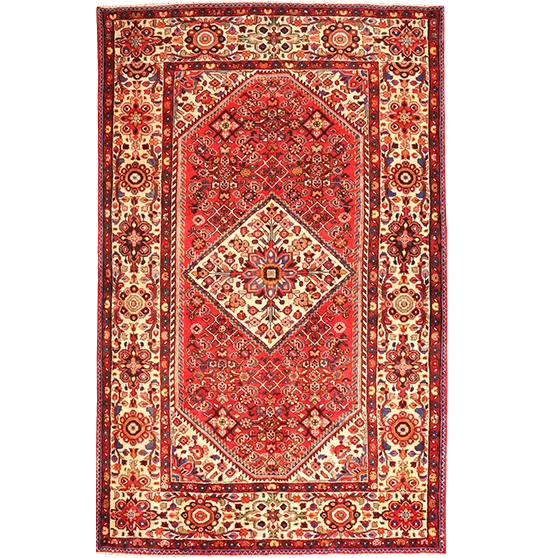
A Borchelu rug of about 11 by 7 feet with a floral medallion on a madder red field, with ivory and navy details - Borchelu Persian Rug 10x6 ft - Medallion Semi Antique Wool Hand Knotted
3
Borchelu Designs in Detail
The floral medallion
The heart of most Borchelu rugs is the medallion. It is usually larger and more rounded than the stepped medallions of other Hamadan villages, and it is filled with small flowers, leaves, and tendrils. Sometimes it has pendants at each end; sometimes it stands alone on the field.
Vines and arabesques
Around the medallion, the field is filled with curving vines that carry flowers and leaves, sometimes forming arabesques. In some rugs the vines form a loose lattice; in others they wander freely. The effect is graceful and lively.
Herati and other fields
Some Borchelu rugs combine a floral medallion with a Herati field, a dense, regular pattern that contrasts nicely with the curving medallion. See our Herati designs.
Navy-field rugs
A navy or dark blue field with a red medallion is a classic and very elegant Borchelu combination. The deep blue makes the red and ivory flowers glow.
Borders
Borchelu borders often carry a running vine with flowers, or a repeating rosette and leaf pattern, framed by narrow guard stripes. The borders frame the field like a garden fence.
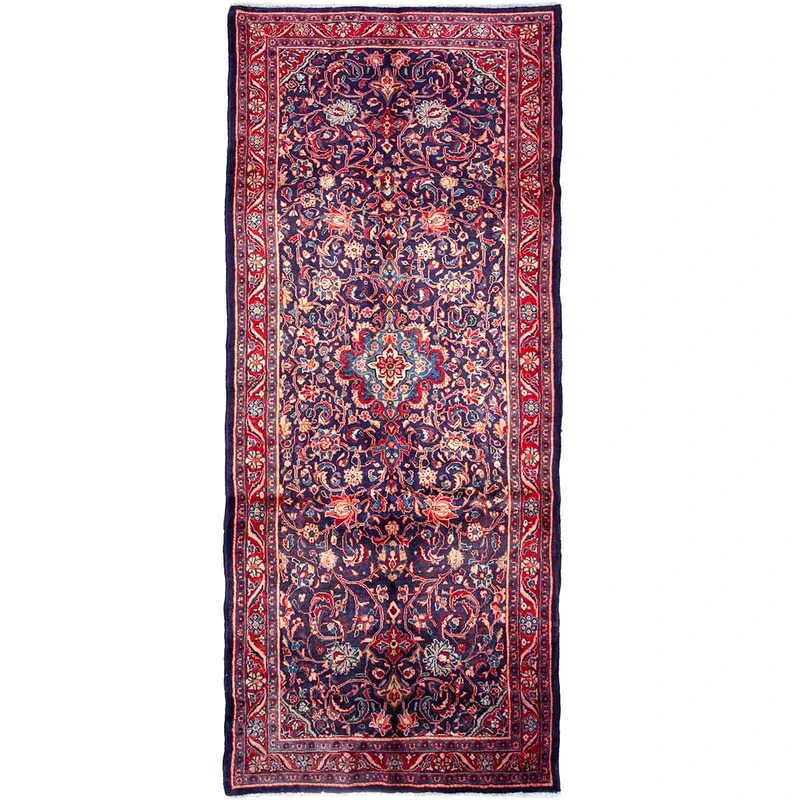
A long Borchelu rug of about 13 by 5 feet with a madder red medallion and Eslimi arabesques on a deep navy field - Borchelu Persian Rug 13x5 ft - Medallion Semi Antique Wool Hand Knotted
4
How Borchelu Rugs Are Built
•
Knot - Symmetric (Turkish) knot.
•
Foundation - Cotton warps and wefts.
•
Wefts - Often two wefts between rows of knots, giving a firmer rug than many single-wefted Hamadan village rugs, though single-wefted pieces also exist.
•
Pile - Thick, lustrous wool, clipped to a medium height.
•
Density - Medium, somewhat finer than many Hamadan village rugs, which allows the curved drawing.
•
Sides and ends - Overcast in wool, cotton fringes.
The finer weave is what makes the floral drawing possible. Curves need more knots than straight lines, so a weaver who wants to draw a smooth flower must work at a higher density. This is one of the clues that set Borchelu apart from its more geometric neighbors.
5
Why Curved Designs Need More Knots
A hand-knotted rug is built from tiny squares of color, one for each knot. Straight lines, horizontal or vertical, are easy to draw at any density. Diagonals are drawn as steps. Curves are made of many small steps, and the smaller the knots, the smoother the curve looks.
This is why village rugs with coarse weaves tend to have geometric designs, while finer rugs can show flowing flowers and vines. A Borchelu sits in between: fine enough to draw flowers that look rounded, but coarse enough to keep a slightly angular, village charm. When you look closely at a Borchelu flower, you will see the small steps that make up its curve.
Curves need more knots than straight lines. The relatively fine weave of Borchelu rugs is what allows their floral medallions and vines.
6
How Floral Designs Reached the Villages
Floral designs are at home in the city rugs of central Persia, where professional designers draw them on squared paper. How did they reach the villages of Hamadan? Part of the answer lies in the trade of the late nineteenth and twentieth centuries. As demand for Persian rugs grew in Europe and America, merchants in Hamadan and in the nearby Arak region encouraged village weavers to produce designs that Western buyers liked, and floral medallions were among the most popular. Cartoons, model rugs, and dyed wool moved from town to village, and some villages adopted the new style while keeping their own structure and wool.
Over time, these villages made the floral style their own. Borchelu weavers did not copy city rugs knot for knot; they simplified the flowers, enlarged the medallions, and gave the designs a relaxed, slightly angular rhythm that suits a village loom. The result is a style that sits between city and village, and that is exactly its appeal. Read more about the history of this period in our article on weaving from 1722 to 1925.
7
The Flowers of a Borchelu
The flowers on a Borchelu are stylized, not botanical portraits, but many recall real plants of the Persian countryside and garden:
•
Rosettes - Round, many-petaled flowers, often at the center of medallions and corners.
•
Palmettes - Fan-shaped flowers built from layered petals, borrowed from classical Persian design.
•
Small blossoms - Five- or six-petaled flowers scattered along the vines.
•
Buds and leaves - Pointed leaves and closed buds that give the vines movement.
Look for how the weaver colors each flower. Often the same flower appears in several color combinations across the field, adding variety to a balanced design. Read more in our article on Persian rug design motifs.
8
Placing a Long Borchelu: A Worked Example
Suppose you have a living room with a sofa 8 feet long against one wall and a fireplace opposite. A long Borchelu of about 13 by 5 feet, placed parallel to the sofa between it and the fireplace, defines the seating area and leaves floor visible at each end. If the room is long and narrow, the long rug also makes it feel more balanced.
In a bedroom with a king bed, the same rug placed across the foot of the bed extends about 3 feet on each side, giving soft footing on both sides without hiding the floor completely.
9
Borchelu and Its Neighbors
Borchelu and other Hamadan village rugs
Most Hamadan village rugs are geometric and often single-wefted. Borchelu rugs are more floral and often firmer. See our Hamadan collection.
Borchelu and Sarouk
Sarouk rugs, from the Arak region, are finer and denser, with deep reds and navies and floral designs. Borchelu rugs are often compared to Sarouks because of their floral look, but they are coarser, with a more relaxed village hand. See our Sarouk collection.
Borchelu and Malayer
Malayer rugs, from south-east of Hamadan, are often double-wefted and can be curvilinear too, but they often have more varied, sometimes geometric designs. See our Malayer collection.
Borchelu and Bibikabad
Bibikabad rugs are dense and geometric, with tightly packed fields. Borchelu rugs are more open and floral. See our Bibikabad collection.
Borchelu and Lilihan
Lilihan rugs, from Armenian villages near Arak, also have floral designs, often with salmon and rose tones. They are close cousins in spirit. See our Lilihan collection.
10
Colors of Borchelu
The Borchelu palette is warm and gentle. Madder red and dark red fields are the most common, with navy fields as a classic alternative. Ivory and cream outline flowers and fill corners, while rose, pink, light blue, gold, and green bring the flowers to life. Black and dark brown give definition.
In semi-antique rugs, these colors have mellowed. The reds have softened toward rose and rust, the navy has deepened, and the ivories have warmed. The result is a rug that looks established and comfortable.
11
Sizes and Formats
Borchelu rugs come in many sizes. Our collection includes medium rugs around 10 by 6.5 feet, long gallery rugs of about 13 by 5 feet, and smaller rugs of about 7.5 by 5 feet.
•
Medium rugs - Ideal for living rooms, dining rooms, and bedrooms.
•
Gallery rugs - Perfect for wide halls, long living rooms, and the foot of a bed.
•
Small rugs - Good for entries, studies, and bedsides.
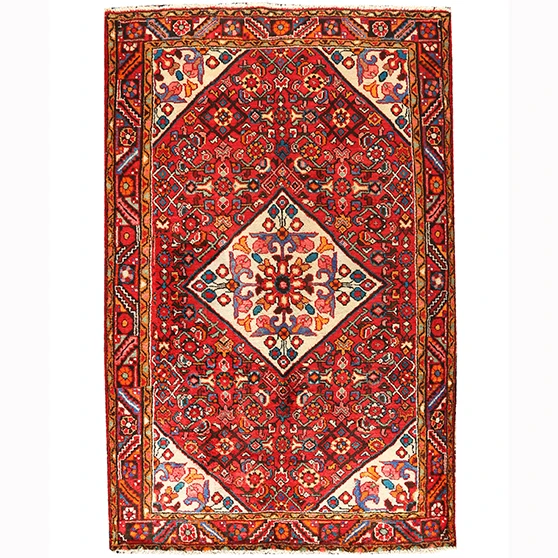
A Borchelu rug of about 7.5 by 5 feet with a medallion and Herati motifs on a madder red field - Borchelu Persian Rug 7x4 ft - Medallion Semi Antique Wool Hand Knotted
12
Borchelu Rugs in Your Home
The floral designs of Borchelu rugs bring softness to a room. In traditional interiors, they pair beautifully with wood furniture, floral fabrics, and warm lighting. In modern interiors, a semi-antique Borchelu adds warmth and a touch of romance without overwhelming clean lines.
Because Borchelu rugs combine floral elegance with village toughness, they suit both formal rooms and everyday spaces. A Borchelu with a navy field can look especially striking in a room with white walls and light wood floors.
•
Living room - Center the medallion on the coffee table.
•
Dining room - A medium Borchelu suits a table for four to six.
•
Bedroom - The floral design creates a calm, welcoming feeling.
•
Hall - A long Borchelu leads the eye through the space.
13
Grades and How to Judge Them
•
Drawing - Smooth, well-proportioned flowers and medallions indicate skilled weaving.
•
Density - Check the back for small, even knots.
•
Wool - Lustrous, springy wool.
•
Color - Clear, harmonious colors without bleeding.
•
Flatness - The rug should lie flat with straight sides.
•
Condition - Even pile, intact sides and ends.
14
Borchelu Through the Seasons
Many Persian families change their rugs with the seasons, and a Borchelu lends itself to this. A red-field Borchelu, with its warm tones, feels cozy in autumn and winter, when it brings color to darker days. A navy-field piece, cooler and calmer, feels fresh in spring and summer, especially with light curtains and plants. If you own two Borchelus, rotating them between rooms or seasons also spreads wear and gives each rug a rest from sunlight. Store the resting rug rolled, wrapped in breathable fabric, in a dry place.
15
Reading the Back of a Borchelu
On the back of a Borchelu, you should see the design clearly, with small, even knots in straight rows. Symmetric knots show two bumps per knot. In double-wefted rugs, the back looks tight and regular; in single-wefted rugs, you will see a thin line of weft between rows.
Check also for repairs and for signs of moth damage near the edges. Small, well-made repairs are normal on semi-antique rugs.
16
Living with a Floral Village Rug
One of the pleasures of a Borchelu is the way its flowers reveal small surprises over time. A blossom drawn in a slightly different color, a vine that changes direction, a leaf that breaks the pattern: these details, the marks of a weaver working by hand, become familiar friends. Unlike a machine-made rug, a Borchelu never looks exactly the same from day to day; its colors shift with the light, and its pile catches the sun differently in the morning and evening.
Many owners find that a floral rug like a Borchelu softens a room in a way that is hard to achieve otherwise. It invites people to sit on the floor, children to play, and guests to linger.
17
Combining a Borchelu with Other Rugs
A Borchelu combines easily with other rugs because it bridges two worlds. Next to a city rug, such as a Kashan or Tabriz, it shares the floral language but adds a village warmth. Next to a geometric village rug, such as a Heriz or a Hamadan, it shares the sturdy feel and warm colors but adds softness. When combining rugs, keep one color in common, such as madder red or navy, and vary the scale of the patterns.
In an open-plan space, a Borchelu with a navy field can anchor the seating area while a smaller red rug marks a reading corner. The shared tones tie the space together.
18
Questions to Ask Before You Buy
•
Is it single or double-wefted? - Double-wefted Borchelus are firmer.
•
What are the exact measurements? - Check both ends of long rugs.
•
Has it been repaired? - Ask where, and how.
•
Has it been washed? - A fresh wash brings out the reds and ivories.
•
How old is it? - Semi-antique pieces have softer, settled colors.
19
Semi-Antique Borchelu Rugs
Our Borchelu rugs are semi-antique, woven roughly forty to sixty years ago. They show the classic floral style of the region, with settled colors and good wool, and they have many years of life ahead. See our semi-antique rugs.
20
What Affects the Price of a Borchelu Rug
•
Drawing quality - Well-drawn floral designs command higher prices.
•
Size - Larger and longer rugs cost more.
•
Density - Finer rugs are more valued.
•
Condition - Even pile and intact edges add value.
•
Color - Harmonious colors, especially navy-field rugs, are sought after.
Borchelu rugs offer the floral elegance often associated with finer city rugs at village prices, making them excellent value.
21
Caring for a Borchelu Rug
Vacuum regularly without a beater bar. Rotate the rug every six months. Blot spills at once. Use a good rug pad. Keep it out of strong direct sunlight, which can fade the reds and roses. Have it professionally washed every few years. See our care instructions and our guide to washing a rug at home.
22
Common Buying Mistakes
•
Expecting Sarouk fineness - Borchelu rugs are village rugs, with a more relaxed hand.
•
Ignoring the spelling - Borchelu, Borchalou, and Borchalu are the same name.
•
Overlooking the back - The back reveals density and repairs.
•
Skipping the pad - A pad protects the rug and keeps it in place.
23
Frequently Asked Questions
Where are Borchelu rugs woven?
In villages of the Hamadan region of western Persia.
How do you spell Borchelu?
It is also written Borchalou, Borchalu, and Borchelou.
What makes Borchelu rugs special?
Their floral, curvilinear designs within the sturdy Hamadan village tradition.
What knot is used?
The symmetric or Turkish knot.
Are Borchelu rugs single or double-wefted?
Many are double-wefted, which gives a firmer rug, though single-wefted pieces exist.
How do Borchelu rugs differ from Sarouk rugs?
Sarouks are finer and denser; Borchelus are coarser, with a village charm.
What colors are typical?
Madder red or navy fields with ivory, rose, light blue, and gold.
Why are Borchelu designs curved when other Hamadan rugs are geometric?
Because Borchelu weavers use a finer weave, which allows smoother curves.
Are Borchelu rugs durable?
Yes. They share the sturdy construction of Hamadan village rugs.
Do Borchelu rugs suit modern homes?
Yes. Their floral designs add warmth and softness to modern rooms.
How did floral designs reach the Hamadan villages?
Through the trade of the late nineteenth and twentieth centuries, when merchants brought cartoons, model rugs, and dyed wool to village weavers.
Can I switch rugs with the seasons?
Yes. A red Borchelu suits autumn and winter, a navy one spring and summer, and rotating rugs spreads wear.
What size Borchelu fits in front of an 8 foot sofa?
A long rug of about 13 by 5 feet, placed parallel to the sofa, works well.
Are the flowers real plants?
They are stylized, though many recall rosettes, palmettes, buds, and leaves of Persian gardens.
How should I clean a Borchelu rug?
Vacuum regularly, blot spills, and have it professionally washed every few years.
24
Choose Your Borchelu Rug
Each Borchelu rug in our collection is hand-knotted, one of a kind, and inspected before it is listed. Browse our Borchelu collection, compare it with our Hamadan, Sarouk, and Malayer rugs, or ask our experts for help.