


In the hills of Zanjan province, between Tabriz and Qazvin, lies a cluster of villages whose rugs have long stood out among the village weavings of north-western Persia. The best known of them is Gholtogh. Persian accounts of Zanjan weaving describe the Gholtogh carpet as one of the oldest and finest of the province, and Western dealers, who often spell the name Koltuk or Kolotuk, have long prized these rugs for their firm handle and clear drawing.
Our Gholtogh collection is made up mainly of small rugs, the kind of pieces that village families wove for their own homes and for the market: entry rugs, bedside rugs, and prayer-size pieces, plus a runner. This guide explains where Gholtogh rugs come from, what sets them apart, how they are built and designed, how they compare with their neighbors, and how to choose and place a small rug.
1
Zanjan and the Khamseh Region
Zanjan is a city and province in north-western Persia, on the main road between Tehran and Tabriz. Historically, the region around it was called Khamseh, meaning "five," after the five districts that made it up. It is a land of high plains and rolling hills, with cold winters and warm summers, and of villages that combine farming with herding.
Weaving has long been part of village life in Zanjan. Persian sources on the province's crafts describe several traditions: an old, thick, heavily wefted type of rug from the Qeydar area; fine village rugs from places such as Gholtogh, Bidgineh, and Abhar; and, more recently, the Afshar style, introduced to the province about half a century ago from West Azerbaijan. Zanjan is also known for its silk rugs in the designs of Qom and Kashan, and for other crafts such as knives and filigree silver.
Gholtogh is a village of Zanjan province, in the old Khamseh region. Persian accounts of Zanjan weaving describe the Gholtogh rug as one of the oldest and finest of the province.
2
What Makes Gholtogh Rugs Special
Several features have earned Gholtogh rugs their reputation:
•
Finer weave - Persian sources note that traditional Gholtogh rugs are woven at about 25 to 28 raj, finer than many village rugs of the region.
•
Firm, packed structure - The rugs feel dense and solid, with little give when folded at a corner.
•
Crisp drawing - The finer weave allows clear, well-defined medallions and borders.
•
Deep colors - Crimson, burgundy, dark red, and navy, with cream, gold, and green accents.
•
Careful finish - Straight sides, even pile, and well-planned borders.
For a buyer, these features mean that a Gholtogh offers more detail and durability than many village rugs of similar size, while keeping a village warmth that city rugs lack.
3
Understanding Raj
In north-western Persia, fineness is often expressed in raj, the number of knots along a fixed length, traditionally about seven centimeters. A rug woven at 25 raj has 25 knots in that length; a rug at 40 raj has 40. Higher numbers mean smaller knots and finer drawing.
At around 25 to 28 raj, traditional Gholtogh rugs sit in a sweet spot: fine enough to draw clean medallions and detailed borders, but robust enough for everyday use. By comparison, many coarse village rugs of western Persia fall below 20 raj, while fine city rugs of Tabriz reach 40 to 50 raj or more.
Raj is the number of knots in about seven centimeters. Gholtogh rugs at around 25 to 28 raj combine village toughness with clear, detailed drawing.
4
How to Recognize a Gholtogh Rug
•
Medallion layout - A central medallion, often a stepped or hooked diamond, with corners and a field of small motifs.
•
Dense field - Small flowers, Herati-like units, or geometric motifs fill the field around the medallion.
•
Deep red ground - Crimson or dark red fields are typical, with navy medallions and borders.
•
Firm handle - A dense, solid feel, firmer than most Hamadan village rugs.
•
Symmetric knot - The Turkish knot used throughout north-western Persia.
•
Cotton foundation - Cotton warps and wefts, often with two wefts between rows.
If a small rug from north-western Persia feels unusually firm, shows crisp drawing, and glows with deep crimson and navy, it may well be a Gholtogh.
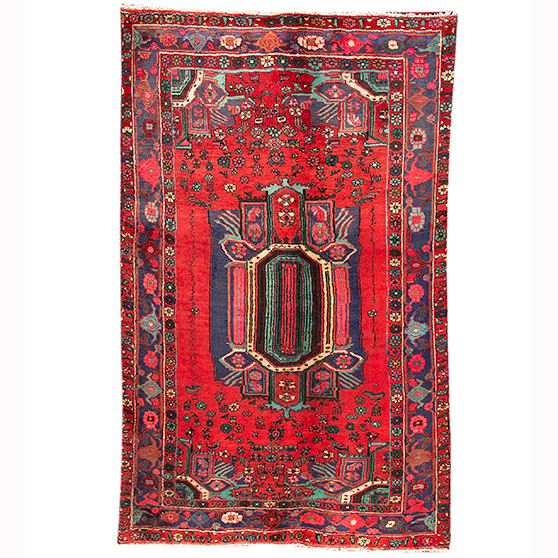
A Gholtogh rug of about 6.5 by 4.5 feet with a medallion on a madder red field, in navy, burgundy, and forest green - Gholtogh Persian Rug 6x4 ft - Medallion Semi Antique Wool Hand Knotted
5
Designs of Gholtogh
The medallion rug
Most of our Gholtogh rugs have a central medallion. It is usually angular, a stepped or hooked diamond or an octagon, outlined in a contrasting color and often filled with smaller motifs. Corner pieces echo the medallion, and the field is filled with small flowers or geometric units. The layout is balanced and formal, ideal for small rugs that are seen as a whole.
Herati-like fields
Some rugs fill the field around the medallion with a small repeating unit related to the Herati, the diamond and leaf pattern so common in western Persia. In Gholtogh rugs it is drawn finely and regularly. See our Herati designs.
Local designs of Zanjan
Persian accounts of Zanjan weaving mention local designs such as Shah Balaghi and Ghalat Mahi, traditionally woven from memory, as well as the Afshar design built from a motif of five small fish. Designs from other regions, such as Shah Abbasi palmettes and Gol Farang roses, were also brought in to add variety.
Borders
Gholtogh borders are usually well planned, with a main border of rosettes or a running vine and narrow guard stripes. The corners are often resolved neatly, a sign of careful work.
6
How Gholtogh Rugs Are Built
•
Knot - Symmetric (Turkish) knot.
•
Foundation - Cotton warps and wefts.
•
Wefts - Often two wefts between rows, beaten firmly.
•
Pile - Good local wool, clipped short to medium.
•
Density - Around 25 to 28 raj in traditional rugs, finer than many village rugs.
•
Sides and ends - Overcast sides and cotton fringes.
This construction gives Gholtogh rugs their solid, firm feel. They lie flat, keep their shape, and wear well.
7
Gholtogh and Its Neighbors
Gholtogh and Hamadan
Gholtogh rugs are often sold alongside Hamadan rugs, and some dealers group them with the Hamadan family. Most Hamadan village rugs, however, are single-wefted and coarser. Gholtogh rugs are firmer and more finely drawn. See our Hamadan collection.
Gholtogh and Zanjan
Rugs sold as Zanjan come from the same province. Many are coarser village rugs with bold geometric designs. Gholtogh is one of the finest village names within the province. See our Zanjan collection.
Gholtogh and Bijar
Bijar rugs, from Kurdistan to the south-west, are even denser and heavier, with thick wefts packed by wet-beating. Gholtogh rugs are firm but lighter. See our Bijar collection.
Gholtogh and Khamseh rugs
The name Khamseh is used for tribal and village rugs of the wider region, often freer and more tribal in design. See our Khamseh collection.
Gholtogh and Afshar
The Afshar style of Zanjan, introduced from West Azerbaijan, is woven at a higher density, around 30 to 40 raj, with its distinctive five-fish motif. Gholtogh rugs keep the older village tradition. See our Afshar collection.
8
Colors of Gholtogh
The Gholtogh palette is deep and warm. Crimson, dark red, and burgundy dominate the fields. Navy fills medallions and borders. Cream and ivory outline motifs and light the design. Gold, forest green, brown, and black add depth and detail.
In semi-antique rugs, these colors have mellowed into a rich, glowing harmony. The deep reds are especially beautiful in warm evening light.

A small Gholtogh rug of about 5 by 3.5 feet in crimson, burgundy, and navy, with a stepped medallion - Gholtogh Persian Rug 5x3 ft - Medallion Semi Antique Wool Hand Knotted
9
The Small Rug: Formats and Uses
Our Gholtogh collection includes rugs of several small sizes. Persian weavers traditionally measured rugs in zar, a unit of about one meter, and several small formats have their own names:
•
Poshti - About 2 by 3 feet, originally a cushion cover or bag face. Ideal as a doormat inside the entry or a bathroom rug in a dry room.
•
Zaronim - About 3 by 5 feet, "a zar and a half." Ideal for entries, bedsides, and in front of a fireplace.
•
Dozar - About 4 by 6.5 feet, "two zar." Ideal for small rooms, studies, and under a desk.
Small rugs are easy to place, easy to move, and easy to change with the seasons. They let you enjoy a fine village rug in any part of the home. See our 3x5 rugs and 4x6 rugs.
10
Placing a Small Gholtogh Rug
•
Entry - Just inside the front door, where it welcomes guests and catches dust from shoes.
•
Bedside - On one or both sides of a bed, for a warm first step in the morning.
•
Fireplace - In front of a hearth, where its deep reds glow in the firelight.
•
Study - Under a desk chair or in front of a bookcase.
•
Bathroom - In a dry, well-ventilated bathroom, for warmth underfoot.
•
Layered - On top of a larger neutral rug, to create a focal point.
•
On the wall - A fine small rug can be hung on a wall, supported along its whole width.
11
The Gholtogh Runner
Our collection also includes a Gholtogh runner of about 10 by 3.5 feet. With its crimson field and navy details, it suits a hallway, the side of a bed, or a kitchen. Its firm weave keeps it flat and straight, which is especially important in a runner. See our runners.
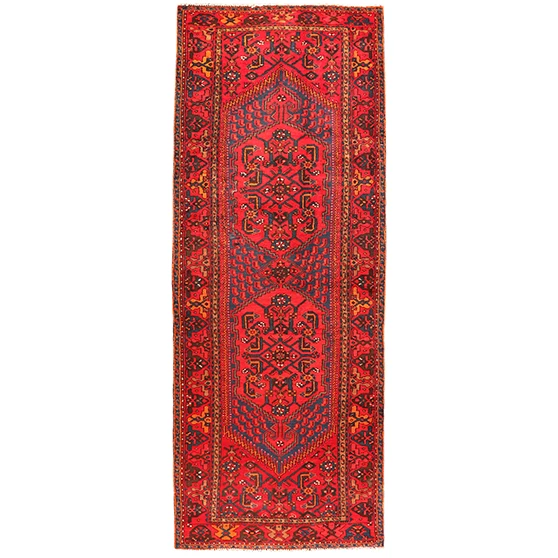
A Gholtogh runner of about 10 by 3.5 feet with a crimson field and navy medallions, ideal for a hallway - Gholtogh Persian Rug 9x3 ft - Medallion Semi Antique Wool Hand Knotted
12
Grades and How to Judge Them
•
Firmness - A good Gholtogh feels dense and solid.
•
Drawing - Clean, symmetrical medallions and well-turned borders.
•
Wool - Lustrous, springy wool.
•
Color - Deep, clear colors without bleeding.
•
Shape - Straight sides and a flat lie.
•
Condition - Even pile, intact sides and ends.
13
Reading the Back
On the back of a Gholtogh, the knots are small and tightly packed, and the design shows clearly. Symmetric knots appear as two small bumps side by side. In double-wefted rugs, the warps lie on two levels, and the back looks tight and slightly ribbed.
Count the knots along an inch or along seven centimeters to estimate the raj. Compare with other village rugs, and you will see why Gholtogh rugs have their reputation.
14
Village Weaving in Zanjan
In the villages of Zanjan, as across north-western Persia, weaving has traditionally been a winter craft. Women set up their looms inside the house when the fields are bare, and work through the cold months, often with daughters or neighbors beside them. Many traditional designs were woven from memory, passed down from mother to daughter, which is why local designs such as Shah Balaghi survived without written patterns.
Persian sources also note that much of the region's wool and dyed yarn came from the major centers of Tabriz and Kashan, while some wool was spun and dyed locally. In recent decades, provincial craft offices have encouraged a return to plant-based dyes. Read more about the people behind rugs in our article on the craft from shepherd to dealer.
15
Small Rugs, Big Craft
It is easy to think of a small rug as a minor piece, but a fine small rug demands as much skill as a large one. The weaver must fit a complete design, with medallion, corners, field, and borders, into a small space, and every motif must be in proportion. In a small rug, mistakes are easy to see, and a well-balanced composition shows real mastery.
This is why collectors often prize small rugs from fine village centers like Gholtogh. They show the full design language of the village in a compact form, and their quality can be judged at a glance. A small Gholtogh is a complete work of art that fits in the hand of a single room.
16
Gholtogh Rugs in Your Home
The deep colors of a Gholtogh bring warmth and richness to a room. In traditional interiors, they pair well with dark wood, leather, and brass. In modern interiors, a small Gholtogh adds a single strong note of color to a neutral space. Because these rugs are firm and durable, they are excellent for entries and hallways, where they take daily traffic without losing their looks.
A pair of matching or similar small Gholtoghs on each side of a bed, or a group of small rugs of different sizes laid along a long hallway, creates a rich, collected look.
17
Combining Gholtogh with Other Rugs
A small Gholtogh pairs well with larger rugs from north-western Persia. Next to a Heriz, a Tabriz, or a Hamadan in a living room, a Gholtogh in the entry or study shares the deep reds and navies. With a pale modern rug, it adds contrast. When combining rugs, keep one main color in common and vary the scale of the patterns.
18
Questions to Ask Before You Buy
•
What is the approximate raj? - Or ask for a close-up photo of the back.
•
Is it single or double-wefted? - Double-wefted rugs feel firmer.
•
Has it been repaired? - Ask where, and how.
•
Has it been washed recently? - A fresh wash shows the true depth of the reds.
•
What are the exact measurements? - Small differences matter more in small spaces.
19
Rotating Small Rugs Through the Seasons
One advantage of small rugs is that they can move around the home. Many Persian families change their small rugs with the seasons: deep reds and navies in the cooler months, lighter pieces in summer. A Gholtogh, with its rich crimson and burgundy, is a natural winter rug, beautiful in front of a fireplace or at a bedside on cold mornings. In summer, it can move to a study or a hallway out of strong sunlight.
Rotating rugs also spreads wear and gives each piece a rest from light. Store resting rugs rolled with the pile outward, wrapped in cotton fabric, in a dry place, and check them now and then for moths.
20
Semi-Antique Gholtogh Rugs
Our Gholtogh rugs are semi-antique, woven roughly forty to sixty years ago. They have settled colors, good wool, and firm construction, and they have many years of life ahead. See our semi-antique rugs.
21
What Affects the Price
•
Fineness - Higher raj and crisper drawing add value.
•
Size - Larger rugs cost more, though small fine rugs offer excellent value.
•
Wool - Lustrous wool is prized.
•
Condition - Even pile, intact sides and ends.
•
Design - Well-drawn, balanced designs are sought after.
22
Caring for a Gholtogh Rug
Vacuum regularly without a beater bar. Shake small rugs outdoors from time to time. Rotate them every few months. Use a non-slip pad, especially on smooth floors. Blot spills at once. Have the rug professionally washed every few years. See our care instructions and our guide to washing a rug at home.
23
Common Buying Mistakes
•
Assuming all small rugs are the same - A fine Gholtogh is very different from a coarse village rug of the same size.
•
Skipping the pad - Small rugs slip easily.
•
Placing in wet areas - Wool rugs should not stay wet.
•
Ignoring the back - The back shows the fineness and any repairs.
24
Frequently Asked Questions
Where is Gholtogh?
In Zanjan province, north-western Persia, in the old Khamseh region.
How is Gholtogh spelled?
Also Qoltuq, Koltuk, and Kolotuk.
What makes Gholtogh rugs special?
A finer, firmer weave than many village rugs, with crisp drawing and deep colors.
What is raj?
The number of knots in about seven centimeters; traditional Gholtogh rugs are about 25 to 28 raj.
Are Gholtogh rugs Hamadan rugs?
They are sometimes grouped with them, but they come from Zanjan and are usually finer and firmer.
What designs are typical?
Medallions with corners on dense fields, Herati-like units, and local Zanjan designs.
What colors are typical?
Crimson, burgundy, dark red, and navy, with cream, gold, and green.
What sizes do you offer?
Small rugs from about 3 by 2 to 6.5 by 4.5 feet, and a runner of about 10 by 3.5 feet.
What is a zaronim?
A traditional size of about 3 by 5 feet, "a zar and a half."
Where should I place a small Gholtogh?
In an entry, beside a bed, in front of a fireplace, or in a study.
Can a small Gholtogh be hung on a wall?
Yes, with a sewn sleeve and a rod supporting its whole width.
Is a small rug less valuable than a large one?
Not in craftsmanship. A fine small rug shows the full design language of its village in a compact form.
How should I store a small rug I am not using?
Roll it with the pile outward, wrap it in cotton fabric, and keep it in a dry place.
What is the Afshar design of Zanjan?
A design built from a motif of five small fish, introduced to Zanjan from West Azerbaijan about half a century ago.
How should I clean a Gholtogh rug?
Vacuum regularly, shake small rugs outdoors, and have it professionally washed every few years.
25
Choose Your Gholtogh Rug
Each Gholtogh rug in our collection is hand-knotted, one of a kind, and inspected before it is listed. Browse our Gholtogh collection, compare it with our Zanjan, Hamadan, and Bijar rugs, or ask our experts for help.