


If you have ever owned a Persian rug, there is a good chance it was a Hamadan. For more than a century, the villages of the Hamadan region have sent rugs to every corner of the world, in every size and in a remarkable variety of designs. They are the everyday rugs of Persia: sturdy, warm, practical, and full of character, at prices that make genuine hand-knotted rugs accessible to many homes.
Because the family is so large, choosing a Hamadan can feel overwhelming. Our own collection includes well over a hundred pieces. This guide is a map. It explains what the Hamadan name covers, how to read the village names you will see, which design families exist, how sizes and grades vary, and how to narrow your search. For the city, its history, and the general character of Hamadan weaving, see our article on weaving in Hamadan.
1
What the Hamadan Name Covers
The city of Hamadan lies on a high plain at the foot of Mount Alvand in western Persia. Around it, in every direction, lie hundreds of villages, many of them Turkic-speaking, others Persian, Kurdish, or Lur. Almost all of them weave, and almost all send their rugs to the Hamadan bazaar. In the market, the name Hamadan is therefore used in two ways:
•
As a family name - For any rug from the region, from the finest to the most rustic.
•
As a label of its own - For rugs whose specific village is not named.
When a rug is sold simply as Hamadan, it usually means a village rug from the region without a more precise attribution. When a village name is added, such as Bibikabad, Borchelu, or Hosseinabad, it tells you more about the rug's style and source.
Hamadan is both the name of a city and the name of a huge family of village rugs from the region around it. Village names, when given, point to more specific styles within the family.
2
Village Names Within the Family
Many villages and towns of the Hamadan region have their own collections on our site. Each points to a particular style:
•
Bibikabad - Dense, tightly patterned rugs with Herati networks and boteh. See our Bibikabad collection.
•
Borchelu - Floral medallions and curving vines, a softer look within the family. See our Borchelu collection.
•
Hosseinabad - Herati fields and medallions in strong reds and navies. See our Hosseinabad collection.
•
Malayer - Finer, often double-wefted rugs, a link between Hamadan and Arak. See our Malayer collection.
•
Tuyserkan and Nahavand - Villages to the south with sturdy geometric rugs. See our Tuyserkan and Nahavand collections.
•
Mehraban, Josan, Kabutarahang, and many others - Village names that appear on labels across the region.
If you already know the look you want, starting with a village collection can save time. If not, browsing the general Hamadan collection lets you see the whole range at once.
3
The Main Design Families
Hamadan weavers work in many designs. Most of our Hamadan rugs belong to one of these families:
Medallion and corners
A central medallion, often a stepped or lobed diamond, with corners and a field of small motifs or flowers. The most common Hamadan layout, ideal for living rooms where the medallion can be centered on a coffee table. See our medallion designs.
Herati
The small repeating unit of diamond, rosette, and curling leaves, drawn in a geometric way. Herati fields are dense and even, and they hide wear well. See our Herati designs.
Afshan
Flowers and small motifs scattered across the field, sometimes over a light ground, giving a lively, decorative effect. See our afshan designs.
Shah Abbasi
Large palmettes and flowing vines, borrowed from the classical city tradition and rendered in the Hamadan manner. See our Shah Abbasi designs.
Boteh
Rows of teardrop or paisley forms, sometimes with small hooks. See our boteh designs.
Geometric
Stepped medallions, diamonds, stars, and small tribal motifs, especially in rugs from Turkic and Kurdish villages. See our geometric designs.
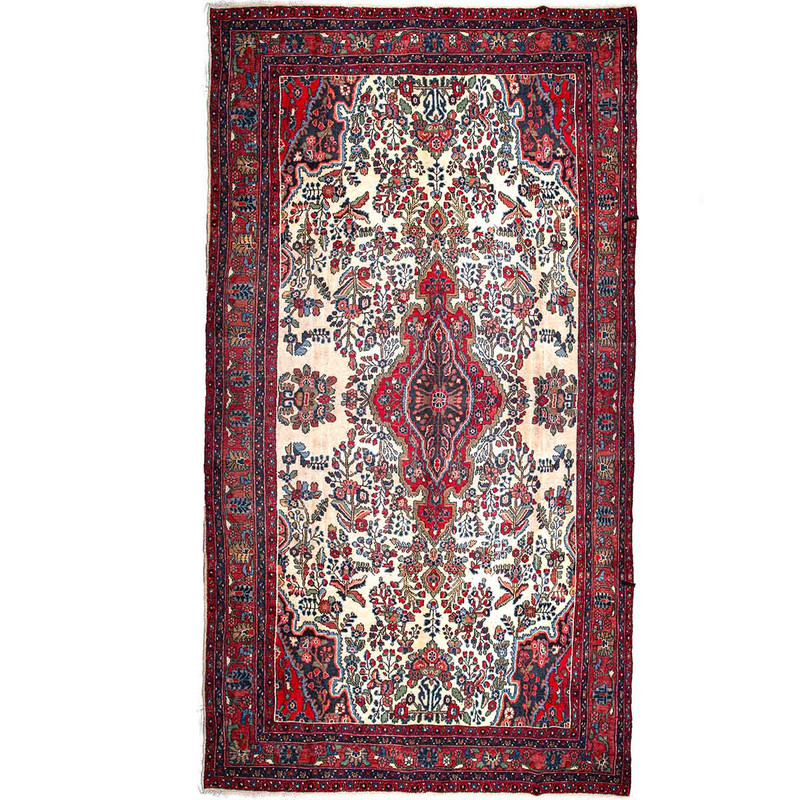
A large Hamadan rug of about 16 by 8.5 feet with an afshan design on a cream field, in madder red, navy, and indigo - Hamadan Persian Rug 16x8 ft - Afshan Semi Antique Wool Hand Knotted
4
Sizes: From Poshti to Oversize
Hamadan rugs come in every size, and our collection covers the full range.
•
Small rugs - About 2 by 3 to 4 by 6 feet. Entries, bedsides, bathrooms, and studies.
•
Medium rugs - About 5 by 8 to 6 by 9 feet. Bedrooms, studies, and small living rooms.
•
Room-size carpets - About 8 by 11 to 10 by 13 feet. Living rooms and dining rooms.
•
Oversize and gallery carpets - Larger or longer rugs, such as about 16 by 8.5 feet, for large rooms and long spaces.
•
Runners - About 2.5 to 3.5 feet wide and 8 to 16 feet long. Hallways and kitchens.
Village looms produce many long formats, so you will find rugs that are longer and narrower than the standard ratios. These are very useful in long rooms and wide halls. See our sizes pages, from 3x5 to oversize.
5
Structure: Single and Double Wefts
Most Hamadan village rugs share a common structure: the symmetric (Turkish) knot, a cotton foundation, and thick, resilient wool. Within this, there are two main traditions:
•
Single-wefted - The most common type around Hamadan, Tuyserkan, and Nahavand. One weft between each row of knots, giving a flexible rug with a characteristic staggered back and a thick pile.
•
Double-wefted - More common in villages along the road toward Malayer and Arak. Two wefts between rows, giving a firmer, flatter rug, often with finer drawing.
Both are sound and durable. Single-wefted rugs feel softer and more relaxed; double-wefted rugs feel firmer and more formal. Turn a rug over to see which it is.
6
Grades and How to Compare Them
With so many Hamadan rugs to choose from, comparing grades helps. Look at:
•
Wool - The most important factor. Lustrous, springy wool wears best and keeps its color.
•
Density - Smaller knots give finer drawing. Count knots along an inch on the back.
•
Drawing - A balanced composition, well-matched corners, and borders that turn neatly.
•
Color - Clear, harmonious colors without bleeding.
•
Shape - Straight sides and a flat lie.
•
Condition - Even pile, intact sides and ends, few repairs.
A coarse Hamadan with excellent wool can be a better buy than a finer rug with poor wool. Trust your hands as much as your eyes.
7
Matching Pairs and Sets
Because village weavers often worked on more than one rug of the same design, matching or near-matching pairs of Hamadan rugs sometimes appear in the market. A pair of medium rugs can flank a bed, frame a fireplace, or furnish two halves of an open-plan room. Two runners of similar design can fill a long or L-shaped hall. If you find a pair you like, consider buying both, since pairs that have stayed together over decades are not easy to find again.
8
Navy Fields and Cream Fields
Most people think of Hamadan rugs as red, and many are. But our collection also includes many rugs with navy fields and with cream or ivory fields, which offer a different mood.
•
Red fields - Warm, welcoming, traditional. Ideal for living rooms, dining rooms, and libraries.
•
Navy fields - Elegant and calm. Beautiful in rooms with white walls and light wood floors.
•
Cream fields - Light and airy. Ideal for modern interiors, sunny rooms, and spaces that need brightening.
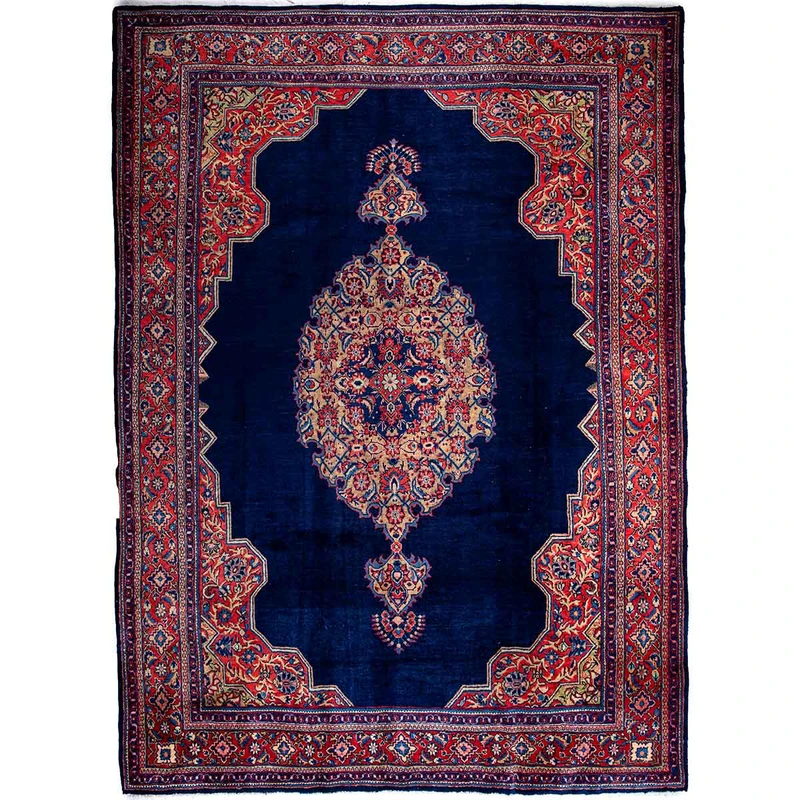
A room-size Hamadan rug of about 13.5 by 10 feet with a Shah Abbasi medallion on a navy field, in madder red, cream, and gold - Hamadan Persian Rug 13x10 ft - Shah Abbasi Semi Antique Wool Hand Knotted
9
Narrowing Your Search
When faced with a large collection, a few steps make choosing easier:
•
1. Measure the space - Note the room size and the furniture that will sit on the rug.
•
2. Choose a size range - Use our size filters to see only rugs that fit.
•
3. Pick a field color - Red, navy, or cream, depending on the room's light and furniture.
•
4. Pick a design family - Medallion for a focal point, Herati or afshan for an allover look.
•
5. Compare a few - Narrow down to three or four rugs, then compare their wool, drawing, and condition.
•
6. Ask for help - Our experts can send extra photos or help you compare pieces.
You can also use our site search to combine filters, for example "Hamadan 9x12 navy medallion."
10
Hamadan and Its Neighbors
Hamadan and Heriz
Heriz rugs are tougher and more angular, with large geometric medallions. Hamadans are more varied and often more affordable. See our Heriz collection.
Hamadan and Arak
Arak village rugs are often double-wefted with Herati fields, close to the finer Hamadans. See our Arak collection.
Hamadan and Bijar
Bijar rugs are much denser and heavier, with thick, packed wefts. See our Bijar collection.
Hamadan and Kurdish rugs
Kurdish village rugs, from the west, are often looser with longer pile and bolder colors. See our Kurdish collection.
11
The Value of a Hamadan
Hamadan rugs are among the best values in the world of Persian rugs. Because the region is so large and productive, prices are moderate, yet the rugs are genuinely hand-knotted, made of good wool, and built to last. A semi-antique Hamadan, with its settled colors and proven durability, offers the character of a genuine hand-knotted rug at a price within reach of many homes.
For buyers furnishing a whole home, Hamadans make it possible to have genuine Persian rugs in every room: a large carpet in the living room, a runner in the hall, small rugs at the bedsides and the door, all from the same family and sharing a common character.
12
Furnishing a Whole Home with Hamadans
•
Living room - A room-size medallion rug, red or navy.
•
Dining room - An allover Herati or afshan rug that hides spills.
•
Hallway - A Hamadan runner in matching colors.
•
Bedrooms - Medium rugs under the bed, or small rugs at each side.
•
Entry - A small, sturdy rug just inside the door.
•
Study - A cream-field rug for a light, calm space.
Keep one or two colors in common across the rugs to tie the home together, and vary the designs from room to room for interest.
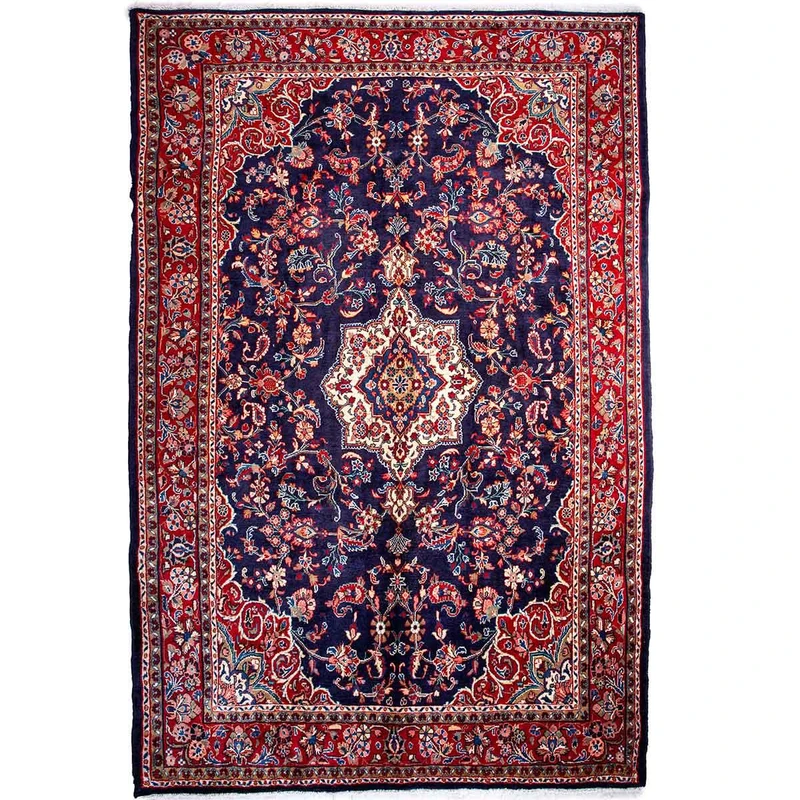
A Hamadan rug of about 12 by 7.75 feet with a medallion on a navy field, a long format for living or dining rooms - Hamadan Persian Rug 12x7 ft - Medallion Semi Antique Wool Hand Knotted
13
Long Formats Explained
Many Hamadan rugs are longer and narrower than the standard Western sizes. A rug of about 12 by 7.75 feet, or 16 by 8.5 feet, comes from village looms built to fit village rooms, and from the traditional practice of laying long rugs along the sides of a room. These formats are often a perfect answer to modern rooms that standard sizes do not fit.
•
Long living rooms - A 12 by 7.75 foot rug fits a room of about 15 by 11 feet, leaving a border of floor around it.
•
Open-plan spaces - A 16 by 8.5 foot rug can run the length of a long seating area or a dining table for ten.
•
Wide hallways and galleries - A long rug of 4 to 5 feet wide fills a generous hall better than a narrow runner.
•
Bedrooms - A long rug under a king bed, extending from the headboard well past the foot of the bed.
When you measure a room, do not limit yourself to standard sizes. A long Hamadan may fit better than any rug with standard proportions.
14
From Village Loom to Hamadan Bazaar
Most Hamadan rugs begin on an upright loom in a village house. Women weave through the winter months, often with daughters or neighbors, and many traditional village designs are woven from memory rather than from paper cartoons. When a rug is finished, it is sold to a local dealer or taken to a market town, and from there it travels to the bazaar of Hamadan, one of the great rug markets of Persia.
In the bazaar, rugs are washed, clipped, sorted by size, grade, and village style, and sold to wholesalers. It is often at this stage that village names are attached. From Hamadan, the rugs travel to Tehran and then abroad. Read more about the people in this chain in our article on the craft from shepherd to dealer.
15
Hamadan Rugs in Modern Interiors
The bold, geometric drawing of many Hamadan rugs suits modern rooms surprisingly well. Their straight lines and clear color blocks echo contemporary furniture and art, and their handmade irregularities add warmth to spaces that might otherwise feel cold. A semi-antique Hamadan with softened colors can be the one traditional element in a modern room, bringing history and texture without clutter.
•
Minimal rooms - A cream-field Hamadan adds texture without heaviness.
•
Industrial spaces - A red Hamadan on concrete or dark wood brings warmth.
•
Scandinavian interiors - A navy Hamadan pairs well with pale wood and white walls.
16
Questions to Ask Before You Buy
•
Is it single or double-wefted? - This affects the feel and the look of the back.
•
What are the exact measurements? - Village rugs vary, so check both ends.
•
Has it been repaired? - Ask where and how.
•
Has it been washed recently? - A fresh wash shows the true colors.
•
Is there a village name? - It helps place the rug within the family.
17
Reading the Back
Turn a Hamadan over and you learn a great deal. In single-wefted rugs, the knots appear offset from row to row and a thin line of weft shows between rows. In double-wefted rugs, the back looks tight and regular. The design should be clear on the back. Check for repairs, which show as areas with different knots, colors, or stiffness, and for moth damage near the edges.
18
Signs of a Well-Kept Semi-Antique Hamadan
•
Even pile - Worn evenly, with no bald patches or deep furniture marks.
•
Supple foundation - The foundation bends without cracking when a corner is gently folded.
•
Intact sides and ends - Overcasting complete, fringes and end bands present.
•
Clean colors - No red running into ivory, and no large faded areas.
•
No moth damage - Check the back and under the edges.
A semi-antique Hamadan that passes these checks has decades of life ahead, and its softened colors and polished wool often look better than a new rug.
19
Semi-Antique Hamadan Rugs
Most of our Hamadan rugs are semi-antique, woven roughly forty to sixty years ago. They have settled colors, good wool, and sturdy construction, with many years of life ahead. See our semi-antique rugs.
20
Caring for a Hamadan
Vacuum regularly without a beater bar. Rotate the rug every six months. Use a good pad. Blot spills at once. Have it professionally washed every few years. Keep the sides and ends in good repair. See our care instructions and our guide to washing a rug at home.
21
Common Buying Mistakes
•
Choosing by design alone - Compare the wool and condition too.
•
Ignoring the format - Many Hamadans are longer than standard; measure carefully.
•
Skipping the pad - Village rugs need a pad to stay flat and in place.
•
Overlooking village names - They can help you find the exact style you want.
22
Frequently Asked Questions
Where is Hamadan?
In western Persia, on a high plain at the foot of Mount Alvand.
What does the Hamadan name cover?
Rugs from the city and the hundreds of villages around it.
What are village names like Bibikabad or Hosseinabad?
More specific names for rugs from particular villages within the Hamadan family.
What designs are common?
Medallions, Herati, afshan, Shah Abbasi, boteh, and geometric designs.
What sizes are available?
Every size, from about 2 by 3 feet to oversize carpets and long runners.
What knot is used?
The symmetric or Turkish knot.
What is the difference between single and double wefts?
Single-wefted rugs are more flexible with a thick pile; double-wefted rugs are firmer and flatter.
Are Hamadan rugs durable?
Yes. Their thick wool and sturdy construction make them very durable.
Are Hamadan rugs good value?
Yes. They are among the best values in genuine hand-knotted Persian rugs.
Can I furnish a whole home with Hamadans?
Yes. The family offers every size and many designs that share a common character.
Are matching pairs of Hamadan rugs available?
Sometimes. Village weavers often made more than one rug of a design, and pairs are worth buying together.
How do I narrow down a large collection?
Measure the room, choose a size range and a field color, then compare a few rugs by wool and condition.
Which field color is best for a sunny modern room?
A cream or ivory field keeps the room light and airy.
Why are many Hamadans long and narrow?
Because of village loom sizes and the traditional practice of laying long rugs along the sides of a room.
Do Hamadans suit modern interiors?
Yes. Their geometric drawing and warm colors work well with modern furniture.
How should I clean a Hamadan?
Vacuum regularly, blot spills, and have it professionally washed every few years.
23
Choose Your Hamadan Rug
Each Hamadan rug in our collection is hand-knotted, one of a kind, and inspected before it is listed. Browse our Hamadan collection, explore the village collections linked above, or ask our experts for help narrowing your search.