


Emerald is the jewel of the green family. It is clear, rich, and full, without the gray of sage or the darkness of forest green. In a Persian rug, emerald rarely covers a whole field. Instead it appears in small, carefully placed areas, where it looks as precious as the stone that gives it its name.
This guide focuses on emerald. For the whole green family, see our guide to green Persian rugs, and for all colors, our guide to Persian rug colors.
1
What We Mean by Emerald
Emerald is a rich, clear green. It is brighter than forest green, less blue than teal, and fuller than olive or sage green. In rugs, emerald often looks strongest in small areas, where it sits next to red and ivory and seems to glow.
Emerald is a rich, jewel-like green made with indigo and a yellow dye such as weld. In Persian rugs it is used carefully, in leaves, flowers, and details that sparkle beside red and ivory.
2
How Green Is Made
Traditional Persian dyers had no good natural green dye that would hold on wool. To make green, they dyed wool twice: first with indigo for blue, then with a yellow dye, most often weld (esparak), or the other way round. The balance of blue and yellow decides the shade: more yellow gives a fresh grass or emerald green, more blue gives teal. Because two baths are needed, green takes more time and skill than red or blue. Our article on the dyeing process follows wool through the dye house.
3
Why Green Is Used Sparingly
In many Persian rugs, green appears only in small areas. Part of the reason is practical: green needs two dye baths, and its yellow part can fade. Part is cultural: green is linked with paradise and with the Prophet's family in Islamic tradition, and some writers say weavers avoided large green fields that would be walked on. Whatever the reason, the result is that green in a Persian rug often feels special: a small, bright accent rather than a background.
There are exceptions. Some Kerman, Bakhtiari, and Khorasan rugs use green more freely, and some modern rugs have full green fields.
4
Emerald and Other Greens
•
Emerald - Rich, clear, jewel-like green.
•
Forest green - Darker and deeper.
•
Teal - Bluer.
•
Olive - Browner and more muted.
•
Sage green - Grayer and softer.
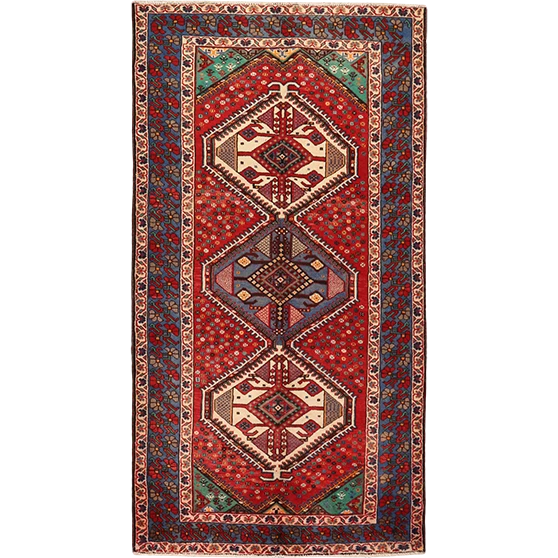
An Isfahan rug of about 10.25 by 5.25 feet with stacked medallions on madder red and small green details - Isfahan Persian Rug 10x5 ft - Medallion Semi Antique Wool Silk Hand Knotted
5
Emerald in Isfahan and City Rugs
In Isfahan rugs, green appears in leaves, vines, and medallion details among red, ivory, and blue. These small green areas give the floral design life, as if the flowers were growing. In Kashan, Tabriz, and Kerman rugs, emerald leaves and borders do the same. Kerman weavers in particular used many shades of green among their wide palette.
6
Emerald in Village and Tribal Rugs
Village and tribal weavers also used green as an accent. In Quchan rugs from the Kurds of Khorasan, rows of geometric motifs in red, ivory, and green give a lively, balanced look. In Bakhtiari rugs, green fills garden panels and trees. In Qashqai rugs, small green flowers and animals sparkle on madder red. Our Quchan rug guide describes the region.
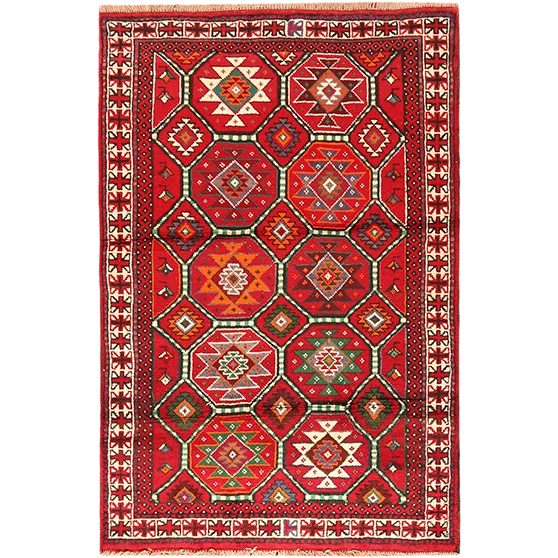
A Quchan rug of about 6 by 3.75 feet with rows of geometric motifs in red, ivory, and green - Quchan Persian Rug 5x3 ft - Geometric Semi Antique Wool Hand Knotted
7
How to Recognize Emerald in a Rug
Look at the leaves and small details. If the green looks clear and full, neither gray nor blue, it is in the emerald range. Compare it with any teal or blue-green areas: emerald has more yellow. Compare it with olive or brown-green: emerald is brighter. In older rugs, compare the front with the back, where the green may be stronger because it has been protected from light.
8
Green and the Persian Garden
The Persian garden, with its water channels, trees, and flower beds, is one of the great themes of Persian art, and green is its color. Garden rugs divide the field into beds and channels, and green trees and plants grow inside them. Even in rugs without a garden design, green leaves and vines remind the viewer of the garden. Emerald, as the brightest green, carries that sense of life and spring.
9
Emerald in Small Rugs
Because green is often used in small areas, it shows up most clearly in small rugs, where every detail is close to the eye. A small Quchan, Qashqai, or village rug with green motifs brings a fresh, lively note to an entry, a reading corner, or a bedside. Browse our small rugs and filter by green to see what is available.
10
Green Through the Seasons
Green is the color of spring in Persian culture, and it is closely tied to Nowruz, the Persian new year, when sprouted wheat and lentils are grown as a sign of renewal. A rug with emerald details brings that sense of spring into a room all year round.
11
Emerald and Red
Green and red are opposites on the color wheel, so a little emerald makes red look warmer and stronger. That is why green leaves around red flowers look so lively. When you choose a red rug, look for green details: they are often what makes the red come alive.
12
Emerald Rugs in Living Rooms
A rug with emerald accents brings life and freshness to a living room. It ties easily to green plants, which many people love to have near a rug. It works with white, cream, and warm walls, and with natural wood. In a room with green walls or fabric, a red rug with emerald details links the floor to the rest of the room.
13
Emerald Rugs in Dining Rooms, Studies, and Bedrooms
In a dining room, green details look rich under warm light. In a study, emerald pairs with dark wood, leather, and brass. In a bedroom, it adds a fresh, natural note. Our size guide explains how to choose the right size.
14
Emerald in Modern Rooms
Deep, jewel-toned greens are popular in modern interiors, in velvet chairs, painted walls, and kitchen cabinets. A Persian rug with emerald details links these modern greens to the warmth of a traditional floor. In a room with an emerald sofa or green walls, a red rug with green leaves and vines looks especially rich, because the green in the rug repeats the green above it. Pair it with brass and natural wood to keep the room warm and inviting.
15
Pairing Colors with an Emerald Rug
•
Ivory and cream - Fresh and bright.
•
Madder red - The classic opposite.
•
Gold and brass - Rich, jewel-like warmth.
•
Natural wood - Like a garden.
•
Plants - Living green echoes the rug.
16
Emerald and Light
Emerald looks brightest in daylight and deeper under warm bulbs. Because it is often in small areas, it can disappear in a dim room, so place a rug with green details where it gets some light.
17
Emerald and Sunlight
Green is less stable than red or blue, because its yellow part fades first. After many years in strong sun, emerald can drift toward teal or blue-green. Rotate the rug every six to twelve months and limit long hours of direct sun.
18
Caring for an Emerald Rug
Vacuum regularly with suction only. Blot spills with cold water and never rub. Avoid bleach and strong cleaners. Have the rug washed by a professional every few years. Our care instructions explain each step.
19
Frequently Asked Questions
How is green made in Persian rugs?
By dyeing wool with indigo and a yellow dye such as weld.
Why is green used so little in Persian rugs?
It needs two dye baths, its yellow can fade, and green has special meaning in Persian and Islamic culture.
Which rugs have emerald green?
Isfahan, Kashan, Kerman, Tabriz, Quchan, Bakhtiari, and Qashqai rugs, among others.
Does emerald fade?
Its yellow part can soften first, shifting it toward teal over many years.
20
Choose Your Emerald Rug
Browse our emerald rugs, compare them with forest green and green rugs, and ask our experts if you would like help choosing.