


Ivory is the lightest of the warm colors in a Persian rug, and one of the most elegant. It is the natural color of good white wool, not snow white but softly warm, like old piano keys or fine paper. An ivory field gives a design room to breathe: navy arabesques, sky-blue flowers, and rose palmettes seem to float on it. Many of the finest Persian rugs have ivory grounds, and an ivory rug brings that sense of refinement and light into a home.
This guide explains what we mean by ivory, where ivory comes from in a hand-knotted rug, how it differs from neighboring colors, which weaving traditions are known for ivory, and how to choose, place, and care for an ivory rug. For the full palette, see our guide to Persian rug colors, and for the warmer light tones, our guide to cream Persian rugs.
1
What We Mean by Ivory
In our catalog, ivory is a light, warm white with a faint creamy tone. A rug is listed as ivory when this color is one of its main colors: an ivory field, an ivory medallion, or wide ivory borders. Ivory is lighter than cream, which has more yellow, and warmer than white, which is brighter and cooler. It is lighter than beige and ecru. Many rugs belong to more than one of these groups, because a light field changes with the light of the room.
Ivory is the natural light color of good white wool, softly warm rather than bright white. It is the classic ground of fine Nain, Isfahan, Kashan, and Tabriz rugs.
2
Where Ivory Comes From
•
Natural white wool - Most ivory in Persian rugs is simply undyed white wool, chosen for its light, even color.
•
Careful sorting - Spinners sorted fleece by color, keeping the lightest wool for ivory fields and highlights.
•
Washing - Every new rug is washed after weaving, which brightens the ivory and removes dust.
•
Silk - In fine rugs, ivory silk highlights add sheen to outlines and details.
Traditional weavers rarely bleached their wool, because bleaching weakens the fiber. That is why the light grounds of Persian rugs have always been ivory rather than pure white. Our article on Persian rug wool explains how fleece is sorted and spun, and our article on washing after weaving explains the first wash.
3
Ivory and the Fine City Rug
Ivory fields are especially associated with the finest city rugs of central Persia. In Nain and Isfahan, weavers combined ivory grounds with navy, sky blue, and soft rose in intricate floral and arabesque designs, often with silk outlines. The light ground shows every detail of the fine knotting, and the rug looks almost like an illuminated page. Our Nain rug guide and Isfahan rug guide explain these rugs and their grades.
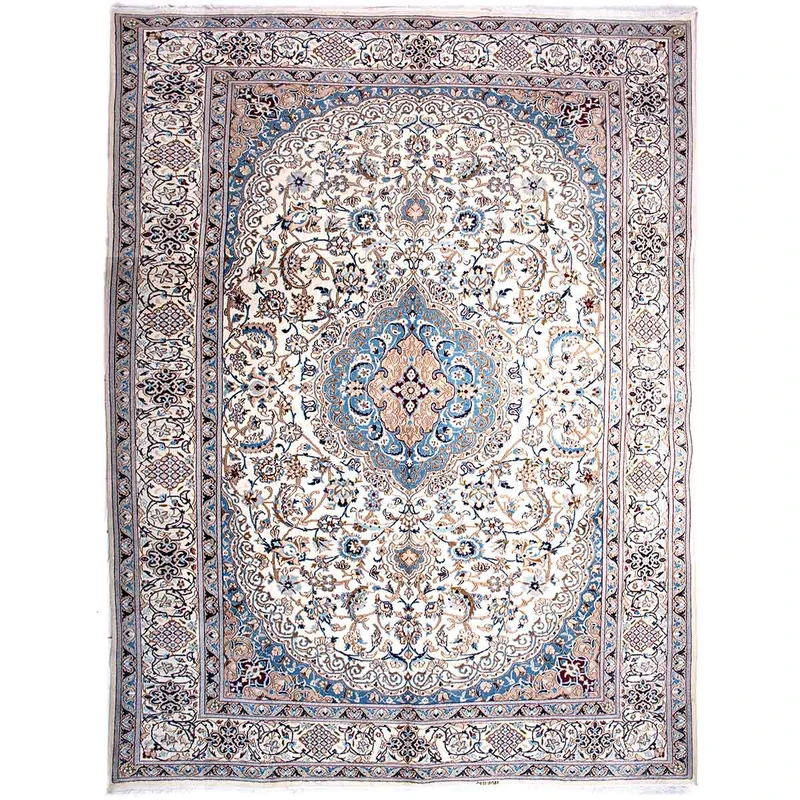
A Tabas rug of about 13.5 by 9.25 feet with a light blue medallion and blue-gray flowers on an ivory field - Tabas Persian Rug 13x9 ft - Medallion Semi Antique Wool Silk Hand Knotted
4
Ivory in Kashan and Tabriz Rugs
Kashan rugs are famous for crimson and navy fields, but Kashan weavers also made ivory-field rugs with blue and rose medallions, crisp and luxurious. Tabriz workshops wove a wide range of ivory rugs, from medallion designs to Afshan fields and garden patterns, often with silk highlights. Both cities show how ivory can carry a fine design with elegance. Our Kashan rug guide and Tabriz rug guide describe their grades and eras.
5
Ivory in Khorasan Rugs
The province of Khorasan, home to Mashhad, Kashmar, Tabas, and Sabzevar, produced many room-size rugs with ivory fields. A typical Khorasan ivory rug has a blue medallion, matching corners, and a dense floral field, framed by navy or rose borders. The generous scale of these rugs makes them perfect for large living and dining rooms. Our Khorasan rug guide explains this region.
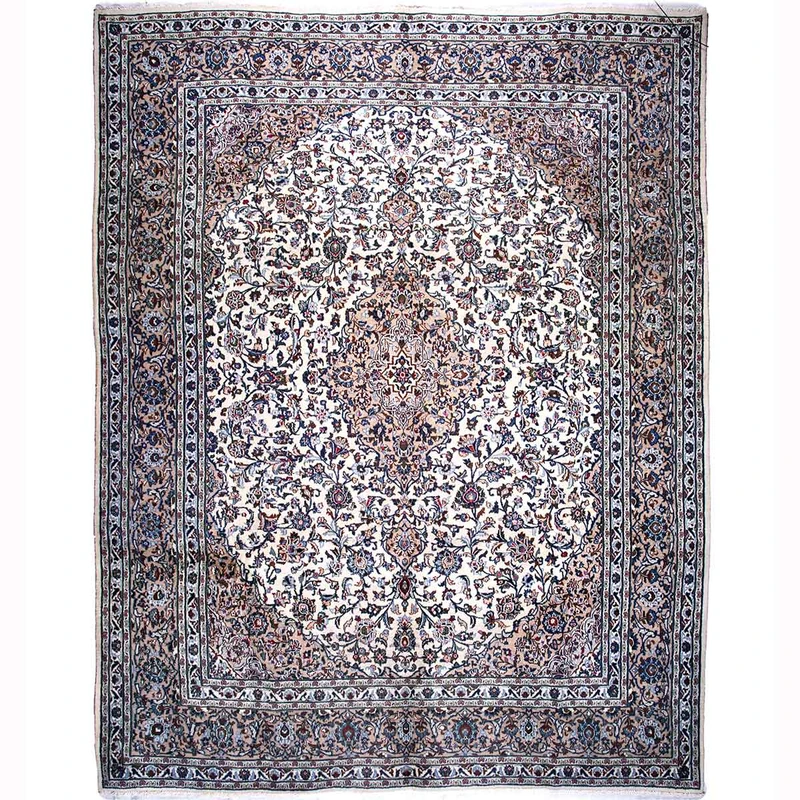
A Kashmar rug of about 12.75 by 9.5 feet with a dense Shah Abbasi floral design on an ivory field, framed by navy borders - Kashmar Persian Rug 12x9 ft - Shah Abbasi Semi Antique Wool Hand Knotted
6
Ivory in Village and Tribal Rugs
In village and tribal rugs, ivory usually plays a supporting role. It appears as medallions, outlines, small animals and flowers, and narrow borders, lighting up rugs with red, navy, and brown grounds. In Heriz rugs, large ivory corners and medallions balance brick red fields; in Qashqai and Shiraz rugs, small ivory motifs sparkle on madder red. These rugs appear in our ivory group too, so look at the photographs to see whether ivory is the field or an accent.
7
Ivory and Blue: The Classic Light Palette
The pairing of ivory and blue is one of the most beloved in Persian rugs. Ivory gives light; navy and sky blue give depth and calm. This palette is typical of Nain, Isfahan, Kashan, and Khorasan rugs, and it suits rooms with white walls, pale floors, and blue or gray textiles. If you love it, also see our blue rugs, especially navy blue and sky blue.
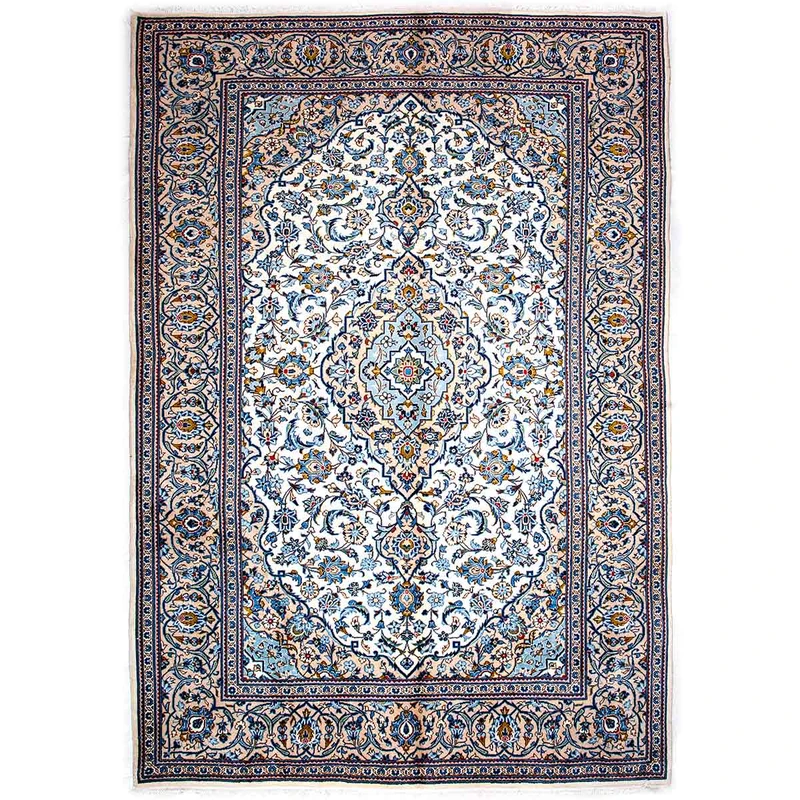
A Kashan rug of about 11.75 by 7.75 feet with a light blue medallion on an ivory and pale blue field, framed by navy borders - Kashan Persian Rug 11x7 ft - Medallion Semi Antique Wool Silk Hand Knotted
8
Ivory, Cream, White, and Beige
•
White - Bright, cooler accents, usually small details in tribal rugs.
•
Ivory - The warm white of natural wool, the classic light ground.
•
Cream - Ivory with a soft, buttery warmth.
•
Ecru - A pale, unbleached tone with a faint gray or green cast.
•
Beige - Darker and sandier.
Light neutrals are hard to judge in photographs. Compare the rug with something white you know, such as a sheet of paper, and look at every photograph in the listing.
9
Designs That Shine on Ivory
•
Islimi - Arabesque scrolls in navy on ivory read like fine ironwork.
•
Shah Abbasi - Palmettes and vines look crisp on an ivory ground.
•
Medallion - Blue or rose medallions on ivory give a strong center.
•
Afshan - Scattered flowers keep an ivory field lively.
•
Vase - Flowering vases suit the garden spirit of light rugs.
•
Tree of Life - Trees and birds on ivory look fresh and joyful.
10
Ivory Rugs in Living Rooms
An ivory rug makes a living room feel bright, open, and elegant. It works with white, cream, and gray walls, with light and dark wood floors, and with both traditional and modern furniture. In a large living room, a room-size ivory rug of 9 by 12 or 10 by 13 feet reaches under all the seating and gives the room a calm, unified base. Our 9x12 rug guide and 10x13 rug guide explain how to size it.
11
Ivory Rugs in Bedrooms
Bedrooms are the easiest place for an ivory rug. Traffic is light, so a light field stays clean, and an ivory rug under the bed makes the room feel calm and spacious. Pair it with white or linen bedding for a serene look, or with navy and blue for a fresh, classic one. For sizes, see our 8x11 and 9x12 guides.
12
Ivory Rugs in Dining Rooms
An ivory rug under a dark wood table is one of the most elegant looks in a formal dining room. Choose a rug with an all-over design, which hides small marks better than an open field, and a size that lets the chairs stay on the rug when pulled out, about 24 inches beyond the table on every side. Blot spills right away. For a dining room used every day by a young family, a darker rug may be easier. Our size guide gives sizes for every table.
13
Ivory and Light
Ivory reflects light and makes a room feel larger. In cool north light, it looks crisp and close to white; in warm afternoon light and under warm bulbs, it glows softly, close to cream. In a dim room, an ivory rug brightens the floor; in a very sunny room, it can look almost white at noon. Think about when you use the room most, and look at the photographs that match that light.
14
Ivory Rugs and Sunlight
An ivory field shows little fading, because it is already light, but the blues and roses of its design can soften in strong sun. Rotate the rug every six to twelve months, and use sheer curtains or UV-filtering film on windows that get long hours of direct sun. Rugs with silk highlights need the most protection.
15
Pairing Colors with an Ivory Rug
•
Navy and indigo - Deep blues echo the designs of many ivory rugs.
•
Sky blue and gray - Soft, airy tones for a light, coastal room.
•
Rose and blush - Warm pinks bring out the flowers in the design.
•
Natural wood - Oak, walnut, and teak all look rich against ivory.
•
Brass and gold - Warm metals add a touch of luxury.
•
Black accents - A few black frames or lamps keep a light room crisp.
16
Ivory Rugs in Modern Homes
An ivory Persian rug is one of the easiest ways to bring a fine traditional rug into a modern home. Its light ground sits comfortably with white walls, pale floors, and clean-lined furniture, while its design adds detail and warmth. In an open-plan home, an ivory rug can define a seating area without darkening the space. Many of our customers in Southern California choose ivory rugs for exactly this reason: they suit bright, light-filled homes.
17
Ivory Rugs and Stains
People often worry about keeping an ivory rug clean, but wool is more forgiving than most people expect. Its natural lanolin slows the absorption of liquids, and its fibers release dirt easily when vacuumed. Blot spills at once with a clean white cloth, rinse with a little cold water, and blot again. Never rub, and never use bleach or strong household cleaners, which can leave yellow or white rings. For deep stains, call a professional rug cleaner.
18
Ivory Rugs and Pets
An ivory rug hides light pet hair well but shows darker hair and muddy paws. If you have a dark-haired dog, choose an ivory rug with a busy all-over design and darker accents, and keep it in a room with less traffic. Vacuum regularly without the beater bar, and treat accidents quickly.
19
Ivory and Silk
Many fine ivory rugs include silk in their outlines and details, and some Nain and Isfahan rugs have a high silk content. On an ivory ground, silk catches the light and makes the design shimmer as you move around the rug. Silk is more delicate than wool, so place a silk-rich rug where it gets moderate traffic and little direct sun. Our silk group lists rugs with silk content.
20
Abrash in Ivory Fields
Because ivory usually comes from undyed wool, ivory fields show less abrash than dyed fields. Still, natural fleece varies slightly in tone, and you may see gentle bands of warmer or cooler ivory, especially in village rugs. This is a natural sign of handwork and gives a light field quiet movement.
21
Older Ivory Rugs
Most of our ivory rugs are semi-antique, about 40 to 60 years old. Age warms an ivory field slightly and gives it a soft glow. When you look at an older ivory rug, check that the field is even and clean, ask about any spots or old stains, and feel the wool: it should be supple, not dry. Our notes on semi-antique and antique rugs, and our Before You Buy page, explain what to look for.
22
Ivory Medallions on Dark Fields
Ivory is not only a field color. Many rugs with red or navy fields have large ivory medallions, which act like a window of light at the center of the rug. A red Hamadan or Arak rug with an ivory medallion feels warmer and lighter than one with a dark medallion, and the ivory makes the design readable from across the room. If you love a red or navy field but want some light in the room, an ivory medallion is a good compromise.
23
Ivory Borders
Some rugs use ivory in their main border, framing a red, navy, or blue field with a band of light. An ivory border makes a dark rug look crisp and tailored, and it connects the rug to light walls and pale floors. In tribal rugs from Fars, narrow ivory borders with small dark motifs are common, adding a lively edge to the rug.
24
Spinning the Lightest Wool
Making an even ivory field takes skill long before the loom. Spinners sort the fleece by color, setting aside the whitest wool for ivory grounds and highlights. Fine, even spinning gives the field a smooth, uniform look; slightly uneven hand spinning gives a gentle variation. In the finest rugs, wool from the shoulders and sides of the sheep, which is softer and more lustrous, is often chosen for the pile. This care is why a good ivory field glows rather than looks flat.
25
Ivory and Gold Accents
Some ivory rugs carry soft gold, camel, and rose accents rather than blue. These rugs feel warm and sunlit, and they pair beautifully with brass, honey-colored wood, and warm textiles. They suit rooms with warm light, where ivory and gold glow together in the afternoon. Our yellow and gold rugs include more rugs with golden tones.
26
Sizes in Our Ivory Group
Our ivory group includes fine small rugs of about 2 by 3 and 3 by 5 feet, ideal for bedsides and entries, mid-size rugs of about 6 by 9 and 8 by 10 feet for bedrooms and smaller living rooms, and many room-size rugs of 9 by 12 feet and larger from Khorasan, Tabriz, and Kashan. Our size guide helps you choose the right size for each room.
27
Seeing Ivory on a Screen
Light neutrals are hard to show accurately on screens. An ivory field can look stark white on one phone and cream on another. Our photographs are taken in consistent light, but if the exact tone matters, compare several photographs of the same rug, and ask us for a description in daylight before you decide.
28
Ivory Rugs and Wood Floors
Ivory rugs look especially beautiful on medium and dark wood floors, where they stand out like a pool of light. On pale oak or maple, an ivory rug blends more softly into a calm, tonal room. If your floors are very light, choose an ivory rug with navy or rose accents so the design still reads clearly from across the room.
29
Ivory in Small Spaces
Light colors make small spaces feel larger. A small ivory rug in a narrow entry, a bathroom, or a compact bedroom reflects light and opens up the room. In an entry, place it a step inside the door with a doormat outside, so it stays clean longer.
30
A Timeless Choice
Fashions in interior color come and go, but ivory Persian rugs have remained in demand for more than a century. Their light grounds and fine designs suit traditional, modern, and eclectic rooms alike, which makes an ivory rug one of the safest long-term choices you can make.
31
Ivory Through the Seasons
An ivory rug adapts easily to the seasons. With white linen and plants in summer it feels fresh and airy; with wool throws and warm lamps in winter it glows softly. Few colors make a room feel so different with so little change.
That quiet flexibility is one of the reasons ivory rugs are so often passed down from one generation to the next.
32
Questions to Ask Before You Buy
•
Is it ivory, cream, or white? - Compare all the photographs with something white.
•
Is ivory the field or an accent? - The answer changes how light the rug feels.
•
What are the accent colors? - Navy, sky blue, and rose each change the mood.
•
Does it include silk? - Silk needs more protection from sun and wear.
•
How busy is the room? - All-over designs hide marks better than open fields.
•
How does the wool feel? - Supple wool is a sign of a healthy rug.
33
Caring for an Ivory Rug
Vacuum regularly with suction only, or with the beater bar raised, and vacuum the back a few times a year. Rotate the rug every six to twelve months. Blot spills at once and never rub. Keep it out of long, direct sun. Have it washed every few years by a professional who cleans hand-knotted rugs. Our care instructions explain each step, and our article on washing at home covers small cleanups.
34
Frequently Asked Questions
Is ivory a traditional color in Persian rugs?
Yes. Ivory, the natural color of white wool, is the classic light ground of Persian weaving, especially in Nain, Isfahan, Kashan, Tabriz, and Khorasan rugs.
What is the difference between ivory and cream?
Ivory is lighter and closer to white; cream has a warmer, slightly yellow tone.
Why are Persian rugs ivory instead of pure white?
Natural wool is warm in color, and traditional weavers rarely bleached it, because bleaching weakens the fiber.
Is an ivory rug hard to keep clean?
Less than most people think. Wool resists stains, and quick blotting and regular vacuuming keep an ivory rug fresh.
What colors go with an ivory rug?
Navy, sky blue, rose, natural wood, and brass all pair beautifully with ivory.
35
Choose Your Ivory Rug
An ivory Persian rug brings light and refinement into your home, with the full detail of a hand-knotted design. Browse our ivory rugs, compare them with our cream and white groups, and ask our experts if you would like help choosing.