


A Persian rug pillow is one of the easiest ways to bring hand-knotted Persian weaving into a room. It needs no floor space, no measuring of rooms, and no pad. It sits on a sofa, a bed, a window seat, or a reading chair, where its wool can be touched and its colors seen up close. And because most rug pillows are made from sections of older rugs, each one is a small piece of a real Persian carpet, with a history of its own.
This guide explains what a rug pillow is, how rug pillows are made, how they connect to the Persian tradition of cushions and floor seating, which weaving traditions you will find in our pillows, how to style them, and how to care for them. For a full overview of rug sizes, see our Persian rug size guide.
1
What Is a Persian Rug Pillow?
A Persian rug pillow is a cushion whose face is a piece of hand-knotted Persian rug: a wool pile knotted by hand on a cotton foundation, just like a floor rug. The face is sewn to a backing to form a cover. Our rug pillows come in two square sizes, about 1 foot 4 inches (40 by 40 cm) and about 1 foot 8 inches (50 by 50 cm). Every listing gives the exact size, and the photos show the face of each pillow. Check each listing for details of the backing and whether an insert is included.
Our Persian rug pillows measure about 1'4" x 1'4" (40 x 40 cm) or 1'8" x 1'8" (50 x 50 cm), with a face of hand-knotted wool pile from an older Persian rug.
2
How Rug Pillows Are Made
Many Persian rugs that have lived a long life on the floor wear unevenly. A rug may have a worn path through the center or damaged ends while large areas of its field and borders are still in beautiful condition. Rather than discard such a rug, craftspeople cut the best sections and turn them into pillow faces. The cut edges are secured so the knots cannot come loose, and the face is sewn to a backing. Some pillows are also made from small pieces woven as cushion faces. Either way, the result is a cushion with genuine hand-knotted pile, and the photos often show part of a medallion, a border, or a section of field, cut from a larger design. This is very different from a fine rug in good condition, which should never be cut; read our article on patchwork rugs made from vintage Persian rugs for more on giving old rugs a new life.
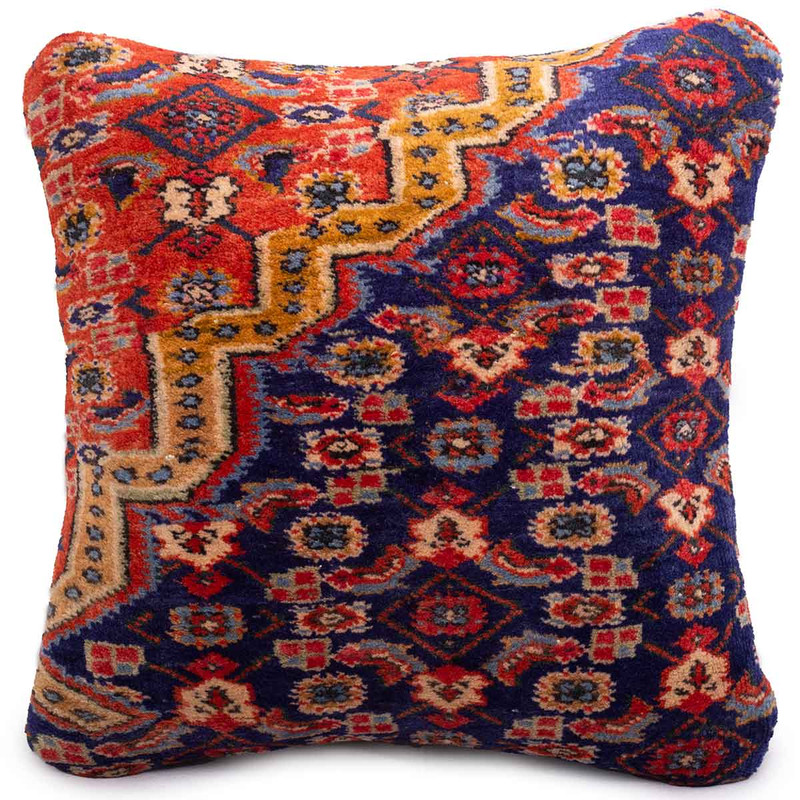
A rug pillow of about 1.75 by 1.75 feet made from a semi-antique Ardabil rug with an Afshan design in navy blue, madder red, and gold - Ardabil Persian Rug 1x1 ft - Afshan Semi Antique Wool Silk Hand Knotted
3
The Poshti: Cushions in the Persian Home
Cushions have a long history in Persian life. In a traditional Persian room, people sat on carpets on the floor and leaned against cushions placed along the walls. The cushion for the back was called a poshti, from the word for "back", and long round bolsters were called mokhadde or motakka. The faces of these cushions were often made of pile weaving or flat weaving, so a family's cushions matched its carpets. In fact, the small rug size of about 2 by 3 feet is still called Poshti in Persian markets, because rugs of that size were used as cushion faces. A Persian rug pillow on a modern sofa continues this old tradition. Read our 2x3 rug guide for more on the Poshti size.
4
Where Rug Pillows Work Best
•
On a sofa - Two to four pillows bring color and texture to a plain sofa.
•
On a bed - In front of plain pillows, as an accent.
•
On a reading chair - A single pillow makes a chair feel complete.
•
On a window seat or bench - Several pillows along a built-in seat.
•
On floor seating - Larger cushions for a low, Persian-style sitting area.
•
On a porch or covered patio - Indoors-out, sheltered from rain and strong sun.
•
As a gift - A pillow is the easiest Persian rug to give.
5
Weaving Traditions in Our Rug Pillows
•
Ardabil - Crisp geometric medallions, Afshan and boteh designs from northwest Persia. See our Ardabil collection.
•
Shiraz - Bold tribal geometry and stripes from Fars. See our Shiraz collection.
•
Mashhad - Floral Afshan fields in crimson and navy from Khorasan. See our Mashhad collection.
•
Ferdows - Geometric village designs from South Khorasan. See our Ferdows collection.
6
Ardabil Pillows
Ardabil rugs come from the far northwest of Persia, near the Caucasus, and they are known for crisp drawing and fresh, clear colors. Ardabil pillows show geometric medallions, small boteh, Herati and Afshan patterns, often in navy, madder red, gold, and ivory. Their fine, dense pile holds a pillow shape well and feels smooth to the touch. Read our Ardabil collection guide.
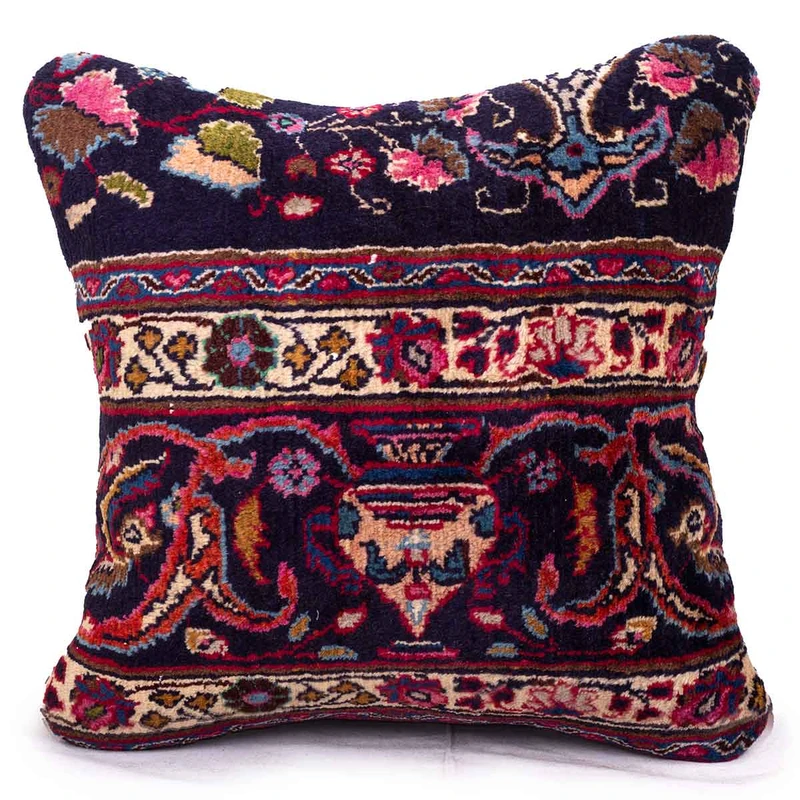
A rug pillow of about 1.75 by 1.75 feet made from a semi-antique Mashhad rug with an Afshan design in navy blue, crimson, and cream - Mashhad Persian Rug 1x1 ft - Afshan Semi Antique Wool Silk Hand Knotted
7
Mashhad Pillows
Mashhad rugs from Khorasan are known for deep crimson and navy, and for flowing floral designs. A Mashhad pillow often shows part of an Afshan field or a floral border, with flowers and vines curving across the face. These pillows suit traditional rooms with wood furniture and rich colors, and they pair beautifully with a Mashhad or Kashan floor rug. Read our Mashhad collection guide.
8
Shiraz and Ferdows Pillows
Shiraz pillows bring the bold, playful geometry of the tribes and villages of Fars: stepped medallions, stars, small animals, and stripes in madder red, burgundy, navy, and ivory. Ferdows pillows, from a village region of South Khorasan, carry strong geometric designs with a rustic character. Both suit casual living rooms, family rooms, and modern interiors, where a single bold pillow can be the focus of a sofa. Read our Shiraz and Ferdows collection guides.
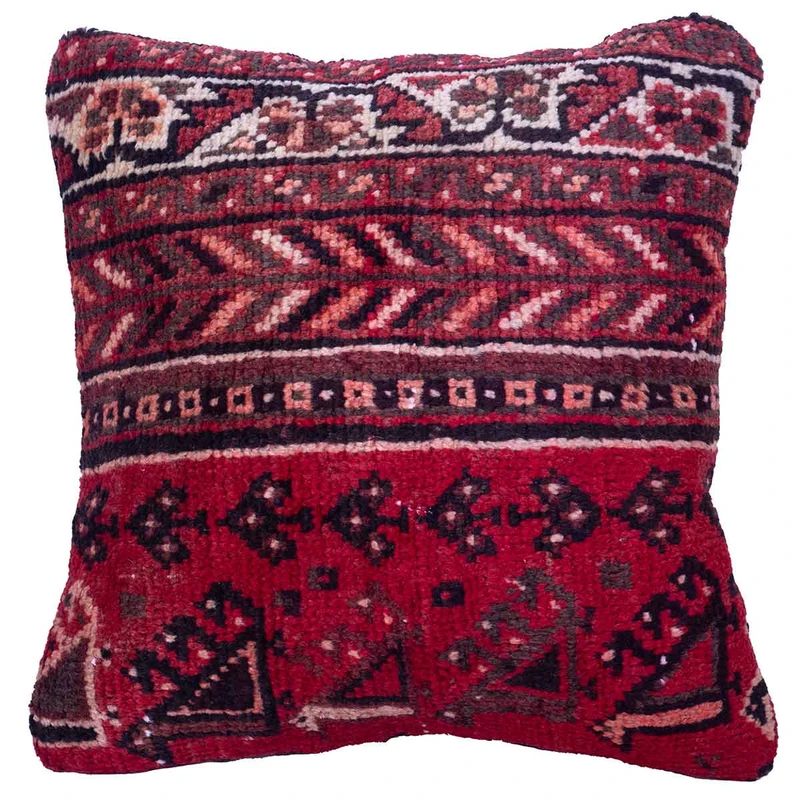
A rug pillow of about 1.75 by 1.75 feet made from a semi-antique Shiraz rug with a striped geometric design in madder red, burgundy, and black - Shiraz Persian Rug 1x1 ft - Geometric Semi Antique Wool Hand Knotted
9
Designs on a Pillow
Because a pillow face is small, it often shows only part of a rug's design, and that is part of its charm. A medallion pillow may show a full small medallion or a quarter of a large one. An Afshan or Herati pillow shows a field of flowers or fish-pattern motifs that runs off every edge. A border pillow shows a band of the rug's frame across its face. A striped pillow, from a rug with the moharramat design, shows parallel bands of color. Mixing pillows with different designs, but shared colors, looks rich and natural. See our Afshan, Herati, and Moharramat designs.
10
Styling Rug Pillows on a Sofa
On a plain sofa, two rug pillows at the ends, or a pair plus one in the center, create a balanced look. Combine them with plain linen or wool pillows in a color taken from the rug pillows, such as ivory, rust, or navy, so the Persian pieces stand out. On a patterned sofa, choose rug pillows with a simpler design or a strong single color. On a leather sofa, rug pillows add softness and warmth, and red and navy pillows look especially good against brown or cognac leather.
11
Styling Rug Pillows on a Bed
On a bed, a rug pillow works best as an accent in front of the sleeping pillows, not as a pillow to sleep on, because hand-knotted wool pile is firm and textured. One large pillow centered in front, or a pair at each side, adds color and pattern to plain bedding. A rug pillow can also echo the colors of a rug beside or under the bed, tying the bedroom together.
12
Matching Pillows with Your Rugs
A rug pillow does not need to match your floor rug, but it can echo it. A Mashhad pillow on a sofa above a Kashan or Mashhad rug repeats the crimson and navy palette; a Shiraz pillow above a Qashqai or Heriz rug repeats the bold geometry. Mixing city and tribal pieces is also lovely: a geometric tribal pillow on a sofa above a fine floral city rug creates a pleasing contrast. Choose by color first and design second.
13
Pillows for Floor Seating
For a low, Persian-style sitting area, place several large rug pillows against a wall or on a low platform, with a Persian rug on the floor in front. This recreates, in a modern way, the traditional Persian room where family and guests sat on carpets and leaned on cushions. It suits a reading corner, a playroom, a meditation space, or a relaxed family room.
14
Rug Pillows as Gifts
A rug pillow is one of the easiest Persian rugs to give: it needs no measuring, it fits any home, and it brings the warmth of hand-knotted wool to a sofa or a bed. It suits a housewarming, a wedding, a birthday, or a thank-you, and it is a good introduction to Persian weaving for someone who does not yet own a Persian rug. Read our article on bringing a Persian rug into your home.
15
How Rug Pillows Feel
A hand-knotted pile pillow feels different from a printed or woven fabric pillow. The wool pile is dense and springy, with a slightly textured surface, and it is cool in summer and warm in winter. Older rugs have a softer, more supple pile from years of use, and their colors have mellowed. A rug pillow is a decorative cushion rather than a soft sleeping pillow, best for leaning on, for display, and for adding texture.
16
Older Rugs, New Life
Because our rug pillows are made from semi-antique rugs, often 40 to 60 years old, each one carries the natural signs of age: colors softened by time, slight variations in the pile, and the hand-drawn irregularities of village and tribal weaving. These are part of the character of a rug pillow. A pillow made from an older rug is also a sustainable choice: it keeps the best parts of a well-loved rug in use for another generation.
17
Choosing Colors for Rug Pillows
Rug pillows are small, so they can carry stronger colors than a large rug. Madder red and crimson pillows bring warmth to a neutral sofa; navy pillows look calm and elegant against white, gray, or blue upholstery; pillows with gold, ochre, and rust suit earthy, natural rooms with wood and leather. Look at the two or three main colors of each pillow and match one of them to something already in the room, such as a rug, a painting, or a curtain. Read our article on the nine ranges of Persian colors for more on Persian palettes.
18
Mixing Two Sizes
Our two pillow sizes work well together. On a large sofa, place two larger pillows of about 1 foot 8 inches at the ends, and one or two smaller pillows of about 1 foot 4 inches in front of them or in the center. The difference in size gives depth to the arrangement. On a chair or a small loveseat, a single smaller pillow is often enough. On a bed, a pair of larger pillows behind and a smaller one in front makes a pleasing layered look.
19
Rug Pillows Through the Seasons
Rug pillows are easy to change with the seasons. In autumn and winter, deep reds, crimsons, and navies make a room feel warm and cozy, and they suit the darker evenings. In spring and summer, pillows with more ivory, gold, and lighter blues lighten a room. Because each pillow is small, keeping a few for each season is a simple way to refresh a room without changing the furniture or the floor rug.
20
Rug Pillows in Offices and Hospitality
A rug pillow brings the warmth of a hand-made object to a reception area, an office sofa, a hotel lobby, a restaurant banquette, or a guest room. In a professional space, a group of pillows from the same region or with the same color family looks calm and intentional. Because the face is hand-knotted wool, it holds up well to everyday leaning, though it should be kept away from food and drink where possible.
21
Pillows, Children, and Pets
A wool pile pillow is sturdy, and its dense pile resists everyday use better than many fabric pillows. On a family sofa, choose pillows with busy geometric designs and deep colors, which hide small marks. Keep pets from scratching or chewing the face, because pulled knots are hard to repair on a small piece. If a spill happens, blot it at once and let the pillow dry flat, face up, away from heat.
22
Collecting Rug Pillows
Some people collect rug pillows as they would small rugs: one from each region, or a group in a single color family, or a set showing different designs, such as a medallion, an Afshan, a boteh, and a striped pillow. A collection of rug pillows on a long sofa or a window seat becomes a small gallery of Persian weaving, and it is an affordable way to learn to recognize the styles of different weaving regions. Our collection guides, such as those for Ardabil and Shiraz, explain what makes each region distinctive.
23
Hand-Knotted Pile Versus Woven Fabric
Many pillows sold as "Persian style" are printed or machine-woven fabric with a Persian-looking pattern. A true rug pillow is different: its face is made of thousands of individual knots tied by hand, with wool pile standing up from a cotton foundation, exactly like a floor rug. Turn a rug pillow's face slightly in the light and you can see the depth of the pile; look closely at the edge of a motif and you can see the small steps of the knots. This is what gives a rug pillow its weight, its texture, and its long life.
24
Displaying a Rug Pillow
A rug pillow does not have to sit on a sofa. A single pillow can rest on a bench at the foot of a bed, on a chair by the door, or on a shelf in a bookcase, where its design can be seen at eye level. A pair of pillows on a window seat, lit by daylight from the side, shows the texture of the pile beautifully. Wherever you place a rug pillow, keep it out of long hours of direct sun.
25
Living with Wool
Wool is naturally resilient, slow to soil, and comfortable in every season. It is also naturally fire-resistant and does not attract dust the way some synthetic fabrics do. These qualities, which make wool the classic material for Persian floor rugs, make it an excellent material for cushions as well. With simple care, a wool rug pillow will last for many years.
26
A First Step into Persian Weaving
For many people, a rug pillow is the first piece of Persian weaving they own. It is a small, affordable way to live with hand-knotted wool every day, to learn the colors and designs of different regions, and to see whether a Persian rug suits their home before choosing a larger piece for the floor.
27
Questions to Ask Before You Buy
•
What size is it? - About 1'4" or 1'8" square; check the listing.
•
Is an insert included? - Check the listing details.
•
Which side is the rug face? - The photos show the hand-knotted face.
•
Does the design suit your other pillows? - Choose by color first.
•
Where will it be used? - Indoors, away from strong sun and rain.
Read our notes on what to know before you buy and our guide on how to buy a Persian rug.
28
Caring for a Rug Pillow
Vacuum the face of a rug pillow gently with an upholstery brush, or brush it lightly by hand, in the direction of the pile. Plump and turn the pillow regularly so it keeps its shape. Blot spills at once with a clean, white cloth and cold water; do not rub, and do not put the pillow in a washing machine or dryer. For a thorough clean, take it to a rug cleaner or an upholstery cleaner who works with wool. Keep rug pillows out of strong, direct sunlight, which fades wool over time, and away from damp outdoor areas. See our care instructions.
29
Frequently Asked Questions
What size are your Persian rug pillows?
About 1'4" x 1'4" (40 x 40 cm) or 1'8" x 1'8" (50 x 50 cm). Check each listing.
Are rug pillows made from real Persian rugs?
Yes. The face is hand-knotted wool pile, usually from sections of older semi-antique rugs.
What is a poshti?
The Persian back cushion of a traditional room, and the name of the 2x3 rug size once used for cushion faces.
Can I wash a rug pillow in the machine?
No. Vacuum or brush the face, blot spills, and have it cleaned by a rug or wool upholstery cleaner.
Can I sleep on a rug pillow?
It is best as a decorative or back cushion; the wool pile is firm and textured.
30
Choose Your Rug Pillow
Each pillow in our collection is one of a kind, made with a face of hand-knotted Persian rug, and inspected before it is listed. Browse our Persian rug pillows, see our small 1x2 rugs and square rugs, read our size guide, or ask our experts for help.