


Persian Rug Motifs: A Guide to Symbols, Shapes, and Meanings
Los Angeles Home of Rugs on Nov 17th 2026
Look closely at any Persian rug and you will find a whole vocabulary of shapes: palmettes and rosettes, teardrops and leaves, trees and birds, stars and hooks, vines that curl endlessly across the field. These individual shapes are called motifs, and they are the words from which every Persian rug design is built. Some are thousands of years old; some carry layers of symbolic meaning; others are simply beloved forms that weavers have repeated for generations because they are beautiful.
Our article on Persian rug design explains the major design families - medallion, all-over, lattice, garden, and more - and how a complete composition is planned. This article zooms in further. It is a guide to the most important individual motifs in Persian weaving: how to recognize them, where they come from, how they are used, and what they are traditionally said to mean. For a broader look at reading symbolism, see our article on how to read a Persian rug's secret language.
1
Three Ways of Drawing - Geometric, Curvilinear, and Stylized
Every motif is made from lines, and the way those lines are drawn determines a rug's whole character. Persian carpet scholars distinguish three broad styles:
•
Geometric - lines move in straight segments and meet at angles. Curves are suggested by steps. This is the natural language of the knotted grid and of rugs woven from memory, typical of tribal and village weaving.
•
Curvilinear - lines flow in smooth curves without visible angles. This requires fine knotting and a detailed cartoon, and it is the signature of city workshops such as Kashan, Isfahan, Tabriz, Qom, and Nain.
•
Stylized - a combination of both, where natural forms such as flowers and leaves are simplified into partly angular, partly rounded shapes. Many village rugs fall into this group.
The same motif can appear in all three styles. A boteh, for example, can be a delicate curving teardrop in a fine Kashan or a bold, stepped shape in a Qashqai rug. Recognizing the style helps you understand where and how a rug was made.
2
A Short History of Persian Motifs
Persian motifs have been gathering for thousands of years, and each era left new forms behind. The Pazyryk carpet, woven around the fifth century BCE, already shows rows of deer, horsemen, and star-like rosettes - motifs that echo Achaemenid art. Sasanian textiles introduced symbols such as the senmurv, a mythical winged creature, and paired animals facing a central tree, forms that echo in later rugs.
After the arrival of Islam, the arabesque and geometric interlace became central to Persian art, and calligraphy entered decoration. Under the Mongols and Timurids, Chinese motifs such as the cloud band (a ribbon-like cloud form), the dragon, the phoenix, and the lotus blossom were absorbed into Persian design, and the Herat school refined the floral vocabulary of palmettes and scrolling vines. The Safavids combined all of these into the great court carpets of the sixteenth and seventeenth centuries. In the Qajar era, European influence brought the naturalistic roses and bouquets of the gol farang. Each layer remains visible in Persian rugs today. Our articles on weaving from the beginning to 1499 and the Safavid golden age tell this story in more detail.
3
Medallions and Corners
The medallion (toranj) is the central motif of many Persian rugs and the anchor of the whole composition. Medallions take many forms: round, oval, lobed, star-shaped, diamond-shaped, or radiating like a sunburst. Some rugs have a single large medallion; others have two or three along the central axis, or a series of linked medallions in a long runner.
Most medallions have pendants - smaller shapes attached above and below, pointing toward the ends of the rug. Quarter sections of the medallion often reappear in the four corners of the field, called corner pieces (lachak). This medallion-and-corner layout, known in Persian as lachak-toranj, came into carpet design from the art of book covers and manuscript illumination in the fifteenth and sixteenth centuries.
In city rugs, medallions are filled with intricate floral detail; in tribal rugs, they become bold hooked diamonds or stacked polygons. In Heriz rugs, the medallion becomes a dramatic angular star that fills much of the field. Browse our medallion designs to see the range.
4
The Boteh - Persia's Most Famous Motif
The boteh is a teardrop or almond shape with a curled tip, known across the world as paisley after the Scottish town that produced shawls copying the design in the nineteenth century. It is one of the oldest and most widely used motifs in Persian art, appearing on textiles, shawls, tiles, and metalwork as well as rugs.
Its origin and meaning have been debated for centuries. It has been interpreted as a flame (a symbol connected with ancient Persian reverence for fire), a cypress tree bending in the wind, a seed or sprouting plant symbolizing life and fertility, a leaf, or even a stylized bird. Whatever its source, the boteh has become a symbol of Persian design itself.
Boteh rugs are woven in many regions. Fine, small boteh in rows appear in Senneh and Birjand rugs; larger, bolder boteh fill the fields of Qashqai, Afshar, and Baluch rugs, sometimes with small boteh nested inside larger ones. Browse our boteh designs.
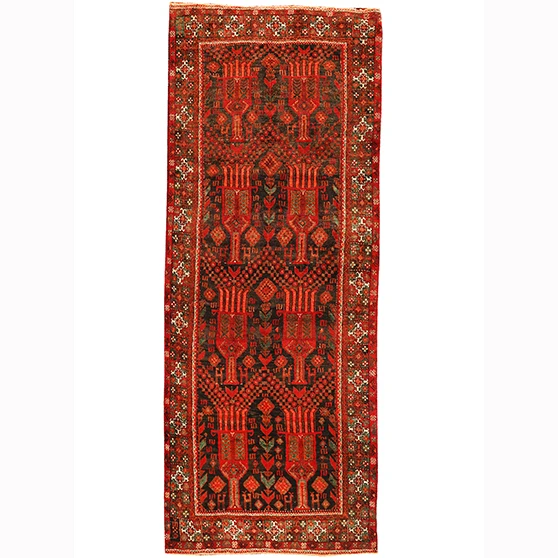
Rows of boteh motifs in a Baluch runner woven with wool and camel hair - Baluch Persian Rug 9x3 ft - Boteh Semi Antique Wool Camel Hair Hand Knotted
5
The Herati - Rosette, Diamond, and "Fish"
The Herati is perhaps the most widely woven repeat motif in Persian weaving. Each unit consists of a central rosette, framed by a diamond of thin vines, with four curving, lancet-shaped leaves placed around it. Western dealers nicknamed these leaves "fish," and in Persian the pattern is often called mahi (fish) or mahi-dar-ham (fish intertwined). Repeated across the field, Herati units form a dense, shimmering all-over pattern.
The motif is traditionally connected with the city of Herat in historic Khorasan, where designers of the Timurid period developed many of the floral forms of later Persian art. Today it appears in rugs from Farahan, Bijar, Tabriz, Khorasan, Hamadan, and many other regions, drawn finely in some and boldly in others. Browse our Herati designs.
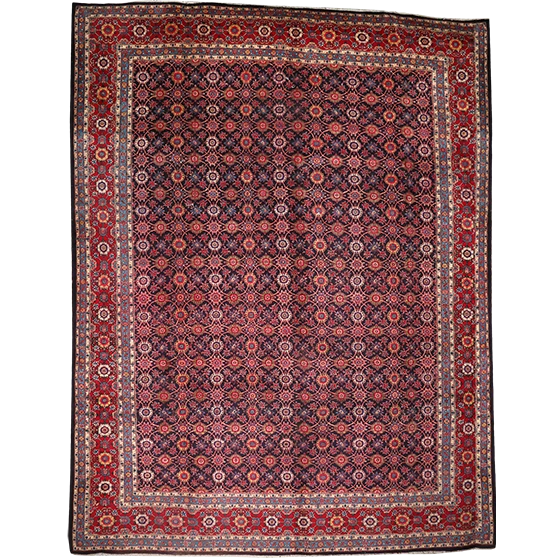
A Varamin rug with an all-over Herati design - Varamin Persian Rug 13x10 ft - Herati Semi Antique Wool Hand Knotted
6
The Shah Abbasi Palmette
The Shah Abbasi motif is a large, elaborate palmette - a stylized flower seen in cross-section, with layered petals radiating from a central core. It takes its name from Shah Abbas the Great, under whose reign in the late sixteenth and early seventeenth centuries Persian court art reached a peak. Shah Abbasi palmettes are usually combined with scrolling vines and smaller flowers in curvilinear designs, especially in Isfahan, Kashan, Nain, Tabriz, and Mashhad rugs.
These palmettes are some of the most recognizable elements of classical Persian design. In large rugs they may be used in the field around a central medallion, in the main border, or arranged in an all-over composition. Browse our Shah Abbasi designs.
7
Islimi and Khatai - The Arabesque and the Flower Scroll
Two essential motifs give curvilinear Persian designs their flowing movement:
•
Islimi (eslimi) - the arabesque: a spiraling, split-leaf vine whose tendrils curl endlessly across the field or medallion. Islimi forms often frame medallions or create a graceful lattice. Browse our Islimi designs.
•
Khatai - a scrolling floral vine with blossoms, buds, and leaves, often attributed to Chinese (Khatai, from "Cathay") influence that entered Persian art under the Mongols and Timurids. Khatai vines link palmettes and flowers throughout many classical designs.
Together, islimi and khatai create the sense of continuous growth and movement that makes classical Persian designs feel alive. They are especially prominent in the finest city rugs of Isfahan, Tabriz, Kashan, and Nain.
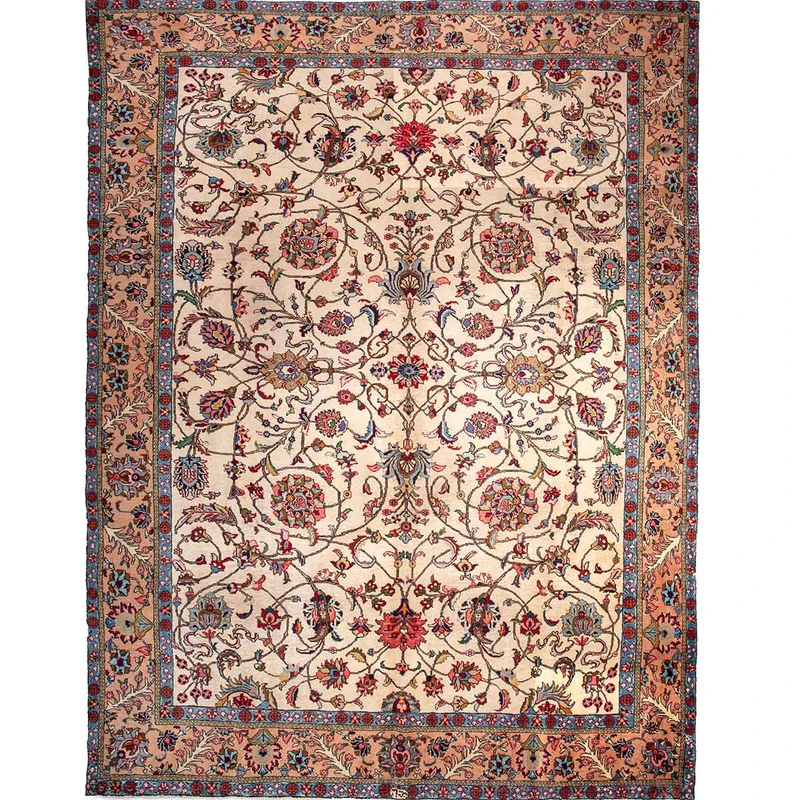
Flowing islimi arabesques in a Tabriz wool and silk rug - Tabriz Persian Rug 13x6 ft - Eslimi Semi Antique Wool Silk Hand Knotted
8
Flowers, Rosettes, and the Gol Farang
Flowers are everywhere in Persian rugs. Besides the great palmettes, weavers use countless smaller blossoms: four- and eight-petaled rosettes, lotus-like flowers, tulips, carnations, and stylized buds. Among the most distinctive floral motifs are:
•
Rosettes - small, round, symmetrical flowers used as filler motifs and as the centers of larger patterns. Browse our rosette designs.
•
Mina Khani - a lattice of daisy-like flowers linked by curving vines, said to be named after a person called Mina Khan, though the origin is uncertain. It is popular in Kurdish, Varamin, and Bijar rugs. Browse our Mina Khani designs.
•
Gol farang - "foreign flower," the naturalistic roses and bouquets that entered Persian design in the nineteenth century under European influence, especially in Senneh, Bijar, and Kerman rugs. Browse our gol farang designs.
•
Gol-e hanai - a small henna-flower motif used in repeating patterns.
9
Trees, Cypresses, and Vases
Trees are among the oldest and most meaningful motifs in Persian art:
•
The tree of life - a single tree rising through the field, often with branches, flowers, and birds, symbolizing the link between earth and heaven and the continuity of life. See our article on the many faces of the tree of life and our tree designs.
•
The cypress (sarv) - an evergreen tree symbolizing eternal life, freedom, and dignity, and one of the oldest symbols in Persian culture. Browse our cypress tree designs.
•
The weeping willow - suggesting water, shade, and sometimes mourning, often found in garden and panel rugs.
•
The vase (goldani) - flowering plants rising from vases, a symbol of abundance associated with Safavid Kerman. Browse our vase designs.
10
Birds and Animals
Living creatures appear in many Persian rugs, especially in hunting, garden, and tribal designs:
•
Birds - peacocks (beauty and immortality), doves (peace), and songbirds and nightingales (love and the poetry of the garden).
•
Lions - strength, courage, and royalty, from the majestic lions of court hunting carpets to the charming lions of Qashqai and Bakhtiari village rugs.
•
Deer, gazelles, and goats - grace and the life of the open landscape.
•
Dragons and phoenixes - mythical creatures borrowed from Chinese art, appearing in some classical carpets.
•
Camels, horses, and dogs - everyday animals of nomadic life, drawn simply in tribal rugs.
Hunting carpets combine riders and animals in lively scenes, while pictorial rugs portray stories from Persian poetry and history. See our hunting designs and our article on pictorial rugs.
11
Tribal and Geometric Motifs
Tribal and village weavers developed a rich vocabulary of geometric motifs, often woven from memory and passed from mother to daughter:
•
Guls - octagonal or lozenge-shaped medallions repeated across the field, the signature of Turkmen weaving, where each tribe had its own gul. Browse our Turkmen gul designs.
•
Hooked diamonds and stepped polygons - bold medallions with hooked edges, common in Qashqai, Afshar, Kurdish, and Caucasian-influenced rugs.
•
Stars - eight-pointed stars and star-shaped flowers, used as filler motifs and medallions.
•
The running dog and the "S" motif - small repeated border motifs.
•
Combs, hands, and amulets - protective symbols sometimes woven into tribal rugs to ward off the evil eye.
•
Small animals and people - goats, birds, and human figures scattered across the field, often reflecting the weaver's daily life.
These motifs give tribal rugs their bold, personal character. Browse our geometric and tribal and nomadic designs.
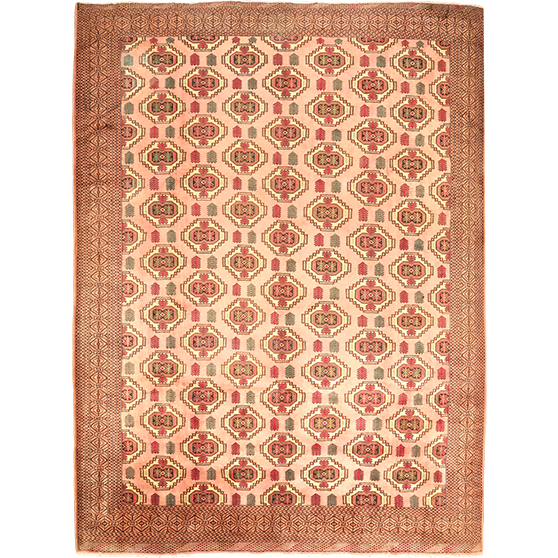
Repeated gul medallions in a Turkmen rug - Turkmen Persian Rug 12x9 ft - Geometric Semi Antique Wool Silk Hand Knotted
12
Borders and Their Motifs
Borders have their own special motifs. The main border often features alternating palmettes and rosettes linked by scrolling vines, or a repeating series of cartouches. Narrow guard borders carry simpler patterns: reciprocal trefoils, small rosettes, running vines, or "barber pole" stripes. A distinctive border motif is the Kufic border, whose angular shapes recall early Arabic calligraphy and appear in some antique and tribal rugs. Some rugs include inscription cartouches with verses of poetry, dates, or the name of the workshop or weaver, which are valuable clues for dating and attribution.
13
Calligraphy and Inscriptions
Writing appears in Persian rugs more often than many people realize. Verses of poetry by Saadi, Hafez, or other poets may run around the border of a fine rug; prayer rugs sometimes include religious inscriptions; and many workshop rugs carry a signature in a small cartouche, especially from Kashan, Tabriz, Isfahan, Qom, and Kerman. Dates are usually written in the Persian (solar or lunar) calendar. For collectors, a genuine inscription or signature can add considerable interest and value.
14
Motifs and Color
A motif never appears alone; it lives through its colors. Weavers use color to make motifs stand out or blend in, to create rhythm, and to guide the eye. In a classic Herati field, for example, the rosettes and leaves may be drawn in ivory, blue, and green on a deep red ground, so that the pattern shimmers as you move around the rug. In tribal rugs, the same motif may be woven in a different color each time it repeats, creating a lively, unpredictable effect that collectors love.
Outlines are especially important. Thin dark outlines, often in brown or navy, give motifs crisp definition, while lighter outlines make them glow softly against a dark ground. In older rugs, these dark outlines may have worn slightly lower than the rest of the pile because of iron mordants, giving the motifs a subtle relief. Our series on Persian rug color, beginning with the master dyer, explains how these colors were made.
15
How Motifs Help Identify a Rug
Motifs are among the most useful clues for identifying a rug's origin. Some combinations are typical of particular regions:
•
Fine small boteh or Herati with a thin, grainy back - often Senneh.
•
Dense Herati or Mina Khani in a very heavy rug - often Bijar.
•
Large angular medallion with bold corners - often Heriz.
•
Shah Abbasi palmettes and islimi on a fine ivory or blue ground - often Isfahan or Nain.
•
Repeated octagonal guls on red - Turkmen.
•
Large stepped boteh and animals on a red ground - often Qashqai or Afshar.
No single motif proves an origin, because designs travel between regions, but together with structure, colors, and materials, motifs allow specialists to attribute rugs with considerable accuracy. Our article on how a Persian rug is made explains the structural clues.
16
Choosing a Rug by Its Motifs
Motifs are not only for scholars; they are a practical guide to choosing a rug that suits your home and taste:
•
For a calm, elegant room - consider fine all-over patterns such as small Herati or Mina Khani, or curvilinear islimi and Shah Abbasi designs in soft colors.
•
For a focal point - a strong medallion draws the eye to the center of a room, ideal under a coffee table or dining table.
•
For warmth and character - tribal motifs such as guls, hooked diamonds, animals, and bold boteh bring personality to relaxed or modern interiors.
•
For a sense of nature - tree of life, cypress, garden, and vase motifs bring the feeling of a garden indoors.
•
For busy family areas - dense, repeating motifs hide everyday wear and marks better than large plain areas.
The size of the motifs matters too. Large-scale motifs read well from across a big room, while small, intricate motifs reward close viewing in bedrooms, studies, and hallways. Our article on decorating with Persian rugs offers more ideas.
17
Do Motifs Really Have Meanings?
It is tempting to read a precise message into every motif, and many books and dealers offer long lists of meanings. The truth is more nuanced. Some symbols, such as the cypress, the tree of life, the garden, and the protective amulet, have well-established cultural meanings. Others have been given interpretations over time, sometimes by Western writers, that weavers themselves may not share. Many weavers describe motifs simply by everyday names - "the fish," "the comb," "the crab," "the chicken" - and choose them because they are traditional, beautiful, or part of the family repertoire.
The best approach is to enjoy the meanings as part of the rich cultural background of Persian rugs, while remembering that the most important message of a rug is the skill, care, and creativity of the person who wove it.
18
Frequently Asked Questions
What is the most common motif in Persian rugs?
The Herati and the boteh are among the most common repeat motifs, while the medallion is the most common central motif.
What does paisley mean in Persian rugs?
The paisley, or boteh, has been interpreted as a flame, a cypress, a seed, or a leaf. It is generally seen as a symbol of life and growth.
Are tribal motifs older than city motifs?
Many geometric tribal motifs are very old and may preserve ancient forms, while the curvilinear city motifs developed mainly from the fifteenth and sixteenth centuries onward.
Can I find a rug with a specific motif?
Yes. You can browse our collection by design, including boteh, Herati, Shah Abbasi, tree of life, and many more.
19
A Language Woven in Wool
Persian rug motifs form a language that has developed over thousands of years, absorbing influences from ancient Persia, the Islamic world, Central Asia, China, and Europe, yet remaining unmistakably Persian. Learning to recognize these motifs turns every rug into something you can read: a record of place, tradition, and the imagination of its weaver.
At Los Angeles Home of Rugs, you can browse our entire collection by design. Every rug comes with a Certificate of Authenticity documenting its origin, materials, and age. If you would like help identifying the motifs in a rug, please ask our experts.