


Arak (Sultanabad) Rugs: History, Ziegler, Sarouk, and Farahan
Los Angeles Home of Rugs on Nov 17th 2026
Arak, known in the 19th century as Sultanabad, is one of the most important rug-producing regions in Persia. The city and the surrounding villages of Markazi Province have woven rugs for centuries, but it was in the Qajar era that the region became one of the great carpet centers of the world, sending thousands of rugs to Europe and America. Names such as Sarouk, Farahan, Mahal, and Sultanabad, all tied to this region, are still among the most respected in the rug trade.
This article gives an overview of the Arak weaving region as a whole: its history, its role in the export trade, its weaving characteristics, and the main rug types it produces. For in-depth guides to individual types, see our articles on Sultanabad rugs, Farahan rugs, and Sarouk weaving.
1
The Land and Villages of the Arak Region
Arak lies in Markazi Province - literally "the central province" - on a high, fertile plain roughly midway between Tehran and Isfahan. The surrounding countryside is dotted with villages, many of which became weaving centers in their own right, and the names of several of them are now famous around the world as rug types. Farahan lies on the plain to the north and east of the city, Sarouk to the north, and Mushkabad close to Arak itself, while Mahallat lies to the east. Further west, toward Hamadan Province, are the weaving districts of Malayer and Lilihan.
This geography matters for collectors. The villages shared wool sources, dye traditions, and trade networks, so rugs from the region have a family resemblance. Yet each village developed its own preferences in design, knotting, and color, which is why experts can often distinguish a Farahan from a Sarouk or a Mahal at a glance. Lilihan, for example, was home to an Armenian community whose rugs show their own distinctive floral style, while Malayer rugs, close to the border with the Hamadan region, combine Arak-style designs with Hamadan-style construction.
Wool, Water, and Weaving
The plains and surrounding hills of the region supported large flocks of sheep, providing a steady supply of good wool. Local streams and qanats provided water for dyeing and washing, and madder was available from the central Persian growing regions. These resources, together with a large rural population skilled in weaving, made the region an ideal base for the commercial expansion that followed.
2
A City Founded in the Qajar Era
The city of Sultanabad was founded in 1815-1816 under the Qajar king Fath-Ali Shah, built by his general Yusuf Khan Gorji as a fortified town in the fertile plains of the region historically known as Eraq-e Ajam. It was later renamed Arak.
Weaving in the area is much older than the city itself. Rugs were already woven in the surrounding districts, especially Farahan and Sarabanad, long before Sultanabad was built. Local tradition also connects the region's weaving to communities of Armenian weavers settled in central Persia during the reign of Shah Abbas the Great in the 17th century. What changed in the 19th century was the scale and the market.
3
The Rise of the Export Trade
In the second half of the 19th century, demand for Persian rugs in Europe and the United States grew rapidly. Merchants first bought up old rugs across Persia, but by around 1880 the supply of fine antique pieces was running low. Many merchants from Tabriz in Azerbaijan began investing heavily in new production in Sultanabad, where weaving skill, good wool, and abundant labor were available.
Foreign companies followed. The most famous was Ziegler and Company, a Manchester-based firm with Swiss origins, which opened an office in Tabriz in 1878 and in Sultanabad in 1883. Ziegler set up looms, supplied materials, ran its own dye house, and commissioned designs suited to European and American interiors. By around 1900 Ziegler is reported to have had about 2,500 looms working in Sultanabad and the surrounding villages. Other firms, such as the Oriental Carpet Manufacturers, also established large operations in the region.
How the Merchant System Worked
The export boom transformed how rugs were made in the region. Instead of weaving rugs for their own use and selling them when needed, many village families began to weave on commission. A merchant or company agent would supply the wool, sometimes already dyed, together with a design or a sample, and agree a price for the finished rug. The weaver, usually a woman working at home with her daughters, would then weave the rug over several months and deliver it to the agent's office in Sultanabad, where it was inspected, washed, and prepared for export.
This system brought steady income to thousands of rural families, and it allowed companies to control size, design, and color to suit Western buyers. It also shaped the character of Arak rugs: large sizes, designs adapted to Western rooms, and palettes chosen to match European and American taste. Persian historical studies note that the trade had a significant effect on the economic and social life of the region's women, whose weaving became a central source of family income.
Arak remained one of the most important centers of rug export to Europe until around 1940. Persian historical research from Arak University continues to study how this trade transformed the local economy and the lives of the women who wove the rugs.
The rugs made for Ziegler, with their large-scale open designs and softer palettes, became so popular that "Ziegler" is still used today as a style name for decorative rugs in this spirit. Original antique Ziegler Sultanabad carpets are now among the most sought-after decorative carpets on the market.
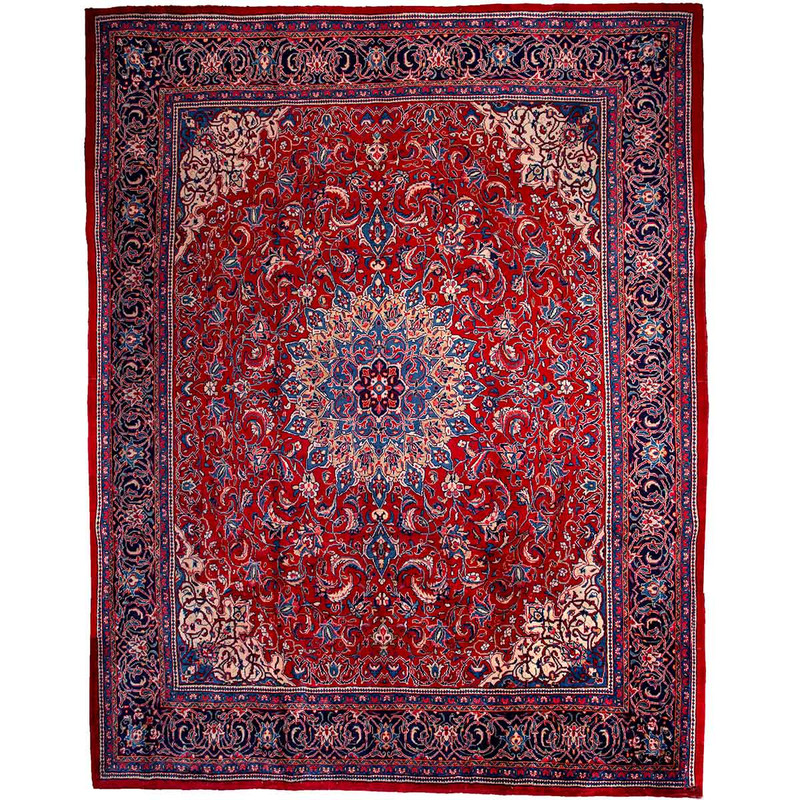
A Mahal medallion rug in madder red, navy blue, and ivory - Mahal Persian Rug 13x10 ft - Medallion Semi Antique Wool Silk Hand Knotted
4
The Ziegler Style in Detail
Ziegler's designers in Sultanabad faced a clear challenge: to create Persian carpets that would look right in the large, light-filled rooms of European country houses and American homes. Their solution was to enlarge and simplify traditional Persian motifs, drawing palmettes, vines, and leaves on a bold, open scale, and to soften the palette with ivory, sand, light blue, and terracotta alongside the traditional reds and indigos.
The result was a new kind of carpet - unmistakably Persian in its vocabulary, yet decorative and relaxed in a way that suited Western interiors. Original Ziegler carpets from the late nineteenth and early twentieth centuries are now prized by interior designers around the world, and the "Ziegler style" has been widely reinterpreted by weavers in Persia and elsewhere. When you see a large, open floral design in soft colors described as "Ziegler," it is a direct descendant of the carpets designed in Sultanabad more than a century ago.
5
The American Sarouk
Another chapter in the region's history was written for the American market. Between roughly the 1910s and the 1930s, enormous numbers of Sarouk rugs were exported to the United States. American buyers favored a particular look: a deep, rich red or raspberry field with detached sprays of flowers scattered across it, and dark blue borders.
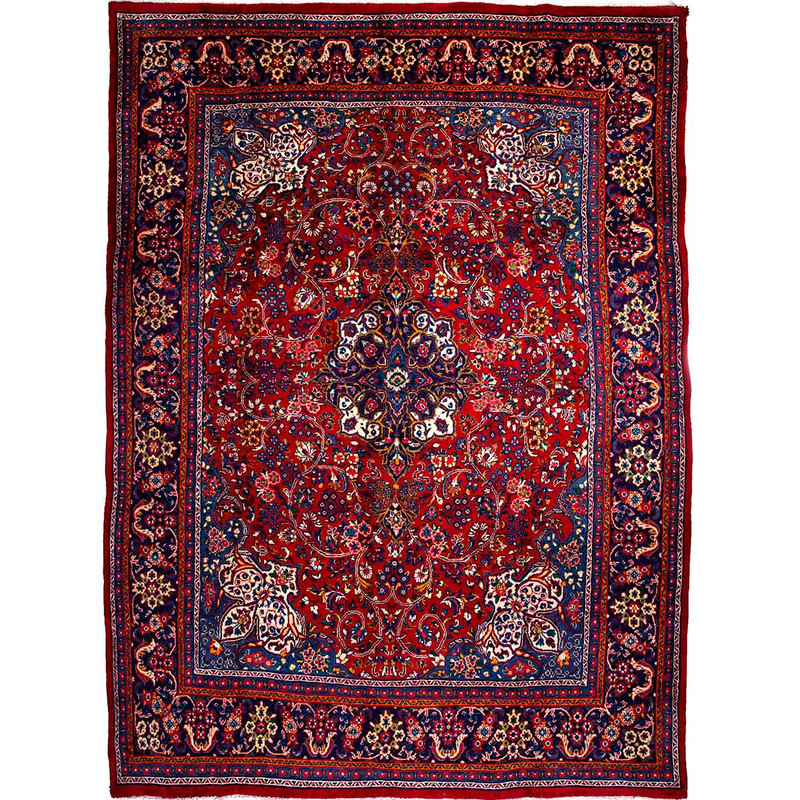
A Sarouk medallion rug in madder red, navy blue, and cream - Sarouk Persian Rug 13x9 ft - Medallion Semi Antique Wool Hand Knotted
To achieve the intensely saturated color that buyers wanted, many of these rugs were chemically washed after arriving in America to remove unwanted tones, and then the field was painted by hand to deepen the red. This practice was common at the time, and many so-called "painted Sarouks" survive today. They are durable rugs with excellent wool and construction, and they remain popular, but specialists distinguish them from unpainted examples. When examining an older American Sarouk, look closely at the base of the pile and the back of the rug, where any difference between painted and original color is easiest to see. Our article on washing a Persian rug after weaving discusses special washes and their effects.
6
Weaving Characteristics of the Arak Region
•
Knot - most rugs of the region are woven with the Persian (Senneh) asymmetrical knot. Some Farahan rugs, however, use the symmetrical knot.
•
Wool - Arak rugs are known for good quality, soft, lustrous wool.
•
Dyes - traditionally the region relied heavily on natural plant dyes, with madder reds and indigo blues at the heart of the palette.
•
Designs - city and workshop weavers generally worked from cartoons. Classic compositions include floral sprays of branches and leaves, all-over palmettes, medallions, and Herati patterns. A characteristic older palette pairs a rose or red field with blue borders.
•
Honest construction - false knots such as jufti are relatively rare in traditional Arak weaving, which helps explain the region's reputation for durable rugs.
7
The Main Rug Types of the Arak Region
•
Sarouk - from the village of Sarouk, about 30 miles north of Arak. Sarouks are finely woven, curvilinear, and durable. In the early 20th century the "American Sarouk," with a deep raspberry-red field and scattered floral sprays, was produced especially for the United States.
•
Farahan - from the plains north of Arak, famous for its fine all-over Herati patterns and a distinctive palette of indigo and celadon green.
•
Mahal - village rugs with bolder, larger-scale designs, often woven for the export market.
•
Mushkabad - a coarser village weave, sturdy and practical, often in large sizes.
•
Arak and Sultanabad - the decorative room-size carpets that made the region's name in the West, including the Ziegler style.
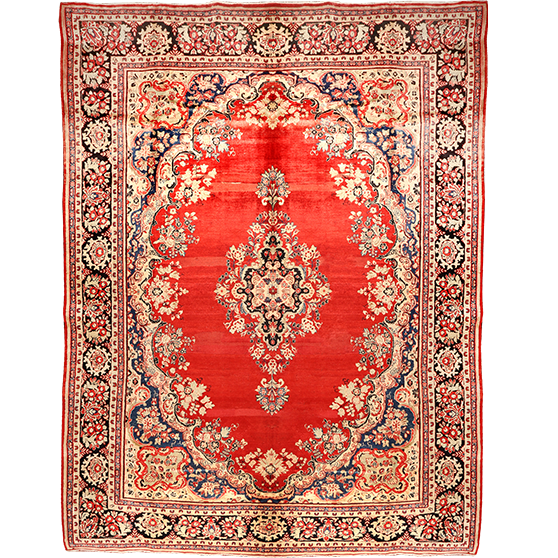
An antique Farahan with a Shah Abbasi medallion - Farahan Persian Rug 13x10 ft - Medallion Antique Wool Hand Knotted
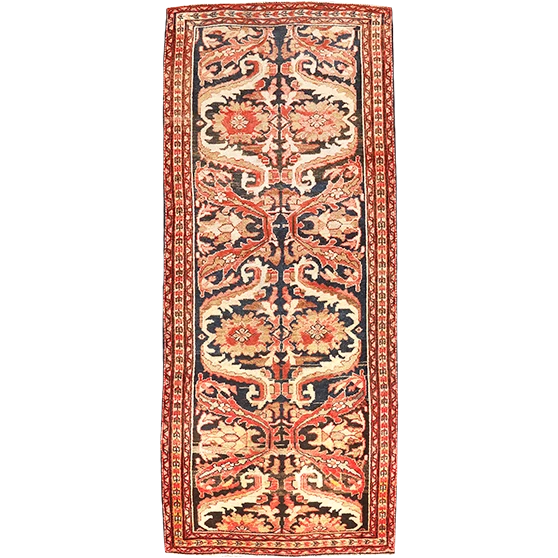
An antique Mushkabad runner with Islimi patterns - Meshkabad Persian Rug 9x3 ft - Eslimi Antique Wool Hand Knotted
8
How to Recognize a Rug from the Arak Region
Rugs from the Arak region share several traits that help distinguish them from other Persian rugs:
•
Foundation - most have cotton warps and wefts, giving a flat, stable rug. Older Sarouks and Farahans often show blue-dyed cotton wefts on the back.
•
Knotting - the asymmetrical Persian knot is typical, packed firmly so that the back of the rug shows a clear, even grid.
•
Design scale - the region produced both very fine, detailed designs (Sarouk, Farahan) and large-scale, open decorative designs (Sultanabad, Mahal, Ziegler style).
•
Palette - classic examples favor madder reds, rose, deep indigo, ivory, and soft greens; Ziegler-style rugs use lighter, more muted tones.
•
Size range - the region is known for producing more large carpets than almost any other part of Persia, alongside smaller scatter rugs.
9
Clues to the Age of an Arak Rug
Dating a rug precisely requires expertise, but several clues help place a rug from the Arak region in its period:
•
Dyes - older rugs typically show natural madder reds and indigo blues that have mellowed evenly. Bright, flat colors or colors that have faded unevenly can point to later synthetic dyes.
•
Wefts - blue-dyed cotton wefts on the back are often associated with older Sarouk and Farahan rugs.
•
Wool and wear - in older rugs the wool has a soft, glossy patina, and wear is gradual and even across the most used areas.
•
Design style - large-scale, open Ziegler designs point to the late nineteenth and early twentieth centuries; detached floral sprays on deep red grounds suggest the American Sarouk period; dense, classical medallions belong to many periods.
•
Size and proportion - some sizes and shapes were made for particular markets at particular times, which can also help with dating.
For an accurate assessment, always consult a specialist. At Los Angeles Home of Rugs, every rug's age range is stated on its Certificate of Authenticity.
10
Collecting Rugs from the Arak Region
Rugs from the Arak region offer something for nearly every collector and homeowner, from durable everyday rugs to museum-quality antiques. When evaluating one, consider:
•
Age - antique Farahan, Sarouk, and Ziegler Sultanabad carpets from before about 1930 are the most sought after. Semi-antique pieces from the middle of the twentieth century offer excellent quality at more accessible prices.
•
Condition - look for even pile, sound foundation, and intact ends and sides. Moderate, even wear is acceptable in older rugs; holes, rot, or extensive repairs reduce value.
•
Color - natural dyes in good, harmonious condition add significantly to value. In American Sarouks, note whether the field has been painted.
•
Design and drawing - fine, confident drawing and well-resolved borders indicate a skilled workshop.
•
Size - large room-size carpets from the region, especially in the Ziegler style, are in strong demand.
Our article on investing in hand-knotted rugs explores how these factors affect long-term value.
11
Decorating with Arak Region Rugs
The variety of the region's weaving makes its rugs remarkably versatile. Fine Sarouks with their deep reds and navy borders suit traditional living and dining rooms, libraries, and studies. Farahan rugs with their all-over Herati patterns work beautifully in rooms where furniture will partly cover the rug. Ziegler-style Sultanabad carpets, with their open designs and softer palettes, are favorites of interior designers for large, light spaces and transitional or modern homes. Sturdy Mushkabad and Mahal carpets are ideal for busy family rooms where durability matters. Our rug size guide will help you choose the right dimensions.
12
Frequently Asked Questions
Is Sultanabad the same as Arak?
Yes. Sultanabad was the city's name in the nineteenth century; it was renamed Arak in the twentieth century. "Sultanabad" is still used for antique carpets from the region, especially in the Ziegler style.
What is the difference between Sarouk and Farahan rugs?
Both come from the Arak region. Farahan rugs are best known for fine all-over Herati designs and a soft palette, while Sarouks are known for dense, curvilinear designs and, in the American Sarouk style, deep red fields with floral sprays.
Are Mahal rugs good quality?
Mahal rugs are sturdy village rugs with bold, decorative designs. They are practical, attractive, and often very good value, especially in large sizes.
Why are so many Arak rugs large?
The export trade of the late nineteenth and early twentieth centuries was aimed at Western homes with large rooms, so the region specialized in room-size and oversized carpets.
13
A Short Timeline of Arak Weaving
•
Before 1800 - village weaving in Farahan, Sarouk, and the surrounding districts, mainly for local use and regional trade.
•
1815-1816 - the city of Sultanabad is founded under Fath-Ali Shah.
•
Around 1870-1880 - Western demand for Persian rugs soars; Tabriz merchants begin organizing production in the region.
•
1883 - Ziegler and Company opens its office in Sultanabad, setting up looms, a dye house, and new decorative designs.
•
Around 1900 - thousands of looms in the region are working for export; Sultanabad becomes one of the largest rug-producing areas in Persia.
•
1910s-1930s - the era of the American Sarouk, with large exports to the United States.
•
Mid-twentieth century - Sultanabad is renamed Arak; the export trade shifts, but village weaving continues.
•
Today - weaving continues in workshops and villages, supported by research and training at local universities.
14
Arak Rugs and Their Neighbors
Arak rugs are sometimes confused with the rugs of neighboring Hamadan, which also produced vast numbers of rugs for export. The difference lies mostly in structure and refinement. Hamadan village rugs are usually woven with the symmetrical knot on a single weft, giving a somewhat looser, more flexible rug with bold geometric designs, while the classic rugs of the Arak region favor the asymmetrical knot, double wefts, and more curvilinear drawing. Rugs from Malayer, which sits between the two regions, often combine features of both. Exploring our Hamadan, Malayer, and Arak collections side by side is a good way to see these differences.
15
Caring for Rugs from the Arak Region
Most Arak region rugs are sturdy and easy to live with, but a few points deserve attention. Their cotton foundations hold their shape well, but fringes and side cords can wear in busy rooms, so they should be checked and repaired early. Older rugs with natural dyes should be protected from strong direct sunlight and rotated regularly. Painted American Sarouks should only be cleaned by professionals experienced with them, because the surface color can react to water and cleaning agents differently from the original dyes. Our care instructions and our guide to professional rug washing give more detail.
16
Arak Weaving Today
Weaving remains an important craft in the Arak region today. Universities in the province, including a dedicated carpet department at Arak University, research the region's historical designs and help train new generations of designers and weavers. Contemporary workshops produce both traditional Sarouk and Farahan designs and modern interpretations of the decorative Sultanabad style. At the same time, antique rugs from the region continue to appear at major auctions, where well-preserved Ziegler and Farahan pieces command strong prices.
17
The Legacy of Arak Weaving
Most rugs woven in the Arak region are of medium to good quality, practical and long-lasting, while the finest antique Sarouk and Farahan rugs are highly prized by collectors. Above all, the region shows how Persian weaving could adapt to world markets while keeping its own identity. The decorative designs created in Sultanabad for Western homes became classics in their own right, and they continue to influence rug design around the world today.
For anyone who loves Persian rugs, the Arak region offers a fascinating lesson in how tradition and commerce can work together. Village weavers kept their skills, designs, and natural materials, while merchants and designers helped them reach new markets around the world. The result is one of the richest and most varied weaving traditions in Persia, still very much alive today.
At Los Angeles Home of Rugs, you can explore authentic rugs from the Arak region, including Sarouk, Farahan, Mahal, and Arak pieces, each with a Certificate of Authenticity documenting its origin and age.
Explore Rugs from the Arak Region
Arak Rugs
Sarouk Rugs
Farahan Rugs
Mahal Rugs
Mushkabad Rugs
Malayer Rugs
Antique Rugs
Persian Rug FAQ