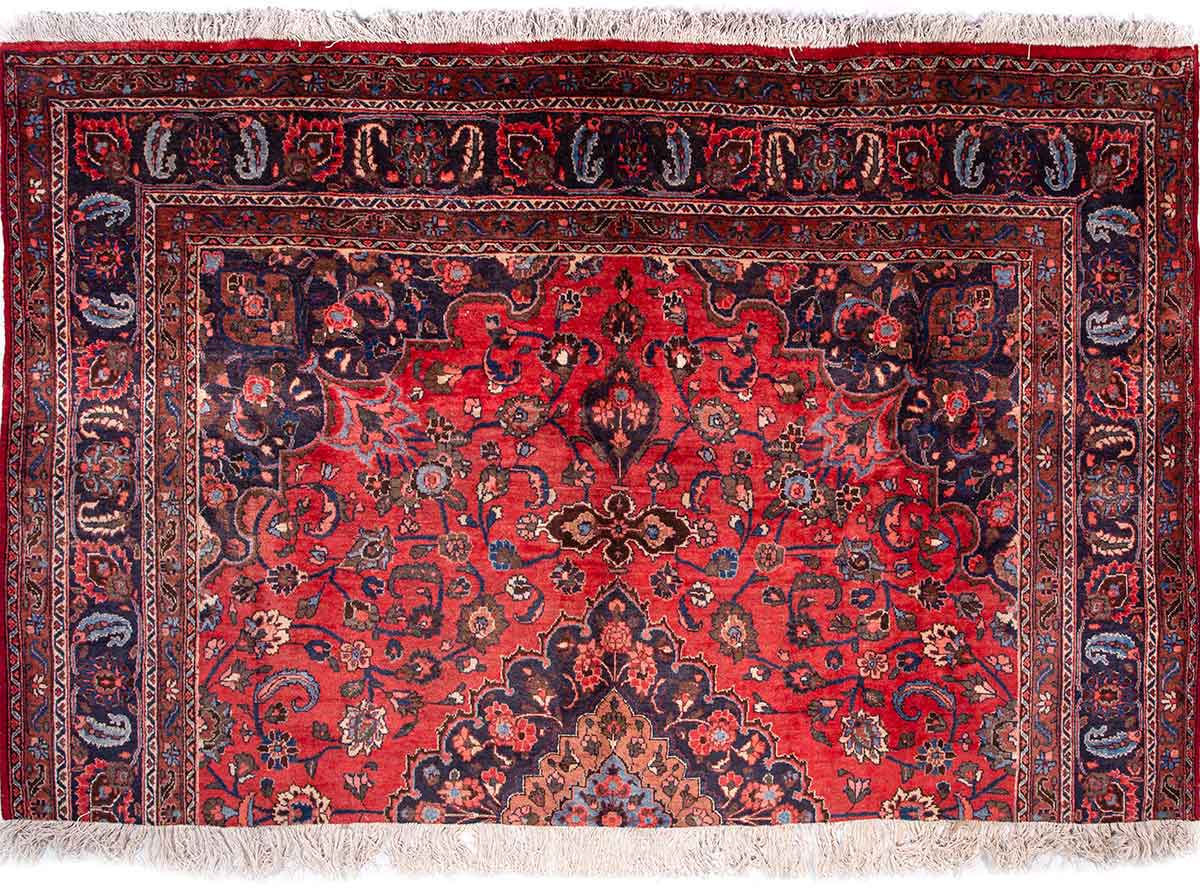
Understanding Unfinished Hand-Knotted Rugs: The Tale of the 'Qahri' Carpets
Los Angeles Home of Rugs on Jun 11th 2024
In the world of traditional Persian carpet weaving, the term Qahri carpet might not ring a bell for many - even among serious enthusiasts and experienced collectors. Yet these remarkable objects occupy a uniquely poignant place in the story of Persian textile art. A Qahri carpet is an unfinished hand-knotted rug that, due to unforeseen circumstances, could not reach completion. Part craft object, part human document, part meditation on the nature of creative work and its interruption by life itself, Qahri carpets embody a dimension of the Persian weaving tradition that is rarely discussed but deeply revealing - about the nature of the craft, the humanity of the craftsperson, and the complex relationship between artistic ambition and the unpredictable flow of human experience.
This article explores the complete story of Qahri carpets: what they are, why they exist, the challenges of completing or preserving them, their artistic and historical significance, and what they reveal about the deeper human meanings embedded in the Persian rug weaving tradition.
1 What Is a Qahri Carpet?
Imagine coming across a hand-knotted rug that is only half-finished - still on its loom, or removed from it with the warp threads hanging loose at the unfinished edge, the design abruptly cut off midway through a composition that was clearly intended to be something extraordinary. This sight - at once puzzling and strangely moving - is the encounter with a Qahri carpet.
The word "Qahri" carries a specific emotional weight in Persian. It derives from the root meaning of abandonment, estrangement, or unfulfilled destiny - the sense of something that was meant to be completed but was not, something that was interrupted before it could reach its natural conclusion. This name, with all its layers of meaning, aptly captures the essence of these objects: they are rugs that carry within them not only the artistry of what was made, but the shadow of what was never finished.
Hand-knotted Persian rugs are among the most time-intensive objects ever produced by human hands. A medium-sized rug of moderate quality can require six months to a year of sustained work by an experienced weaver. A large, finely knotted piece - a room-size Kashan medallion rug or a pictorial Tabriz carpet of high raj quality - can require two, three, or even more years of daily work at the loom. During this extended period, anything can happen in a human life. And when it does, the rug - still on the loom, still incomplete - becomes a Qahri carpet: a frozen moment in a creative journey that circumstances did not allow to reach its destination.
For a sense of the time involved: a 6-meter rug with a knot density of 50 raj - a respectable but not exceptional quality level for Tabriz city production - can take well over a year to complete for a single experienced weaver working full-time. At 70 raj or above, with a more complex design, the same size rug might require two to three years. This is the temporal investment that every authentic hand-knotted Persian rug represents - and it is the temporal investment that a Qahri carpet carries, incomplete, within its unfinished form.
2 Why Rugs Are Left Unfinished - The Human Stories Behind Qahri Carpets
Every Qahri carpet has a story. Sometimes that story is known and documented. More often it has been lost with the passage of time, leaving only the object itself as evidence that something interrupted the creative process before it reached completion. The circumstances that produce Qahri carpets are as varied as human life itself - but certain patterns recur across the tradition.
• Death of the weaver - the most poignant and most common cause of Qahri carpets is the death of the weaver before the work could be completed. In a tradition where the finest rugs require years of sustained work by a single master weaver, the statistical probability of death or serious illness occurring before completion is significant - particularly in eras before modern medicine. A rug left incomplete by a weaver who died at her loom carries a specific kind of melancholy that is immediately felt by anyone who holds it or examines its unfinished edge.
• Serious illness or incapacity - a weaver who develops a condition affecting her vision, her hands, or her general physical capacity may be unable to continue work even without dying. The extreme precision required for fine hand-knotted work - particularly at high raj quality levels where individual knots are tiny and the design differences between adjacent colors are subtle - makes it impossible to continue after certain types of physical deterioration.
• Financial difficulties - the production of a fine hand-knotted Persian rug is a significant financial undertaking, requiring sustained investment in materials - Kork wool, silk, natural dyes - over a period of months or years before any return is possible. Financial crises affecting either the weaver or the patron or dealer financing the work can bring production to an abrupt halt, leaving the rug incomplete on the loom.
• Disputes between weaver and patron - traditional Persian rug production was typically organized as a commission relationship between a weaver (or weaving family) and a merchant or dealer who provided the materials and financing in exchange for the completed rug at an agreed price. Disputes over the terms of this relationship - disagreements about quality, timeline, compensation, or design - could cause the weaver to abandon the work before completion, leaving the patron with an incomplete rug and no practical recourse.
• Loss of interest or creative dissatisfaction - occasionally, a weaver abandons a piece not because of external circumstances but because of an internal creative crisis - a loss of confidence in the design, a recognition that the work is not achieving the quality she envisioned, or simply a loss of the emotional connection to the project that sustained her through the long months of concentrated work.
• Wars, displacement, and social disruption - throughout the turbulent history of the Iranian plateau, wars, invasions, and forced population movements have repeatedly interrupted weaving traditions at every level. Tribal communities displaced from their traditional territories, city workshops disrupted by conflict or political upheaval, and weaving families scattered by historical forces beyond their control - all of these circumstances have produced Qahri carpets as silent testimony to historical disruption.
3 The Fate of Unfinished Rugs - Two Paths
When a rug is abandoned before completion, its future typically follows one of two paths - each carrying its own implications for the object's integrity, authenticity, and ultimate value.
Path 1 - Continuation by Another Weaver
Although rare, another weaver may take on the task of completing the unfinished rug. This path is uncommon for several interconnected reasons - technical, ethical, and artistic - and when it does occur, it typically produces results that are visible to an experienced eye as a disruption in the rug's continuity.
• The problem of matching yarns - natural dye lots are inherently variable. Even when the same dye source, the same mordant, and the same fiber are used, two separately dyed batches of wool will never produce perfectly identical colors. If the original dyed yarn has been exhausted - which is common in long projects - a new weaver continuing the work will be unable to obtain an exact color match, creating a visible horizontal line in the design where the transition between original and new yarn occurs.
• The problem of tension and technique - every weaver has a characteristic hand tension that determines the tightness of her knots and the compactness of her weft beating. A second weaver with a different natural tension will produce a subtly different pile density and pile height from the original weaver - creating a visible change in texture at the point of transition that cannot be fully concealed even by skilled trimming and finishing.
• The ethical dimension - many artisans in the Persian weaving tradition hold the deeply felt belief that each rug carries a part of the original weaver's soul and spirit - that the creative work of weaving is not merely technical production but a form of personal expression in which the maker's identity is embedded in the object. To continue another weaver's work is, in this view, to overwrite someone else's artistic identity - an act that many regard as ethically and artistically problematic regardless of how skillfully it is executed.
Path 2 - Preservation as Found
More often, Qahri carpets remain unfinished. Removed from the loom with the warp threads at the unfinished edge secured against unraveling, they enter the world as permanently incomplete objects - framed and displayed as wall pieces, sold to collectors as unique artifacts of the weaving tradition, or simply preserved within families as tangible connections to the weavers who made them. This path preserves the integrity of the original weaver's work entirely and allows the object to be appreciated for what it genuinely is: a fragment of a larger vision, complete in its incompleteness, honest about its own history in a way that a completed-by-another rug can never be.
4 The Technical Challenges of Completing a Qahri Carpet
For any weaver or workshop considering taking on the completion of a Qahri carpet - whether as a commission from a collector, as a family obligation, or as a professional restoration challenge - the technical obstacles are substantial and often ultimately insurmountable. Understanding these challenges helps explain why so many Qahri carpets remain permanently unfinished, and why this outcome is often the most honest and respectful one available.
• Natural dye variability - as noted above, natural dye lots are inherently variable. But the challenge is even greater than simple batch-to-batch variation: over the months or years since the original dyeing was done, the existing pile has been exposed to light and air and has begun the natural mellowing process that eventually produces the characteristic antique patina of aged Persian rugs. New yarn, even if dyed to an initially close match, will not have undergone this mellowing and will therefore appear visibly fresher and brighter than the existing pile - creating a color discontinuity that will only become more pronounced over time as the new section mellows at a different rate from the old.
• Fiber availability and matching - the specific wool or silk used in the original weaving may no longer be commercially available in the same grade, from the same source region, or with the same fiber characteristics. Persian rugs use highly specific fiber grades - Maku wool for Tabriz, Kork wool from specific regions for Isfahan and Kashan - and substituting a different fiber grade will produce visible differences in pile sheen, texture, and wear behavior.
• Design continuity - unless the original cartoon or design chart is available and in good condition, a second weaver must reconstruct the intended design from the existing pile - essentially reverse-engineering the original designer's intentions from an incomplete execution. This is particularly difficult in complex curvilinear compositions where the relationship between partially completed motifs and their intended final forms is not immediately obvious.
• Structural condition - if the Qahri carpet has been removed from the loom and stored for any period before a completion attempt is made, the warp threads may have relaxed, the pile may have settled, and the overall structure may have shifted in ways that make it difficult to resume weaving without distorting the original design alignment.
5 The Artistic Value of Incompleteness - What Qahri Carpets Reveal
To collectors and art historians, Qahri carpets offer something that completed rugs cannot: a window into the process of creation itself. When you examine a finished Persian rug, you see the product - the final result of all the creative decisions, technical choices, and sustained labor that went into its making. When you examine a Qahri carpet, you see the process frozen mid-execution - the design in one of its intermediate states, with the structural elements of warp and weft still partially visible, the pile colors not yet unified by overall composition, the weaver's individual knot-tying pattern visible in a way that the finished pile conceals.
• Technical transparency - a Qahri carpet reveals the construction of a hand-knotted rug in a way that a finished piece does not. The transition between pile and unwoven warp, the relationship between the cartoon color squares and the actual pile colors, the structure of the foundation - all of these elements, normally concealed beneath a uniform pile surface, become visible and examinable in an unfinished rug. For students of the craft, this technical transparency makes Qahri carpets uniquely instructive objects.
• The weaver's individual hand - in a Qahri carpet, the individual hand of the weaver is often more visible than in a finished piece. The characteristic tension of her knots, the specific way she handles color transitions at motif edges, the slight variations in her pile height from one working session to the next - all of these micro-level individual characteristics are preserved in the unfinished surface in ways that finishing and trimming would have smoothed away.
• The design at an intermediate stage - sometimes, seeing a design in its unfinished state reveals aspects of its compositional structure that the completed version would obscure. The logic of how a complex medallion composition is built up from its separate elements, the relationship between field and border before they are unified by the completed pile, the color balance of the partially executed design - these intermediate states can be as aesthetically interesting as the final composition, and occasionally more so.
• The narrative dimension - every Qahri carpet carries a human story in a more immediate and visceral way than most finished rugs. The abrupt end of the design - the last row of knots, the dangling warp threads - speaks of interruption, of a creative life cut short, of the fragility of human plans and ambitions in the face of the unpredictable flow of time. This narrative dimension gives Qahri carpets an emotional resonance that transcends their status as decorative objects and connects them to some of the deepest themes of human experience.
Consider the example of the Clark Sickle-Leaf Carpet - sold at Sotheby's New York in 2013 for $33.7 million. Its extraordinary value lay not merely in its material composition or its physical dimensions, but in its ability to narrate the story of its time: the specific weaving techniques, design vocabulary, and cultural context of Safavid Persia at a particular moment in history. A Qahri carpet carries this same narrative power - the power to tell the story of its time and its maker - but with an additional layer of human poignancy that a completed masterwork cannot offer.
6 Who Collects Qahri Carpets - And Why
Qahri carpets occupy a specific and distinctive niche in the collecting world - one that is not for every collector, but that attracts a particular type of buyer whose engagement with Persian rugs goes beyond aesthetics and investment to encompass history, craft, and the human stories embedded in objects.
• Collectors who value artistic process over finished product - for buyers whose primary interest is in the craft of weaving rather than the decorative function of the finished rug, Qahri carpets offer an irreplaceable kind of insight. They are, in effect, three-dimensional cross-sections through the weaving process - objects that make visible what is normally hidden and that reward the kind of close, sustained attention that the finest Persian rugs always deserve.
• Collectors interested in the human stories of Persian weaving - for buyers who approach Persian rugs primarily as cultural and historical objects - as physical documents of a civilization and its creative life - Qahri carpets offer stories of particular intimacy and immediacy. A rug abandoned at the moment of its maker's death is a more direct human document than any completed masterwork can be.
• Interior designers seeking unique statement pieces - displayed as a wall piece or framed textile, a Qahri carpet can be one of the most striking and conversation-generating objects in an interior. Its incompleteness is not a flaw to be hidden but a feature to be celebrated - a visual reminder that behind every Persian rug is a human life, and that human lives are always, in one sense or another, works in progress.
• Families preserving personal heritage - the most emotionally significant Qahri carpets are those preserved within the families of the weavers who made them - grandmother's unfinished rug, kept and cherished not for its decorative value but for what it represents: a tangible connection to a specific human life, a specific act of creation, a specific moment when circumstances intervened between the weaver and her art.
7 Qahri Carpets and the Broader Meaning of Persian Rug Weaving
The existence of Qahri carpets within the Persian weaving tradition illuminates something important about the nature of the craft itself - something that the pristine perfection of the finest completed masterworks can sometimes obscure. Persian rug weaving is not a mechanical process of translating designs into pile. It is a sustained human creative act, carried out by specific individuals in specific circumstances over specific periods of time - and like all sustained human creative acts, it is subject to all the unpredictability, fragility, and ultimate incompleteness of human life itself.
The great Safavid medallion carpets that hang in the Victoria and Albert Museum and the Metropolitan Museum of Art represent the triumphant conclusion of the weaving process - the rug as completed vision, as realized ambition, as human creativity brought to its fullest possible expression within the constraints of the medium. Qahri carpets represent the other face of the same coin - the rug as interrupted vision, as unrealized ambition, as human creativity stopped short of its destination by the interventions of time and circumstance.
Both faces are true. Both are necessary for a complete understanding of what Persian rug weaving actually is as a human activity. The masterworks in the museum collections tell us what Persian weavers aspired to and achieved at their best. The Qahri carpets in private collections and family homes tell us what Persian weavers aspired to and could not always achieve - and in doing so, they connect us more intimately to the weavers as human beings, with all the vulnerability and incompleteness that human life entails.
Behind every rug lies a story. Sometimes that story is one of triumph - of vision realized, of years of sustained effort rewarded with an object of lasting beauty. And sometimes that story is one of interruption - of a creative journey cut short, of a dream that circumstances did not allow to reach its destination. Qahri carpets remind us that both kinds of stories are real, and that both deserve to be understood and honored.
Understanding and Appreciating the Incomplete Masterpiece
Qahri carpets, though perhaps unfamiliar to many in the broader collecting world, represent a uniquely revealing and deeply moving facet of the Persian rug weaving tradition. For those who value the artistry and craftsmanship of hand-knotted rugs - who understand that a Persian rug is not merely a decorative object but a human document, a cultural artifact, and a form of art that encodes within its knots and colors the life and intentions of its maker - Qahri carpets are genuinely valuable objects. They encapsulate the dedication and skill of the weaver even in their incompleteness. Their irregular endings, their abrupt transitions from pile to warp, their frozen intermediate states - all of these features narrate a tale of interruption that no completed rug can tell.
By understanding and appreciating these incomplete masterpieces, we see beyond their superficial imperfection to the deeper truth they embody: that every Persian rug is a human act of sustained creative devotion, and that such acts of devotion deserve recognition and respect whether they reach their intended conclusion or not.
At Los Angeles Home of Rugs, our deep appreciation for the full story of Persian carpet weaving - including its incomplete chapters - informs everything we do. We invite you to explore our collection of authenticated Persian rugs, each one a story waiting to be discovered, and to bring into your home an object that carries within it the extraordinary human heritage of one of civilization's greatest art forms.