


The name Arak on a rug label tells you where a rug was made, but it also opens the door to one of the largest and most influential weaving regions of Persia. The villages around Arak have produced carpets for local homes for centuries, and from the late nineteenth century they became a major source of room-size Persian rugs for Europe and America. Many of the rugs that furnished grand houses in London, Paris, and New York a hundred years ago came from here.
This guide is written for buyers. It explains what the Arak name means today, how the region's weaving grew, which designs and sub-types you will meet, how Arak rugs are built and graded, and how to judge and care for one. For the region's history in more depth, see our articles on rug weaving in Arak, Sultanabad rugs, and Farahan rugs.
1
Arak, Once Sultanabad
Arak is the capital of Markazi province, the central province of Persia, about 280 kilometers south-west of Tehran. The city is young by Persian standards. It was founded in 1815-1816 (1231 in the lunar calendar) by Yusef Khan Gorji, a Georgian-born commander in the service of the Qajar king Fath-Ali Shah, as a fortified garrison town to secure the region. It was named Sultanabad, and it kept that name until the twentieth century, when it was renamed Arak.
Although it began as a military town, Sultanabad soon became a center of trade for the fertile plains around it, including the Farahan plain and the valleys of Kamareh and Saruk. Villages in these areas had woven rugs for their own use for generations. What changed everything was the arrival of international demand.
Arak, called Sultanabad until the twentieth century, was founded in 1815-1816 by Yusef Khan Gorji. Its surrounding villages became one of the largest sources of Persian room-size carpets for Western homes from the late nineteenth century on.
2
The Landscape of the Arak Region
The weaving villages of Markazi province lie on high plains and in valleys between the Zagros ranges. To the north-east of Arak stretches the Farahan plain, a historic farming district whose name is attached to some of the finest antique rugs of the region. Near the city lies the Meyghan wetland, a seasonal salt lake that attracts flamingos and cranes in winter. To the south-west are the valleys of Kamareh, around the town of Khomeyn, where Armenian and Persian villages wove side by side, and the district of Saruk, home of the famous Sarouk rugs. Further east, towns such as Tafresh and Ashtian have their own weaving traditions. See our Tafresh collection.
The region's farms grow wheat, barley, and fruit, and its pastures support large flocks of sheep. This combination of agriculture and herding provided both the wool for weaving and a rural population with time in the winter months to work at the loom.
3
The Western Firms and the Weaving Boom
In the 1870s and 1880s, Western interest in Persian carpets grew rapidly. Merchants looked for regions that could supply large rugs in quantity, in colors and designs suited to European and American rooms. The villages around Sultanabad, with their skilled weavers, good wool, and relatively low costs, were ideal.
The most famous of the firms that came to Sultanabad was Ziegler and Company, a Manchester-based trading house with Swiss roots, which began organizing carpet production in the region in the 1880s. Ziegler supplied weavers with dyed wool and designs, often adapted from older Persian patterns but enlarged and simplified for Western taste, and bought the finished rugs. Other firms followed, including Hotz, Castelli, and later Oriental Carpet Manufacturers (OCM), founded in 1911. Persian merchants and companies were equally active, and the town became one of the busiest carpet markets in the country.
Research on the economic history of Sultanabad between 1906 and 1941 shows how foreign companies, local merchants, and, to a lesser extent, the central government together made the town one of the main centers of rug production in Persia, bringing relative prosperity to the region, even as the First World War and later instability slowed growth. Read more about this period in our history of weaving from 1722 to 1925.
4
How the Western Firms Changed Design
The foreign firms that arrived in Sultanabad did not simply buy rugs; they shaped them. Their designers in the town drew cartoons that adapted classical Persian patterns to the tastes of Western buyers. Motifs were often enlarged and spaced out, creating the airy, large-scale floral and palmette designs that collectors now associate with the best Ziegler-era pieces. Colors were chosen to suit Western rooms, sometimes softer and more muted than local taste. Sizes were matched to European and American floor plans, which explains the many room-size carpets of the region.
Weavers in the villages worked from these cartoons or from finished rugs used as models, with wool dyed in central dye houses. This system brought consistency and scale, and it created a distinctive Arak-region style that blended Persian craftsmanship with Western taste. Many designers of today's transitional and Ziegler-style rugs, woven in several countries, still draw on the patterns first developed in Sultanabad.
5
What the Arak Name Means Today
In today's market, the label Arak usually refers to village rugs from Markazi province that do not carry a more specific name. Some rugs from the same region are sold under their own village or district names, each with its own reputation:
•
Sarouk - Dense, fine, double-wefted rugs, famous for deep reds and navies. See our Sarouk collection and our guide to Sarouk weaving.
•
Mahal - Looser, more affordable rugs with large-scale floral and medallion designs. See our Mahal collection.
•
Farahan - Older rugs from the Farahan plain, often with fine Herati fields and characteristic green borders. See our Farahan collection.
•
Lilihan - Rugs from Armenian villages of Kamareh, with single wefts and salmon tones. See our Lilihan collection and our article on Armenian weaving in Persia.
•
Mushkabad and Sultanabad - Historic trade names for coarser and finer Arak-region rugs, used especially for older pieces.
•
Serapi - A trade name for antique rugs with large, open, angular designs, often associated with the Heriz region but sometimes used loosely. See our Serapi collection.
A rug sold simply as Arak is therefore a member of a large family. Understanding its relatives helps you see what you are buying.
6
The Herati: Arak's Signature Field
If one design defines Arak rugs, it is the Herati, also called mahi, meaning fish. It is built from a small unit, a rosette inside a diamond, surrounded by four curling leaves that look like little fish, repeated across the field in a dense, even grid. In Arak rugs the Herati is often drawn slightly larger and more openly than in fine city rugs, giving the field a gentle, shimmering texture.
The Herati may cover the whole field, or it may surround a central medallion. Many Arak rugs combine a diamond or lobed medallion with a Herati ground and Herati-inspired corners. The design is practical as well as beautiful: its small, regular pattern hides wear and furniture marks and looks balanced from every side. See our Herati rugs.
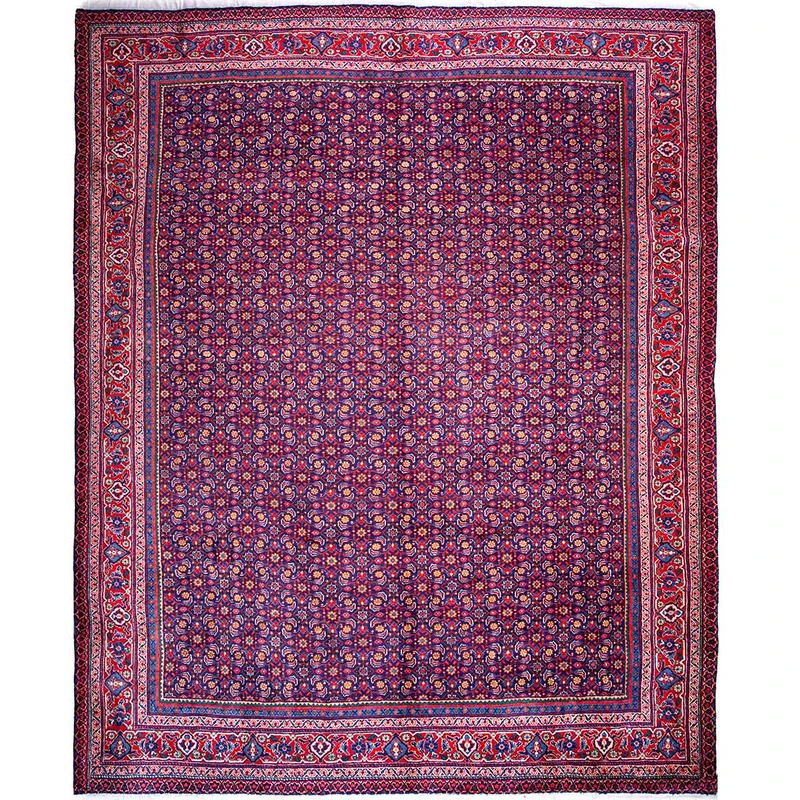
An Arak rug with an allover Herati field in classic red and navy - Arak Persian Rug 12x9 ft - Herati Semi Antique Wool Hand Knotted
7
Medallions, Vases, and Trees
•
Medallion designs - A central medallion, often a lobed diamond, with corners and a floral or Herati field. A classic choice for living rooms.
•
Allover floral designs - Large-scale flowers, palmettes, and vines covering the field, a style closely associated with Western-market rugs of the early twentieth century.
•
Vase designs - Flowering vases repeated in rows, related to the old Persian vase carpets.
•
Tree of life - Trees and flowering plants rising through the field, often in runners and smaller rugs. Read more in our article on the tree of life.
•
Gol Farang - European-style roses, fashionable in some periods for Western buyers.
8
How Arak Rugs Are Built
Arak-region rugs share a solid, practical structure designed for long use.
•
Foundation - Cotton warps and wefts in most twentieth-century pieces, which keep the rugs flat and stable.
•
Wefts - Usually two wefts between rows of knots in finer rugs such as Sarouk; single wefts appear in some village groups such as Lilihan.
•
Knots - Both symmetric and asymmetric knots are found in the region, depending on the village and the workshop.
•
Pile - Good-quality local wool, clipped to a medium height.
•
Density - Ranges widely, from coarse village rugs to finely knotted Sarouks.
•
Edges - Overcast in wool, usually in one color, with plain cotton fringes.
9
Grades and Qualities
Because the Arak region is so large and has produced rugs for so many markets, quality varies widely. A few practical points help you judge where a rug sits:
•
Knot density - Turn the rug over and look at the size of the knots. Finer rugs show smaller, more regular knots and a sharper image on the back.
•
Weave firmness - Double-wefted rugs feel firmer and heavier; looser rugs feel softer and more pliable.
•
Drawing - Finer rugs have smoother curves and more detailed motifs; coarser rugs have bolder, more angular forms.
•
Wool - Lustrous, springy wool is a sign of quality at any level.
Coarser does not mean worse. Many of the most attractive Arak-region rugs, such as Mahals, are prized for their large-scale designs and relaxed, painterly look.
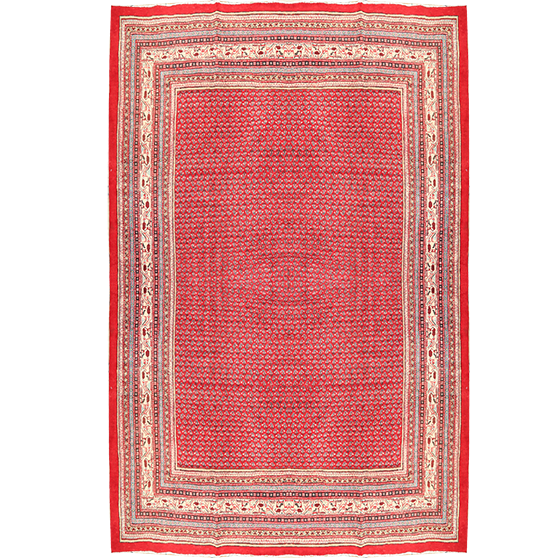
A room-size Arak rug with a central medallion, sized for a living or dining room - Arak Persian Rug 13x10 ft - Medallion Semi Antique Wool Hand Knotted
10
Colors of Arak
The traditional Arak palette is rich and warm. Madder red in shades from brick to rose, and indigo blue from navy to sky blue, dominate. Ivory and cream appear in fields, corners, and medallions, and green, gold, rust, and soft pink fill the details. Older pieces often show beautiful abrash and mellow, sun-softened tones.
In the early twentieth century, some Arak rugs exported to America were chemically washed and even painted to deepen their reds, a practice applied especially to Sarouks. Today, many buyers prefer the natural, softer colors of unpainted rugs.
11
Arak Rugs and Western Interiors
Arak-region rugs were designed in large part for Western homes, and it shows. Their sizes match Western rooms, with many pieces around 9 by 12 feet and larger. Their colors suit wood paneling, upholstered furniture, and painted walls. Their designs, especially the large-scale floral and Herati fields, look natural under sofas and dining tables.
This makes them excellent choices today. An Arak rug can anchor a formal living room, ground a dining room, or bring warmth to a library or study. Semi-antique pieces, with their gently softened colors, also sit beautifully in modern and transitional interiors, adding history and texture to clean, simple spaces. For styling ideas, see our article on choosing a Persian rug for your home.
12
Weaving in Arak Today
Weaving continues in many villages of Markazi province, though, as in other regions, fewer young women take up the loom than in the past. Arak itself has become a major industrial city, but its rug heritage remains strong. The University of Arak teaches carpet design and weaving, and its researchers study the region's designs, history, and economy, helping to preserve and develop the craft. Regional exhibitions and cooperatives support weavers and promote local rugs.
13
Antique, Semi-Antique, and New
•
Antique - Rugs from before about 1930, including the famous Ziegler-era pieces, often with natural dyes, soft colors, and large-scale designs. Highly collectible.
•
Semi-antique - Rugs from the mid twentieth century, with good wool and well-settled colors, offering excellent value and durability.
•
New - Recent rugs, usually with brighter colors and fuller pile.
Our Arak collection includes many semi-antique pieces, which combine the classic look of the region with practical condition for daily use. See also our semi-antique rugs.
14
Sizes
Arak rugs come in every size, but the region is especially known for room-size carpets, typically 8 by 10, 9 by 12, and 10 by 14 feet, as well as large oversize pieces. Runners, small rugs, and medium rugs are also common. Browse our 9x12 and 10x13 collections for room sizes.
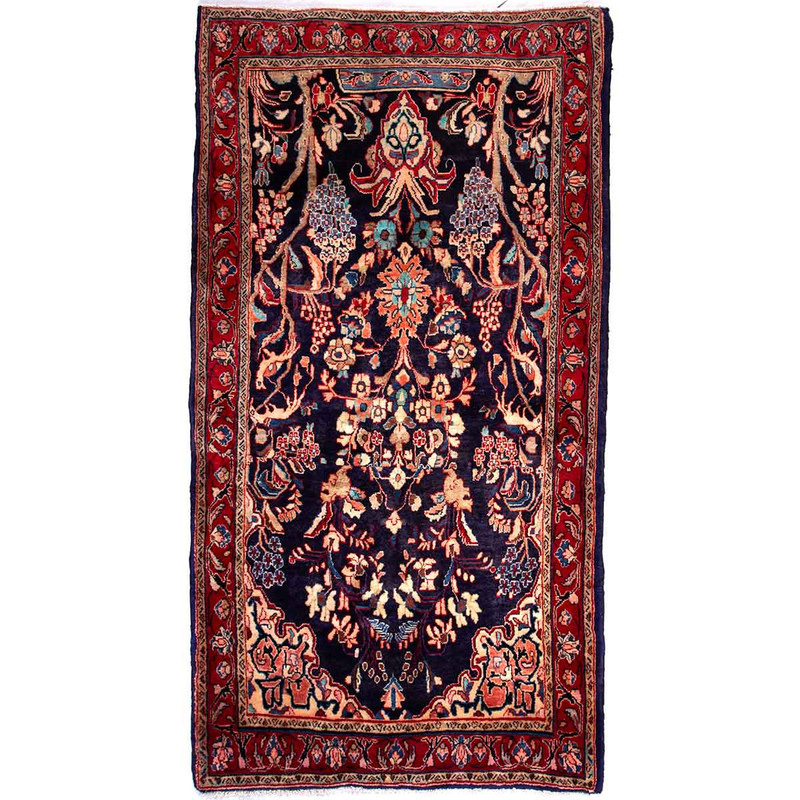
An Arak rug with a tree of life design, a gentle choice for a bedroom or study - Arak Persian Rug 8x4 ft - Tree of Life Semi Antique Wool Hand Knotted
15
Reading the Back of an Arak Rug
The back of an Arak-region rug can tell you a great deal. On a finer, double-wefted rug such as a Sarouk, the back looks tight and smooth, with small knots and the design clearly visible, and the warps lie on two levels, giving the rug a firm, slightly ribbed feel. On a looser village rug such as a Mahal, the knots are larger, the design on the back is softer, and the rug folds more easily. On a single-wefted rug such as a Lilihan, you may see the weft between each row of knots, sometimes dyed pink.
Look also at the ends. The fringe should be the continuation of the warp threads, not sewn on, and the knots near the ends should be secure. Small kilim bands at the ends help hold the last rows of knots in place. On older rugs, check that the ends have not been cut back too far, which can make a rug look shorter and less balanced.
16
Arak Rugs Through the Seasons
The warm reds and blues of most Arak rugs make them especially welcoming in autumn and winter, when they bring color and comfort to rooms. In summer, a rug with an ivory or light blue field feels fresher. Some families keep two rugs for a main room and change them with the seasons, a custom with a long history in Persian homes. Whichever you choose, rotate the rug regularly so that it wears and fades evenly.
17
How to Judge an Arak Rug
•
Overall design - Look for a balanced composition with well-matched corners and borders.
•
Wool and pile - Springy, lustrous wool and even pile height.
•
Color - Natural-looking, harmonious colors. Check for running or painted areas.
•
Flatness - The rug should lie flat with straight sides.
•
Back - Even knots and a clear image of the design.
•
Condition - Check ends, sides, and any repairs, especially on older pieces.
18
Common Buying Mistakes
•
Judging only by the label - Arak, Sarouk, and Mahal names are sometimes used loosely. Look at the structure and quality, not just the name.
•
Ignoring the back - The back of a rug reveals knot size, weft structure, and repairs more honestly than the front.
•
Overlooking painted color - In older rugs, check whether red areas have been painted, especially in worn spots.
•
Choosing the wrong size - Measure the room and furniture before you buy. Arak rugs come in many sizes, so you can usually find one that fits well.
•
Forgetting the pad - A good pad protects both the rug and the floor and keeps large rugs from shifting.
19
Caring for an Arak Rug
Vacuum regularly without a beater bar, rotate the rug every six months, use a good rug pad, and protect it from strong direct sunlight. Blot spills promptly and have the rug professionally washed every few years. See our guides to washing at home and professional washing, and our care instructions.
20
Frequently Asked Questions
What was Arak called before?
Sultanabad. The city was founded in 1815-1816 and renamed Arak in the twentieth century.
Who founded Sultanabad?
Yusef Khan Gorji, a Georgian-born commander of the Qajar king Fath-Ali Shah.
What is Ziegler and Company?
A Manchester-based firm with Swiss roots that organized carpet production around Sultanabad from the 1880s.
What does the Arak name mean on a rug today?
Usually a village rug from Markazi province without a more specific village name.
What is the Herati design?
A repeating unit of a rosette inside a diamond with four curling leaves, also called mahi, the signature field of many Arak rugs.
How are Arak rugs related to Sarouk, Mahal, and Farahan rugs?
They are all from the same region; Sarouk, Mahal, Farahan, and Lilihan are more specific names within the Arak family.
Are Arak rugs durable?
Yes. Their cotton foundations and good wool make them suitable for everyday use.
What sizes are common?
Especially room-size carpets of 8 by 10 to 10 by 14 feet, plus runners and smaller rugs.
Were Arak rugs painted?
Some early twentieth century export rugs, especially Sarouks, were chemically washed and painted to deepen their reds.
Is rug weaving still active around Arak?
Yes, in many villages, supported by cooperatives and by the University of Arak's carpet programs.
What is the Farahan plain?
A historic farming district north-east of Arak whose name is attached to some of the finest antique rugs of the region.
Do Arak rugs suit modern homes?
Yes. Semi-antique pieces with softened colors look especially good in modern and transitional interiors.
What is a Ziegler rug?
A rug made in the Sultanabad region under the Ziegler firm from the 1880s, known for large-scale designs and soft colors; the name is also used today for modern rugs in that style.
How should I clean an Arak rug?
Vacuum regularly without a beater bar and have it professionally washed every few years.
21
Choose Your Arak Rug
Each Arak rug in our collection is hand-knotted, one of a kind, and inspected before it is listed. Browse our Arak collection, compare it with our Sarouk, Mahal, and Farahan collections, or ask our experts for help.