


Ask most people about rugs from north-western Persia and they will name Tabriz. Behind that great name stands a ring of towns and villages that weave in the same tradition, supply the same markets, and often share the same designers. Azarshahr is one of them. Its rugs are less famous than those of the provincial capital, but they carry the same classical design language and the same solid construction, usually at a more modest price.
This guide explains where Azarshahr rugs come from, how they relate to Tabriz, how they are designed and built, how to judge their quality, and how to choose and care for one. For the history of Tabriz weaving itself, see our articles on weaving in Tabriz and Tabriz rug designers.
1
Azarshahr: From Dehkharqan to Azarshahr
Azarshahr is a town in East Azerbaijan province, about 50 kilometers south-west of Tabriz. For most of its history it was known as Dehkharqan (also written Dehkhvareqan). In the twentieth century it was renamed Azarshahr, a name that links it to Azarbaijan, the historic name of the region.
The town lies on the western slopes of Mount Sahand, a great volcanic massif whose summer pastures have fed sheep for thousands of years, and on the plain that runs down to the eastern shore of Lake Urmia, once the largest lake in Persia. Orchards, vineyards, and fields of wheat surround the town, and the mountain villages above it raise sheep whose wool has long supplied local looms.
The district includes several smaller towns and many villages. Weaving takes place both in workshops and in homes, where women work at upright looms in the winter months. Much of the output goes to the bazaar of Tabriz, which has been the commercial heart of the region for centuries.
Azarshahr, formerly Dehkharqan, lies about 50 kilometers south-west of Tabriz, between Mount Sahand and Lake Urmia. Its rugs belong to the Tabriz weaving family and are often sold in the Tabriz bazaar.
2
Part of the Tabriz Weaving Family
Tabriz is not only a city of weavers; it is also a city of designers, dyers, wool merchants, and traders. Over the last century and a half, its workshops have sent designs and materials to towns and villages across the province, and these places have returned finished rugs to the Tabriz bazaar. Azarshahr has long been part of this network.
As a result, many Azarshahr rugs look very much like Tabriz rugs. They use the same cartoons, often drawn by Tabriz designers, the same layouts, and the same structure. Many have been sold simply as "Tabriz" in the international market. When a rug is labeled Azarshahr, it usually means that the dealer knows its origin more precisely, and it is a sign of a rug woven in the Tabriz manner outside the city itself.
The differences, where they exist, are subtle. Azarshahr rugs are often somewhat coarser than the finest Tabriz workshop pieces, with slightly bolder drawing and a simpler color range. In return, they tend to be sturdier and more affordable. For a buyer who wants the Tabriz look for a busy room, that balance is often ideal.
3
How to Recognize an Azarshahr Rug
•
Classical Tabriz layout - A central medallion, often round or lobed, with pendants, matching corners, and a floral field.
•
Curvilinear drawing - Palmettes, flowers, and vines drawn with curves, though often a little more angular than in fine Tabriz rugs.
•
Symmetric knot - The Turkish or symmetric knot used throughout the Azerbaijan region of Persia.
•
Cotton foundation - Cotton warps and wefts, with two wefts between each row of knots.
•
Short to medium pile - Clipped evenly so the design stays clear.
•
Room sizes - Many pieces are room-size, around 8 by 10 to 10 by 13 feet.
In practice, an Azarshahr rug is recognized by its Tabriz-style design combined with a somewhat bolder execution and a firm, solid handle.
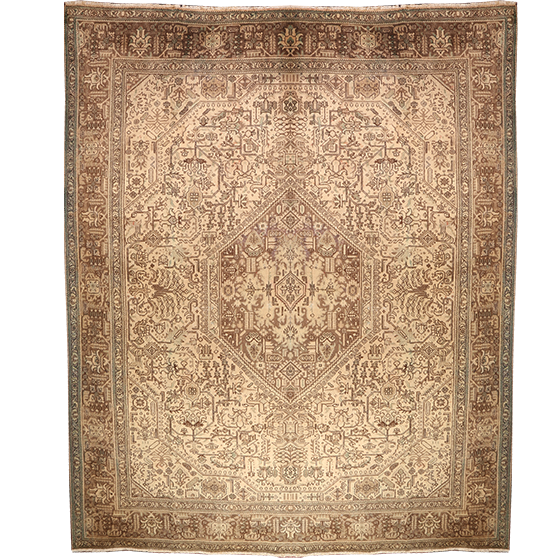
A room-size Azarshahr rug with a central medallion in soft cream, camel, and brown tones - Azarshahr Persian Rug 12x9 ft - Medallion Semi Antique Wool Silk Hand Knotted
4
Designs You Will Meet
The classical medallion
The most common Azarshahr design is the toranj, a central medallion surrounded by a floral field, with quarter medallions in the corners. The medallion may be round, star-shaped, or lobed, and it is usually echoed by pendants above and below. This design has a calm, formal balance that suits living and dining rooms. See our medallion designs.
Shah Abbasi and Eslimi fields
Around the medallion, the field is filled with Shah Abbasi palmettes and Eslimi arabesque vines. In finer pieces these motifs are drawn with long, flowing curves; in coarser pieces they become a little more angular but keep their elegance.
Herati and mahi
The Herati or mahi pattern, a small repeating unit of a diamond, rosette, and curling leaves, is a classic of the Tabriz region. In Azarshahr rugs it may fill the whole field or surround a medallion. It gives a fine, even texture that hides wear. See our Herati designs.
Tone-on-tone rugs
Some Azarshahr rugs are woven in close, harmonious tones, such as cream, camel, beige, brown, and taupe. These rugs, popular in recent decades, have a soft, quiet look that suits modern interiors and lets furniture and art take the lead.
5
How Azarshahr Rugs Are Built
•
Knot - Symmetric (Turkish) knot. Tabriz-region weavers traditionally tie the knot with the help of a small hooked knife, which allows fast and regular work.
•
Foundation - Cotton warps and wefts. The warps are usually set at two levels, which makes the rug firm and flat.
•
Wefts - Two shoots between each row of knots, beaten down firmly.
•
Pile - Local wool, clipped short to medium. Some pieces use silk for small highlights.
•
Edges - Sides overcast in wool, usually in a single color, with cotton fringes.
This structure gives Azarshahr rugs their firm, heavy handle. They lie flat, keep their shape, and wear well in busy rooms.
6
Understanding Raj: The Tabriz Quality Scale
In the Tabriz region, the fineness of a rug is often described in raj, the number of knots along a fixed length of the rug, traditionally about seven centimeters. A rug described as "40 raj" has forty knots in that length. Higher numbers mean finer rugs. Fine Tabriz workshop rugs may reach 50 raj or more, while many village and town rugs of the region are in the range of 25 to 40 raj.
Most Azarshahr rugs fall in the lower to middle part of this scale. That is not a weakness. A medium-fine rug with good wool is often more durable than a very fine one, and its bolder drawing reads well across a room. When comparing rugs, ask about the raj, but also look at the wool, the drawing, and the condition.
Raj is the Tabriz measure of fineness: the number of knots in about seven centimeters. Many Azarshahr rugs fall between 25 and 40 raj, a range that balances detail with durability.
7
Azarshahr Compared with Its Neighbors
Azarshahr and Tabriz
Tabriz rugs cover a wide range, but the best are very finely knotted, with complex drawing and many shades. Azarshahr rugs share the design language but are usually coarser and less expensive. See our Tabriz collection.
Azarshahr and Heriz
Heriz rugs, from the mountains east of Tabriz, are strongly geometric, with large angular medallions and thick pile. Azarshahr rugs are curvilinear and closer to the city style. See our Heriz collection.
Azarshahr and Ahar
Ahar rugs, from north-east of Tabriz, often have simpler, bolder versions of Tabriz designs and a sturdier, more rustic feel. Azarshahr rugs are generally closer to the classic Tabriz look. See our Ahar collection.
Azarshahr and Ardabil
Ardabil rugs, from further north-east, are more geometric and Caucasian in character, with lighter palettes. Azarshahr rugs are more floral and classical. See our Ardabil collection.
8
Colors of Azarshahr
Azarshahr rugs come in two main color families. The first is the classic Tabriz palette of madder red, navy blue, and ivory, with gold, green, and burgundy accents. These rugs are warm and rich, ideal for traditional rooms.
The second is a softer palette of cream, camel, beige, brown, and taupe, sometimes with small touches of red or blue. These quiet, earthy rugs suit modern and transitional interiors.
In semi-antique rugs, both palettes have softened over forty to sixty years. Reds have warmed toward rust, blues have deepened, and creams have taken on a gentle golden tone.
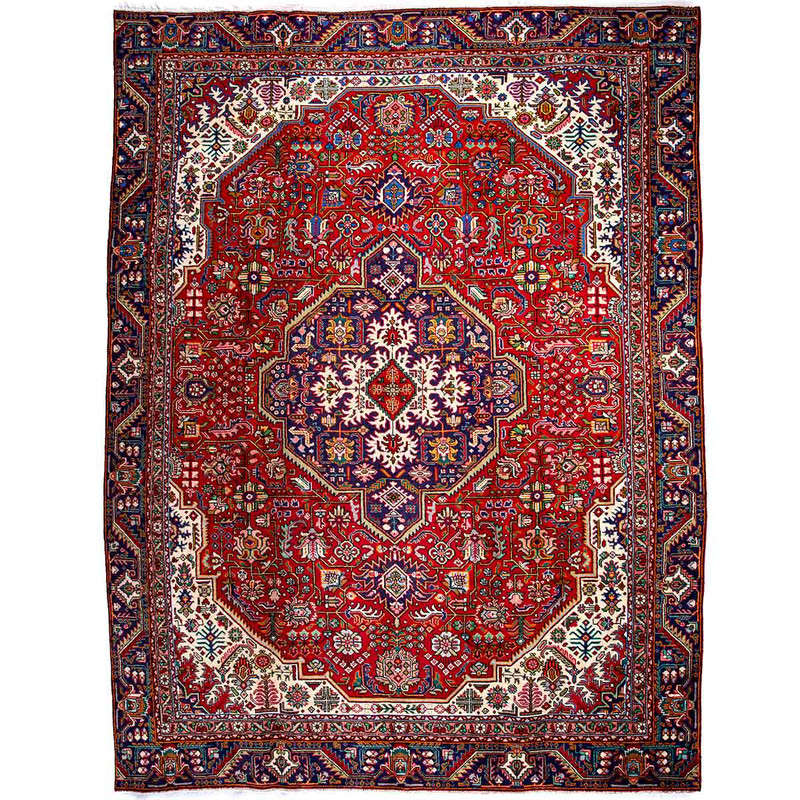
An Azarshahr rug of about 12 by 9 feet in madder red, ivory, and navy, the classic Tabriz palette - Azarshahr Persian Rug 11x8 ft - Medallion Semi Antique Wool Silk Hand Knotted
9
Grades and Quality
•
Drawing - Smooth curves and well-matched corners show good weaving.
•
Raj - Higher raj means finer detail; check the back to see knot size.
•
Wool - Lustrous, springy wool resists wear and keeps colors bright.
•
Color - Clear colors with no bleeding.
•
Flatness - The rug should lie flat with straight, parallel sides.
•
Condition - Even pile, intact ends and sides, and few repairs.
10
Reading the Back of an Azarshahr Rug
On the back, you should see the design clearly, with straight rows of knots. Symmetric knots show two even bumps per knot. Because the warps are set at two levels, the back looks tight and slightly ribbed. The white cotton wefts may show between the rows.
Check the ends and sides carefully. The fringe should be the ends of the warp threads, not sewn on. The overcasting should be secure, and the last rows of knots should be held firmly by a small band of weaving at each end.
11
The Wool of Mount Sahand
The quality of any rug begins with its wool. The high pastures of Mount Sahand, which rises to more than 3,700 meters above Azarshahr, have been grazed for millennia by flocks that move up the mountain in summer and down to the villages in winter. The cool climate and rich grasses produce wool with a good staple length and a natural luster, well suited to the medium-fine rugs of the region.
Traditionally, wool was washed, carded, and spun by hand in the villages. Today much of it is machine-spun, but good workshops still choose wool carefully, since it determines how well a rug will wear, how it takes dye, and how it shines in the light. When you run your hand over a good Azarshahr rug, the pile should feel springy and slightly cool, not dry or brittle. Read more in our article on wool in Persian rugs.
12
From Cartoon to Finished Rug
An Azarshahr rug is the product of a chain of specialists, much like a Tabriz rug.
•
Design - A designer draws the pattern on squared paper, the cartoon, in which each small square stands for one knot. Many cartoons used in Azarshahr come from Tabriz design studios.
•
Dyeing - Wool is dyed in batches to match the colors marked on the cartoon. Dyers work to keep each batch consistent, since a large rug may need many kilograms of a single shade.
•
Warping - The cotton warps are stretched on an upright loom. In the Tabriz region, the loom is often of a type that allows the finished part of the rug to be moved, so that very long rugs can be woven by weavers sitting at a constant height.
•
Knotting - The weavers tie each knot around a pair of warps, cut it with the hooked knife, and after each row pass the wefts and beat them down with a heavy comb.
•
Clipping - The pile is roughly trimmed during weaving, then clipped evenly when the rug comes off the loom.
•
Washing and finishing - The rug is washed, stretched, and dried so that it lies flat and square, and the ends and sides are finished.
Each step affects the final result. A good cartoon, well-matched dyes, even knotting, and careful finishing together make a rug that looks balanced and lasts for generations. Read more about the craft in our article on traditional dyeing.
13
Questions to Ask Before You Buy
•
How old is the rug? - Semi-antique rugs have softer colors; new rugs have fuller pile.
•
What is the fineness? - Ask about the raj or knots per square inch, and check the back yourself.
•
Has it been repaired? - Small, well-made repairs are normal on older rugs, but you should know about them.
•
Has it been washed recently? - A freshly washed rug shows its true colors.
•
Will it fit my room? - Measure the room and the furniture before choosing a size.
14
Sizes and Placement
Azarshahr rugs are especially common in room sizes, around 8 by 10, 9 by 12, and 10 by 13 feet, which makes them good choices for main living spaces.
•
Living rooms - A 9 by 12 or 10 by 13 rug can hold a full seating group, with all furniture legs on the rug or the front legs resting on it.
•
Dining rooms - An 8 by 10 or 9 by 12 rug suits a table for six to eight, with room for chairs.
•
Bedrooms - A 9 by 12 rug works under a king bed, with the borders framing the space.
Place the medallion under the coffee table or dining table to center the room. See our 9x12 rugs and 10x13 rugs.
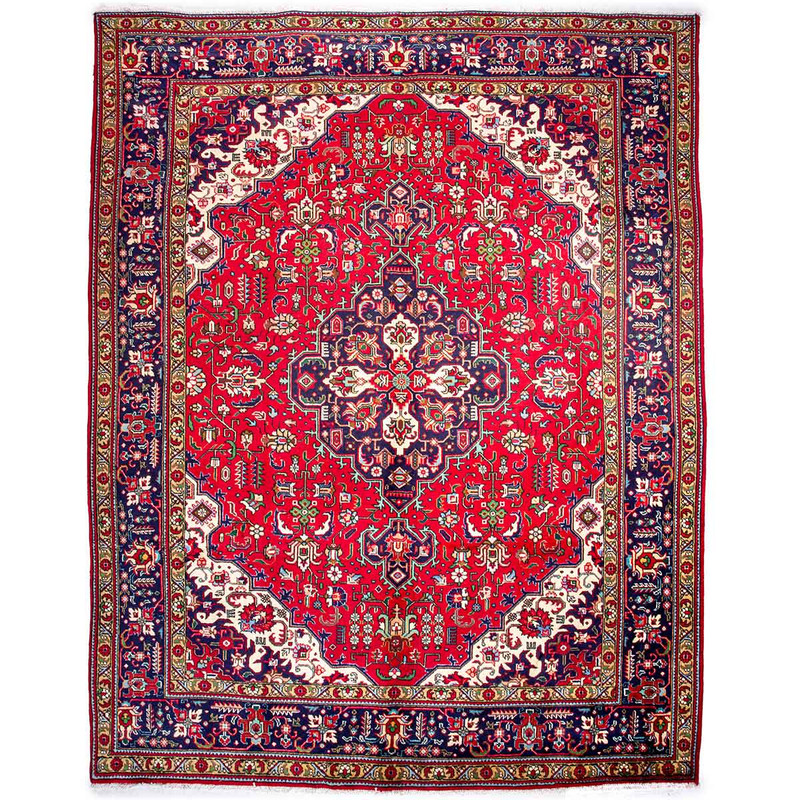
An Azarshahr rug of about 10 by 8 feet with a red field, navy accents, and a jewel-like central medallion - Azarshahr Persian Rug 10x8 ft - Medallion Semi Antique Wool Silk Hand Knotted
15
Azarshahr Rugs in Your Home
The classic Tabriz look of an Azarshahr rug brings calm, balanced elegance to a room. In a traditional setting, a red and navy rug pairs well with dark wood, leather, and rich fabrics. In a modern room, a cream and camel piece adds texture and warmth without competing with clean lines and neutral furniture.
Because Azarshahr rugs are sturdy, they suit family rooms and dining rooms as well as formal spaces. Their medium pile is comfortable underfoot but low enough for chairs to move easily. For ideas on styling a rug of the Tabriz family, see our article on matching a Tabriz rug with your interior.
16
Semi-Antique Azarshahr Rugs
Most Azarshahr rugs in our collection are semi-antique, woven roughly forty to sixty years ago. They offer settled colors, wool that has developed a gentle sheen, and strong foundations ready for many more years of use. They also show the classic Tabriz-region designs as they were woven in the mid twentieth century, before more recent fashions. See our semi-antique rugs.
17
What Affects the Price
•
Size - Room-size rugs cost more than small rugs.
•
Raj - Finer rugs take longer to weave.
•
Condition - Even pile and intact edges raise value.
•
Design and color - Well-drawn, harmonious rugs are more desirable.
Azarshahr rugs usually cost less than Tabriz rugs of similar size and fineness, because the name is less famous. This makes them good value for buyers who want the Tabriz look.
18
Common Buying Mistakes
•
Judging by the name alone - Look at the structure and quality, not just the label.
•
Ignoring the back - The back shows the raj and any repairs.
•
Buying too small - A room-size rug should hold the main furniture group.
•
Skipping the pad - A pad protects the rug and keeps it from slipping.
19
Caring for an Azarshahr Rug
Vacuum regularly without a beater bar. Rotate the rug every six months. Blot spills at once. Keep it out of strong direct sunlight. Have it professionally washed every few years. See our care instructions and our guide to washing a rug at home.
20
Frequently Asked Questions
Where is Azarshahr?
In East Azerbaijan province, about 50 kilometers south-west of Tabriz, between Mount Sahand and Lake Urmia.
What was Azarshahr called before?
Dehkharqan, also written Dehkhvareqan.
Are Azarshahr rugs the same as Tabriz rugs?
They belong to the same weaving family and share designs and structure, but they are usually somewhat coarser and less expensive.
What knot is used?
The symmetric or Turkish knot.
What is raj?
The Tabriz measure of fineness: the number of knots in about seven centimeters.
What designs are typical?
Classical medallions with Shah Abbasi and Eslimi fields, Herati patterns, and tone-on-tone rugs.
What colors are typical?
Red, navy, and ivory, or soft cream, camel, beige, and brown.
What sizes are common?
Especially room sizes of 8 by 10 to 10 by 13 feet.
Are Azarshahr rugs durable?
Yes. Their cotton foundation and firm weave make them very durable.
Do they suit modern interiors?
Yes, especially the softer cream and camel pieces.
Is a lower raj rug a worse rug?
Not necessarily. A medium-fine rug with good wool is often more durable, and its bolder drawing reads well across a room.
Where does the wool come from?
Much of it comes from flocks that graze the summer pastures of Mount Sahand, above the town.
Who draws the designs?
Designers, many of them from Tabriz studios, draw the patterns on squared paper cartoons that the weavers follow knot by knot.
Why are some Azarshahr rugs sold as Tabriz?
Because they are woven in the Tabriz manner and are often traded through the Tabriz bazaar. A precise Azarshahr label shows that the dealer knows the rug's actual origin.
How should I clean an Azarshahr rug?
Vacuum regularly, blot spills, and have it professionally washed every few years.
21
Choose Your Azarshahr Rug
Each Azarshahr rug in our collection is hand-knotted, one of a kind, and inspected before it is listed. Browse our Azarshahr collection, compare it with our Tabriz, Heriz, and Ahar rugs, or ask our experts for help.