


Tabriz Rugs Buyer's Guide: Raj, Designs, and Haj Jalili
Los Angeles Home of Rugs on Nov 17th 2026
Tabriz is the most versatile carpet city in Persia. No other center weaves such a wide range of designs, qualities, and sizes: from sturdy everyday carpets to museum-quality masterpieces, from classical medallions to elaborate pictorial scenes, in wool, silk, and every combination of the two. This variety is part of Tabriz's appeal - and also why buying a Tabriz rug can feel confusing. Two rugs that both say "Tabriz" on the label can differ enormously in fineness, materials, and value.
Our article on Azerbaijan rugs introduces Tabriz within its region, and our article on the art of Tabriz rugs explores its artistic traditions. This article is a practical buyer's guide. It explains how Tabriz rugs are graded, which designs to look for, what makes antique Tabriz rugs special, and how to choose the right Tabriz for your home.
1
A Brief Portrait of Tabriz
Tabriz, the capital of East Azerbaijan Province, has been one of the great cities of Persia for many centuries. It served as a capital under the Ilkhanids, the Turkmen dynasties, and the early Safavids, and its vast covered bazaar - inscribed on UNESCO's World Heritage List - has been a hub of trade between Persia, the Caucasus, Anatolia, and Europe since the Middle Ages. In the nineteenth century, Tabriz merchants led the revival of the Persian rug trade, and the city became the center of a network of weaving that stretched across the country. See our article on Persian rug history from 1722 to 1925.
Today, Tabriz is still one of the largest carpet-producing cities in Persia, with thousands of looms in workshops and homes, and its carpet bazaar remains one of the most important in the country.
2
Tabriz Through the Centuries
Tabriz's carpet history is long and rich. Under the Ilkhanids in the thirteenth and fourteenth centuries, the city was one of the great capitals of the Mongol world, linked by trade to China and Europe, and its artists absorbed new motifs such as cloud bands and lotus blossoms. In the fifteenth century, the Turkmen dynasties made Tabriz their capital, and their court workshops are believed to have produced fine carpets that bridged Timurid and Safavid styles.
When Shah Ismail I founded the Safavid dynasty in Tabriz in 1501, the city became the first Safavid capital, and some of the earliest Safavid court carpets are associated with Tabriz workshops. Although the capital later moved to Qazvin and then Isfahan, Tabriz remained a major weaving center. In the nineteenth century, its merchants organized the revival of Persian weaving for export, and foreign companies set up offices in the city. Throughout the twentieth century, Tabriz workshops continued to produce fine rugs for Persian and international clients. See our articles on the Safavid golden age and Persian rugs from 1925 to today.
3
Inside the Tabriz Carpet Bazaar
The covered bazaar of Tabriz is one of the largest in the world, a vast network of brick-vaulted lanes, domed halls, caravanserais, and courtyards. A whole section is devoted to carpets: dealers' shops stacked high with folded and rolled rugs, merchants inspecting new pieces brought in from workshops and villages, and porters carrying heavy bundles through the crowds. Rugs from Tabriz itself are sold alongside rugs from Heriz, Ardabil, Sarab, and the wider region.
For centuries, the bazaar has been the heart of the Tabriz carpet trade. Here merchants commissioned rugs, bought finished pieces, arranged washing and repair, and prepared rugs for export. Many family firms have traded in the bazaar for generations, and their knowledge of weaving, quality, and markets has helped keep Tabriz at the center of the Persian rug world.
4
Master Designers of Tabriz
Tabriz has long been a city of great carpet designers. The designer's cartoon - a detailed drawing on squared paper in which each square represents one knot - is the foundation of every fine Tabriz rug, and the best designers became famous figures. In the twentieth century, masters such as Rassam Arabzadeh created elaborate, painterly designs that pushed the possibilities of carpet weaving, and their workshops produced rugs that are now treasured by collectors. Many Tabriz rugs carry the signature of the workshop or designer woven into the border.
Tabriz also has a strong tradition of training designers and weavers, and its art schools and workshops continue to develop new designs alongside classical ones. This depth of design talent is one of the reasons Tabriz can weave such a wide variety of rugs.
5
How Tabriz Rugs Are Made
The Knot and the Hook
Tabriz weavers use the symmetrical (Turkish) knot, tied with a distinctive tool: a small knife with a hook at its tip. The weaver uses the hook to pull the yarn around the warps and the blade to cut it, in a single swift motion. This technique allows Tabriz weavers to work very quickly and precisely.
The Tabriz Loom
Many Tabriz rugs are woven on the Tabriz loom, a vertical loom on which the completed part of the rug is rolled around the lower beam. This allows long carpets to be woven on a compact frame while keeping warp tension even, which helps produce straight, flat rugs.
Foundation and Structure
Tabriz rugs are usually woven on cotton foundations, with two wefts after each row of knots. Fine Tabriz rugs may have silk foundations. The pile is generally clipped short to medium, keeping designs crisp. Our article on how a Persian rug is made explains these terms.
The combination of the hooked knife, the symmetrical knot, and the Tabriz loom gives Tabriz rugs their characteristic precision and flat, even structure.
6
Workshop and Home Weaving
Tabriz rugs are woven both in large workshops and in homes. In workshops, teams of weavers sit side by side at large looms, following cartoons under the supervision of a master. At home, families weave on smaller looms, often on commission from merchants who supply wool, dyes, and designs. Both systems produce excellent rugs, and many of the city's weavers have learned their craft in the family before working in a workshop. This combination of organized production and household skill has allowed Tabriz to remain one of the most productive weaving cities in Persia.
7
Music and Weaving in Tabriz
Weaving in Tabriz has long been accompanied by music and song. Azeri songs, with their haunting melodies, filled homes and workshops, and some weavers sang as they tied knots. Our article on Tabriz rugs and the melody of a traditional Azeri song explores this beautiful connection between sound and pattern.
8
Understanding Raj - The Tabriz Quality Scale
The most important term to know when buying a Tabriz rug is raj. Raj is the traditional measure of knot density: the number of knots counted across about seven centimeters of the rug's width. Tabriz dealers and weavers describe rugs by their raj, and it gives a quick indication of fineness:
•
Around 30 to 40 raj - medium-quality rugs with sturdy construction and simpler designs; durable and good value.
•
Around 40 to 50 raj - good-quality rugs with more detailed designs; a popular range for everyday use.
•
Around 50 to 60 raj - fine rugs with detailed, curvilinear designs and often silk highlights.
•
Around 60 to 70 raj and above - very fine rugs with intricate detail, usually with generous silk and sometimes silk foundations; the highest grades.
To estimate raj yourself, measure seven centimeters (about two and three-quarter inches) across the back of the rug and count the knots along that line. Higher raj means a finer rug and more weaving time, which is reflected in the price - but quality also depends on wool, dyes, design, and condition.
9
The Great Designs of Tabriz
Tabriz designers are famous for their range. Among the most important designs are:
•
Mahi (Herati) - the classic Tabriz all-over pattern of small rosettes and curved "fish" leaves, often with a medallion. Mahi Tabriz rugs are among the most popular Tabriz designs. See our Herati designs.
•
Medallion and corner - from bold, geometric medallions to elaborate floral compositions. See our medallion designs.
•
Shah Abbasi - large palmettes and scrolling vines in the classical Safavid style. See our Shah Abbasi designs.
•
Hunting and animal designs - riders and animals in floral landscapes, inspired by Safavid hunting carpets. See our hunting designs.
•
Garden and panel designs - compartments filled with trees, vases, and flowers. See our article on Persian garden rugs.
•
Pictorial rugs - scenes from Persian literature and history, portraits, and landscapes, a Tabriz specialty. See our article on pictorial rugs.
•
Afshan and all-over floral designs - flowers and vines spread evenly across the field. See our afshan designs.
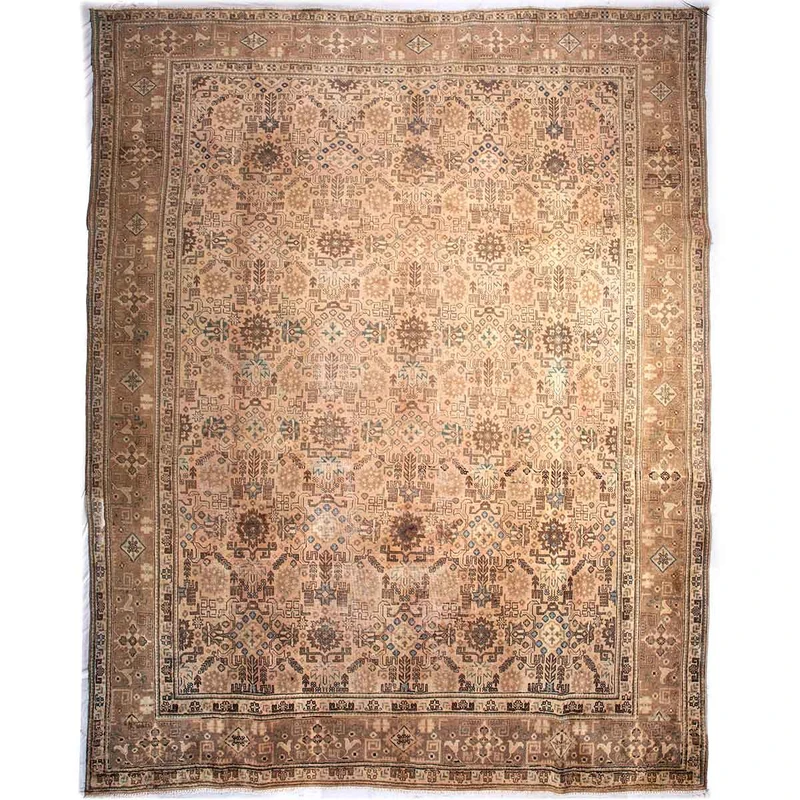
A Tabriz rug with an all-over Herati (Mahi) design in camel, cream, and brown - Tabriz Persian Rug 12x9 ft - Herati Semi Antique Wool Silk Hand Knotted
10
Antique Tabriz and Haj Jalili
Antique Tabriz rugs from the late nineteenth and early twentieth centuries are among the most admired Persian rugs. Woven during the export boom, they combine fine natural dyes, excellent wool, and designs that range from classical medallions to sophisticated compositions made for Western homes.
The most celebrated name in antique Tabriz weaving is Haj Jalili, a master weaver traditionally associated with fine Tabriz rugs of the late nineteenth century. Rugs attributed to Haj Jalili are known for their soft, harmonious colors - often with apricot, ivory, and soft red tones - elegant designs, and refined craftsmanship. Genuine Haj Jalili pieces are rare and highly valued, though the name is sometimes used loosely in the trade for fine Tabriz rugs in a similar style.
Antique Tabriz rugs also include fine silk rugs, prayer rugs, and pictorial pieces. When evaluating an antique Tabriz, look at the dyes, the softness of the wool, the condition of the pile and foundation, and the quality of the drawing. Browse our antique and semi-antique collections.
11
Tabriz Silk Rugs
Tabriz has a long tradition of silk weaving. Pure silk Tabriz rugs and wool rugs with extensive silk highlights are among the city's finest products. Silk allows very high knot densities and gives colors a brilliant sheen that changes with the light. Silk Tabriz rugs are often smaller and best suited to low-traffic areas or as wall hangings. See our article on Persian silk rugs.
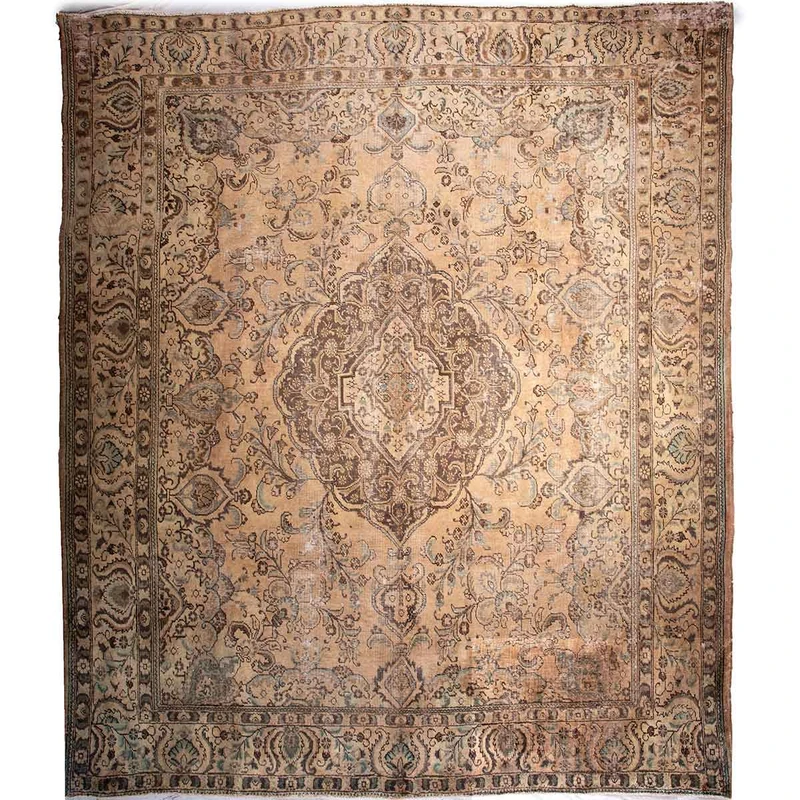
A Tabriz medallion rug with Shah Abbasi motifs in cream, camel, and brown - Tabriz Persian Rug 12x10 ft - Medallion Semi Antique Wool Silk Hand Knotted
12
Wool and Materials
Tabriz weavers have access to the strong, lustrous wool of the Azerbaijan highlands, and fine Tabriz rugs often use carefully selected wool with good luster and resilience. Silk is used generously for highlights in finer rugs and for the pile and foundations of the finest pieces. Many Tabriz workshops are known for their wide range of carefully graded colors, which allow subtle shading in floral and pictorial designs. Our articles on Persian rug wool and natural dyes explain why these materials matter.
13
Sizes and Formats
Tabriz rugs are woven in every size, from small mats and prayer rugs to very large room-size carpets. Room sizes around 8 by 11 and 9 by 12 feet are especially common, and Tabriz is also a good source of large carpets for spacious rooms. Pictorial and silk Tabriz rugs are often smaller. Because Tabriz rugs are woven on frames with even tension, they usually lie flat with straight sides, which makes them easy to place in rooms of any shape.
14
Colors of Tabriz
Tabriz palettes are as varied as its designs. Classic Tabriz rugs feature deep red and navy blue with ivory. Many twentieth-century Tabriz rugs favor softer tones: ivory, beige, camel, light blue, sage green, and rose, which suit contemporary interiors. Antique Tabriz rugs often show beautiful natural dyes with soft apricot, rust, and celadon tones. Because the range is so wide, Tabriz is one of the easiest Persian rug types to match to almost any color scheme.
15
How to Recognize a Tabriz Rug
•
Symmetrical knots and double wefts - visible on the back as a tight, even grid.
•
Flat, even structure - straight sides and square corners, thanks to the Tabriz loom.
•
Precise drawing - from detailed curvilinear city designs to bolder medallions.
•
Silk highlights - common in finer pieces.
•
Wide design range - Mahi, medallion, Shah Abbasi, hunting, pictorial, and garden designs.
Tabriz designs are widely copied, so structure and drawing matter. Our article on how to read a Persian rug's secret language explains how specialists identify rugs.
16
Tabriz Compared With Other City Rugs
•
Tabriz vs Kashan - Tabriz uses the symmetrical knot and offers a wider range of designs and palettes; Kashan uses the asymmetrical knot and is known for classic red and navy medallions. See our article on Kashan rugs.
•
Tabriz vs Isfahan - both can be very fine, but Isfahan is known for classical designs on light grounds with silk foundations, while Tabriz covers a broader range of styles and qualities. See our article on Isfahan rugs.
•
Tabriz vs Heriz - both are from Azerbaijan, but Heriz rugs are bold, geometric village rugs woven from memory, while Tabriz rugs are curvilinear city rugs woven from cartoons. See our Heriz collection.
17
Common Misunderstandings
"All Tabriz rugs are the same quality."
Tabriz rugs range from medium-quality everyday rugs to the finest masterpieces. Raj, materials, and condition make a huge difference.
"Higher raj is always better."
Higher raj means finer knotting, but a well-made 40 raj Tabriz with excellent wool can be a better choice for a busy room than a very fine but delicate rug.
"Silk highlights mean a silk rug."
Many wool Tabriz rugs have silk highlights for outlines and details. A pure silk rug has silk pile throughout.
"Every Haj Jalili is genuine."
The name is sometimes used loosely for fine antique Tabriz rugs in a similar style. Genuine attributions require expert judgment.
18
Choosing the Right Tabriz for Your Home
Because Tabriz rugs come in so many qualities, start by thinking about where the rug will go:
•
High-traffic living and dining rooms - a 40 to 50 raj Tabriz with good wool offers durability and detail at reasonable cost.
•
Formal living rooms and bedrooms - a finer 50 to 60 raj rug with silk highlights brings elegance and refinement.
•
Display pieces - very fine 60+ raj rugs and silk Tabriz rugs are best in low-traffic areas or on walls.
•
Classic interiors - red and navy medallion or Mahi designs.
•
Transitional and modern interiors - Tabriz rugs in ivory, beige, camel, or soft blue and green.
Our rug size guide will help you choose the right size, and our article on how to buy a Persian rug offers a complete checklist.
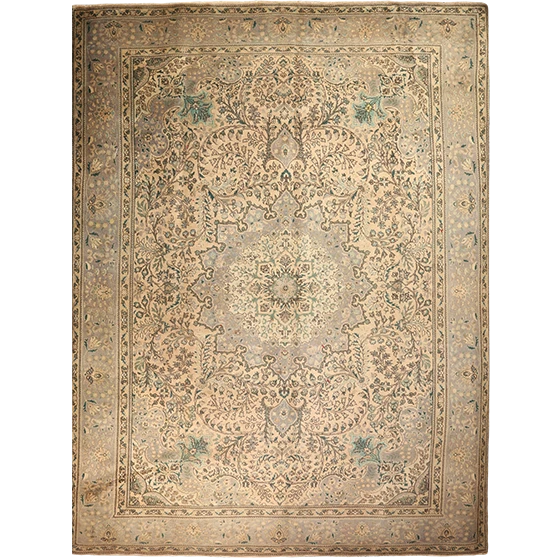
A Tabriz medallion rug in wool with silk highlights - Tabriz Persian Rug 13x9 ft - Medallion Semi Antique Wool Silk Hand Knotted
19
Questions to Ask When Buying a Tabriz
•
What is the raj? - a reliable seller can tell you approximately, or show you how to count it.
•
Is there silk, and where? - highlights only, the whole pile, or the foundation.
•
How old is the rug? - antique, semi-antique, or new.
•
Has the rug been repaired, cleaned, or retouched?
•
Is it signed? - and is the signature consistent with the quality?
It also helps to ask for close-up photos of the back of the rug, the fringe, and the edges before you buy. The back shows the knot count and the evenness of the weave, the fringe shows the foundation material, and the edges reveal any past repairs. A seller who is proud of a rug will gladly share these details, and a few extra photos often tell you more than a long description.
Clear answers to these questions, together with a certificate of authenticity, will help you buy with confidence.
20
Caring for Tabriz Rugs
Wool Tabriz rugs are durable and easy to care for: vacuum regularly without a beater bar, rotate the rug once or twice a year, and blot spills promptly. Rugs with silk highlights and pure silk Tabriz rugs need gentler care and should be cleaned only by specialists experienced with silk. Protect all rugs from strong direct sunlight. See our guides to cleaning a Persian rug at home and professional rug cleaning.
21
Frequently Asked Questions
What does 50 raj mean?
It means about 50 knots across seven centimeters of width - a fine rug with detailed designs.
What is a Mahi Tabriz?
A Tabriz rug with the Herati, or "fish," pattern, often combined with a medallion. It is one of the most popular Tabriz designs.
Who was Haj Jalili?
A master weaver traditionally associated with exceptionally fine Tabriz rugs of the late nineteenth century, known for their soft colors and refined designs.
How do I measure raj myself?
On the back of the rug, measure about seven centimeters (two and three-quarter inches) across the width and count the knots along that line.
Are pictorial Tabriz rugs meant for the floor?
Many pictorial rugs are fine pieces intended as wall hangings, where their detailed scenes can be admired without wear.
Are Tabriz rugs durable?
Yes. Wool Tabriz rugs with good knotting are very durable. Silk Tabriz rugs are more delicate and best in low-traffic areas.
22
The City of a Thousand Designs
Tabriz has given the world an extraordinary variety of rugs, from humble everyday carpets to some of the finest Persian rugs ever woven. Understanding raj, designs, and materials helps you find the Tabriz that suits your home, your taste, and your budget - and gives you a deeper appreciation of the city's remarkable weaving tradition.
At Los Angeles Home of Rugs, you can explore our Tabriz collection, with rugs in many designs, sizes, and qualities, each with a Certificate of Authenticity documenting its origin, materials, and age. If you have questions, please ask our experts.
Explore the Collection
Tabriz Rugs
Herati Designs
Shah Abbasi Designs
Medallion Designs
Silk Rugs
Antique Rugs
Persian Rug FAQ