


How a Persian Rug Is Made: Looms, Knots, and Weaving
Los Angeles Home of Rugs on Nov 17th 2026
Persia has long been known as a fountain of beautiful and legendary rugs. Since ancient times its weaving centers have produced countless rugs and carpets, many of them precious works of art now treasured in museums and private collections. Many art forms in Persia have reached remarkable levels of splendor, from architecture and tilework to calligraphy and miniature painting, but none is as closely tied to the daily life of its people as the art of rug weaving.
This article explains how a Persian rug is actually made: the looms and tools, the two great knot types, the weaving process from warp to finished pile, and the different worlds of city, village, and tribal weaving. For the history of the craft across the centuries, see our series beginning with Persian weaving from its origins to 1499.
1
Why Weaving Flourished in Persia
The reasons Persian rug weaving reached such heights lie in both the land and its people. The Persian plateau supports vast flocks of sheep and goats, which provide abundant, high-quality wool. Its varied climate offers a wide range of dye plants. Long winters and a strong tradition of household crafts gave families time and reason to weave. And above all, Persian culture has always valued beauty in everyday objects, so a rug was never just a floor covering but an expression of taste, identity, and pride.
Weaving began among nomadic peoples, who needed warm, portable floor coverings for their tents. For this reason Persian sources often call tribal rugs the mother of all Persian rugs. Over time, weaving spread to villages and then to city workshops, where it reached its greatest technical refinement.
2
From Fleece to Yarn - Preparing the Materials
Long before a weaver sits at the loom, the materials must be prepared, and their quality shapes the finished rug as much as the weaving itself.
Wool
Most Persian rugs have a wool pile. In spring, sheep are sheared, and the fleece is sorted by quality: the softest, longest, and most lustrous wool, often from the shoulders and sides of the animal, is reserved for the best rugs. The fleece is washed to remove dirt, though some natural lanolin is kept to protect the fibers. It is then carded or combed to open and align the fibers, ready for spinning. Mountain sheep from cold regions tend to give especially strong and lustrous wool, which is one reason Persian rugs from regions such as Kurdistan and the Zagros are so durable. Our article on Persian rug wool explains the qualities weavers look for.
Spinning
Traditionally, wool was spun by hand using a drop spindle (duk) or a spinning wheel, often by women in villages and nomadic camps while they watched flocks or cared for children. Hand-spun wool is slightly irregular in thickness, which gives naturally dyed rugs their subtle texture and abrash. Today, many rugs use machine-spun wool, which is more uniform. Two or more single strands are usually twisted together (plied) to make a stronger yarn. Our article on spinning in Persian rug making describes this craft in detail.
Cotton and Silk
City rugs usually have a foundation of cotton warps and wefts, which are strong, stable, and hold their shape well, allowing very fine knotting. Tribal and many village rugs use wool for the foundation, which is more flexible and suits portable looms. Silk is used for the pile and sometimes the foundation of the finest rugs, especially in Qom, Kashan, Isfahan, and Tabriz, where it allows extremely high knot densities and a brilliant sheen. See our article on Persian silk rugs.
Dyeing
Once spun, the yarn is dyed. In city workshops, all the yarn for a carpet is usually dyed in advance; in villages and tribes, it is often dyed in smaller batches. Our series on color, beginning with the master dyer, explains this stage in depth.
3
The Loom and the Weaver's Tools
Every Persian rug is woven on a frame called a loom (dar-e qali). There are two main types:
•
Horizontal loom - two beams staked to the ground with the warp threads stretched between them. It is light and portable, so it can be taken apart and carried during migration. Nomadic tribes such as the Qashqai and the Turkmen traditionally weave on horizontal looms. Weavers sit on the completed part of the rug as they work.
•
Vertical loom - an upright frame used in villages and city workshops. It allows larger and finer rugs and lets several weavers sit side by side on a bench. A version known as the Tabriz loom allows the finished rug to be rolled around the lower beam, so very long carpets can be woven on a frame of modest height.
The weaver's toolkit is simple but precise:
•
Comb beater (daftin) - a heavy metal comb used to beat each row of knots and wefts down tightly.
•
Knife (kard) - a small hooked knife used to tie and cut each knot. In some regions, such as Tabriz, the knife has a hook for pulling the yarn.
•
Scissors (qeichi) - heavy, flat scissors for trimming the pile evenly.
•
Warp and weft yarns - the foundation threads, usually cotton in city rugs and wool in tribal rugs, sometimes silk in the finest pieces.
•
Pile yarn (khameh) - the colored wool or silk that forms the knots and the visible surface.
4
Persian and Turkish Knots
Two knot types dominate Persian weaving:
•
Persian or asymmetrical knot (Senneh) - the yarn wraps around one warp thread and passes loosely behind the next. It can open to the left or the right. Because it lies flatter and allows tighter packing, it is ideal for fine curvilinear designs and is used in centers such as Kashan, Isfahan, Qum, and Kerman.
Persian sources also describe a false knot called jufti, in which one knot is tied over four warps instead of two. It saves time but halves the knot density and weakens the rug, so it lowers quality and value. Our article on blind knots discusses other faults to watch for.
Knot density is one of the main measures of quality. A fine city rug may have several hundred knots per square inch, which is why a single large carpet can take a team of weavers many months or even years to complete.
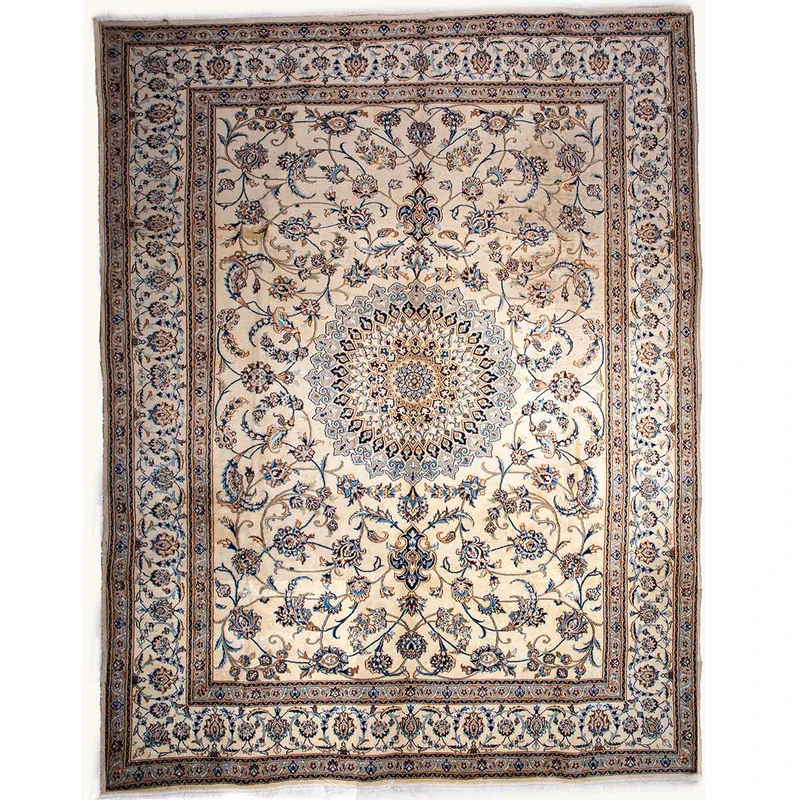
A finely knotted Nain in ivory, navy blue, and crimson wool and silk - Nain Persian Rug 12x9 ft - Medallion Semi Antique Wool Silk Hand Knotted
5
Understanding Knot Density
Knot density - the number of knots in a given area - is one of the most important technical measures of a hand-knotted rug. In the West it is usually expressed in knots per square inch (KPSI). In Persia, weavers and merchants traditionally use a measure called raj, the number of knots along a fixed length of about seven centimeters (roughly two and three-quarter inches) across the width of the rug.
Density varies enormously between rug types:
•
Tribal and nomadic rugs - often around 40 to 120 KPSI, suited to bold geometric designs and generous pile.
•
Village rugs - commonly in a similar or slightly higher range, depending on region.
•
Good city rugs - often 150 to 300 KPSI or more, allowing curvilinear floral designs.
•
The finest silk rugs - can exceed 500 and in exceptional cases reach far higher densities, with designs as detailed as a miniature painting.
Higher density means more work and finer detail, but it is not the only measure of quality. A well-woven village rug with good wool, natural dyes, and a lively design can be more beautiful and more durable than a dense rug with poor materials. To estimate density, turn the rug over and count the knots along one inch horizontally and one inch vertically, then multiply the two numbers.
6
Foundation and Structure - The Hidden Signature
The structure of a rug, visible mainly on its back, tells experts a great deal about where and how it was made:
•
Number of wefts - some rugs have one weft between each row of knots (single-wefted), others two (double-wefted). This varies by region and helps with attribution.
•
Depressed warps - in many fine city rugs and in Bijar, alternate warps are pulled to different levels, which makes the rug firmer and thicker and allows denser knotting.
•
Edge finishing - the sides may be overcast with wool or silk, or finished with a flat woven selvage; tribal rugs often have colorful, decorative edges.
•
Ends - kilim bands, knotted fringes, and other end finishes vary by region and tradition.
Together with design and color, these structural details allow specialists to identify a rug's origin with surprising accuracy. Our article on reading a Persian rug's secret language explores this kind of detective work.
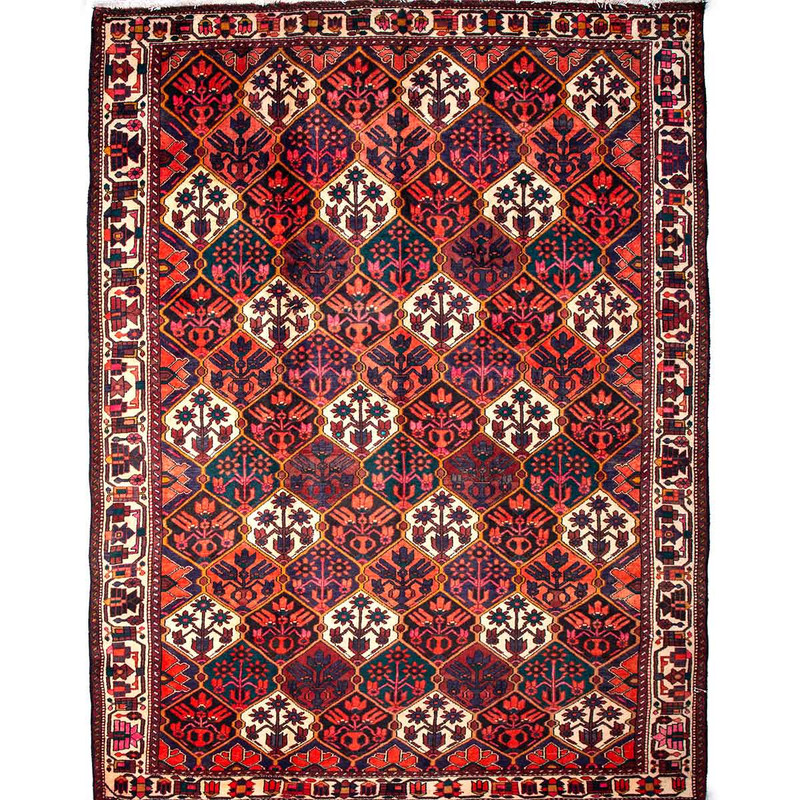
A village Bakhtiari rug with a diamond lattice design - Bakhtiari Persian Rug 9x6 ft - Diamond Lattice Semi Antique Wool Hand Knotted
7
The Weaving Process Step by Step
•
Warping (chelleh keshi) - the warp threads are stretched tightly and evenly on the loom. Even tension is essential for a straight, flat rug.
•
Starting the kilim end - a band of flatweave is woven at the bottom to secure the rug and protect the first row of knots.
•
Knotting - the weaver ties a row of knots across the width, following a cartoon in a city workshop or working from memory in a tribal tent.
•
Passing the wefts - after each row of knots, one or more weft threads are passed across and beaten down with the comb to lock the knots in place.
•
Trimming - the pile is cut roughly as the weaver goes and then evenly trimmed, gradually revealing the design.
•
Finishing - when the rug is complete, the top kilim end is woven, the rug is cut from the loom, the sides are overcast, and the rug is washed after weaving and stretched.
8
Weaving Techniques Across the Regions
Although all Persian weavers share the same basic method, each region developed its own techniques, and these leave recognizable traces in the finished rugs:
•
Tabriz - weavers use a hooked knife that both ties and cuts the knot, allowing great speed. Tabriz rugs are typically woven with the Turkish knot on cotton foundations.
•
Bijar - famous for extremely dense, heavy rugs. Weavers pack the wefts with great force, traditionally using a metal tool to compress the rows, which is why Bijar rugs are often called the "iron rugs of Persia."
•
Kashan and Isfahan - city workshops using the Persian knot, fine cotton or silk foundations, and detailed cartoons for curvilinear designs.
•
Kerman - historically associated with the chanted talim instructions and with very wide palettes and soft, flowing floral designs.
•
Heriz - village weavers who create bold geometric medallions from memory, with sturdy construction and thick, durable wool.
•
Qashqai - nomadic weavers using horizontal ground looms, wool foundations, and vibrant, freely drawn designs.
These regional methods are part of what makes Persian weaving so rich. Two rugs with similar designs can feel completely different underfoot because of differences in knotting, wefting, and finishing. For more on individual traditions, explore our articles on weaving in Kerman, weaving in Fars, and the art of Tabriz rugs.
9
How Long Does a Persian Rug Take to Weave?
The time needed depends on size, knot density, and the number of weavers. A skilled weaver ties several thousand knots a day. A small, medium-quality rug may take a few weeks, while a finely knotted room-size carpet can occupy a team of weavers for a year or more. The finest silk rugs, with knot densities of several hundred per square inch, can take even longer. This investment of time is one reason authentic hand-knotted rugs hold their value so well. See our article on investing in hand-knotted rugs.
10
Who Weaves - Cities, Villages, and Tribes
In villages and tribes, rugs of every size are woven almost entirely by women and girls, often at home alongside their other work. Skills pass from mother to daughter, together with the family's favorite designs and colors. In city workshops, both men and women weave, and production is organized around master designers, dyers, and supervisors.
A Day at the Loom
In a village house, the loom often stands against a wall in the main room, and weaving fits around the rhythm of daily life. A woman may weave for a few hours in the morning, attend to her household and animals, and return to the loom in the afternoon, sometimes joined by daughters or neighbors who weave alongside her on the same bench. Weaving is often a social activity, accompanied by conversation and sometimes by song.
In the large city workshops of the past, particularly in Kerman and its surroundings, a remarkable tradition developed: the talim. A master read the design from the cartoon and chanted it aloud in a special sung code, calling out the colors and number of knots for each row, while the weavers followed his voice. This allowed large teams to weave complex designs in perfect coordination. Our article on Persian rug music explores the connection between weaving and song.
These three worlds create three broad categories of Persian rugs. City rugs are fine, curvilinear, and made from cartoons. Village rugs combine regional designs with sturdy construction. Tribal rugs are bold, geometric, and woven from memory, carrying the most personal expression of the weaver. Explore our city, village, and nomadic collections to compare them.
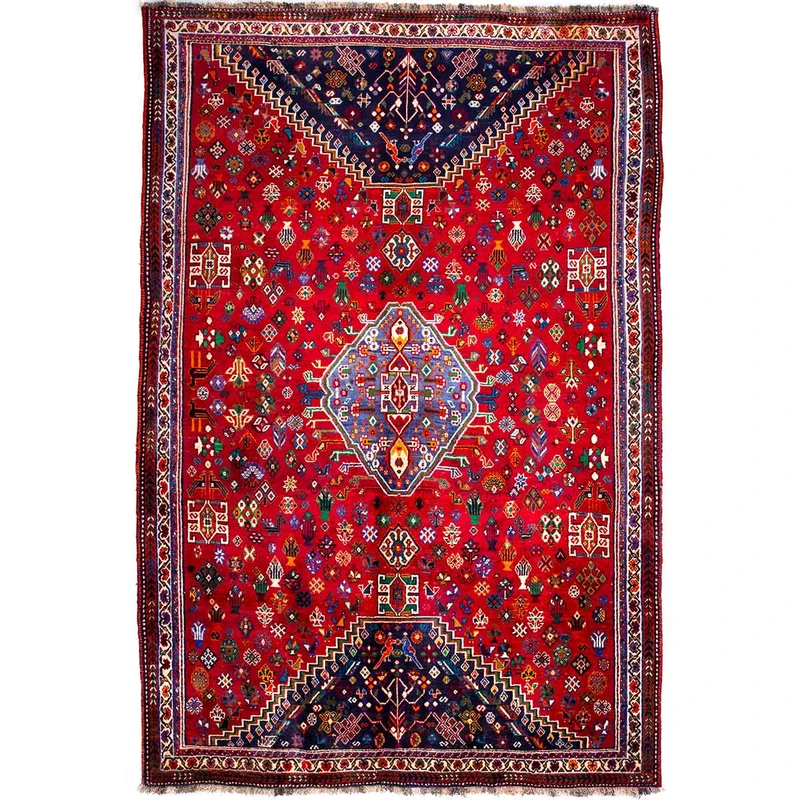
Bold tribal geometry in a Qashqai woven in crimson, navy blue, and ivory - Qashqai Persian Rug 9x5 ft - Geometric Semi Antique Wool Hand Knotted
11
How to Recognize a Genuine Hand-Knotted Rug
With so many machine-made and hand-tufted rugs on the market, it helps to know how to recognize the real thing:
•
Look at the back - in a hand-knotted rug, the design is clearly visible on the back, with each knot slightly irregular. In a hand-tufted rug, the back is covered with a glued fabric backing.
•
Check the fringe - in a hand-knotted rug, the fringe is the end of the warp threads that run through the whole rug. In many machine-made and tufted rugs, the fringe is sewn or glued on afterward.
•
Look for small irregularities - slight variations in shape, knot alignment, and color are normal in handmade rugs. Perfect uniformity often indicates machine production.
•
Fold the pile - folding a hand-knotted rug reveals rows of individual knots at the base of the pile.
•
Ask for documentation - a reputable seller will state the origin, materials, and construction clearly.
Hand-knotted rugs take far longer to make, last far longer, and hold their value in a way that machine-made rugs do not. Our article on how to buy a Persian rug provides a fuller checklist.
12
Frequently Asked Questions
How many knots can a weaver tie in a day?
A skilled weaver can tie several thousand knots in a working day, depending on the fineness of the rug and the complexity of the design.
Is the Persian knot better than the Turkish knot?
Neither is better. The Persian knot suits fine curvilinear designs; the Turkish knot is very strong and suits bold designs. Both appear in excellent rugs.
Why do some Persian rugs have small mistakes?
Small irregularities are a natural result of handwork. Some people also say weavers include deliberate imperfections, believing only God creates perfection, though this is more popular belief than documented practice.
What are "iron rugs"?
The name is often given to the extremely dense, heavy rugs of Bijar, whose tightly packed wefts make them unusually stiff and durable. Our article on Persian iron rugs explains the technique.
How long does a hand-knotted Persian rug last?
With reasonable care, a well-made hand-knotted Persian rug can last for generations. Many rugs in daily use today are more than fifty or even a hundred years old, and some antique pieces have survived for centuries. Durability depends on the quality of the wool, the density of the weave, the stability of the dyes, and the care the rug receives.
Why are hand-knotted rugs so much more expensive than machine-made rugs?
A single room-size hand-knotted rug can contain hundreds of thousands or even millions of individual knots, each tied by hand. Add the work of shearing, spinning, dyeing, designing, washing, and finishing, and the time involved is measured in months or years rather than hours.
Are Persian rugs still woven by hand today?
Yes. Hand-knotted rugs are still woven in cities, villages, and tribal areas across Persia, alongside a growing revival of natural dyes and traditional designs.
13
The Living Art of Persian Weaving
In 2010, UNESCO recognized the traditional skills of carpet weaving in Fars and Kashan as part of the Intangible Cultural Heritage of Humanity. That recognition honors not only the finished rugs but the living knowledge of the weavers - the patience, memory, and skill that turn wool and dye into lasting art. Every authentic hand-knotted rug carries a part of that heritage. Learn more in why Persian rugs are famous around the world.
Every hand-knotted rug at Los Angeles Home of Rugs is the product of this long chain of skill - from the shepherd and the spinner to the dyer, the weaver, and the washer. Each comes with a Certificate of Authenticity documenting its origin, materials, and age, so you know exactly what you are bringing into your home. Browse our city, village, and nomadic rugs, or ask our experts if you would like help understanding how a particular rug was made.
Explore the Collection
Hand-Knotted Rugs
City Rugs
Village Rugs
Nomadic Rugs
Kashan Rugs
Tabriz Rugs
Qashqai Rugs
Persian Rug FAQ