


Spinning Wool for Persian Rugs: Hand-Spun vs Machine-Spun Yarn
Los Angeles Home of Rugs on Nov 17th 2026
Between the fleece of a sheep and the knots of a finished rug lies a step that most rug owners never think about: spinning. Before wool can be dyed or woven, its loose fibers must be twisted into a continuous, strong yarn. How that yarn is spun - by hand or by machine, tightly or loosely, in one strand or several - shapes the look, feel, durability, and character of the finished rug in ways that are easy to see once you know what to look for.
This article explains the craft of spinning for Persian rugs: how fibers are prepared, the traditional tools of hand spinning, the science of twist and plying, the different yarns needed for warp, weft, and pile, the rise of machine spinning, and why hand-spun wool has returned to favor in many of today's finest rugs. It complements our articles on Persian rug wool and how a Persian rug is made.
1
Why Spinning Matters
A wool fiber on its own is only a few inches long. To make a yarn that can be wrapped around warps, knotted, and walked on for a century, thousands of fibers must be drawn out and twisted together so that they grip one another along their whole length. The scales on the surface of wool fibers help them cling together, and the twist locks them in place.
The way this is done determines several qualities of the finished yarn:
•
Strength - more twist generally makes a stronger, more compact yarn.
•
Softness - less twist leaves a softer, loftier yarn.
•
Luster - well-aligned fibers reflect light and give wool its sheen.
•
Evenness - machine spinning produces very uniform yarn; hand spinning produces natural variation.
•
Dye uptake - the density and twist of a yarn affect how deeply dye penetrates, and so how its color looks.
2
A Short History of Spinning
Spinning is one of humanity's oldest technologies. Archaeologists have found spindle whorls - the small weights of drop spindles - at very early settlements across the Near East, and the domestication of wool-bearing sheep made spinning wool a central household task for thousands of years. The Pazyryk carpet, woven around the fifth century BCE, was already made from finely spun, plied wool, showing how advanced the craft had become.
For most of history, all yarn was spun on hand spindles. The spinning wheel appeared later, spreading through Asia and the Islamic world by the medieval period, and it gradually became common in settled communities. Machine spinning, which developed in Europe during the Industrial Revolution, reached Persian rug making mainly in the twentieth century. Through all these changes, the drop spindle never disappeared, and it is still used by tribal spinners today.
3
Preparing the Fibers
Sorting and Washing
After shearing, the fleece is sorted by hand: the longest, finest wool, usually from the shoulders and sides, is set aside for the best rugs, while shorter or coarser wool may be used for foundations, kilims, or felt. The wool is then washed to remove dirt and excess grease, leaving enough natural lanolin to protect the fibers.
Opening and Carding
Next, the wool must be opened and the fibers separated and aligned. Traditionally, this was done with hand cards - pairs of paddles set with fine wire teeth - which comb the wool into soft, airy rolls. In some regions, a large bow-like tool was used: its string was plucked so that its vibrations fluffed and cleaned the fibers, a technique also used for cotton. Combing, which aligns longer fibers more precisely and removes short ones, produces a smoother, more lustrous yarn.
4
The Tools of Hand Spinning
The Drop Spindle
The oldest and simplest spinning tool is the drop spindle, known in Persian as the duk: a wooden shaft with a weight, or whorl, near one end. The spinner draws out a few fibers from a bundle of prepared wool, attaches them to the spindle, and sets it spinning. As it turns, it twists the fibers into yarn, which is then wound onto the shaft. The spindle is light and portable, so nomadic women could spin while walking with their flocks, tending children, or sitting outside the tent, turning every spare moment into yarn.
The Spinning Wheel
In villages and towns, many spinners used a spinning wheel (charkh), in which a large wheel turned by hand drives a small spindle at high speed. The wheel is faster than the drop spindle and allows more consistent yarn, but it is less portable. Spinning wheels were common in settled communities and workshops, while drop spindles remained the tool of choice among nomads.
Hand spinning was traditionally women's work, and in many Persian villages and tribal camps it still is. A single large rug can require many pounds of yarn, representing weeks or months of spinning before the first knot is tied.
5
Spinning in Nomadic Life
In a nomadic camp, spinning is almost constant. Women and girls carry a spindle and a bundle of wool wherever they go, spinning while they walk beside the flocks during migration, while they talk with neighbors, or while they watch over children. The steady rhythm of the turning spindle is part of daily life, and a skilled spinner can produce fine, even yarn without looking at her hands.
Because so much yarn is needed for a single rug, spinning is often shared among the women of a family or camp. Each spinner's yarn is slightly different, and when their yarns are woven into the same rug, these differences become part of its character - a quiet record of the many hands that made it. Our article on Qashqai weaving describes this world.
6
The Spinner's Skill
Good hand spinning looks simple but takes years to master. The spinner must draw out exactly the right amount of fiber with one hand while controlling the twist with the spindle or wheel, keeping the yarn even, strong, and suited to its purpose. Too little twist, and the yarn falls apart or wears quickly; too much, and it becomes hard and kinky. An experienced spinner adjusts constantly by feel, sensing the yarn between her fingers.
Spinners also learn to work with different wools. Long, lustrous mountain wool spins into strong, shiny yarn; shorter, finer wool needs more care. Many spinners blend wool from different parts of the fleece to achieve the right balance of softness and strength. These skills, passed from mother to daughter, are part of the hidden knowledge behind every hand-spun Persian rug.
7
Twist and Plying
Spinning twists fibers in one of two directions, known as Z-twist and S-twist (named after the slope of the letters' central strokes). Most yarn for Persian rugs is first spun with a Z-twist, producing a single strand. Two or more singles are then twisted together in the opposite direction, S-twist, to make a plied yarn. Plying balances the twist, making the yarn stronger, more even, and less likely to kink.
The amount of twist and the number of plies vary according to the purpose of the yarn:
•
Warp yarn - must be very strong and resist stretching, so it is tightly twisted and often plied from several strands. In city rugs, warps are usually cotton or silk; in tribal rugs, wool or goat hair.
•
Weft yarn - passes across the rug between rows of knots. It is usually less tightly twisted and sometimes thicker, to pack the knots firmly.
•
Pile yarn - forms the knots and the visible surface. It is usually more lightly twisted, so that the cut ends open up into a soft, full pile. Many pile yarns are two-ply, but weavers sometimes use several strands together for each knot.
Specialists use the direction of twist and the number of plies as clues when identifying where and when a rug was made.
8
Hand-Spun Wool and the Character of a Rug
Hand-spun yarn is never perfectly even. Its thickness varies slightly along its length, and different spinners produce slightly different yarns. When this yarn is dyed, the thicker and thinner parts take up dye a little differently, and when it is knotted, some knots sit fuller than others. Persian weavers have a lovely expression for the way a hand-spun knot opens and blooms on the surface of the rug: they say the knot "flowers."
Together, these small variations give hand-spun rugs a lively, textured surface that seems to shimmer and change as the light moves. They also contribute to the gentle color variations known as abrash, especially in naturally dyed tribal and village rugs. Many collectors and designers prize this quality above perfect uniformity. Our article on natural dyes explains how dye and yarn work together.
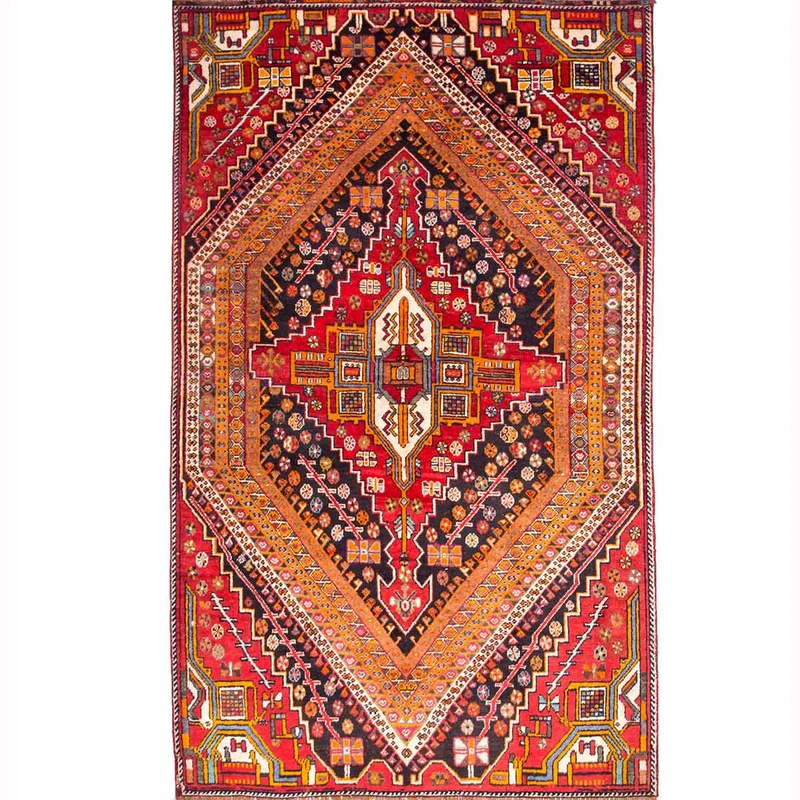
A Qashqai rug with the lively texture of tribal wool - Qashqai Persian Rug 7x4 ft - Geometric Semi Antique Wool Hand Knotted
9
Spinning and Dyeing Together
In most Persian rug making, wool is spun first and dyed afterward, in skeins. This allows dyers to control colors precisely and to dye exactly the amount of yarn needed. In some traditions, however, raw fleece is dyed before spinning, which can produce a slightly heathered, blended color when fibers of different shades are spun together.
The way yarn is spun affects how it takes dye. Tightly twisted yarn absorbs dye more slowly at its core, while loosely spun yarn takes dye more evenly through its thickness. Hand-spun yarn, with its variations in thickness and twist, takes dye a little unevenly, which contributes to the soft color variations prized in natural-dye rugs. Our series on Persian rug color, beginning with the master dyer, explains the dyeing process in detail.
10
Yarn Thickness and Knot Density
The thickness of yarn is closely linked to how finely a rug can be woven. Fine city rugs with several hundred knots per square inch require thin, strong warps and fine pile yarn, often of silk or very fine wool. Tribal and village rugs, with fewer knots per square inch, use thicker yarns that build a fuller, deeper pile. Weavers and spinners therefore work together: the spinner produces yarn suited to the rug's intended fineness, and the weaver adjusts her knots to the yarn. Our article on how a Persian rug is made explains knot density.
11
The Rise of Machine Spinning
In the twentieth century, machine-spun wool became increasingly common in Persian rugs. Machine spinning is faster and cheaper, and it produces very uniform yarn in large quantities. This allowed workshops to make rugs with precise, even colors and very consistent pile, and it made weaving more efficient.
Machine-spun wool can make excellent rugs, and many fine city rugs use it. But it has a different character: the surface tends to look smoother and more uniform, and colors appear more even. Some machine-spun wools are also processed more heavily, which can reduce their natural luster and resilience. Many buyers prefer the evenness of machine-spun rugs for formal settings, while others seek the vitality of hand-spun wool.
12
How to Tell Hand-Spun from Machine-Spun Wool
•
Look at the pile surface - hand-spun rugs show subtle variations in texture and fullness from knot to knot; machine-spun rugs look more uniform.
•
Look for abrash - natural, irregular color variation is more common with hand-spun, naturally dyed wool.
•
Examine the back - in hand-spun rugs, the knots on the back may vary slightly in size and shape.
•
Feel the wool - hand-spun wool often feels springier and more lively; machine-spun wool can feel smoother but flatter.
•
Ask the seller - a knowledgeable dealer can usually tell you how the wool was spun.
None of these signs is absolute on its own, but together they give a good indication.
13
Silk and Cotton Yarns
Silk
Silk is not spun in the same way as wool. Silkworm cocoons are softened in hot water, and the long continuous filaments are reeled off and combined into threads. Because each filament can be hundreds of meters long, silk yarn is extremely strong and smooth, with a brilliant natural luster. In Persia, silk has traditionally come from the Caspian provinces of Gilan and Mazandaran, and from Khorasan. Silk is used for the pile of the finest rugs, for highlights in wool rugs, and for foundations that allow extremely fine knotting. See our article on Persian silk rugs.
Cotton
Cotton fibers are shorter than wool and are spun into strong, smooth yarns that do not stretch. This makes cotton ideal for the warps and wefts of city and village rugs, where a stable foundation allows straight edges and fine, even knotting. Cotton was traditionally spun by hand in many regions of Persia; today most rug cotton is machine-spun.
14
Camel Hair and Goat Hair
Camel hair, gathered when camels shed their soft undercoat, is spun into warm, golden yarns used in some tribal rugs, especially by Baluch weavers. Goat hair, strong and coarse, is spun for selvages, tent cloth, bags, and sometimes warps, because it resists wear and water. Both fibers require their own spinning techniques and add distinctive texture and color to the rugs that use them.
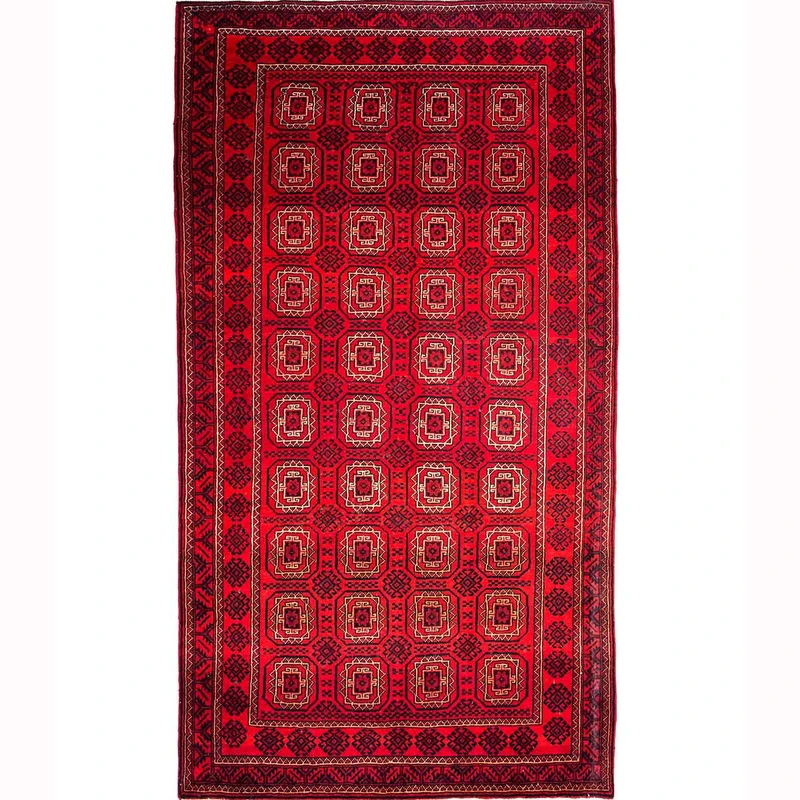
A Baluch rug woven with wool and natural camel hair - Baluch Persian Rug 10x5 ft - Geometric Semi Antique Wool Camel Hair Hand Knotted
Whatever the fiber, the principle is the same: the right yarn, spun with care for its purpose, is the foundation of a rug that lasts.
15
The Hand-Spun Revival
In the late twentieth century, as machine-spun wool became the norm, a revival of hand spinning began, especially among tribal weavers in Fars and in workshops dedicated to natural dyes. Gabbehs and other tribal rugs made with hand-spun, naturally dyed wool won international acclaim for their depth of color and lively texture, and hand-spun wool once again became a mark of quality and authenticity. See our articles on Gabbeh rugs and Fars rugs.
16
Spinning and Sustainability
Hand spinning is also one of the most sustainable parts of rug making. It uses no electricity, produces no waste, and relies entirely on human skill and simple wooden tools. Combined with wool from local flocks and natural dyes from local plants, hand-spun rugs represent a way of making textiles that has very little environmental impact - one reason they appeal to many buyers today. Supporting rugs made this way also helps sustain the rural and tribal communities who keep these skills alive.
17
Spinning and the Value of a Rug
The yarn in a rug is one of the quiet factors in its value. Hand-spun wool, especially when combined with natural dyes and good fleece, takes more time and skill and produces rugs with more character, which collectors often prize. Well-spun yarn of any kind - with the right twist for its purpose - produces rugs that wear well, keep their pile, and age gracefully. Poorly spun yarn, whether by hand or machine, can lead to weak warps, uneven wear, or excessive shedding. Our article on how to buy a Persian rug explains how to assess quality.
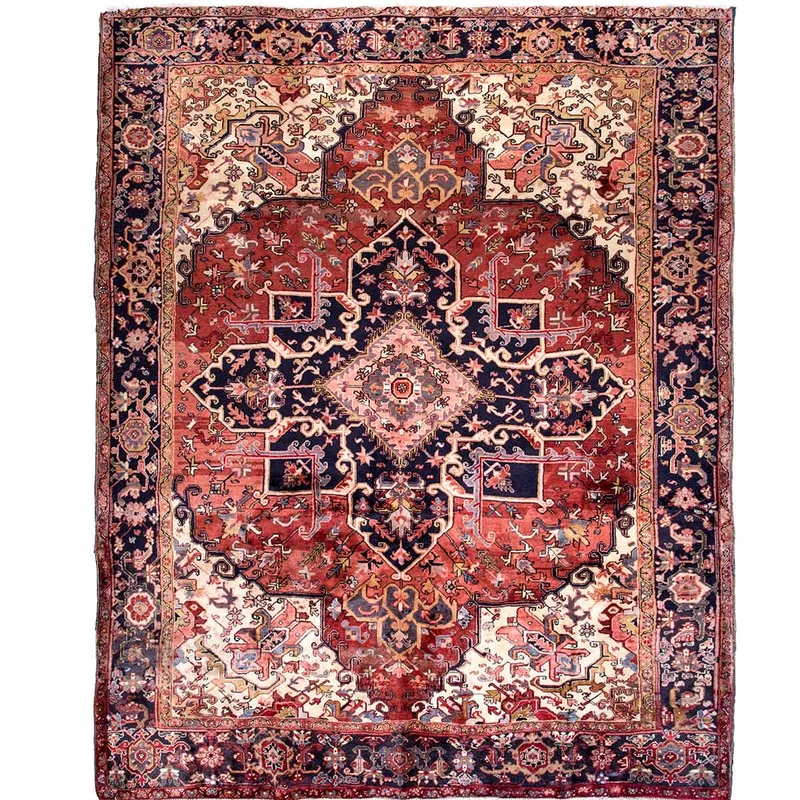
A Heriz medallion rug in madder red, navy blue, and ivory - Heriz Persian Rug 10x8 ft - Medallion Semi Antique Wool Hand Knotted
18
Caring for Rugs Made With Hand-Spun Wool
Rugs made with hand-spun wool are durable, but their slightly irregular yarn and natural dyes reward a little care. Vacuum regularly with suction only, rotate the rug to even out wear and light, and avoid strong household cleaners that can strip lanolin from the wool. Some light shedding is normal at first. Professional cleaning by specialists experienced with tribal and natural-dye rugs keeps the wool soft and the colors bright. See our guides to cleaning a Persian rug at home and professional rug cleaning.
19
Frequently Asked Questions
Is hand-spun wool better than machine-spun wool?
Not necessarily better, but different. Hand-spun wool gives more texture, character, and natural color variation; machine-spun wool gives more uniformity. Both can make excellent rugs.
Why do some rugs shed more than others?
Shedding depends partly on the length of the wool fibers and how the yarn was spun. Short fibers and loosely spun yarn tend to shed more.
What is a ply?
A single strand of spun yarn. Two or more plies twisted together make a stronger, more balanced yarn.
What is the difference between Z-twist and S-twist?
They are the two directions in which fibers can be twisted. Persian rug yarns are commonly spun Z and plied S, which balances the twist.
Why are warps tightly twisted?
Warps carry the tension of the loom and support every knot, so they must be very strong and resist stretching.
How long does it take to spin the wool for a rug?
It depends on the size and fineness of the rug, but spinning the yarn for a room-size rug by hand can take a family of spinners many weeks.
Are new Persian rugs still made with hand-spun wool?
Some are, especially tribal and natural-dye rugs from Fars and workshops specializing in traditional methods. Many others use machine-spun wool.
20
The Thread That Holds It Together
Spinning is one of the oldest crafts in the world, and in Persian rugs it remains one of the most important. Every knot in a rug begins as a twist of fibers, made by the hands of a spinner or by a machine, and the quality and character of that twist echo through the whole rug. Next time you look at a Persian rug, look closely at its pile and its back: you may see the patient work of the spinner as clearly as that of the weaver.
At Los Angeles Home of Rugs, our collection includes rugs woven with both hand-spun and machine-spun wool, from tribal pieces full of texture to refined city rugs. Every rug comes with a Certificate of Authenticity documenting its origin, materials, and age. If you have questions, please ask our experts.
Explore the Collection
Wool Rugs
Silk Rugs
Nomadic Rugs
Village Rugs
Gabbeh Rugs
Baluch Rugs
Persian Rug FAQ