


Natural Dyes in Persian Rugs: How to Recognize Them
Los Angeles Home of Rugs on Nov 17th 2026
Ask an experienced rug collector what separates a good Persian rug from a great one, and the answer will very often be color. Not simply which colors a rug uses, but the quality of those colors: their depth, their softness, the way they shift subtly across the field, and the way they mellow over decades rather than fading. Most of that quality comes from one source - natural dyes.
Natural dyes are colorants obtained from plants, insects, and minerals rather than from industrial chemistry. For more than two thousand years they were the only way to color wool in Persia, and today they are again prized by collectors, designers, and homeowners who want a rug that looks alive. In our opening article we told the story of the master dyer and the history of Persian dyeing. This article is more practical. It explains exactly what natural dyes are, how they compare with the synthetic dyes used in many rugs today, how you can recognize them yourself, how they age, and why they are worth paying attention to when you choose a rug.
1
What Counts as a Natural Dye
Traditional dyers drew their colors from three great sources in nature. Each one behaves differently in the dye bath and each leaves its own character in the finished rug.
Plant Dyes
The great majority of Persian rug colors came from plants. Different parts of a plant hold color: the roots of madder give the classic Persian reds; the leaves of the indigo plant give blue; flowers such as weld, larkspur, and saffron give yellows; fruit rinds and husks such as pomegranate peel and green walnut husk give yellows, browns, and blacks; and bark, galls, and leaves rich in tannin give tans, grays, and deep browns. Our article on the principal sources of natural color describes each of these in depth.
Insect Dyes
A small number of insects produce some of the most brilliant reds known. In Persia these included kermes, called qermez (the root of the English word crimson), and later cochineal, along with lac from India. Insect reds were expensive and were used carefully, often for fine city carpets, silk rugs, and small accents of especially bright crimson.
Mineral Substances
Minerals rarely provided color directly, but they played a vital role. Alum, iron salts, and other mineral compounds were used as mordants, the fixing agents that bind dye to wool and change its shade. Iron, for example, turns a tannin yellow into gray or black. We explain these in our article on Persian rug mordants.
A natural dye is rarely a single chemical. Madder root, for example, contains dozens of related coloring compounds in varying amounts. This natural complexity is exactly why naturally dyed wool has more depth than wool dyed with a single synthetic colorant.
2
The Science Behind the Beauty
The difference between natural and synthetic color is not only a matter of romance. It has a real physical basis.
A synthetic dye is usually one carefully purified compound. It absorbs light at a precise point in the spectrum, so it reflects one clean, uniform color. That is very useful in industry, where consistency is the goal. A natural dye, by contrast, is a mixture. Madder root contains alizarin, purpurin, and many smaller related compounds; the exact balance depends on the age of the root, the soil, the climate, and how the dyer prepared it. Each compound absorbs light slightly differently, so the color the eye sees is a blend - richer, warmer, and more complex.
This complexity has a second effect. Because natural dyes rarely penetrate wool perfectly evenly, and because each batch varies slightly, naturally dyed yarn has tiny variations from fiber to fiber and from skein to skein. Across the surface of a rug, those variations catch the light in different ways, creating a soft shimmer and the gentle bands of tone known as abrash. Synthetic dyes can be made to imitate abrash, but they rarely reproduce the fine, inner variation of a naturally dyed fiber.
Finally, natural dyes tend to harmonize with one another. Colors made from the same small group of sources - madder, indigo, and a yellow plant - share underlying tones, so even a rug with many colors feels balanced. This is one reason so many interior designers prefer naturally dyed rugs: they sit easily in a room and work with a wide range of furnishings.
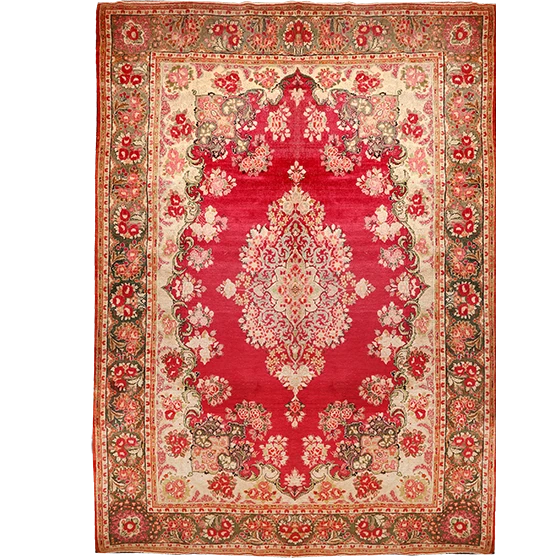
Madder red, cream, and forest green in an antique Farahan - Farahan Persian Rug 14x10 ft - Medallion Antique Wool Hand Knotted
3
Natural Dyes Versus Synthetic Dyes
To understand natural dyes, it helps to know what they are compared with. Synthetic dyes in rugs fall into two broad families.
Early Aniline Dyes
The first synthetic dyes reached Persia in the late nineteenth century. They were cheap and easy to use, but many were unstable: they faded quickly in light or bled when the rug was washed. Their story, and the Persian government's attempts to ban them, is told in our article on Persian rug dyeing. Rugs with poor aniline dyes are usually recognizable by colors that have faded to unusual tones - for example, purples that have turned gray-brown on the front while remaining bright on the back.
Modern Chrome Dyes
In the twentieth century, much more stable synthetic dyes were developed, generally called chrome dyes because many use chromium compounds as part of the fixing process. These dyes are durable, colorfast, and consistent, and they are used in a large share of good modern hand-knotted rugs. A chrome-dyed rug is not a poor rug. It simply has a different character: cleaner, more uniform colors, and less variation within each color area.
The table of differences can be summarized simply:
•
Color depth - natural dyes give layered, complex color; synthetic dyes give clean, uniform color.
•
Variation - natural dyes produce natural abrash and fiber-to-fiber variation; synthetic dyes are very even unless variation is added deliberately.
•
Aging - good natural dyes mellow and soften gracefully; good chrome dyes change very little; poor anilines fade unattractively.
•
Harmony - natural palettes tend to blend easily; synthetic palettes can be bolder and sometimes more contrasting.
•
Cost and time - natural dyeing is slow and skilled work, which is reflected in the price of the finished rug.
4
Seven Ways to Recognize Natural Dyes
No single test can prove that a rug is naturally dyed - in difficult cases specialists use laboratory analysis. But the following observations, used together, will give you a very good sense of what you are looking at.
1. Look for Living Color
Stand back and look at the rug in daylight. Naturally dyed colors usually have a soft, glowing quality, with slight variation within each color area. Synthetic colors can look flatter, more uniform, or occasionally almost too bright.
2. Look for Gentle Abrash
Soft horizontal bands where a color shifts slightly in tone are typical of hand-dyed wool, especially in village and nomadic rugs where wool was dyed in small batches. Abrash in a natural rug usually looks organic and irregular.
3. Compare Front and Back
Turn a corner over. The back of the rug has been shielded from light, so it shows the original colors. In an older naturally dyed rug, the front will be somewhat softer and lighter, but the colors will still clearly belong to the same family. If a color has changed into a completely different hue, that suggests an unstable early synthetic dye.
4. Part the Pile
Fold the rug gently so the pile opens along a line of knots. In a naturally dyed rug that has seen some light, you will often see that the tips of the fibers are a little lighter and the base a little deeper. This gradual change is normal and attractive. A sharp difference, or a base color that is completely different from the tips, can point to fading of an unstable dye or to surface treatment.
5. Look at the Edges of Colors
Look closely where a red or dark blue area meets white or ivory. Stable dyes leave crisp edges. A pink or gray halo spreading into the white ground can indicate a dye that has bled during washing. Natural dyes properly mordanted rarely bleed.
6. Notice How the Colors Age
In an older rug, natural colors age in characteristic ways: madder reds soften toward rose and coral, indigo becomes a softer, slightly greener blue, and yellows mellow. Dark browns made with iron may wear lower than the surrounding pile. These signs of graceful aging are among the most valued features of antique and semi-antique rugs.
7. Ask and Verify
Finally, ask the seller. A reputable dealer will tell you what is known about a rug's dyes, origin, and age, and will be honest when something is uncertain. Documentation, such as a certificate of authenticity, adds confidence.
A gentle tip from experience: never test a rug's dyes yourself by rubbing it with a wet cloth or chemicals. You may damage the pile, and the result is easy to misread. If you are seriously considering a valuable rug, ask a specialist.
5
How Natural Dyes Age Over Time
One of the most compelling reasons to choose a naturally dyed rug is the way it develops over the years. A new naturally dyed rug can look quite vivid. With time, gentle exposure to light, and normal use, the colors soften and come closer together, creating the warm, harmonious look that people associate with old Persian rugs. This process, sometimes called patina, cannot be truly reproduced by artificial means, although many modern rugs are chemically washed to imitate it.
The changes are not random. Each natural dye follows its own path:
•
Madder reds - become softer and warmer, moving from deep red toward brick, coral, and rose.
•
Indigo blues - lighten slightly and can take on a gentle gray or green tone.
•
Yellows - plant yellows are the least lightfast of the natural dyes and often soften considerably, which is why some old greens have turned blue as their yellow component faded.
•
Browns and blacks - iron-based dark colors gradually weaken the wool and wear down, leaving those areas slightly lower than the surrounding pile.
Collectors value these signs because they tell the story of a rug's life. A rug that has aged this way has a quiet authenticity that a new rug, however fine, cannot yet have.
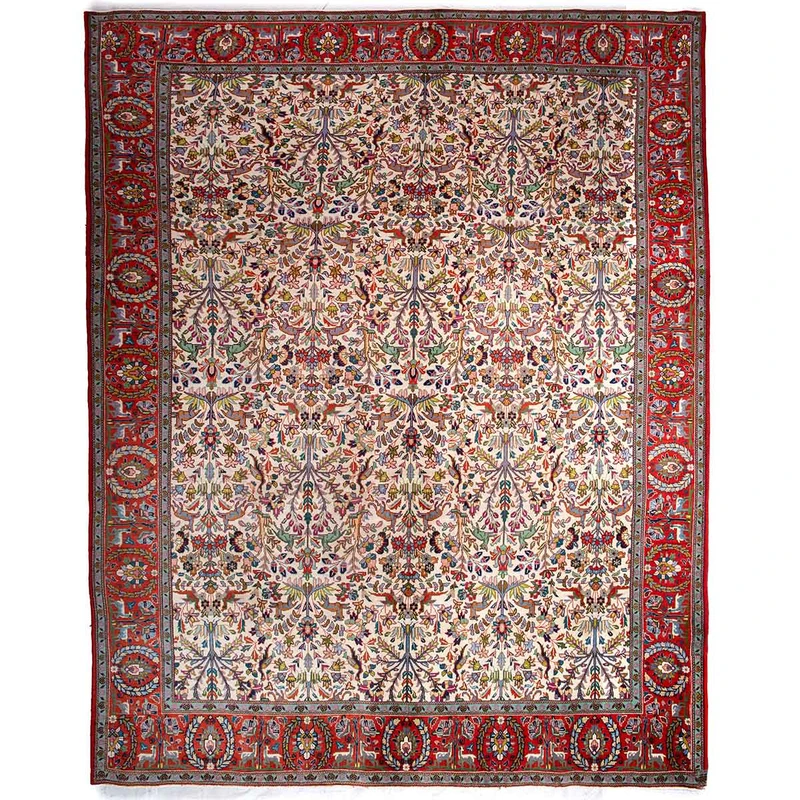
Cream, madder red, and green in a Tabriz all-over design - Tabriz Persian Rug 12x10 ft - Afshan Semi Antique Wool Silk Hand Knotted
6
Natural Dyes and Value
Natural dyeing takes longer, needs more skill, and uses more expensive materials than synthetic dyeing. Madder roots must grow for several years before harvest. Indigo vats take days to prepare. A single color may require multiple baths. All of this is reflected in the price of a naturally dyed rug, and in its long-term value.
In the antique market, the quality of the dyes is one of the main factors that experts use to judge a rug. A nineteenth-century rug with beautiful, stable natural colors from a known region can be worth many times more than a similar rug with faded early synthetic dyes. Among contemporary rugs, those made with hand-spun, naturally dyed wool - including many fine Gabbeh and tribal rugs - have built a loyal following. Our article on investing in hand-knotted rugs looks at how these factors shape value over time.
7
Natural Dyes and the Environment
Natural dyes also appeal to people who think carefully about what they bring into their homes. They are made from renewable plants and from by-products such as pomegranate peel and walnut husk that would otherwise be thrown away. Traditional mordants such as alum are relatively benign compared with many industrial chemicals. Persian researchers studying traditional dyes have pointed out that their sustainability, alongside their colorfastness, is a strong argument for keeping the craft alive.
It is fair to add that natural dyeing is not entirely without impact - it uses water, heat, and some mineral salts - and that good modern synthetic dyes are carefully regulated. But for many buyers the combination of beauty, tradition, and natural materials makes naturally dyed rugs especially attractive.
8
Caring for a Naturally Dyed Rug
Naturally dyed rugs are durable, but like any fine textile they reward a little care:
•
Limit strong direct sunlight - plant yellows in particular can fade. Rotate the rug once or twice a year so that it ages evenly.
•
Vacuum gently and regularly - grit wears fibers and dulls color. Use suction without an aggressive beater bar.
•
Blot spills quickly - use cool water and a clean white cloth. Avoid strong household cleaners, which can strip or shift natural colors.
•
Wash professionally - a hand wash in cool water with gentle wool soap preserves dyes best. See our guide to professional rug washing.
•
Avoid chemical bleaching - some modern washes lighten rugs with chemicals to imitate age. This weakens wool and is never appropriate for a fine naturally dyed rug.
Our care instructions page and our article on washing a Persian rug at home give more detailed guidance.
9
Common Myths About Natural Dyes
"Natural dyes never fade."
All dyes change over time. Good natural dyes change gracefully, which is different from not changing at all.
"Bright colors mean synthetic dyes."
Not necessarily. Fresh madder, indigo, and insect reds can be very vivid. Brightness alone tells you little; the quality and complexity of the color tell you more.
"Any rug with abrash is naturally dyed."
Abrash can be created deliberately with synthetic dyes. It is one useful sign among several, not proof.
"Synthetic dyes mean a rug is not authentic."
A hand-knotted Persian rug made with good chrome dyes is still an authentic hand-knotted Persian rug. Dye type is about character and value, not authenticity.
10
Natural Dyes in Different Types of Persian Rugs
Natural dyes do not look the same in every kind of rug. The way wool was dyed depended on how and where the rug was made, and this shows clearly in the finished piece.
City Workshop Rugs
In the great weaving cities such as Kashan, Isfahan, Tabriz, and Kerman, workshops usually dyed all the yarn for a carpet before weaving began, in large, carefully controlled batches. The result is a refined, even palette with very little abrash, and often a wide range of carefully graded shades - several reds, several blues, and soft secondary colors used for shading in floral designs.
Village Rugs
Village weavers, such as those of Heriz, Hamadan, and the Arak region, often dyed their own wool or bought it from a local dyer in smaller quantities. Their rugs typically show bolder, simpler palettes and more visible abrash, especially in the large red or blue fields. Many collectors find this spontaneity part of their charm.
Nomadic and Tribal Rugs
Nomadic weavers of the Qashqai, Bakhtiari, Kurdish, and Baluch peoples dyed wool in small batches as they moved between summer and winter pastures, using whatever plants were available along the way. Their rugs often show the strongest abrash of all, and the most personal color choices. Our articles on Qashqai weaving and Kurdish rugs explore these traditions.
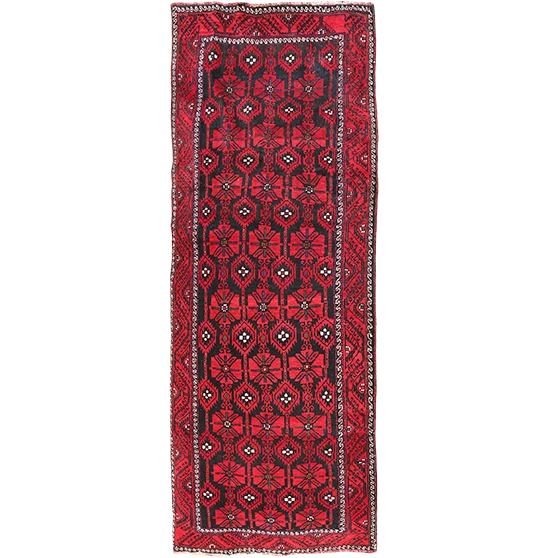
Baluch weaving in wool and natural camel hair - Baluch Persian Rug 13x5 ft - Herati Semi Antique Wool Camel Hair Hand Knotted
Silk Rugs
Silk takes natural dyes beautifully, giving deep, jewel-like colors with a natural sheen, but it is more delicate to dye than wool. Fine silk rugs from Qom, Kashan, and Isfahan have historically used insect reds and indigo for their most brilliant tones. Our article on Persian silk rugs explains more about this fiber.
11
Questions to Ask Before You Buy
When you are considering a rug and color matters to you, a few direct questions will help you understand what you are buying:
•
Are the dyes natural, synthetic, or a mix? Many rugs combine natural reds and blues with a few synthetic accent colors, and a knowledgeable seller will tell you so.
•
Was the wool hand-spun? Hand-spun wool takes dye less evenly than machine-spun yarn, which deepens the natural variation in color.
•
Has the rug been chemically washed? Strong chemical washes can soften colors quickly but also weaken the wool.
•
Has any color been retouched? Worn areas in older rugs are sometimes painted to hide wear. Small professional touches are common, but you should know about them.
•
Where and roughly when was it made? Region and period help explain the palette and how it has aged.
Our article on how to buy a Persian rug and our Before You Buy page cover many other useful points.
12
A Short Glossary of Dye Terms
•
Abrash - natural variation in a color across a rug, caused by differences between dye batches.
•
Mordant - a substance, such as alum, that fixes dye to fiber and can change its shade.
•
Over-dyeing - dyeing yarn in a second bath to create a new color, such as yellow over blue for green.
•
Patina - the soft, mellow appearance that natural colors develop with age and use.
•
Chrome dye - a stable modern synthetic dye used in many contemporary rugs.
•
Aniline dye - an early synthetic dye, often unstable, introduced in the late nineteenth century.
For many more terms, see our Persian rug glossary.
13
Why the Tradition Continues
Natural dyeing almost disappeared in the twentieth century, overwhelmed by cheaper and faster synthetic methods. That it survives today is thanks to families who kept their recipes, researchers who documented them, and buyers who continued to value the results. Each naturally dyed rug carries that history with it - the roots, flowers, and husks of the Persian countryside, transformed by skilled hands into color that will last for generations.
To go further, read about mordants, the principal sources of natural color, and other color plants, or explore what each color means in the nine iconic Persian color ranges.
At Los Angeles Home of Rugs, every rug comes with a Certificate of Authenticity documenting its origin, materials, and age. If you would like to know more about the dyes in a particular rug, ask our experts - we are always happy to help.
Explore the Collection
Antique Rugs
Semi-Antique Rugs
Village Rugs
Nomadic Rugs
Gabbeh Rugs
Madder Red
Indigo
Wool Rugs
Certified Authentic
Persian Rug FAQ