


Principal Natural Dyes of Persian Rugs: Madder, Indigo & More
Los Angeles Home of Rugs on Nov 17th 2026
A classical Persian rug may display fifteen or twenty colors, but behind that palette stands a surprisingly short list of dye sources. A handful of roots, leaves, insects, rinds, and flowers, combined with skill and patience, produced almost every color seen in Persian weaving for more than two thousand years. Knowing these principal dyes helps you understand why Persian rugs look the way they do, why certain colors are associated with certain regions, and why some colors age differently from others.
In our earlier articles we introduced the master dyer, explained natural dyes and how to recognize them, and described the mordants that fix them to wool. This article looks closely at the principal dye sources one by one: where they come from, how they were prepared, which colors they give, where in Persia they were most important, and how they appear in rugs today. Our next article covers the many secondary color plants that completed the dyer's palette.
1
Madder - The Root of Persian Red
If one dye could be called the foundation of Persian rug color, it is madder, known in Persian as runas. Madder (*Rubia tinctorum*) is a climbing perennial plant whose long, reddish roots contain a rich mixture of coloring compounds, chief among them alizarin and purpurin. Scientists have identified dozens of related compounds in madder root, and that complexity is precisely what gives madder reds their warmth and depth.
Cultivation and Harvest
Madder has been grown in Persia for millennia. The arid central regions around Yazd, Ardakan, Bafgh, and Kerman have been especially famous for it, and the dry desert soils were believed to produce particularly strong roots. Madder is slow: roots are usually harvested after three years or more. Persian studies note that the strength of the color tends to increase from about the third year, with older roots giving deeper, more purple-red tones, and that very old roots lose value. After harvest the roots are washed, dried, and ground into a coarse red-orange powder.
Colors from Madder
Madder is extraordinarily versatile. With an alum mordant it gives the classic clear reds of Persian rugs; with different mordants, temperatures, and additives it gives:
•
Deep crimsons and wine reds - achieved through careful temperature control, alkaline additions, or longer dyeing.
•
Pinks, roses, and corals - from weak baths or from madder that has already been used once.
•
Oranges - from madder combined with yellow dyes, or with tin mordants in later periods.
•
Purples and browns - from madder with iron, or madder over-dyed with indigo.
The dyer's secret was temperature. Madder kept warm but well below boiling gives clear reds; overheated, it turns dull and brownish. Many traditional recipes also called for soaking the ground root overnight before the bath was heated.
How Madder Ages
Madder is one of the most lightfast natural dyes. Over many decades madder reds gradually soften toward rose, coral, and terracotta, which is why antique Persian rugs so often show those warm, mellow tones. You can explore this color range in our madder red and red rugs collections.
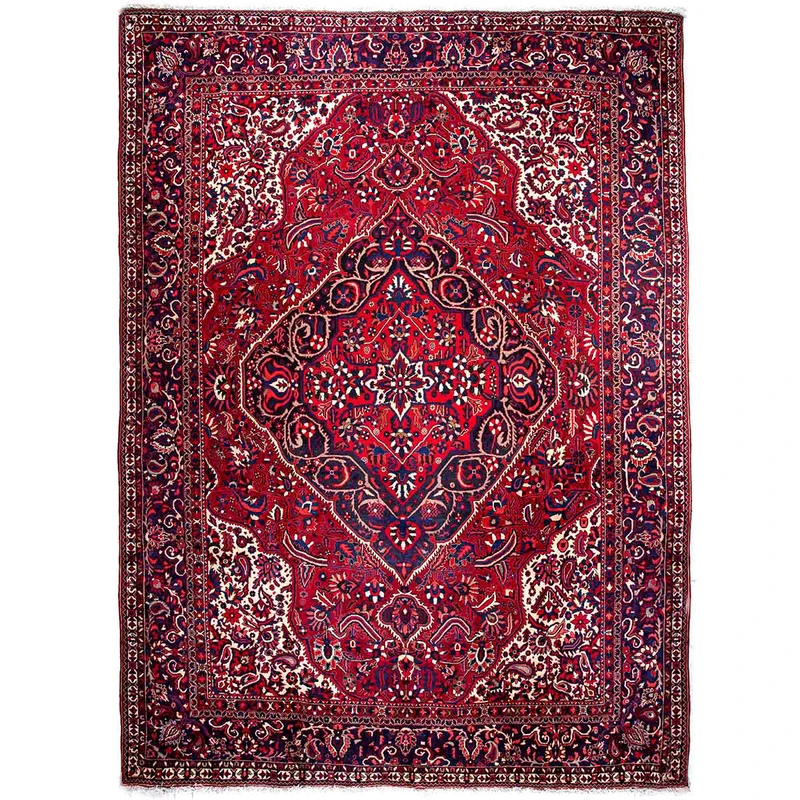
Madder red and navy blue in a Bakhtiari medallion rug - Bakhtiari Persian Rug 14x10 ft - Medallion Semi Antique Wool Hand Knotted
2
Indigo - The Blue of Kings and Nomads
The second great Persian dye is indigo, called nil in Persian. Indigo is obtained from the leaves of plants of the *Indigofera* genus. Unlike madder, the dye does not exist in a ready-made form in the plant: the leaves are fermented in water, the liquid is beaten to introduce air, and a blue sediment forms that is collected, pressed, and dried into cakes.
A Traded Treasure
Much of the indigo used in Persia came historically from India, carried by caravan and sea, and it was one of the most valuable commodities in the dye trade. Indigo was also cultivated in the warm south of Persia, around Kerman and Bam, and in parts of Khuzestan. Before indigo became widely available, and in some areas alongside it, the related plant woad (*Isatis tinctoria*) provided a weaker blue from the same coloring compound.
The Indigo Vat
Indigo is insoluble in water, so it cannot be used like other dyes. The dyer must prepare a special vat in which the indigo is converted into a soluble, colorless form, traditionally through slow fermentation with plant material and an alkali such as potash. Wool dipped into this vat comes out greenish-yellow and turns blue as it meets the air. Light blues need only one dip; deep navy needs many dips with airing between each one. Because the color builds up in layers, indigo-dyed wool has great depth.
Colors from Indigo
Indigo gives every shade from pale sky blue to the deepest midnight navy, and it is the essential partner of yellow in making greens and of madder in making purples. Explore indigo, navy blue, and midnight blue rugs in our collection.
How Indigo Ages
Indigo is very lightfast but slowly lightens with wear, as its color sits on the surface of the fiber. Older indigo often takes on a soft, slightly grayish or greenish tone that many collectors find especially beautiful.
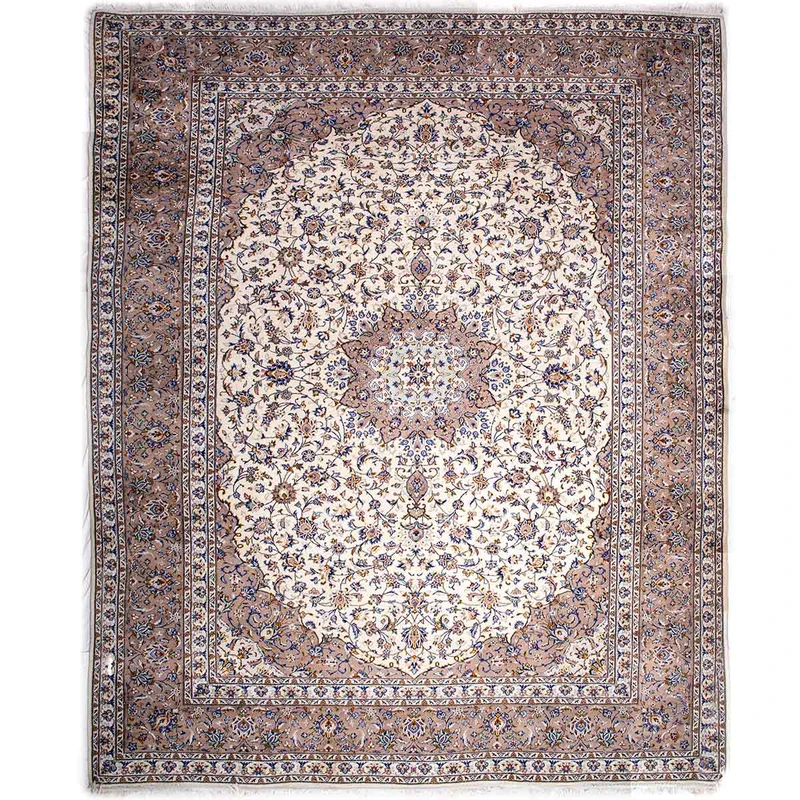
Navy blue, cream, and brown in a Kashan wool and silk rug - Kashan Persian Rug 12x9 ft - Medallion Semi Antique Wool Silk Hand Knotted
3
Kermes and Cochineal - The Crimson Insects
The most brilliant reds in Persian weaving came not from plants but from insects. Kermes (*Kermes vermilio*), an insect that lives on oak trees around the Mediterranean and the Near East, was used for red dye since ancient times. Its Persian and Arabic name, qermez, is the source of the English words crimson and carmine.
A related insect from the Caucasus and Armenian highlands, sometimes called Armenian cochineal, was also prized, and the reds of the ancient Pazyryk carpet were made with an insect dye of this kind. Later, cochineal from the Americas (*Dactylopius coccus*), which lives on prickly pear cactus, arrived through global trade and gradually replaced the older insect dyes because it gave more color per pound.
Insect dyes were expensive, so they were used selectively: in fine city carpets, in silk rugs, and for especially bright crimson and magenta accents. With alum they give brilliant crimson; with tin, scarlet; with iron, purple and gray. In Kashan and other centers of fine weaving, insect reds were especially associated with silk, which takes them beautifully. Explore our crimson and cardinal red rugs.
How can you tell madder red from insect red? Generally, madder gives a warmer, slightly orange or brick red, while insect reds lean toward a cooler crimson or raspberry. Only laboratory analysis can be certain, but this difference in temperature is often visible to an experienced eye.
4
The Great Yellows - Larkspur, Weld, and Saffron
Yellow is the third primary color, and Persian dyers had several sources for it. Yellow was rarely a large field color in Persian rugs, but it was essential for highlights and, above all, for making greens and oranges through over-dyeing.
Esparak
The most famous Persian yellow dye is esparak. In the Persian dye tradition, esparak usually refers to a yellow-flowering species of larkspur (*Delphinium*) that grows wild in the mountains of Khorasan and northern Persia and has long been gathered for dyeing. Some modern studies also use the name for weld (*Reseda luteola*), the classic European dyer's yellow, which belongs to a different plant family but gives a similar clear yellow. Both give bright, clean yellows with alum and olive tones with iron, and both were used in the green-making process.
Saffron
Saffron, the stigma of the crocus flower and one of Persia's most famous products, has been used for golden yellow since ancient times. Persia is still the world's largest producer of saffron, much of it grown in Khorasan. Because saffron is so costly and not very lightfast, it was used sparingly in rugs, usually for small accents in the finest pieces. Today the word lends its name to a whole color family - see our saffron and gold rugs.
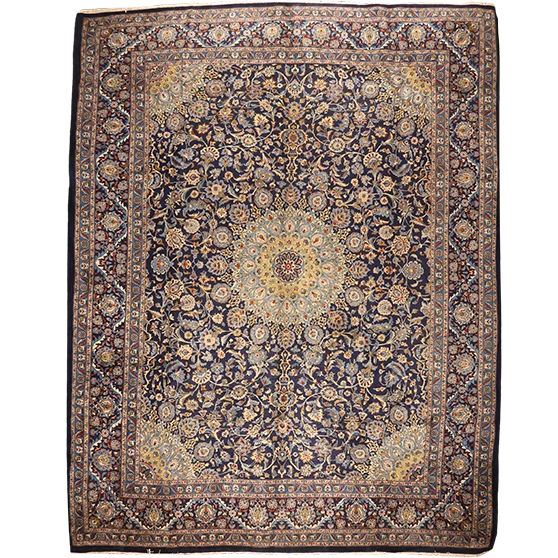
Antique gold accents in a Kashmar Shah Abbasi design - Kashmar Persian Rug 12x10 ft - Shah Abbasi Semi Antique Wool Hand Knotted
Turmeric and Other Yellows
Turmeric gives a strong, deep yellow but fades relatively quickly in light, so it was used with caution. A recent Persian university study comparing ten traditional yellow dye plants on wool found that onion skin and esparak gave the strongest colors, while turmeric showed the weakest resistance to light - confirming what traditional dyers knew from experience.
5
Pomegranate - Color and Mordant in One
The pomegranate, a fruit deeply embedded in Persian culture and poetry, was also an important dye. Its dried rind, pust-e anar, is rich in tannin and gives soft yellows, golden tans, and khaki shades. With iron it turns gray-green to dark gray. Because of its tannin content, pomegranate rind also served as a mordant and as a base for other dyes, as we explain in our article on mordants.
Pomegranate rinds were a by-product of a fruit grown widely in central and southern Persia, around Saveh, Yazd, Kashan, and Fars, which made them cheap and readily available. Many of the subtle olive greens and camel tones of Persian rugs owe something to pomegranate.
6
Walnut - Browns and Blacks
The green outer husk of the walnut, called pust-e gerdu, provides warm browns without any mordant, and very dark browns or near-blacks with iron. Walnut trees grow widely in the mountain valleys of Persia, and walnut husk was one of the most important sources of brown for village and nomadic weavers. Walnut leaves and bark were used as well.
Browns and blacks were essential for outlining motifs and for the dark details of many designs. Because dark colors were often fixed with iron, they are the colors most associated with corrosion and the embossed effect in old rugs. Explore brown rugs and camel rugs in our collection.
7
Oak Galls and Tannin Blacks
For the deepest blacks, dyers turned to oak galls - the hard, nut-like growths that form on oak trees after gall wasps lay their eggs. Galls are among the richest natural sources of tannin, and with iron they give a deep, permanent black that was also used for ink. Galls were gathered especially in the oak forests of the Zagros Mountains and traded throughout Persia.
Because pure black dyes tended to weaken wool, many weavers also used the natural dark brown or black wool of their own sheep and goats, which needed no dye at all. Many tribal rugs mix naturally dark wool with dyed colors.
8
The Undyed Palette - Natural Wool Colors
Not every color in a Persian rug came from a dye bath. Sheep, goats, and camels provided a whole range of natural shades that weavers used directly, and these undyed colors are an important part of the Persian palette.
•
Ivory and cream - natural white wool, sometimes lightly washed or sun-bleached, used for fields, borders, and highlights. See our ivory and cream collections.
•
Natural browns and blacks - the dark wool of certain sheep and goats, used for outlines and details without any risk of dye corrosion.
•
Gray and beige - blended or naturally colored fleece, especially common in Gabbeh and tribal rugs.
•
Camel hair - a warm, golden-tan natural fiber used in some tribal and Hamadan-region rugs, often in its undyed state.
Many of the most admired contemporary Gabbeh rugs combine undyed natural wool with a few naturally dyed colors, creating a calm, earthy palette that suits modern interiors.
9
Quality Grades and the Dye Bazaar
The principal dyes were traded goods, and like any traded goods they came in different qualities. Experienced dyers judged madder by the color of the cut root and the fineness of the powder, indigo by the coppery sheen on the surface of the cake and the way it broke, and insect dyes by their purity and dryness. Adulteration was a known problem: madder powder could be mixed with cheaper materials, and poor indigo could contain sand or clay.
A dyer's reputation depended on buying well. Workshops that consistently used the best materials produced colors that were deeper, more even, and more lasting - qualities that buyers and merchants learned to recognize. In this sense, the quality of a rug's colors reflects not only the skill of the dyer but also the network of growers, gatherers, and traders that supplied him.
Preparing the Principal Dyes
Each principal dye needed its own preparation before it could color wool:
•
Madder - dried roots were ground in stone mills and often soaked overnight. Some dyers washed the powder briefly to remove yellowish compounds and obtain a purer red.
•
Indigo - cakes were ground finely and introduced into a carefully maintained fermentation vat that might be kept going for weeks.
•
Insect reds - dried insects were crushed and boiled, and the dye liquid was strained before the wool was added.
•
Yellow plants - flowers, leaves, and stems were boiled to extract color, usually just before use, as the color weakens with storage.
•
Rinds and husks - pomegranate rind and walnut husk were dried, broken up, and soaked or boiled for long periods to release their tannins and color.
Each of these steps required judgment, and small differences in preparation explain much of the variation between dye houses using the same materials.
10
Greens, Oranges, and Purples - Colors Made by Combination
Some of the most beautiful colors in Persian rugs came from no single plant at all. They were made by combining the principal dyes:
•
Green - yellow (esparak, weld, or pomegranate) over indigo, or indigo over yellow. Explore green, forest green, and olive rugs.
•
Purple and aubergine - madder or insect red over-dyed with indigo, or madder with iron.
•
Camel and tan - walnut, pomegranate, or madder in weak baths, sometimes combined.
Over-dyed greens tell an interesting story as they age. Because plant yellows fade faster than indigo, some greens in old rugs have gradually shifted toward blue. When you see a blue-green leaf in an antique rug, it may once have been a bright green.
11
Where the Dyes Came From - A Map of Persian Color
The principal dyes were tied closely to geography, and that geography left its mark on regional rug palettes:
•
Central desert regions (Yazd, Ardakan, Kerman) - madder cultivation, giving rise to the strong reds of central Persian rugs.
•
The south (Kerman, Bam, Fars) - indigo cultivation and pomegranates, contributing to the rich blues and soft tones of Kerman and southern tribal rugs.
•
Khorasan in the northeast - esparak and saffron, supporting the yellows and greens of eastern Persian weaving. See Khorasan rugs.
•
The Zagros Mountains in the west - oak galls, acorns, and walnut, providing browns and blacks for Kurdish, Luri, and Bakhtiari weavers.
•
The Caucasus and northwest - insect reds and trade routes linking Persia with Anatolia and Armenia, important for Tabriz and Azerbaijan workshops.
Trade connected all these regions, so a dyer in Tabriz might use madder from Yazd, indigo from India, and galls from Kurdistan in the same rug.
12
How the Source of a Color Shows in a Rug
With a little practice, you can begin to read the principal dyes in a rug:
•
Warm, brick-toned reds that have softened evenly usually point to madder.
•
Cool, raspberry-toned crimson accents may indicate an insect dye, especially in fine city or silk rugs.
•
Deep, layered blues with slight variation suggest natural indigo.
•
Dark brown outlines worn lower than the rest of the pile suggest walnut or gall dyes fixed with iron.
•
Greens that have drifted toward blue suggest over-dyed natural yellows that have faded.
These signs are not proof on their own, but together they help you appreciate the rug's history. For a broader guide, see our article on recognizing natural dyes.
13
The Principal Dyes Today
The principal natural dyes have never entirely disappeared from Persian weaving, and in recent decades they have returned strongly. Madder is still cultivated in the Yazd and Kerman regions, and Persian researchers continue to study how root age, origin, and dyeing method affect its color. One study comparing madder from several Persian growing areas found that the dyeing method mattered more to the final shade than where the roots were grown - a reminder that the dyer's skill remains the decisive factor.
Indigo, pomegranate, and walnut remain widely used by workshops that specialize in natural dyes and by many village and tribal weavers, while insect reds are used more selectively because of their cost. For buyers, this means that new rugs made with the principal natural dyes are available alongside antique and semi-antique pieces, and that each carries the same color heritage described in this article. When you browse rugs, look for sellers who can tell you clearly which dyes were used.
14
Frequently Asked Questions
What is the most important natural dye in Persian rugs?
Madder. It provides the reds that dominate so many Persian rugs, and with different mordants and combinations it also gives pinks, oranges, purples, and browns.
Was indigo grown in Persia?
Yes, in the warm south, but much indigo was also imported from India. Both sources were used for centuries.
Why are yellows less common than reds and blues?
Plant yellows are less lightfast than madder and indigo, so they were used more for small details and for mixing greens and oranges than for large fields.
Are these dyes still used today?
Yes. Madder, indigo, pomegranate, walnut, and other traditional dyes are used today by natural-dye workshops and many tribal and village weavers.
15
From Plants to Palette
Madder, indigo, insect reds, the yellow flowers, pomegranate, walnut, and oak galls - these few sources, refined over centuries, created one of the most admired color traditions in the world. Each rug that uses them carries a little of the Persian landscape: the desert madder fields, the southern indigo, the mountain walnut groves, and the skill of the dyers who brought them together.
Complete the series with our article on other color plants, and for the cultural meaning of each color, read the nine iconic Persian color ranges.
At Los Angeles Home of Rugs, every rug comes with a Certificate of Authenticity documenting its origin, materials, and age. Browse our collection by color, or ask our experts about the dyes in any rug.
Explore by Color
Madder Red
Crimson
Indigo
Navy Blue
Saffron
Olive
Camel
Antique Rugs
Persian Rug FAQ