


Mordants in Persian Rug Dyeing: The Key to Lasting Color
Los Angeles Home of Rugs on Nov 17th 2026
Every Persian rug owner admires the colors, but very few have heard of the ingredient that makes those colors last. It is called a mordant, and without it most natural dyes would wash out of wool within a few cleanings or fade within a few summers. Mordants are invisible in the finished rug, yet they decide how a red looks, how long it stays red, and even how the wool beneath it ages over a century.
The word comes from the Latin *mordere*, "to bite," because early dyers imagined that the mordant helped the dye bite into the fiber. Persian dyers called it dandaneh, from the word for tooth, with exactly the same idea. This article, the third in our series on Persian rug color, explains what mordants are, which ones Persian dyers used, how they were applied, how they change color, and why they matter to anyone choosing a rug today. It follows our articles on the master dyer and natural dyes.
1
Why Wool Needs a Mordant
Wool is made of keratin, a protein with many chemical "handles" that can bond with other substances. Some dyes, such as indigo, attach to wool without help. But most natural dyes - including madder, the great source of Persian reds, and nearly all the yellow plant dyes - bond only weakly on their own. Dyed without a mordant, they give pale colors that rinse out easily and fade quickly in light.
A mordant solves this problem. It is usually a metal salt. When wool is simmered in a mordant bath, metal ions attach to the fiber. When the wool then enters the dye bath, the dye molecules attach to those metal ions, forming a stable, insoluble complex locked into the fiber. In effect, the mordant acts as a bridge between wool and dye.
Mordants do more than fix color. They also change it. The same madder root can give a bright red with alum, a deep purple-brown with iron, and an orange-red with tin. This is why mordants were one of the dyer's most powerful tools for building a varied palette from a small number of dye plants.
Dyers sometimes divide natural dyes into two groups: substantive dyes, which can bond with fiber on their own, and adjective dyes, which need a mordant. Indigo, walnut husk, and some tannin-rich materials are largely substantive; madder and most yellows are adjective dyes.
2
The Classic Mordants of the Persian Dye House
Alum - The Dyer's Most Trusted Ally
The most important mordant in Persian dyeing, as in much of the world, was alum, known in Persian as zaj-e sefid, or white alum. Alum is a double sulfate of aluminum and potassium, found naturally in certain rocks and once traded widely across the Middle East. It is relatively safe, inexpensive, and - crucially - it brightens colors rather than dulling them.
Alum gives madder its classic clear reds and allows yellow plants to produce clean, bright yellows. Combined with over-dyeing in indigo, it makes possible the fresh greens seen in many fine rugs. A typical traditional practice was to simmer wool with a measured amount of alum for an hour or more, sometimes with a little cream of tartar or a plant acid to help the process and to keep the wool soft. Modern studies of Persian madder dyeing still use alum at only a few percent of the weight of the wool, much as traditional dyers did.
Iron - Deepening and Darkening
Iron mordants, usually in the form of iron sulfate (often called green vitriol or copperas, and in Persian zaj-e siah or zaj-e sabz), were used to darken and "sadden" colors. Iron turns yellows into olive and khaki, reds into purples and browns, and - most importantly - turns tannin-rich materials into grays and blacks.
Before iron salts were readily available, dyers produced iron mordants in simpler ways, such as steeping rusty iron in vinegar or sour liquids, or using iron-rich mud. Iron was indispensable, because the deep browns and blacks used for outlines, motifs, and borders in many Persian rugs were typically produced by combining tannins with iron.
Copper and Tin
Copper, sometimes added in the form of copper sulfate or simply through dyeing in copper vessels, could shift yellows toward green and give some colors added depth. Some dyers believed that the copper vats of particular towns helped give their colors a distinctive tone. Tin, introduced more widely in later periods, brightens reds toward scarlet and orange and is still used in some modern natural dyeing. A recent Persian university study of ten yellow dye plants found that a tin pre-mordant improved both washing and light fastness of the dyed wool.
Chrome - A Modern Mordant
In the twentieth century, potassium dichromate came into use as a mordant, and chromium compounds later became central to the stable synthetic dyes known as chrome dyes. Chrome mordants give good fastness but are toxic and require careful handling, which is why many contemporary natural dyers avoid them.
3
Natural Mordants from Plants
Not all mordants came from mines. Persian dyers also used plant materials that either act as mordants themselves or help a dye bond to wool.
Tannins
Tannins are natural compounds found in bark, galls, leaves, and fruit rinds. They bond well with protein fibers and with metal mordants, and they are also dyes in their own right, giving tans, yellows, and browns. Persian dyers used several tannin sources:
•
Pomegranate rind - one of the most valued, giving a yellow-tan color and acting as a strong tannin mordant. It was widely available from the pomegranate-growing regions of central and southern Persia.
•
Oak galls - the hard growths on oak trees caused by gall wasps, extremely rich in tannin. Combined with iron, they give deep blacks.
•
Sumac - the leaves and branches of the sumac shrub, used for tans and as a tannin base.
•
Acorn cups and oak bark - common sources of tannin in the oak forests of the western mountains, especially among Kurdish and Luri weavers.
Plant Acids
Mild acids help wool take up mordants and dyes evenly and can brighten certain colors. Traditional sources included sour grape juice (ab-ghooreh), sour pomegranate juice, vinegar, and fermented bran or yogurt whey (doogh). These were often added in small amounts to mordant or dye baths, and each dyer had preferences that contributed to a workshop's characteristic colors.
Alkalis
Some steps required alkaline conditions instead. A traditional alkali was qalyab, potash made from the ashes of desert saltwort plants (called eshnan), which was also used for washing wool. Lime and wood ash served similar purposes. In the indigo vat, alkaline conditions are essential, and in some madder dyeing, a touch of alkali shifts the red toward a bluer, more crimson tone.
4
The Mordant Bath Step by Step
While every dye house had its own variations, a traditional alum mordanting process followed a pattern like this:
•
Scouring - the wool was washed to remove dirt and excess grease, so that the mordant could reach the fiber evenly.
•
Weighing - the dyer measured alum in proportion to the weight of the wool, a ratio learned through long experience. Too little gave weak colors; too much made the wool harsh and sticky.
•
Dissolving - the alum was dissolved in hot water, sometimes with a plant acid, before the wool was added.
•
Simmering - the wet wool was placed in the bath and heated slowly to just below boiling, then held there for an hour or more. Rapid heating or boiling would felt and damage the wool.
•
Resting - the wool was often left to cool in the bath overnight to deepen the effect.
•
Rinsing or ageing - the wool was rinsed lightly and either dyed at once or dried and stored for later use.
Throughout this process the dyer worked by feel and eye: the temperature of the bath judged by hand, the condition of the wool judged by touch. This practical knowledge, passed from master to apprentice, is part of what made each dye house unique.
5
The Three Ways to Apply a Mordant
Dyers could introduce a mordant at different stages, and each method gives slightly different results:
•
Pre-mordanting - the wool is mordanted before dyeing. This is the most common method for alum and gives the most reliable, even colors.
•
Simultaneous mordanting - the mordant is added directly to the dye bath. This saves time and fuel and was common in village and nomadic dyeing.
•
Post-mordanting (afterbath) - the wool is dyed first and then treated with a mordant, usually iron, to darken or shift the color. This allowed a dyer to create a darker shade from part of a batch that was already dyed.
By combining these methods - for example, alum before dyeing and a light iron afterbath - a skilled dyer could create subtle variations within one color family, such as several shades of brown, rose, or olive for a single rug.
6
How Mordants Change Color
To appreciate the role of mordants, it helps to see how they transform common Persian dyes. The examples below are typical, though actual shades vary with recipe and wool:
•
Madder - with alum, clear red; with iron, purple, plum, or brown; with tin, orange-red; with more alkali, a bluer crimson.
•
Yellow plants such as weld or larkspur - with alum, bright yellow; with iron, olive green or khaki; with copper, greenish yellow.
•
Pomegranate rind - with alum, golden tan; with iron, gray-green to dark gray.
•
Walnut husk - with no mordant, warm brown; with iron, very dark brown to black.
•
Oak galls - with iron, deep black.
This is why the colors in a Persian rug, though they may number fifteen or more, often trace back to only a handful of plants. Our article on the principal sources of natural color explains each dye plant in detail.
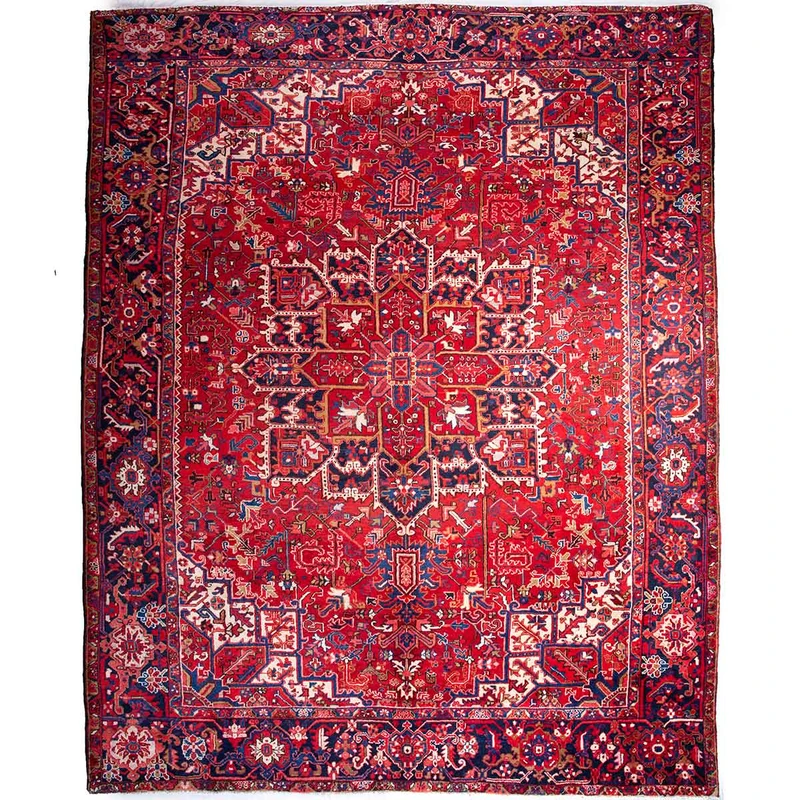
Madder red and navy blue in a Heriz Herati design - Heriz Persian Rug 12x9 ft - Herati Semi Antique Wool Hand Knotted
7
Iron, Corrosion, and the Embossed Effect
Iron mordants have a fascinating side effect that every owner of an older Persian rug should understand. Over many decades, the iron and tannin used to produce dark browns and blacks slowly weaken the wool fibers. In older rugs these dark areas wear faster than the colors around them, until the dark outlines and motifs sit noticeably lower than the rest of the pile.
Rug specialists call this corrosion or oxidation. In a moderate form it is not considered a defect; in fact, it creates a beautiful relief effect, as though the design had been carved into the surface, and it is one of the signs collectors look for when judging age and authenticity. Some weaving areas, notably Bijar, are known for this effect, and contemporary weavers sometimes imitate it by deliberately clipping certain areas lower. Our article on inlaying and embossing in Bijar rugs explores the technique.
If you own an antique rug with worn-down dark brown areas, this is usually natural iron corrosion, not damage from pests or poor care. Where the dark pile has worn down to the foundation, a skilled restorer can reknot it with matching wool.
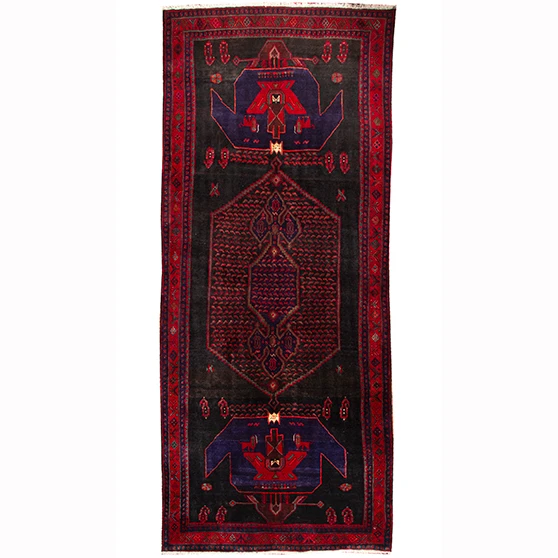
Dark red, navy, and black tones in a Bijar - Bijar Persian Rug 13x5 ft - Medallion Semi Antique Wool Silk Hand Knotted
8
A Brief History of Mordants
Mordant dyeing is one of the oldest chemical technologies in human history. Archaeologists have found mordant-dyed textiles thousands of years old across the Middle East, and the reds of the Pazyryk carpet, woven around the fifth century BCE, already depended on a knowledge of how to fix dye to wool. Alum was one of the great traded commodities of the ancient and medieval world, carried along the same caravan routes as silk, spices, and dyestuffs.
Medieval scholars of the Persian-speaking world wrote about minerals and their uses, including the vitriols and alums that dyers relied on, and the bazaars of major cities had merchants known as attar, who sold herbs, medicines, and dye materials side by side. By the Safavid period, when carpet weaving reached its artistic peak, dyers had access to a sophisticated range of mordants and an accumulated body of practical knowledge that allowed them to produce the remarkably stable colors still visible in sixteenth- and seventeenth-century carpets.
In the nineteenth century, European chemistry began to explain what Persian dyers had known through experience: that aluminum, iron, tin, and copper ions each bond with dye molecules in their own way and produce characteristic colors. That scientific understanding later fed into the development of synthetic dyes, but the traditional mordants of the Persian dye house remain the basis of natural dyeing today.
9
Mordants in Village and Nomadic Dyeing
In city workshops, mordanting was a separate, carefully controlled step. In villages and nomadic camps, it was often simpler and more flexible, adapted to what was available.
A nomadic dyer might add alum directly to the dye bath, mordant and dye together in a single pot over an open fire, or rely on tannin-rich plants gathered along the migration route. Sour fruits, whey from the family's own dairy, and the ash of desert plants all found a place in the process. Iron could come from a piece of old iron left to soak in sour water. The results were less uniform than in city workshops, which is one reason nomadic and tribal rugs often show stronger abrash and more spontaneous color.
Field studies in Persian villages have documented recipes in which local plants, soda, and other simple additives were used to produce dozens of stable colors without any purchased chemicals. These recipes are a reminder that the quality of traditional dyeing came from knowledge rather than expensive materials.
Mordants and Different Fibers
Wool, silk, and cotton respond differently to mordants. Wool and silk, both protein fibers, take alum and most natural dyes readily. Cotton, a plant fiber, bonds poorly with most mordants unless it is first treated with tannin, which is one reason cotton in Persian rugs was usually left undyed and used for the hidden foundation, while wool or silk carried the colors of the pile. Where cotton does appear in color, for instance in white highlights, it is usually used for its natural brightness rather than dyed.
10
Mordants and Regional Color Signatures
Mordants helped give each weaving region its own color identity. Local minerals, the composition of the water, and the habits of local dyers all played a part:
•
Water - hard, mineral-rich water acts as a partial mordant in its own right, and dyers in different towns noticed that the same recipe produced different colors with different water. The famous reds of Heriz have often been credited partly to local water.
•
Local minerals - regions with access to particular alum or iron deposits developed recipes around them.
•
Local plants - pomegranate rind in the central plateau, oak galls and acorns in the western mountains, and sumac in many areas provided different tannin bases.
These differences are subtle, but experienced specialists can often sense them, and they are part of what makes the color of a Kerman rug feel different from that of a Kashan or a Kurdish rug.
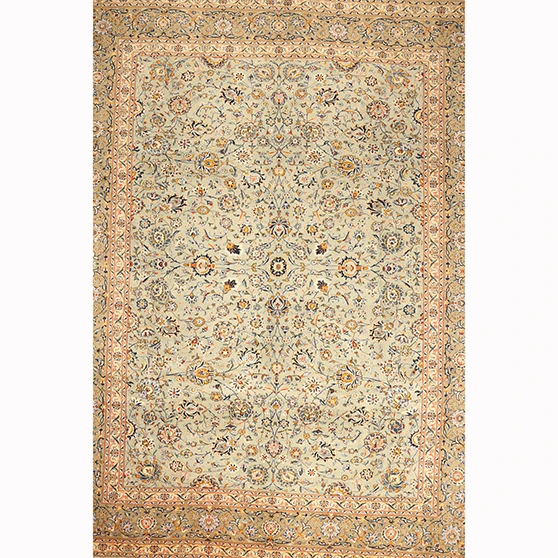
Cream, camel, and rust red in a Kashan - Kashan Persian Rug 12x9 ft - Afshan Semi Antique Wool Silk Hand Knotted
11
Mordants in the Modern Natural Dye Revival
As natural dyeing has returned to Persian weaving over the past few decades, mordants have become a subject of renewed attention. Researchers at Persian universities have tested traditional and modern mordants to measure their effect on colorfastness and shade, and many contemporary natural dyers now favor alum and plant tannins over heavier metals like chrome, which carry environmental and health concerns. The best modern natural dye houses combine traditional recipes with careful measurement, producing colors that are both authentic and reliable.
12
What Mordants Mean for Rug Buyers
You will never see a mordant in a rug, but you can see its effects. Understanding them helps you judge a rug more confidently:
•
Colorfastness - well-mordanted natural dyes resist bleeding and fading. If colors in an older rug remain clear and crisp-edged, the dyer did his work well.
•
Graceful aging - alum-mordanted colors usually soften evenly and attractively over time.
•
Dark-area wear - lower pile in dark brown or black areas is a normal sign of iron mordants, not a defect, as long as the foundation is sound.
•
Washing - naturally mordanted dyes are stable, but cool water and gentle wool soap are always safest. Our guides to professional washing and washing at home explain the details.
•
Restoration - if dark areas have worn through, an experienced restorer can reknot them with suitably dyed wool. See our care instructions.
13
Frequently Asked Questions
Do all Persian rug dyes need a mordant?
No. Indigo bonds with wool on its own, and some tannin-rich dyes such as walnut husk also work without one. But most reds and yellows need a mordant to be lasting.
Is iron corrosion a sign of a bad rug?
Not at all. Moderate wear in dark areas is a normal feature of many antique and semi-antique rugs and is often admired. Only severe wear that has damaged the foundation needs attention.
Are traditional mordants safe in my home?
Yes. Once a rug is dyed, rinsed, and washed, the mordant is locked into the fiber. Traditional mordants like alum are among the gentlest used in textile dyeing.
Can mordants help date a rug?
Sometimes. Laboratory analysis of mordants and dyes can help specialists identify periods and regions, especially for important antique rugs.
14
The Invisible Art
The mordant is the least visible part of a Persian rug, yet it shapes everything we admire about its color: the clear reds, the fresh greens, the deep blacks of the outlines, and even the gentle relief of an old rug's dark motifs. It represents centuries of practical chemistry, refined by generations of dyers who had no laboratory but their own experience.
Continue our series with the principal sources of natural color and other color plants, or return to the master dyer and natural dyes.
At Los Angeles Home of Rugs, every rug comes with a Certificate of Authenticity documenting its origin, materials, and age. If you have questions about the colors or condition of a rug, please ask our experts.
Explore the Collection
Antique Rugs
Semi-Antique Rugs
Bijar Rugs
Heriz Rugs
Red Rugs
Green Rugs
Wool Rugs
Care Instructions
Persian Rug FAQ