


Hidden Palette of Persian Rugs: Leaves, Peels & Desert Plants
Los Angeles Home of Rugs on Nov 17th 2026
The great dye sources of the Persian tradition - madder for red, indigo for blue, the yellow flowers, pomegranate, and walnut - are described in our article on the principal natural dyes. But a Persian dyer's knowledge reached much further. In villages and nomadic camps across the plateau and the mountains, dyers learned to draw color from almost anything that grew nearby: the leaves of grapevines and mulberry trees, the papery skins of onions, chamomile and safflower flowers, barberry roots, sumac, acorn cups, and even the tough shrubs of the desert.
These secondary color plants rarely produced the dominant colors of a rug. Instead they supplied the soft greens, golds, beiges, olives, and gentle earth tones that give so many village and tribal rugs their warm, natural character. This final article in our color series explores this hidden palette: why dyers used it, which plants mattered most, how regional traditions developed around them, and what it means for anyone who owns or is choosing a naturally dyed rug.
1
Why Dyers Used Secondary Plants
Secondary dye plants played several practical roles in the traditional dye house:
•
Local availability - village and nomadic dyers worked with what grew around them or along their migration routes. A grapevine beside the house, an onion harvest, or a stand of desert shrubs was a free and renewable source of color.
•
Cost - imported indigo and insect reds were expensive. Leaves, peels, and wild flowers allowed weavers to widen their palette at almost no cost.
•
Special shades - some plants gave subtle tones that the principal dyes could not easily produce alone, such as soft olive, warm apricot, or pale straw.
•
Fixing power - many of these plants contain tannins that help fix other dyes, so they served as helpers as well as colors. Our article on mordants explains this role.
•
Seasonal rhythm - dyeing followed the seasons. Spring flowers, summer leaves, and autumn fruit husks each had their time, and a dyer's palette shifted slightly through the year.
Persian researchers studying village dyeing in South Khorasan documented twenty-six stable colors produced mostly from local plants, roots, husks, and insect dyes. Most of the dyers who still held this knowledge were in their seventies and eighties - a reminder of how precious and fragile this tradition is.
2
Leaves - Vine, Mulberry, Plane Tree, Walnut, and Henna
Grape Leaves (Barg-e Mo)
Vine leaves were one of the most useful yellow and green sources in village dye houses, especially in grape-growing regions such as Azerbaijan, Qazvin, Hamadan, and Khorasan. With alum, grape leaves give a soft yellow; with iron, they give olive and khaki greens. Because they were available in large quantities after pruning, they were a practical everyday dye.
Mulberry Leaves (Tut)
The mulberry tree holds a special place in Persian textile history because its leaves feed the silkworms that produce silk for the finest rugs. The leaves can also be used for yellow and greenish dyes, and the dark fruit of the black mulberry gives purplish stains, though these are not very lasting. Mulberry dyeing was a natural part of life in the silk-producing regions of the north, such as Gilan and Khorasan.
Plane Tree Leaves (Chenar)
The plane tree, a familiar sight along Persian streams and in city avenues and gardens, gives yellowish and olive tones from its leaves, depending on the mordant. It was one of many common trees whose leaves dyers learned to use.
Walnut Leaves
While the green husk of the walnut is a principal source of brown, walnut leaves were also used. They give lighter browns, tans, and with iron, grayish tones, and they were especially useful in the mountain villages where walnut trees are common.
Henna (Hana)
Henna, famous for decorating hands and hair in Persian celebrations, also dyes wool. It gives warm orange-brown and tan colors and was used in parts of southern and central Persia, often alongside other dyes to warm a palette.
3
Peels, Rinds, and Fruits
Onion Skins (Pust-e Piyaz)
The dry outer skins of onions are a remarkably strong dye. They give golden yellows, warm oranges, and rusty browns with alum, and olive tones with iron. A recent Persian university study comparing ten traditional yellow dye plants on wool found that onion skin gave the strongest color of all - stronger even than the classical yellow dye esparak. For village households, onion skins were simply collected from the kitchen until there were enough for a dye bath.
Barberry (Zereshk)
The barberry shrub, whose tart red berries are a beloved ingredient in Persian cooking, is a dye plant through its roots and bark rather than its fruit. Barberry root gives a bright, clear yellow that needs little or no mordant. Barberry grows widely in Khorasan, around Birjand and Qaen, and it appears in the dye traditions of eastern Persia.
Sumac (Somagh)
Sumac, familiar as a tart red spice, is a tannin-rich plant whose leaves and branches give tans and soft yellows, and grays or blacks with iron. In the same university study of yellow dyes, sumac gave the weakest yellow color, which fits its traditional role as a tannin source and mordant helper more than as a yellow dye in its own right.
Pistachio Hulls
In the pistachio-growing regions of Kerman and Rafsanjan, the soft outer hulls of pistachio nuts, rich in tannin, were used for browns and grays. This is a good example of how dyers turned local agricultural by-products into color.
4
Flowers - Chamomile, Safflower, Marigold, and Roses
Chamomile (Baboneh)
Several species of chamomile, including dyer's chamomile, give clear, warm yellows with alum. Chamomile grows wild across much of Persia, and its flowers were gathered in spring and early summer for dyeing as well as for tea and medicine.
Safflower (Golrang)
Safflower is an unusual plant because its flowers contain two dyes: a water-soluble yellow and a red that can be extracted in alkaline conditions. Safflower was cultivated in Persia for oil and color, and its yellows were among the stronger plant yellows in the Persian study mentioned above. Its red is beautiful but not very lightfast, so it was used more for silk and fabrics than for rug wool.
Marigold and Other Garden Flowers
Marigolds and related garden flowers give light yellows and golds. They were generally used as supplementary colors rather than main dyes, and their shades tend to be soft and somewhat fugitive.
Rose Petals
Persia's famous damask roses, grown above all around Kashan and Qamsar for rose water, were part of some local dye traditions. Field studies of village dyeing in South Khorasan include rose petals among the plants used for soft tones. Like many flower dyes, they give delicate shades rather than strong colors.
5
Herbs and Desert Plants
Jashir
Jashir (*Prangos ferulacea*) is a tall herb of the umbrella family that grows in the mountains of western and southern Persia. It gives yellow tones and has been studied by Persian researchers as one of the traditional yellow dyes. In some regions it was also used as animal fodder, so its use as a dye fit naturally into pastoral life.
Tagh and Other Desert Shrubs
In the deserts of eastern Persia, the hardy saxaul shrub, known locally as tagh (*Haloxylon*), was used for dyeing. Field research in the villages of Darmian in South Khorasan describes greens such as pistachio, turquoise, and olive made from a yellow base of tagh and another local yellow plant, enhanced with indigo. Desert plants like these show how dyers adapted the craft to even the harshest environments.
Turmeric and Spices
Turmeric, a spice brought from India, gives a strong, deep yellow, but it fades quickly in light. Dyers who used it often combined it with more stable dyes or used it only for small details. Its weak lightfastness has been confirmed by modern testing.
6
Bark, Roots, and Acorns
Trees and shrubs also offered color in their bark and roots. Oak bark and acorn cups from the oak forests of the Zagros Mountains provided tannins for tans, browns, and blacks, and were especially important for Kurdish, Luri, and Bakhtiari weavers. Pomegranate bark and root bark of various shrubs served similar purposes. These materials were often combined with iron to give the dark tones used for outlines and details.
7
A Dyeing Season in a Persian Village
To imagine how the hidden palette was used, picture a village on the edge of the eastern desert in late summer, the traditional time for dyeing after the wool has been sheared, washed, and spun. Field research among the dyers of Darmian in South Khorasan gives a vivid picture of how this work was done.
Large cauldrons were set over fires in the open air, and the plant materials - dried leaves, roots, husks, and flowers gathered earlier in the year - were boiled to release their color. The spun wool, already washed, was immersed in the warm bath, and the temperature was kept steady by feeding the fire with care. Two broad methods were used: hot-bath dyeing in cauldrons, and slower fermentation dyeing, in which materials were left to ferment and the wool was soaked over a longer period. Some villages specialized in one method, and some bought fermentation-dyed yarn from the dyers of nearby Birjand.
Simple additives were used to fix and adjust the colors. After dyeing, the wool was rinsed in the cool running water of the qanat - the ancient underground channels that bring water to Persian desert villages - and beaten against stones to remove excess dye before drying in the sun. The master dyers of these villages had learned from a respected local teacher, and the colors they produced, from beige and camel to pistachio, gray-blue, and indigo, were valued for their fastness by local weavers and visiting merchants alike.
Scenes like this, repeated in countless villages across Persia, are the real origin of the soft, varied colors seen in village rugs. Our article on the master dyer describes the parallel world of the city dye house.
8
How Secondary Plants Work With the Principal Dyes
Secondary plants were rarely used in isolation. More often they worked alongside madder, indigo, and the main yellows in clever combinations:
•
Shading reds - a madder red could be warmed toward orange with an onion skin bath, or deepened toward brown with a tannin plant and a touch of iron.
•
Building greens - a yellow from vine leaves, chamomile, or a desert plant, over-dyed with indigo, gave greens from pale pistachio to deep bottle green.
•
Making olives and khakis - a yellow plant dye with an iron afterbath gave the muted olives prized in many tribal rugs.
•
Softening contrasts - a light bath of a tannin plant could tone down a bright color, helping it sit more harmoniously with the rest of the palette.
•
Preparing the fiber - tannin-rich plants such as sumac and pomegranate rind were used before dyeing to help other colors bond more firmly.
This flexibility is why village dyers could produce such a wide range of shades from a small, local set of materials.
9
A Color-to-Plant Guide
The following guide links common colors in village and tribal rugs with the secondary plants often used to make them. These associations are typical rather than certain, since any color can be made in more than one way:
•
Gold and straw - onion skins, chamomile, safflower, vine leaves, or barberry root with alum.
•
Olive and khaki - vine leaves, plane leaves, or other yellows with iron.
•
Pistachio and apple green - local yellows over-dyed lightly with indigo.
•
Apricot and warm orange - onion skins or henna, sometimes combined with madder.
•
Camel and tan - walnut leaves, pistachio hulls, henna, or weak tannin baths.
•
Soft gray - tannin plants such as sumac or acorn cups with a little iron.
•
Dark brown and black - acorn cups, oak bark, or galls with iron, or naturally dark wool.
You can explore many of these colors in our collection, including olive, moss green, sage green, gold, camel, and beige rugs.

Soft sage green, cream, and beige in a Tabriz - Tabriz Persian Rug 12x9 ft - Medallion Semi Antique Wool Silk Hand Knotted
10
Regional Traditions of the Hidden Palette
The secondary dye plants used in any area depended on its landscape, and this helped create distinct regional color personalities:
•
Khorasan and Birjand - barberry, saffron by-products, desert shrubs like tagh, and local yellows created a distinctive eastern palette of golds, pistachio greens, and soft earth tones.
•
Qashqai and Fars - nomadic weavers used wild plants along their migration routes, alongside madder and indigo, producing vivid but varied colors and strong abrash. See Qashqai weaving.
•
Kurdish rugs - oak galls, acorns, walnut, and mountain plants gave rich, saturated colors and deep browns.
•
Baluch - Baluch weavers of the eastern borderlands are known for a dark, rich palette of deep reds, browns, and blues, often with natural dark wool and only small touches of lighter plant colors.
•
Turkmen - Turkmen weavers favored deep madder reds, with secondary plants and natural wool providing browns, ivories, and occasional yellow or green accents.
•
Kerman - pistachio hulls and other local materials contributed to an unusually wide and subtle palette.
•
Gabbeh - contemporary Gabbeh weavers of Fars have revived many local plant dyes, combining them with undyed natural wool for calm, earthy rugs. Read more in our Gabbeh rugs article.
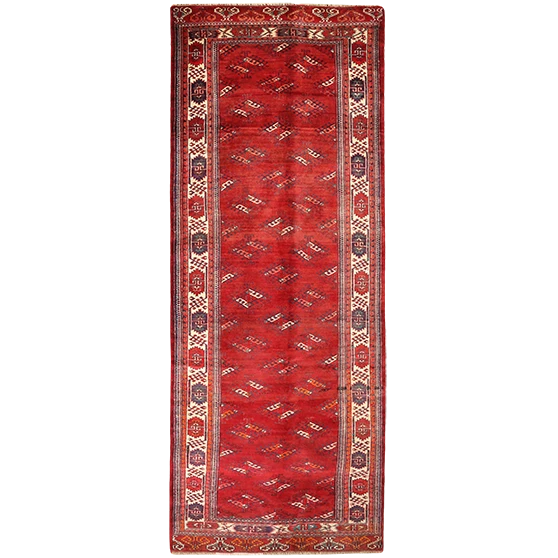
Baluch boteh design in madder red and cream - Baluch Persian Rug 12x4 ft - Boteh Semi Antique Wool Camel Hair Hand Knotted
11
What This Means for Collectors
Understanding the hidden palette helps you appreciate the qualities of village and tribal rugs:
•
Softer, warmer tones - secondary plant dyes often give gentle olives, golds, and earth tones rather than bright primary colors.
•
More abrash - small batches of locally gathered plants rarely produced perfectly consistent colors, so rugs using them often show attractive variation.
•
Faster aging of yellows - many secondary yellows are less lightfast than the principal dyes. In older rugs they may have softened considerably, and some greens may have drifted toward blue as their yellow component faded.
When you look at an old village rug and see a soft olive or a warm straw color that is hard to name, it may well come from one of these plants, gathered by the weaver's family from the hills or fields nearby.

Qashqai geometric weaving in madder red and navy blue - Qashqai Persian Rug 8x5 ft - Geometric Semi Antique Wool Hand Knotted
12
Preserving Soft Natural Colors
Because some secondary plant dyes are more sensitive to light than madder and indigo, a little care helps them last:
•
Protect from strong sunlight - use curtains or UV-filtering film in very bright rooms, and rotate the rug regularly.
•
Clean gently - vacuum without a harsh beater bar and blot spills with cool water.
•
Avoid harsh chemicals - strong detergents, bleach, and chemical washes can shift or strip natural colors.
•
Use specialist cleaners - professional hand washing preserves natural dyes best. See professional rug washing and our care instructions.
13
A Palette Built on Thrift and Sustainability
Long before sustainability became a modern concern, the hidden palette of the Persian village was a model of thrift. Almost every material it used was either a by-product or freely available: onion skins from the kitchen, vine leaves from pruning, pomegranate rinds and pistachio hulls from the harvest, walnut leaves from the orchard, and wild flowers and shrubs from the surrounding hills. Nothing needed to be bought from distant markets, and very little was wasted. Even exhausted dye baths were sometimes reused to give lighter shades.
This way of working kept the cost of dyeing low for families whose weaving was an important source of income, and it tied each rug closely to its environment. Persian researchers studying traditional dyeing have pointed out that this local, affordable knowledge supported the rural carpet economy for generations, and that reviving it could support rural communities again today.
For modern buyers who care about the materials in their homes, rugs colored with these plants offer something rare: a beautiful object made almost entirely from renewable, local, and natural resources, using knowledge refined over centuries.
14
Rediscovering the Village Palette
For much of the twentieth century, the knowledge behind these plants was in danger of disappearing, as synthetic dyes reached even remote villages. Today, researchers at Persian universities are documenting village recipes, testing the colorfastness of traditional plants, and encouraging young dyers to learn from the last generation of masters. Natural-dye workshops and revived tribal weaving have brought many of these colors back into new rugs.
For rug lovers, this revival is good news. It means that the soft, earthy colors of the Persian countryside are not only a feature of antique rugs but are being woven again today, connecting new rugs to centuries of tradition.
15
Frequently Asked Questions
Are secondary plant dyes lower quality than madder and indigo?
Not necessarily. Many give beautiful, stable colors. Some yellows are less lightfast, which is why they were often used for details and mixed colors rather than large fields.
How can I tell which plant was used in my rug?
Usually you cannot by eye alone. Only laboratory analysis can identify a specific plant. But soft olives, golds, and earth tones in a village rug often point to local plant dyes.
Why do some old rugs have blue leaves where I would expect green?
Greens were often made by dyeing yellow over blue. Over time, the yellow can fade more than the indigo, leaving a blue-green or blue color.
Are these dyes still used today?
Yes. Many natural-dye workshops and tribal weavers use onion skin, vine leaves, chamomile, pomegranate, and other plants alongside the principal dyes.
16
The End of Our Color Journey
Together, the five articles in this series trace the full story of Persian rug color: the master dyer, natural dyes and how to recognize them, the mordants that make color last, the principal natural dyes, and the hidden palette of leaves, peels, flowers, and desert plants described here. For the cultural meaning of each color, read the nine iconic Persian color ranges.
At Los Angeles Home of Rugs, every rug comes with a Certificate of Authenticity documenting its origin, materials, and age. Explore our village and nomadic rugs, or ask our experts about the colors in any piece.
Explore the Collection
Village Rugs
Nomadic Rugs
Gabbeh Rugs
Green Rugs
Olive
Saffron
Beige Rugs
Antique Rugs
Persian Rug FAQ