


Persian Rug Dyeing: History and Secrets of the Master Dyer
Los Angeles Home of Rugs on Nov 17th 2026
In the making of a Persian rug, no single craftsperson holds more quiet influence over the finished piece than the dyer. A rug can have a flawless design and impeccable knotting, but without color there is no design at all - only a field of undyed wool. It is the dyer who turns raw fleece into the deep reds, luminous blues, and soft golds that make an authentic hand-knotted rug instantly recognizable as Persian. For centuries this figure stood at the center of the craft and yet remained somewhat mysterious, because the knowledge behind each color was guarded closely and passed from one generation to the next within families and workshops.
This article opens our series on Persian rug color. It is the broadest of the five, and it tells the story of the dyer himself: who he was, how he trained, what happened inside a traditional dye house, how Persian dyeing developed over more than two thousand years, how it survived the arrival of cheap synthetic dyes in the nineteenth century, and why the quality of dyeing is still one of the surest measures of a rug's beauty and long-term value. The companion articles then go deeper into natural dyes, mordants, the principal dye sources, and the lesser-known color plants.
1
The Dyer - Keeper of a Guarded Tradition
In traditional Persian society the dyer, known as the rangraz, was a respected specialist whose craft sat at the meeting point of botany, chemistry, and art. A weaver could learn the basic knot in a matter of weeks and become fast and accurate within a few years, but a dyer needed a long apprenticeship to master the behavior of plants, water, heat, acidity, and time. He had to know which roots were mature enough to harvest, how finely to grind them, how long to soak them, what the local water would do to a given dye, and how a color would look not only when it came out of the bath but after decades of sunlight and foot traffic.
Every dye house had its own formulas: the exact proportion of madder root to wool, the length of a soak, the sequence of baths needed to reach a particular shade, and the small additions - a handful of pomegranate rind here, a cup of sour grape juice there - that shifted a color by a single, recognizable degree. These recipes were rarely written down. They lived in memory and in practice, taught by a master to a son or a trusted apprentice over many years of working side by side.
This secrecy was not simple protectiveness. A family's reputation, and often its livelihood, depended on the colors it could produce that others could not. A distinctive crimson, a deep and even indigo, or a stable green that did not drift toward yellow could make a workshop famous across a whole region. Merchants and workshop owners would travel to buy yarn from a particular dyer, and a weaving town's identity was often tied to the palette its dyers produced. In the old bazaars of Isfahan, Kashan, Yazd, Kerman, and Tabriz, the dyers' quarter was a recognizable part of the city, and many families still carry the surname Rangraz or Sabbagh, both meaning dyer.
A useful way to think about it: the designer decides where every color goes, and the weaver places every knot, but the dyer decides what each color actually looks like - and how it will age over the next hundred years.
2
How a Master Dyer Was Trained
Apprenticeship in a traditional dye house usually began in boyhood. The new apprentice would spend his first years doing the heaviest and least glamorous work: carrying water, feeding the fires under the vats, pounding dried roots in stone mortars, and hauling wet skeins of wool to the drying lines. Only gradually was he allowed near the dye baths themselves, and even then he would watch far longer than he worked.
The skills he was expected to learn were remarkably broad:
•
Reading raw materials - judging the age and quality of madder roots by their color when cut, recognizing good indigo by its coppery sheen, and knowing when a batch of pomegranate rind or walnut husk was too old to give a clean color.
•
Reading water - understanding that hard, mineral-rich water and soft river water change the same dye in different ways. Many dyers insisted on water from a particular spring or qanat for particular colors.
•
Controlling heat - keeping a bath just below a boil for hours without scorching the wool, using only a wood fire and experience.
•
Judging by eye and hand - knowing when a skein was ready by its color in daylight and by the feel of the bath, since wet wool always looks darker than dry wool.
•
Planning a palette - working out how much of each color a rug would need, because a dye lot could never be perfectly repeated once it was finished.
Only after many years would an apprentice be trusted with the most valuable dyes, such as indigo and insect reds, and only a few would ever be taught the family's most closely held recipes. The title of ostad, or master, was earned rather than given, and in many towns the master dyer was as well known as the master weaver.
3
Building a Palette from Three Primary Colors
Persian dyers worked with an intuitive grasp of color theory long before it was formalized in modern textbooks. When white light passes through a prism it separates into the spectrum of the rainbow. Within that spectrum, three colors - red, yellow, and blue - act as primaries, while orange, green, and violet are secondaries formed by mixing them. The dyer's art was to build a full palette from a very small number of reliable dye sources, one for each primary.
By combining these primaries in different proportions, and by dyeing the same skein of wool in successive baths, a master dyer could create an almost endless range of shades:
•
Greens - produced by dyeing wool first in yellow and then in blue, or the reverse. A light yellow over a pale blue gives a fresh apple green; a strong yellow over deep indigo gives a dark bottle green.
•
Oranges and apricots - created by layering yellow and red, from the softest peach to a rich burnt orange.
•
Violets and aubergine tones - made by combining red and blue, often by over-dyeing a madder red with indigo.
•
Browns and camel tones - built by mixing all three primaries, or by using tannin-rich materials such as walnut husk and oak galls.
•
Pinks and rose tones - made with a weak madder bath, or by using madder that had already been used once, so that only the gentlest color remained.
This is why a single classical Persian rug can contain twelve to twenty distinct colors even though its dyer may have relied on only three or four principal dye sources. The skill lay not in owning many ingredients but in knowing how to combine a few of them with precision. Our article on the nine iconic Persian color ranges explores what these colors mean culturally; here the focus is on how they were made.
4
Inside the Traditional Dye House
A traditional Persian dye house, or rangrazkhaneh, was a place of heat, steam, strong smells, and careful timing. Large copper or glazed clay vats sat over wood fires or were sunk into the floor, indigo vats were kept warm and covered in a separate corner, and skeins of hand-spun wool hung drying from poles in the courtyard or on the flat roofs. The work generally followed a sequence that changed little over centuries:
•
Washing the wool - raw wool was scoured to remove dirt and excess grease so that it could absorb color evenly. Some natural lanolin was deliberately left in place to protect the fiber and give it luster. Our article on Persian rug wool explains why this fiber takes dye so well.
•
Mordanting - the wool was treated with a fixing agent such as alum so that the dye would bond permanently to the fiber. We cover this step in detail in our article on Persian rug mordants.
•
Preparing the dye - roots were ground, peels and husks were soaked, and leaves were boiled to extract their color. Some dyes, such as madder, were often soaked overnight before heating.
•
Dyeing - the mordanted wool was immersed in the dye bath and kept at a controlled temperature for hours, sometimes over several days with repeated dips.
•
Over-dyeing - for secondary colors, the skein was dried and then dyed again in a second bath.
•
Rinsing and sun-drying - the finished skeins were rinsed in running water and dried in daylight, which also revealed whether the color had settled evenly.
Indigo was a world of its own. Unlike most dyes, it does not dissolve in plain water, so it had to be prepared in a fermentation vat where natural bacteria slowly changed it into a soluble form. Wool dipped into this vat comes out yellowish-green and turns blue before the dyer's eyes as it meets the air. Dark navy required many dips, with the wool aired between each one, and a skilled indigo dyer was often a specialist who did nothing else.
Because each batch depended on the season's plants, the mineral content of the local water, and the dyer's judgment on the day, no two dye lots were ever exactly the same. That small variation is the origin of abrash - the gentle bands of tonal change seen across the field of many hand-knotted rugs, and one of the clearest signs of authentic handmade work. In village and nomadic rugs, where wool was dyed in small batches as weaving progressed, abrash can be pronounced; in city workshop rugs, where all the yarn was dyed at once, it is usually much subtler.
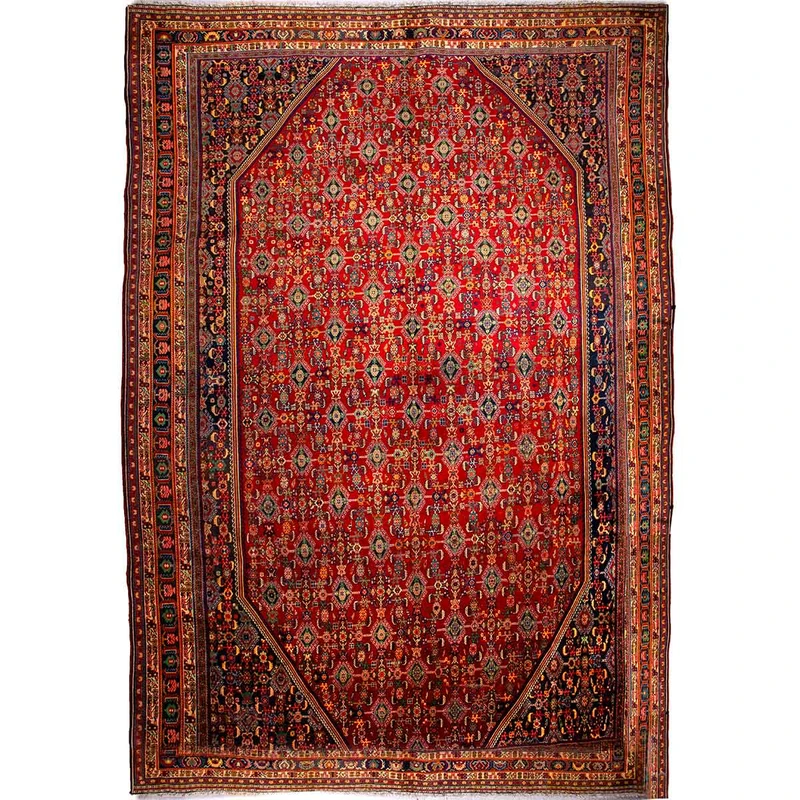
Nomadic Qashqai weaving in madder red and navy blue - Qashqai Persian Rug 15x10 ft - Herati Semi Antique Wool Hand Knotted
5
A Short History of Color in Persian Weaving
Ancient Foundations
Persian dyeing is far older than any surviving Persian rug. The famous Pazyryk carpet, found frozen in a Scythian burial mound in the Altai Mountains and dated to around the fifth century BCE, was already colored with insect red and plant dyes, and many scholars connect its design to the Achaemenid world. Textiles and records from the Achaemenid and Sasanian periods describe richly colored fabrics, and the Silk Road made Persia a crossroads where dyestuffs such as indigo from India and insect reds from the Caucasus and Anatolia were traded alongside locally grown madder.
The Safavid Golden Age
Under the Safavid dynasty in the sixteenth and seventeenth centuries, carpet weaving became a royal art. Court workshops in Isfahan, Kashan, Tabriz, and Kerman produced carpets of extraordinary refinement, and the dyers who served them had access to the finest materials in the empire. The great masterpieces of this period, including the Ardabil Carpet, show a palette of remarkable depth and subtlety, with as many as two dozen shades in a single carpet. Many of these colors remain strong after four and a half centuries, which tells us as much about the dyers as about the weavers.
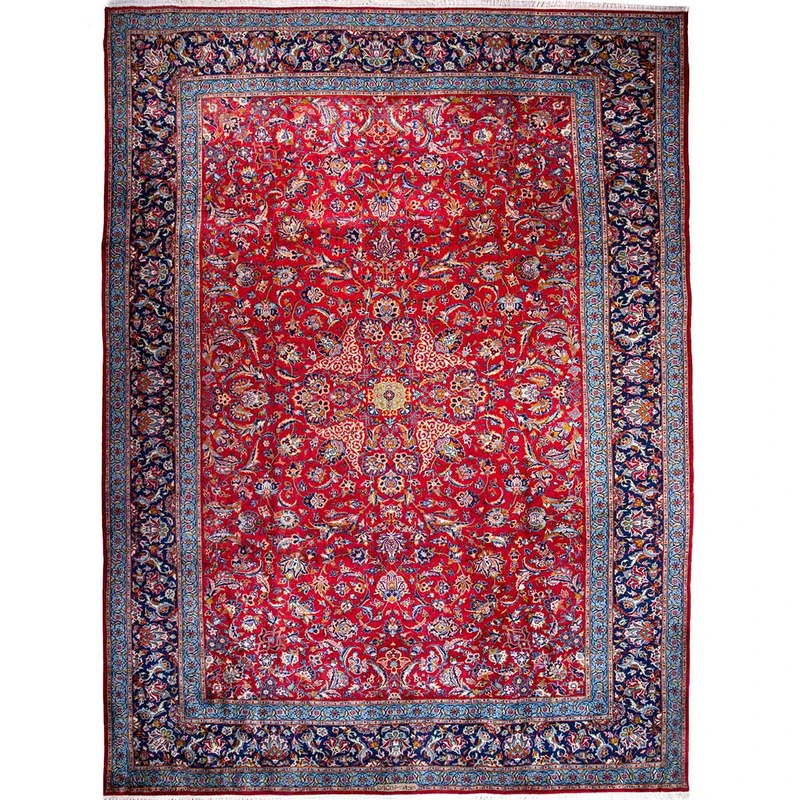
Deep crimson and indigo in a Kashan workshop rug - Kashan Persian Rug 14x10 ft - Medallion Antique Wool Silk Hand Knotted
The Qajar Revival and Western Demand
In the nineteenth century, Persian carpet weaving expanded rapidly to meet demand from Europe and America. Merchants from Tabriz and foreign firms such as Ziegler and Company organized large workshops in Sultanabad (today's Arak), Tabriz, Kerman, and elsewhere. This commercial growth brought work and prosperity to many weaving towns, but it also created enormous pressure to produce more yarn, more quickly, and more cheaply - pressure that would soon change Persian dyeing forever.
6
The Aniline Crisis and the Persian Response
The first synthetic dyes were invented in Europe in the 1850s, beginning with the discovery of mauveine by the young English chemist William Perkin. Within a few decades German and British factories were producing a wide range of so-called aniline dyes, and by the 1870s they were reaching Persian dye houses. They were cheap, quick to use, and required none of the years of training that natural dyeing demanded.
The results were often disappointing. Many early aniline dyes faded badly in sunlight, turning bright magentas into dull grays, and others bled when the rug was washed, spreading color into neighboring areas. Western buyers, who had come to love the harmonious palettes of Persian rugs, began to complain about harsh, unstable colors, and the reputation of the trade suffered.
The Persian government responded with some of the earliest consumer-protection measures in the history of the rug trade. In the early twentieth century, around 1904, the import of aniline dyes was officially banned, graduated taxes were used to discourage their use, and there were attempts to confiscate carpets woven with synthetically dyed yarn. Stories circulated of harsh punishments for dyers who broke the rules. Enforcement was uneven, and historians note that synthetic dyes continued to appear, but the bans signaled how seriously Persia regarded the quality of its national craft.
Many late nineteenth and early twentieth century rugs show no trace of synthetic dye at all. Rug historians have noted that several weaving areas simply kept their traditional methods, which is one reason antique rugs from these regions are so sought after today.
Later in the twentieth century, a second generation of synthetic dyes appeared, often called chrome or metal-complex dyes. These were far more stable than the early anilines - they resist fading and bleeding well - and they are still widely used for many good-quality modern rugs. Their limitation is aesthetic rather than practical: each color is very uniform, so rugs dyed this way tend to have less depth and less of the living variation that natural dyes provide.
7
The Return of Natural Dyes
From the late twentieth century onward, a revival of natural dyeing took root in Persia. Researchers, workshop owners, and weaving families began to rediscover old recipes, interview the last generation of traditional dyers, and train young people in the craft. Some of the most celebrated contemporary Persian rugs, including many fine Gabbeh rugs from the Qashqai and Luri weavers of the south, are made with naturally dyed, hand-spun wool, and collectors around the world have responded enthusiastically.
Academic research has joined this effort. Persian universities, including those in Birjand, Yazd, and Isfahan, have published studies measuring the colorfastness of traditional plant dyes and documenting village dye recipes before they disappear. One field study of villages in South Khorasan recorded twenty-six distinct, stable colors still produced from local plants, roots, husks, and insect dyes - and found that most of the remaining master dyers were in their seventies and eighties. The knowledge survives, but it survives in a small number of hands.
8
Regional Dyeing Traditions
Just as each weaving region has its own designs, each has its own color personality, shaped by local plants, water, and taste. A few examples show how strongly color is tied to place:
•
Kerman - famous for an unusually wide palette with many soft, pastel shades. Kerman dyers were historically among the most skilled in Persia, and the city was an important center for madder and indigo trade.
•
Tabriz - a major commercial center whose dye houses supplied workshops across Azerbaijan, producing reliable, balanced palettes for city carpets. See our guide to the art of Tabriz rugs.
•
Heriz - known for brick reds, deep blues, and ivory, with color qualities often credited to the local water and the copper content of the area.
•
Kashan - long celebrated for deep crimsons and rich indigo, and for fine dyeing of silk as well as wool.
•
Qashqai - nomadic weavers of Fars who dyed small batches on the move, producing vivid reds, deep blues, and pronounced abrash. Our article on Qashqai weaving tells their story.
•
Bijar - Kurdish weavers known for saturated, durable colors and for the iron-mordanted dark tones that create the embossed effect described in our article on inlaying and embossing in Bijar rugs.
These regional signatures help experts attribute rugs to their place of origin, and they are part of the reason two rugs with similar designs can feel entirely different in a room.
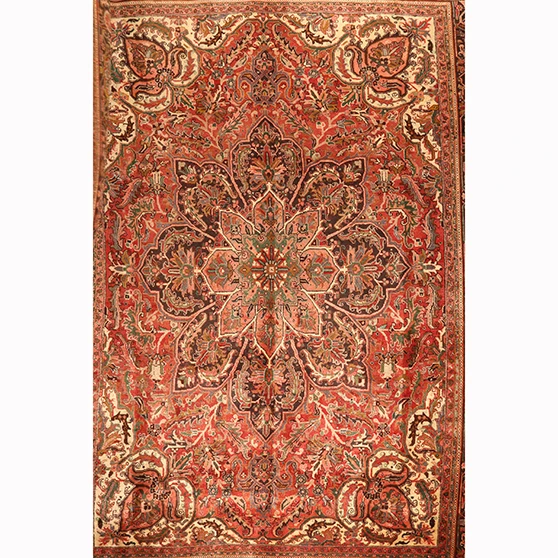
Brick and madder reds with ivory, typical of Heriz dyeing - Heriz Persian Rug 13x10 ft - Medallion Semi Antique Wool Hand Knotted
9
Why Dyeing Determines a Rug's Value
Collectors and specialist dealers often say that color is the first thing they judge in a Persian rug, and for good reason. The quality of dyeing affects a rug in several lasting ways:
•
Beauty - well-made dyes produce colors with depth and subtle internal variation. Poorly made dyes look flat, harsh, or chalky.
•
Durability - properly fixed colors resist fading from sunlight and bleeding during washing. Unstable dyes can run into neighboring areas the first time a rug is cleaned.
•
Aging - high-quality natural dyes mellow gracefully over decades, softening into the harmonious tones prized in antique Persian rugs. Poor dyes simply fade.
•
Harmony - colors made from the same family of natural sources tend to sit well together, because they share underlying tones. This is one reason naturally dyed rugs seem calm and balanced even when they use many colors.
•
Collectability - rugs with excellent, stable dyes from a known region and period hold their value best over time. Our article on investing in hand-knotted rugs discusses how condition and color affect long-term value.
This is why the dyeing method is one of the most important questions to ask when evaluating any rug. Our guide to natural dyes in Persian rugs explains how to recognize them and why they command a premium.
10
How to Look at Color When Choosing a Rug
You do not need to be a chemist to evaluate the dyeing of a Persian rug. A few simple observations will tell you a great deal:
•
Look at the back - turn a corner over. The colors on the back are less exposed to light and show the original shades. Some difference from the front is normal and expected in an older rug; a dramatic difference may indicate fading or, occasionally, surface painting.
•
Part the pile - fold the rug gently so the pile opens. Natural dyes often show a slightly deeper color near the base of the knots, where light has not reached.
•
Look for gentle abrash - soft, horizontal shifts in tone across the field are a natural result of hand-dyed yarn. They are a sign of authenticity, not a flaw.
•
Check the borders between colors - crisp edges suggest stable dyes. Pink or gray halos around red or dark areas can suggest bleeding from an unstable dye.
•
Trust your eye in daylight - natural colors usually look rich and slightly complex in daylight, while some synthetic colors look unusually bright or uniform.
If you are unsure, ask the seller directly about the dyes, the age, and the origin, and ask whether the rug has been professionally washed. A reputable dealer will answer clearly. Our article on how to buy a Persian rug offers a broader checklist.
11
Caring for the Dyer's Work
Even the best dyes benefit from sensible care. Direct, strong sunlight is the main enemy of color over the long term, so rotating a rug once or twice a year helps it age evenly. When a rug needs cleaning, a professional hand wash in cool water with a gentle wool detergent is safest, especially for older pieces. Our guides to washing a Persian rug at home and professional rug washing explain the details, and our care instructions page summarizes the essentials.
12
Frequently Asked Questions
Were all old Persian rugs naturally dyed?
Most rugs made before about 1870 were dyed entirely with natural materials. After that, synthetic dyes appear in some rugs, while many regions continued to use natural dyes for decades. Each rug needs to be judged individually.
Is a synthetic dye always a bad sign?
No. Early aniline dyes were often unstable, but modern chrome dyes are durable and are used in many fine contemporary rugs. The difference is mainly in character: natural dyes give more depth and variation.
Does abrash reduce a rug's value?
Gentle, natural abrash is valued by most collectors because it shows hand-dyed wool. Very strong or unattractive color bands can affect desirability, but this is a matter of taste rather than a defect.
Why do some antique rugs have worn-down dark areas?
Dark browns and blacks were often made with iron, which slowly weakens wool. These areas wear faster than the surrounding pile, which can create an attractive raised effect. Our article on mordants explains why.
13
The Dyer's Legacy in Every Rug
When you look at a fine Persian rug, you are seeing the work of several masters at once. The designer's vision and the weaver's patience are visible in the pattern, but the dyer's knowledge is present in every single knot. The richness of a madder red field, the depth of an indigo border, the gentle shift of abrash across the ground - all of these are the dyer's signature, carried forward through generations of inherited skill and, in many cases, through generations of the same family.
Continue the series with our articles on natural dyes, mordants, the principal sources of natural color, and other color plants. For the cultural meaning behind each hue, see the nine iconic Persian colors, and for the full process from fleece to finished yarn, see the Persian rug dyeing process.
At Los Angeles Home of Rugs, every rug in our collection comes with a Certificate of Authenticity documenting its origin, materials, and age, so you can buy with confidence in the craftsmanship behind its colors. If you have a question about a particular rug's dyes, our specialists are happy to help through Ask Our Experts.