


Fars Rugs: Qashqai, Khamseh, Luri, and Gabbeh Weaving
Los Angeles Home of Rugs on Nov 17th 2026
The province of Fars, in southwestern Persia, is the historic heartland of the Persian nation. It gave its name to the Persian language (Farsi) and to Persia itself, and it holds the ruins of Persepolis and Pasargadae, the great capitals of the ancient Achaemenid kings. For rug lovers, Fars is something more: the home of some of the world's most celebrated tribal weavers, whose rugs, Gabbehs, kilims, and bags are admired for their vivid colors, bold designs, and remarkable vitality.
This article explores the weaving of Fars: its landscape and nomadic way of life, the great tribal confederations of the Qashqai and the Khamseh, the Luri weavers, the town rugs of Shiraz and Abadeh, the Gabbeh and kilim traditions, the region's natural dye revival, and how to recognize and care for rugs from Fars. For a closer look at the Qashqai alone, see our article on Qashqai weaving.
1
Fars in Persian History
Few regions are as central to Persian history as Fars. Here Cyrus the Great built Pasargadae, with the earliest known four-part Persian garden, and Darius and his successors built Persepolis, whose stone reliefs show delegations from across the empire bringing gifts, including textiles, to the king. Later, the Sasanian dynasty rose from Fars, building cities and palaces at Firuzabad and Bishapur. In the eighteenth century, Karim Khan Zand made Shiraz his capital, adorning it with gardens, a citadel, and a magnificent bazaar.
This long history has left deep cultural roots. The poets Saadi and Hafez, whose verses are still recited by Persians everywhere, lived in Shiraz, and the gardens and architecture of the city inspired generations of artists. Tribal weaving in Fars grew up alongside this courtly and urban culture, and the two influenced each other: town weavers borrowed tribal designs, and tribal weavers absorbed motifs from city art. Our article on Persian garden rugs describes the garden tradition that began at Pasargadae.
2
A Land of Mountains and Migrations
Fars stretches from the high Zagros Mountains in the north to the warm lowlands near the Persian Gulf in the south. This geography has shaped life here for thousands of years. Nomadic tribes migrate with their flocks of sheep and goats twice a year: in spring they travel north to the cool summer pastures (yeylaq) of the mountains, and in autumn they return south to the mild winter pastures (qeshlaq) near the coast. These migrations, which can cover hundreds of miles, have long been one of the great spectacles of Persian life.
For centuries, a large part of the population of Fars lived this way, and although many families have now settled in villages and towns, migration remains part of the identity of the tribes. The flocks provide wool for weaving, and the mountain and valley plants provide dyes, so the tribal rugs of Fars are deeply connected to the land.
In 2010, UNESCO recognized the traditional skills of carpet weaving in Fars as part of the Intangible Cultural Heritage of Humanity, honoring the knowledge passed down among the region's weavers for generations.
3
A Year in the Life of a Tribal Weaver
For a nomadic weaving family in Fars, the year follows the rhythm of migration. In spring, after the lambs are born, the sheep are sheared, and the women wash, card, and spin the new wool, often spinning by hand as they walk with the flocks or sit outside the tent. Dye plants are gathered along the migration route, and small batches of wool are dyed in pots over open fires.
When the family reaches its summer pastures in the mountains, the horizontal loom is pegged to the ground beside the tent, and weaving begins. Mothers, daughters, and sometimes neighbors work side by side, weaving from memory and from the designs they grew up with. A rug may be finished before the autumn migration, or it may be rolled up on its loom and carried to the winter pastures to be completed there. Each rug therefore carries the marks of its journey: small changes in color as new batches of wool are used, slight variations in width, and the personal touches of the weavers.
Many rugs were woven for the family's own use - for the tent floor, as bedding, or as storage bags - or as part of a daughter's dowry. Only some were sold, usually through the markets of Shiraz and other towns. This is why fine old tribal rugs from Fars are so personal, and why no two are ever alike.
4
The Qashqai Confederation
The largest tribal group in Fars is the Qashqai, a confederation of Turkic-speaking tribes that rose to power in the region over the last few centuries. The Qashqai are made up of several major tribes, including the Amaleh, Kashkuli, Shishbuluki, Darrehshuri, and Farsimadan, each with its own sub-tribes, territories, and weaving traditions.
Qashqai women are celebrated as some of the finest tribal weavers in the world. Their rugs are woven on horizontal looms with wool foundations and lustrous wool pile, and they feature bold medallions - often a series of linked diamond medallions - stylized animals, birds, and flowers, the boteh, and the famous Qashqai lion motif. Colors are vivid and deep: madder reds, indigo blues, ivory, gold, and green, with pronounced abrash from small dye batches. Fine antique Qashqai rugs, especially those of the Kashkuli, are among the most prized tribal rugs. See our articles on Qashqai weaving and the Qashqai and Bakhtiari tribes, and our Qashqai collection.
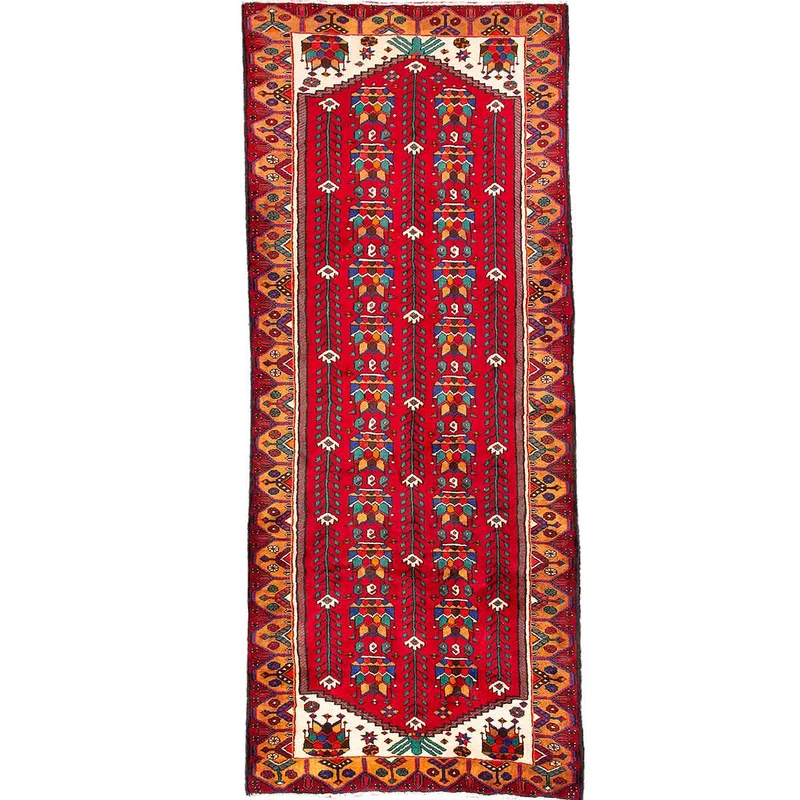
A Qashqai runner with geometric medallions - Qashqai Persian Rug 10x3 ft - Geometric Semi Antique Wool Hand Knotted
5
The Khamseh Confederation
The second great confederation of Fars is the Khamseh, meaning "the five," made up of five tribes of diverse origin: the Arab, Basseri, Baharlu, Inanlu, and Nafar. Some are Persian-speaking, some Turkic-speaking, and the Arab tribe preserves an Arabic heritage. The Khamseh confederation was organized in the nineteenth century to balance the power of the Qashqai.
Khamseh rugs are often looser in weave than Qashqai rugs and are particularly known for their charming bird motifs - sometimes called the "Khamseh bird" - scattered across the field, along with stacked diamond medallions and bright colors. Basseri and Arab weavers in particular have produced distinctive rugs and bags. Explore our Khamseh collection.
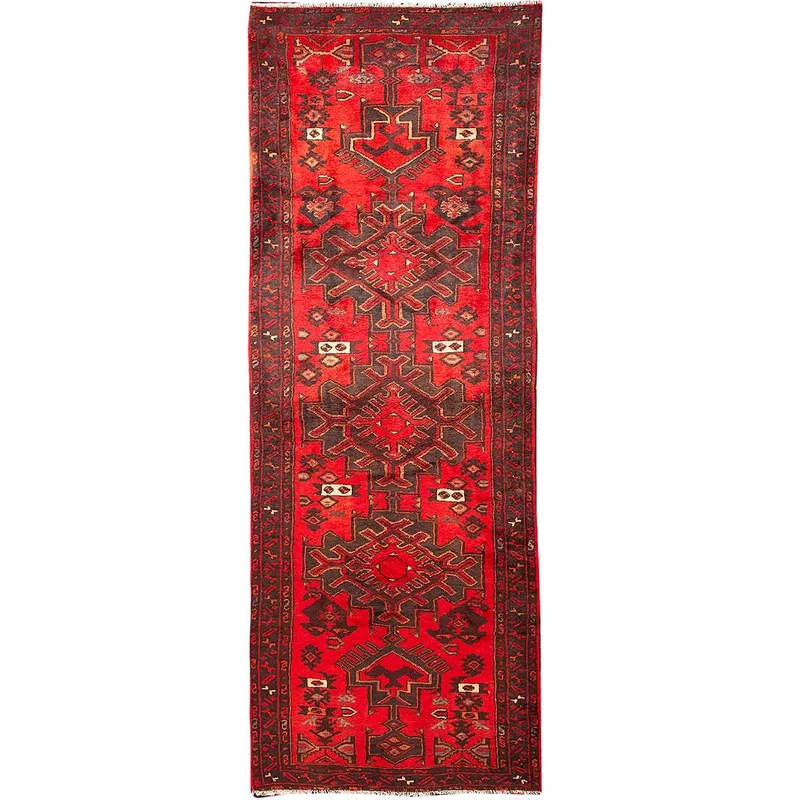
A Khamseh runner with a medallion design - Khamseh Persian Rug 9x3 ft - Medallion Semi Antique Wool Hand Knotted
6
The Luri Weavers
The Luri (Lori) peoples of the Zagros, including Lur communities living in Fars, have their own weaving traditions. Luri rugs are often thick and sturdy, with bold geometric designs, stepped medallions, and deep colors, frequently with dark blues and reds. Luri women are also known for Gabbehs and kilims. Explore our Lori collection.
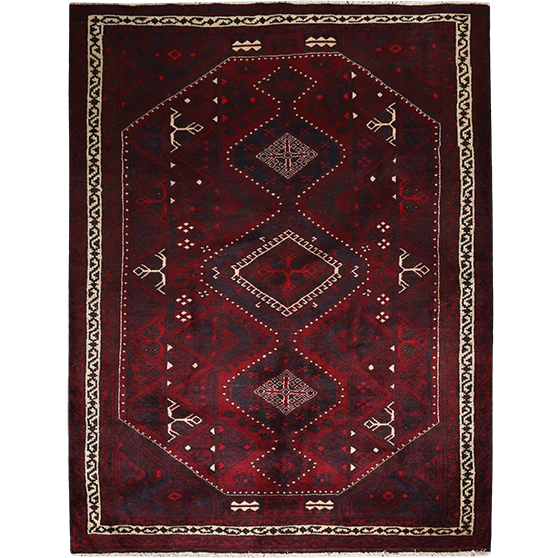
A Lori rug with a bold geometric design - Lori Persian Rug 9x7 ft - Geometric Semi Antique Wool Hand Knotted
7
Shiraz - The Market City
Shiraz, the capital of Fars, is one of Persia's most beloved cities, famous for its gardens, poets, and culture: it is the city of Saadi and Hafez, whose tombs are visited by admirers from across the world. For the rug trade, Shiraz has long been the market where tribal rugs from across Fars were bought and sold.
As a result, the name "Shiraz" is used in the trade for a broad group of tribal and village rugs from the region, often woven by Qashqai, Khamseh, Luri, and other weavers and marketed through the city. Shiraz rugs are typically geometric, with diamond medallions, stylized motifs, and warm red, blue, and ivory palettes. They vary in quality, from simple, sturdy pieces to fine tribal work. Explore our Shiraz collection.

A Shiraz rug with a geometric design - Shiraz Persian Rug 9x6 ft - Geometric Semi Antique Wool Hand Knotted
8
Abadeh - Town Weaving with Tribal Roots
Abadeh, in the north of Fars on the road to Isfahan, is a town whose weavers adopted Qashqai designs and wove them with the precision of town workshops. Abadeh rugs typically show a central diamond medallion, often with small stepped corners, on a red or ivory field filled with stylized flowers, animals, and vases. They are woven on cotton foundations with a firm, even structure, which makes them more regular than true tribal rugs while keeping their tribal charm. Explore our Abadeh collection.
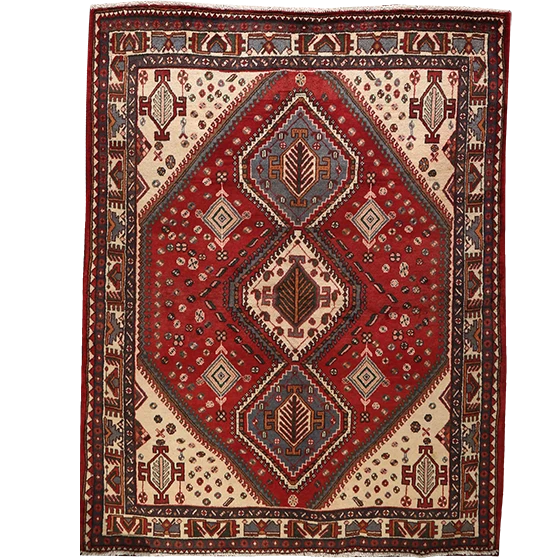
An Abadeh rug with a geometric design - Abadeh Persian Rug 6x5 ft - Geometric Semi Antique Wool Hand Knotted
9
The Gabbeh - Simplicity and Soul
Perhaps the most famous weaving of Fars today is the Gabbeh. Traditionally, Gabbehs were thick, coarsely knotted rugs with a long pile, woven by Qashqai and Luri women for their own use, often as sleeping rugs or for the floor of the tent. Their designs are simple and spontaneous: open fields of color, small stylized animals, trees, or human figures, and geometric blocks, woven from memory and imagination.
In the 1970s and 1980s, Western buyers discovered Gabbehs, and their minimalist, almost modern look made them popular with designers. Today, Gabbehs are woven in many qualities, from traditional tribal pieces to fine workshop rugs with hand-spun wool and natural dyes. See our articles on Gabbeh rugs and Gabbehs of Bushehr, and our Gabbeh collection.
10
Kilims, Bags, and Flatweaves
The tribes of Fars are also masters of flatweaving. Qashqai and Luri kilims, with bold bands, diamonds, and zigzags in vivid colors, are among the most admired flatweaves in the world. Weavers also produce gelims for floors, jajims (fine striped textiles used as covers), saddlebags (khorjin), storage bags (mafrash), salt bags, and decorative animal trappings. These pieces were made for daily use in the tents, and fine old examples are highly collectible. Explore our kilim collection.
11
Wool and Materials of Fars
The wool of Fars is one of the secrets of its rugs. Sheep grazing the high summer pastures of the Zagros grow long, strong, lustrous fleece, and tribal weavers traditionally spun it by hand, leaving a slightly irregular yarn that catches the light and takes dye beautifully. Warps are usually wool too, sometimes mixed with goat hair, which makes tribal rugs flexible and gives their edges a natural, hand-finished look. In older pieces, the combination of this wool with natural dyes produces a soft, glowing surface that improves with age. Our article on Persian rug wool explains why mountain wool is so prized.
12
Natural Dyes and the Fars Revival
Fars has been at the center of the revival of natural dyes in Persian weaving. Tribal weavers here never entirely abandoned plant dyes, and from the late twentieth century onward, workshops around Shiraz worked with tribal weavers to restore hand-spun wool and traditional natural dyes - madder, indigo, pomegranate rind, walnut husk, and local plants - to their rugs. The results, with their deep, glowing colors and lively abrash, have won international acclaim and inspired similar efforts elsewhere.
The rugs of Fars therefore offer some of the best opportunities to buy new rugs made with natural dyes, alongside antique and semi-antique tribal pieces. Our series on Persian rug color, beginning with the master dyer, explains how these dyes are made, and our article on the hidden palette describes many of the plants used by tribal dyers.
13
Settled Life and Changing Traditions
Over the twentieth century, life in Fars changed greatly. Government policies, economic pressures, and modernization led many nomadic families to settle in villages and towns, and today only a minority of tribal families still migrate with their flocks. Settlement brought new opportunities, such as schools and health care, but it also changed weaving. Settled weavers often use vertical looms, cotton foundations, and machine-spun wool, and some weave on commission for merchants rather than for their own homes.
At the same time, many families have kept their weaving traditions alive, and the natural dye revival has given new value to traditional skills. Cooperatives and workshops in Shiraz and the surrounding region work with tribal weavers to produce rugs and Gabbehs that combine traditional designs with excellent materials, helping to keep the craft rewarding for a new generation.
14
Other Weaving Communities of Fars
Besides the great confederations, many other communities in Fars weave rugs and flatweaves. Villages around Firuzabad, Kazerun, and Sarvestan have their own local traditions, and some Bakhtiari and Kurdish families living on the edges of the province contribute their own styles. Town weavers in Shiraz itself have produced rugs in both tribal and city styles. This diversity is part of what makes the weaving of Fars so rich, and why rugs labeled "Shiraz" can vary so widely in design and quality.
15
Designs and Symbols of Fars
•
Linked diamond medallions - a series of two or three medallions joined along the central axis, very common in Qashqai and Shiraz rugs.
•
The Qashqai lion - a proud, stylized lion, sometimes with a sword or a sun, a symbol of courage and strength.
•
Birds - especially in Khamseh rugs, scattered across the field.
•
The boteh - in rows or filling medallions.
•
The tree of life and cypress - often in Gabbehs and prayer designs.
•
Small animals and human figures - goats, dogs, horses, and people drawn from daily life.
These motifs give Fars rugs their lively, personal character. See our article on Persian rug motifs for more on their meanings.
16
How to Recognize a Rug from Fars
•
Wool foundations - typical of tribal rugs, often with dark or multicolored wefts; town rugs such as Abadeh use cotton.
•
Lustrous, soft wool - from mountain flocks, often hand-spun in older and natural-dye pieces.
•
Vivid colors and strong abrash - from small batches of natural or traditional dyes.
•
Geometric medallions and lively motifs - animals, birds, and stylized flowers.
•
Decorative ends and sides - colorful side cords and flatwoven ends in tribal pieces.
17
Fars Rugs in Your Home
Fars rugs bring warmth, color, and a sense of life to any room. Qashqai and Shiraz rugs suit living rooms, studies, and bedrooms, pairing well with both rustic and modern furniture. Gabbehs, with their simple designs and soft pile, are perfect for contemporary interiors and for anyone who loves a relaxed, natural look. Runners from Fars bring character to hallways, and kilims make beautiful floor coverings, throws, and wall hangings. Our rug size guide will help you choose the right dimensions.
Fars rugs are also wonderful for mixing styles. A colorful Qashqai rug can bring life to a neutral modern room, while a soft Gabbeh can calm a busy, traditional space.
18
Caring for Fars Rugs
Tribal rugs with wool foundations can shrink or distort if they are washed and dried carelessly, so they should be cleaned by specialists experienced with tribal textiles. Vacuum them regularly without a beater bar, rotate them to even out wear, and keep them out of strong direct sunlight to protect their natural colors. Some abrash and slight irregularity in shape are natural features of tribal rugs, not defects. See our guides to cleaning a Persian rug at home and professional rug cleaning.
19
Collecting Rugs from Fars
Tribal rugs from Fars have a devoted following among collectors. Antique Qashqai rugs, especially fine Kashkuli pieces with natural dyes and lustrous wool, are among the most sought-after tribal rugs, while old Khamseh rugs with their charming bird motifs and early Gabbehs with bold abstract designs are increasingly appreciated. Bags, saddlebags, and kilims offer an affordable way to collect fine tribal weaving.
When evaluating a rug from Fars, look at the wool, the dyes, the condition of the pile and foundation, and the originality of the ends and sides. Strong, harmonious natural colors and confident, lively drawing add greatly to value. Semi-antique tribal rugs in good condition often offer outstanding value for their quality and character. See our article on investing in hand-knotted rugs.
20
Frequently Asked Questions
What is the difference between Qashqai and Shiraz rugs?
Qashqai rugs are woven by the Qashqai tribes. "Shiraz" is a broader trade name for tribal and village rugs from Fars marketed through Shiraz, which may include Qashqai, Khamseh, and Luri work.
What is a Gabbeh?
A thick, long-piled tribal rug from Fars with simple, spontaneous designs, traditionally woven by Qashqai and Luri women for their own use.
Are Fars rugs made with natural dyes?
Many are. Fars has been at the center of the natural dye revival, and many tribal and workshop rugs from the region use hand-spun wool and natural dyes.
What is a Kashkuli rug?
A rug woven by the Kashkuli, one of the main Qashqai tribes, famous for some of the finest and most detailed Qashqai rugs.
Are Gabbehs good for modern homes?
Yes. Their simple, open designs, soft pile, and natural colors make them especially well suited to contemporary interiors.
Why do tribal rugs from Fars have uneven colors?
Wool was dyed in small batches, often with natural dyes, so slight color differences called abrash appear across the rug. This is a sign of authenticity.
21
The Tribal Heart of Persia
From the migrating tribes of the Zagros to the market of Shiraz, Fars is one of the great homes of tribal weaving. Its rugs carry the energy of nomadic life, the colors of mountain plants, and the creativity of generations of women weavers. Whether you choose an antique Qashqai, a lively Khamseh runner, or a modern natural-dye Gabbeh, a rug from Fars brings a piece of that living tradition into your home.
At Los Angeles Home of Rugs, you can explore our Qashqai, Shiraz, Abadeh, Khamseh, Lori, and Gabbeh collections. Every rug comes with a Certificate of Authenticity documenting its origin, materials, and age. If you have questions, please ask our experts.
Explore Rugs from Fars
Qashqai Rugs
Shiraz Rugs
Abadeh Rugs
Khamseh Rugs
Lori Rugs
Gabbeh Rugs
Kilims
Nomadic Rugs