


History of Persian Rugs: From the Beginnings to 1499
Los Angeles Home of Rugs on Nov 17th 2026
Every Persian rug in a modern home is the latest chapter in a story that began thousands of years ago. Long before the great Safavid court carpets, before Persian rugs were traded across the world, the peoples of the Persian plateau and Central Asia were learning to spin wool, dye it with plants and insects, and knot it into warm, colorful floor coverings. The early chapters of this story are only partly known, pieced together from a handful of surviving fragments, ancient writings, miniature paintings, and the craft traditions that still survive among nomadic weavers.
This article is the first in our series on the history of Persian weaving. It traces the story from its earliest origins to the end of the fifteenth century, on the eve of the Safavid dynasty. The next article covers the Safavid golden age, 1499 to 1722, followed by 1722 to 1925 and 1925 to the present.
1
Before the Knotted Rug
Weaving is one of humanity's oldest crafts. Long before anyone tied a pile knot, people were twisting plant fibers into cords, weaving mats from reeds, and making simple flatwoven textiles. Archaeologists have found evidence of weaving in the Near East going back many thousands of years, and the domestication of sheep and goats in the uplands of the Zagros and Taurus mountains, roughly ten thousand years ago, eventually provided the most important raw material for rugs: wool.
Early textiles were flatwoven, much like the kilims still woven today. The knotted pile rug - in which short lengths of yarn are tied around warp threads to form a thick, soft surface - came later. Most scholars believe it was invented by nomadic herders of Central Asia and the Persian plateau, who needed warm, durable, and portable floor coverings for their tents. A pile rug imitated the warmth of an animal fleece while allowing weavers to create colorful patterns. This is why Persian sources often describe tribal rugs as "the mother of all Persian rugs."
Early European scholars believed that rug weaving began in ancient Egypt or Mesopotamia, based on references in ancient texts and carvings that show patterned floor coverings. These sources prove that patterned textiles were valued, but they do not show knotted pile. The discovery of the Pazyryk carpet in the twentieth century changed the debate entirely.
2
Weaving in Nomadic Life
To understand why the pile rug was born among nomads, imagine life on the high pastures of Central Asia and the Persian plateau thousands of years ago. Families moved with their flocks between summer and winter grazing grounds, living in felt or woven tents. They needed coverings that were warm, durable, and easy to roll up and carry, as well as bags to store and transport their belongings. Everything had to be made from what the flocks provided: wool, goat hair, and leather.
Pile rugs answered all these needs. They insulated the cold ground, softened sleeping areas, decorated the tent, and could be traded or given as gifts. Weaving was done on light horizontal looms that could be taken apart and moved with the camp - the same type of loom still used by tribal weavers such as the Qashqai today. Patterns were woven from memory and passed from mother to daughter, which helps explain why tribal designs have changed so slowly over the centuries. Our article on how a Persian rug is made describes these looms.
3
Color in the Ancient World
The earliest rugs were already colorful. The Pazyryk carpet used an insect red, and the dye plants that would later define Persian rugs - madder for red, indigo for blue, and a range of yellow plants - were known across the ancient Near East. Madder was cultivated in the region for thousands of years, while indigo and insect reds were valuable traded goods. The knowledge of how to fix these dyes to wool with mordants such as alum was also ancient. Our series on Persian rug color, beginning with the master dyer, explores this heritage in depth.
4
The Pazyryk Carpet - The Oldest Surviving Pile Rug
In 1949, the Russian archaeologist Sergei Rudenko excavated a group of burial mounds at Pazyryk, in the Altai Mountains of southern Siberia. The tombs belonged to nomadic chieftains of the Scythian world, and because water had seeped into them and frozen, many objects survived in remarkable condition. Among them was a knotted pile carpet, buried around the fifth century BCE, making it the oldest surviving pile rug in the world.
The Pazyryk carpet measures roughly six feet square (about 200 by 183 centimeters). It is woven with the symmetrical knot at a density of around 36 knots per square centimeter - roughly 230 knots per square inch, comparable to a good modern city rug. Its design shows a central field of star-like rosettes, framed by borders of deer and of horsemen leading or riding horses, along with griffin motifs. It was dyed with natural dyes, including an insect red.
The carpet's origin is still debated. Many scholars point to its close similarities with Achaemenid Persian art - the processions of horsemen recall the reliefs of Persepolis - and suggest it was made in, or under the influence of, the Achaemenid Persian world. Others suggest Armenian, Median, or Central Asian origins. Whatever its exact source, the Pazyryk carpet proves that the knotted pile technique had already reached a high level of skill more than 2,400 years ago. It is now preserved in the State Hermitage Museum in St. Petersburg. Read more in our article on the Pazyryk rug.
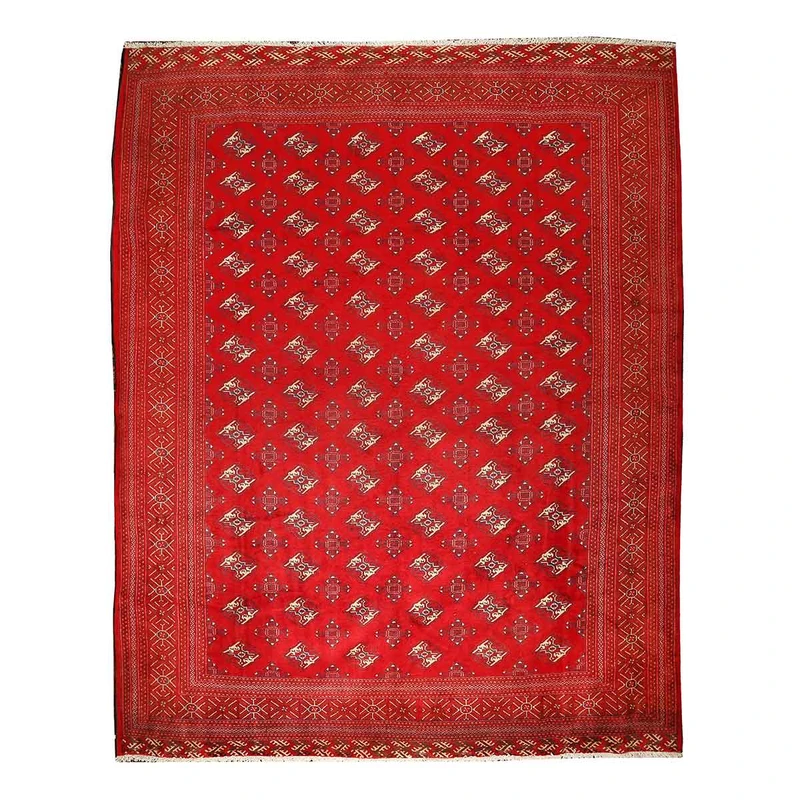
Repeated geometric motifs in a Turkmen rug, an echo of the ancient nomadic weaving tradition - Turkmen Persian Rug 12x10 ft - Geometric Semi Antique Wool Silk Hand Knotted
5
The Achaemenid Empire - Luxury and Splendor
The Achaemenid Persian Empire (about 550 to 330 BCE), founded by Cyrus the Great, was the largest empire the world had yet seen, stretching from Egypt and Anatolia to the Indus Valley. Its royal courts at Pasargadae, Susa, and Persepolis were famous for their luxury. Greek writers who encountered the Persians described their richly colored textiles and soft coverings, and the Persian love of fine furnishings became proverbial in the Greek world.
Although no Achaemenid carpet survives in Persia itself, the artistic vocabulary of the period - processions, rosettes, lotus flowers, winged creatures, and stately animals - echoes through later Persian art, and the Pazyryk carpet shows how such motifs could appear in pile weaving. The garden of Cyrus at Pasargadae, with its stone water channels, also provides the earliest known evidence of the four-part Persian garden that would later inspire Persian garden rugs.
6
The Parthians and Sasanians
After Alexander the Great's conquest and the Seleucid period, Persia was ruled by the Parthians (about 247 BCE to 224 CE) and then the Sasanians (224 to 651 CE). The Sasanian era was one of the most brilliant in Persian history, famous for its architecture, metalwork, silk textiles, and court culture. Sasanian silks, with their roundels enclosing paired animals, birds, and mythical creatures such as the senmurv, were traded as far as China and Europe and influenced textile design across the medieval world.
The Spring of Khosrow
The most famous carpet of the ancient Persian world is one that no longer exists. According to early historians, the palace of the Sasanian kings at Ctesiphon contained an immense carpet known as the Spring of Khosrow (Baharestan). It is said to have represented a garden in springtime, with paths, streams, flower beds, and trees, worked in silk, gold, silver, and precious stones, so that the king could enjoy the sight of spring even in winter. Accounts describe it as enormous - many meters long on each side.
When Arab armies captured Ctesiphon in the seventh century, the carpet was taken as booty, cut into pieces, and divided among the soldiers. Nothing of it survives, and some details of the accounts may be legendary, but the story shows how highly carpets were valued at the Sasanian court and how early the idea of the carpet as a garden had taken root.
7
The Early Islamic Centuries
After the Arab conquest in the seventh century, Persia became part of the Islamic world, and Persian culture, in turn, deeply shaped Islamic civilization. Persian scholars, administrators, poets, and craftsmen played leading roles under the Abbasid caliphs in Baghdad. Medieval geographers and historians writing in Arabic and Persian mention carpets, rugs, and textiles among the products of various Persian regions, including Fars, Tabaristan, and Khorasan, and among the tribute paid to rulers.
Islamic art brought new elements to Persian design: the arabesque (islimi), geometric interlace, and calligraphy. These would later become essential parts of the Persian rug vocabulary, especially in borders and in the curvilinear designs of city workshops.
8
Carpets in Persian Poetry and Ceremony
Even in this early period, carpets held a special place in Persian life beyond their practical use. They marked places of honor, welcomed guests, and set the scene for feasts and ceremonies. In the great Persian epic, the *Shahnameh*, completed by Ferdowsi around the year 1010, kings hold court and celebrate victories surrounded by rich furnishings, and the image of a beautifully spread carpet became a familiar part of Persian literary imagination. Later poets compared spring meadows to carpets of flowers - a metaphor that carpet designers would return to again and again.
Carpets were also valued gifts between rulers and an important part of royal treasuries. The tradition of giving fine carpets as diplomatic gifts would become even more important under the Safavids, when Persian carpets were sent to the courts of Europe and the Ottoman Empire.
9
The Seljuks and the Turkic Nomads
In the eleventh century, the Seljuk Turks, nomadic peoples from Central Asia, swept into Persia and established a great empire. The Seljuks adopted Persian culture and language at court while bringing with them the weaving traditions of the steppe. Their arrival strengthened the role of nomadic and Turkic weavers in the region, and it helped spread the symmetrical knot widely in northwestern Persia, Anatolia, and the Caucasus.
Some of the oldest surviving carpets of the Islamic world come from the Seljuk realm in Anatolia: a group of thirteenth-century carpets discovered in mosques in Konya and Beyşehir, with small, repeated geometric motifs and angular Kufic-style borders. Though made outside Persia, they show the geometric style that was widespread in the region at the time and the importance of Turkic weaving traditions that also existed in Persia.
10
The Mongols and the Ilkhanids
In the thirteenth century, the Mongol invasions brought devastation to much of Persia, but they also connected the country with China and the whole of Asia under a single empire. Under the Ilkhanid dynasty, Mongol rulers based in Tabriz and Soltaniyeh, Persian culture recovered and flourished. Tabriz became one of the great cities of the world, a center of trade, scholarship, and art.
Contact with China introduced new motifs into Persian art: cloud bands, dragons, phoenixes, and lotus blossoms, as well as a new interest in naturalistic flowers and landscapes. These elements, visible in Ilkhanid manuscript painting, would later find their way into Persian carpet design. The Venetian traveler Marco Polo, passing through the region in the late thirteenth century, praised the beautiful carpets made by Turkoman weavers in neighboring Anatolia - a reminder that the carpet was already an admired product of the region.
11
The Timurid Renaissance
In the late fourteenth century, the conqueror Timur (Tamerlane) built an empire centered on Samarkand. His successors, the Timurids, became great patrons of art and learning. Under Shah Rukh (ruled 1405 to 1447) and later rulers, the city of Herat - then part of greater Khorasan - became one of the most brilliant artistic centers in the world.
Herat's painters, including the celebrated master Kamal ud-Din Behzad, created exquisite miniature paintings, and these paintings are among our most important sources for the carpets of the period. They show rulers and courtiers seated on carpets in palaces and gardens. The carpets in earlier miniatures are mostly geometric, with small repeating motifs and Kufic-style borders, but by the late fifteenth century, some paintings begin to show more curvilinear, floral designs - the first signs of the revolution in carpet design that would flower under the Safavids.
The Timurid court style also developed the refined floral vocabulary - palmettes, scrolling vines, and lotus blossoms - that later carpet designers adopted. The famous Herati pattern, still woven across Persia today, is traditionally associated with the designers of Herat. Read more in our articles on Persian rug motifs and Khorasan rugs.
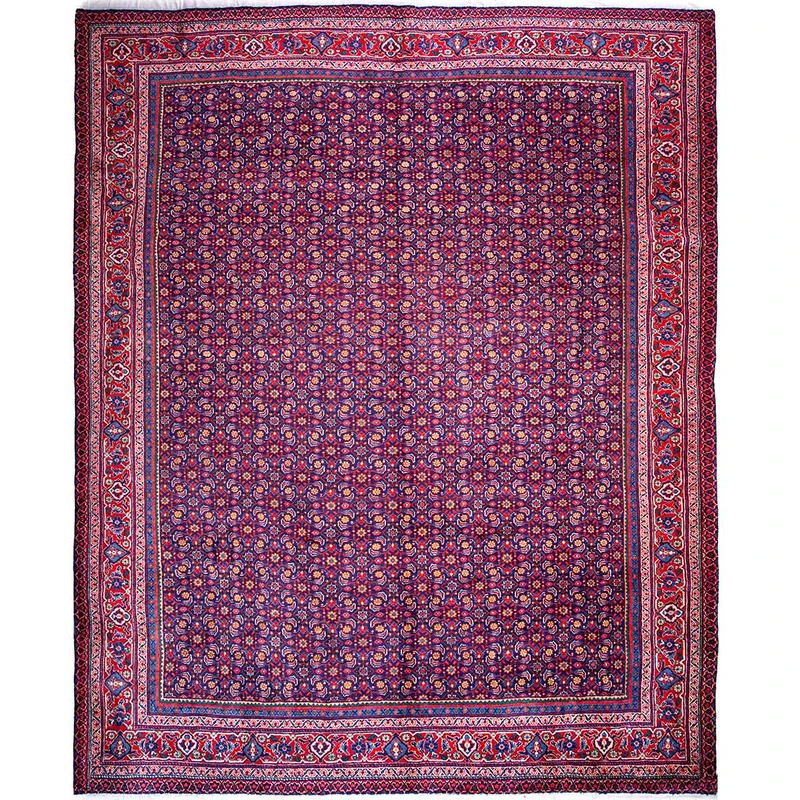
An Arak rug with an all-over Herati design, a pattern traditionally linked to Herat - Arak Persian Rug 12x9 ft - Herati Semi Antique Wool Hand Knotted
12
The Turkmen Dynasties and Tabriz
In the fifteenth century, western Persia was ruled by two Turkmen confederations, the Qara Qoyunlu ("Black Sheep") and the Aq Qoyunlu ("White Sheep"), both of which made Tabriz their capital. The Aq Qoyunlu court, especially under Uzun Hasan, was a center of art and culture, and its workshops are believed to have produced carpets of high quality. Historians see the art of the Turkmen courts as an important bridge between the Timurid style and the Safavid style that followed, when Shah Ismail I took Tabriz in 1501 and founded the Safavid dynasty.
13
From Geometric to Curvilinear
The most important change in Persian carpet design during this long period was the gradual shift from geometric to curvilinear design. For most of history, carpets were woven with geometric patterns: straight lines, angles, and stepped shapes that suit the grid of knots and can be woven from memory. These designs remained the language of tribal and village weavers.
By the end of the fifteenth century, however, a new idea was emerging. Court designers, trained in manuscript illumination and painting, began to design carpets on paper, drawing flowing floral compositions that skilled weavers then translated into fine, densely knotted carpets. This required new methods - the cartoon, or design drawn on squared paper, and organized workshops with master designers, dyers, and weavers. This transformation, which reached its peak under the Safavids, is the subject of our next article. See also our guide to Persian rug design.
14
What Survives and What We Know
One of the challenges of studying early Persian rugs is how little survives. Wool and cotton are fragile; carpets were used daily, worn out, and replaced. Apart from the Pazyryk carpet and a few fragments, our knowledge of carpets before 1500 comes mainly from:
•
Written sources - histories, geographies, travel accounts, and poetry that mention carpets.
•
Miniature paintings - especially Timurid and Turkmen paintings that show carpets in detail.
•
Related arts - textiles, tiles, metalwork, and manuscript illumination that share motifs with carpets.
•
Living traditions - the techniques and designs of tribal weavers, many of which preserve very old forms.
Together, these sources allow historians to reconstruct the outline of the story, even if many details remain uncertain.
15
A Timeline of Early Persian Weaving
•
About 10,000 years ago - sheep and goats are domesticated in the Zagros and Taurus mountains.
•
About the 5th century BCE - the Pazyryk carpet is buried in the Altai Mountains; the Achaemenid Empire rules Persia.
•
224 to 651 CE - the Sasanian era; the legendary Spring of Khosrow carpet adorns the palace at Ctesiphon.
•
7th century - the Arab conquest; Persia becomes part of the Islamic world.
•
11th to 12th centuries - the Seljuk Turks rule Persia, strengthening Turkic weaving traditions.
•
13th to 14th centuries - the Mongol Ilkhanids rule from Tabriz; Chinese motifs enter Persian art.
•
15th century - the Timurid renaissance in Herat; the Turkmen dynasties rule from Tabriz; carpet design begins to become curvilinear.
•
1501 - Shah Ismail I founds the Safavid dynasty in Tabriz, opening the golden age of Persian carpets.
16
The Legacy of the Early Centuries
The early history of Persian weaving established the foundations on which everything later was built: the knotted pile technique, natural dyes such as madder, indigo, and insect red, the love of gardens, animals, and flowers, the arabesque and the palmette, and the deep cultural value placed on fine carpets. Many motifs woven by tribal weavers today - stars, rosettes, animals, and the tree of life - may preserve forms that are thousands of years old. See our article on the many faces of the tree of life.
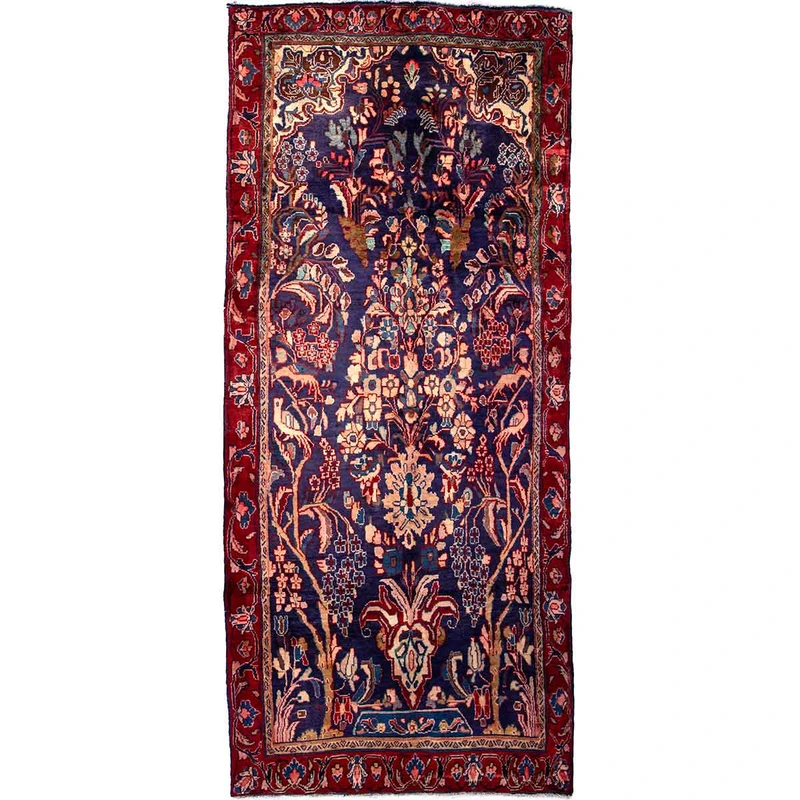
A tree of life runner from Arak, a motif with roots in ancient Persian art - Arak Persian Rug 9x3 ft - Tree of Life Semi Antique Wool Hand Knotted
17
Frequently Asked Questions
What is the oldest Persian rug?
The Pazyryk carpet, from around the fifth century BCE, is the oldest surviving knotted pile rug. Its exact origin is debated, but many scholars connect it with the Achaemenid Persian world.
Who invented the pile rug?
Most scholars believe nomadic herders of Central Asia and the Persian plateau developed the knotted pile technique, but its exact origin is unknown.
What was the Spring of Khosrow?
A legendary Sasanian carpet representing a spring garden, made with silk and precious materials. It was cut up after the Arab conquest, and nothing survives.
When did Persian rugs become curvilinear?
The shift began in the late fifteenth century, in the Timurid and Turkmen court workshops, and reached its peak under the Safavids in the sixteenth century.
18
Continue the Story
The story continues in our next article, The Art of Weaving from 1499 to 1722, which covers the Safavid golden age, when Persian carpet weaving became a royal art and produced some of the greatest carpets ever made. For a broader overview, see why Persian rugs are famous around the world.
At Los Angeles Home of Rugs, every rug in our collection continues this ancient tradition and comes with a Certificate of Authenticity documenting its origin, materials, and age. Explore our antique and nomadic rugs, or ask our experts about the history of a particular piece.
Explore the Collection
Antique Rugs
Nomadic Rugs
Turkmen Rugs
Geometric Designs
Herati Designs
Tree of Life
Persian Rug FAQ