


Persian Rug Design: Design Families, Cartoons, and Styles
Los Angeles Home of Rugs on Nov 17th 2026
Of all the qualities that made Persian rugs famous across the world, design may be the most important. Each Persian rug has a design of its own, and across the whole tradition there are thousands of distinct patterns, from the bold geometry of tribal weavings to the flowing floral compositions of the great city workshops. Yet behind this variety lies a clear structure: a set of design families, compositional rules, and working methods that Persian artists have refined over centuries.
This article explains how Persian rug designs are created, introduces the main design families recognized by Persian carpet scholars, and traces how design evolved from geometric to curvilinear. For the individual symbols that appear inside these designs, see our companion guide to Persian rug design motifs.
1
A Design Language Shaped by Many Cultures
Persia sits at a crossroads of civilizations, and its artists have always absorbed ideas from the cultures that settled in or passed through the land. Persian designers selected the forms they found most beautiful from neighboring and invading peoples and blended them with their own ancient vocabulary. Over time this created a design language that is unmistakably Persian yet remarkably rich.
Design also never developed in isolation. The motifs painted on tiles, carved in stucco, illuminated in manuscripts, and woven into carpets influenced and enriched one another. In the Safavid era the same master artists often designed for several media at once, which is why a carpet from Isfahan can echo the dome of a mosque in the same city.
2
The Designer and the Cartoon
In city workshops, a rug begins long before the first knot is tied. A master designer (naqqash) draws the complete design on squared paper, called a cartoon or naqsheh. Each small square represents one knot, and its color tells the weaver exactly which yarn to use. For a symmetrical rug, the designer usually draws only one quarter of the field and half of the border; the weavers mirror it to complete the rug.
Village and tribal weavers work differently. Many weave from memory, guided by designs passed down in their families, or copy from a small sample rug called a vagireh. This difference explains much of the visual contrast between city and tribal rugs: the precise, flowing curves of a cartoon-based rug versus the bold, slightly irregular geometry of a rug woven from memory. Our article on reading a Persian rug's secret language explores this difference in depth.
Except for pictorial rugs that portray scenes or faces, most Persian rugs are symmetrical along both their vertical and horizontal axes. This mirrored structure is one of the defining principles of classical Persian design.
From Idea to Cartoon
Creating a new design for a fine city rug was a long and careful process. The designer usually began with freehand sketches of the overall composition: the shape of the medallion, the rhythm of the field, the balance between field and border. Once the idea was settled, he transferred it to graph paper, square by square, deciding the exact color of every single knot. A large, finely knotted carpet can contain well over a million knots, so a complete cartoon for one quarter of the design might take a skilled designer several months.
Cartoons were valuable property. Workshops kept them for generations and reused successful designs many times, sometimes adapting them to new sizes or color schemes. In the great weaving cities, certain designers became famous in their own right. In twentieth-century Tabriz, for example, master designers such as Rassam Arabzadeh were celebrated for elaborate, painterly carpet designs, and workshops proudly wove their names or signatures into the borders. Today many designers work on computers, but the principles of the cartoon - one square for one knot - remain exactly the same.
The Weaver's Freedom
Even with a cartoon, the weaver is not a machine. Experienced weavers make small decisions throughout the work: adjusting a curve that does not sit well on the grid, compensating when the rug drifts slightly in width, or changing a color when a yarn runs out. In village and tribal weaving this freedom is much greater, and each rug becomes a personal interpretation of a shared design tradition.
3
The Main Design Families
Persian carpet scholars have classified the traditional designs in several ways. A widely used Persian classification groups them into about nineteen families. Among the most important are:
•
Medallion and corner (lachak-toranj) - a central medallion with quarter medallions in the corners, the most iconic Persian composition, perfected in Kashan, Isfahan, and Tabriz. See our medallion designs.
•
All-over or scattered (afshan) - flowers, palmettes, and vines spread evenly across the field without a central focus. See our afshan designs.
•
Repeating lattice (bandi) - a small unit repeated across the field to form a continuous network, such as the Herati and Mina Khani patterns.
•
Panel or garden (khesti) - the field divided into compartments, each holding a motif, derived from Persian garden plans. Read more in our article on the Persian garden design.
•
Vase (goldani) - flowering plants rising from vases, a design with roots in Safavid court weaving. See our vase designs.
•
Prayer niche (mehrabi) - an arch at one end of the field, inspired by the mihrab of a mosque. See our mihrab designs.
•
Hunting (shekargahi) - hunters, animals, and birds within a floral landscape. See our hunting designs.
•
Tree (derakhti) - trees of life, cypresses, and flowering trees. See our tree designs.
•
Boteh - fields filled with the teardrop motif known in the West as paisley. See our boteh designs.
•
Stripes (moharramat) - vertical bands of color and pattern, common in tribal and village rugs. See our moharramat designs.
•
Geometric (hendesi) - angular medallions and motifs typical of tribal and village rugs from regions such as Heriz and the Qashqai. See our geometric designs.
•
European floral (gol farang) - naturalistic roses and bouquets that entered Persian design in the Qajar era. See our farangi gul designs.
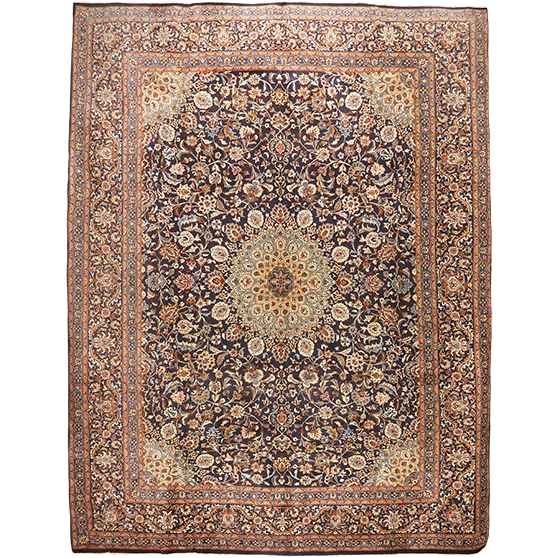
A Shah Abbasi medallion design in navy blue and ivory - Kashmar Persian Rug 13x10 ft - Shah Abbasi Semi Antique Wool Hand Knotted
The Art of the Border
Borders deserve more attention than they usually receive. A classical Persian rug often has three to seven border bands: a wide main border in the center, flanked by narrower minor borders and thin guard stripes. Designers filled the main border with alternating palmettes and rosettes linked by scrolling vines, cartouches, or repeating geometric motifs, while guard stripes carried small, simple patterns that act like a picture frame.
One of the hardest challenges in rug design is turning the corner. Because the border pattern runs in a continuous rhythm along all four sides, the designer must plan exactly how it will meet at each corner. In refined city rugs the corners are resolved perfectly, often with a diagonal motif; in village and tribal rugs the weaver frequently improvises, and the pattern may be cut off or compressed. These "unresolved" corners are not mistakes in the eyes of collectors but a sign of a rug woven from memory.
4
Color as Part of the Design
A Persian rug design is not only a drawing but also a color plan. The same medallion design can feel formal in deep red and navy, airy in ivory and soft blue, or warm and rustic in rust and camel. Designers used color to create depth, placing darker tones in the background and lighter tones in the motifs so that the pattern seems to float, and they used contrasting colors to separate the field from the border.
Color also guides the eye. A bright accent repeated at intervals across the field creates rhythm, and a light-colored medallion on a dark field draws attention to the center. Our series on Persian rug color, beginning with the master dyer, explains how these colors were made, and our article on the nine iconic Persian color ranges explores their meanings.
5
Symbolism in Persian Designs
Many Persian designs carry layers of meaning. The garden layout recalls paradise, the tree of life suggests eternity and the link between earth and heaven, the boteh has been read as a flame, a cypress, or a seed, and the vase stands for abundance. Some meanings are well documented, while others are interpretations added over time, and weavers themselves often describe motifs simply by their everyday names. Our articles on Persian rug design motifs and how to read a Persian rug's secret language explore these meanings in detail.
6
A Closer Look at Five Great Design Families
The Medallion and Corner Design
The medallion design is the most recognizable Persian composition. Its roots lie in the art of book covers and illuminated manuscripts, where a central medallion and four corner quarters framed the page. Carpet designers of the Safavid court adopted this layout in the sixteenth century, and it reached one of its most famous expressions in the Ardabil Carpet, dated to the 1540s, whose great golden medallion is surrounded by lamps and a field of flowering vines. Medallion rugs remain the classic choice for living and dining rooms, where the central focus anchors the space.
The All-Over Afshan Design
In an afshan design, which literally means "scattered," the field is covered with flowers, palmettes, and vines that spread evenly without a single focal point. This creates a calm, continuous surface that looks attractive from every direction - one reason all-over designs are so popular in rooms where furniture will cover part of the rug.
The Herati Pattern
The Herati is perhaps the most widely woven repeat pattern in Persian weaving. Each unit consists of a central rosette inside a diamond, flanked by curving lancet leaves, often described in the West as "fish" because of their shape. Named after the historic city of Herat, once part of the Persian cultural world, the pattern appears in rugs from Farahan, Bijar, Tabriz, Khorasan, and many other regions, each giving it a slightly different character.
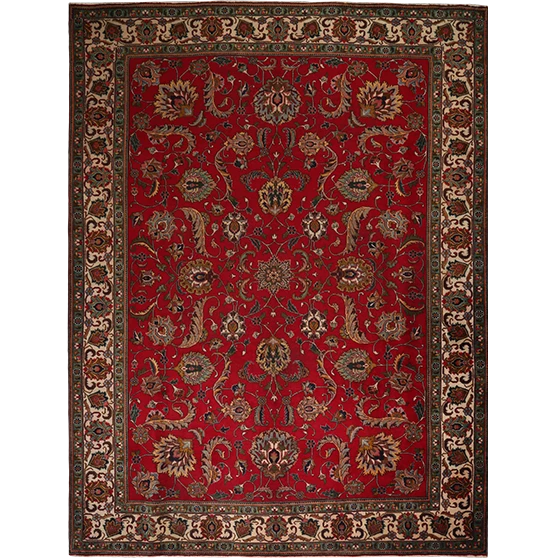
An all-over afshan design in a Tabriz wool and silk rug - Tabriz Persian Rug 13x9 ft - Afshan Semi Antique Wool Silk Hand Knotted
The Vase Design
Vase designs show flowering plants rising from small vases, arranged in rows or in a lattice. They are associated especially with Safavid Kerman, where a group of famous carpets in a distinctive "vase technique" was woven in the seventeenth century, and the design later spread to other weaving centers. The vase is a symbol of abundance and of the garden in bloom.
The Hunting Design
Hunting carpets show riders pursuing lions, deer, and other animals through flowering landscapes. One of the most famous examples, now in a museum in Milan, carries a woven inscription naming its designer and a date in the mid-1500s, making it a precious document of Safavid court art. Hunting scenes reflect royal pastimes, Persian painting, and the imagery of paradise gardens filled with animals.
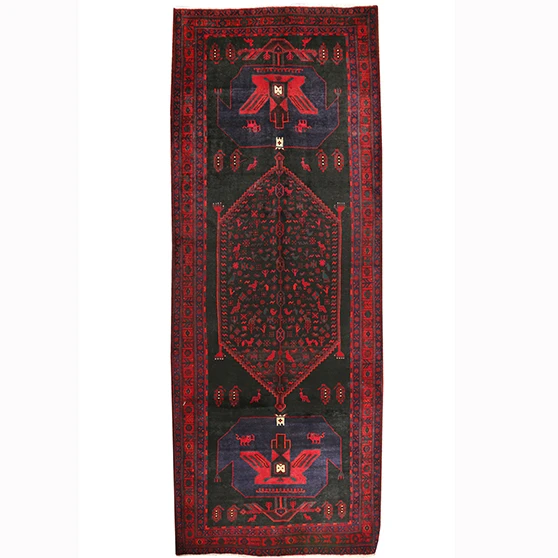
A mihrab (prayer niche) design in a Bijar - Bijar Persian Rug 14x5 ft - Mihrab Semi Antique Wool Silk Hand Knotted
7
Regional Design Signatures
Each weaving region developed favorite designs and a recognizable way of drawing them. Knowing these signatures helps you place a rug quickly:
•
Tabriz - the most versatile design center in Persia, weaving everything from medallions and hunting scenes to pictorial rugs with great precision.
•
Kashan - elegant medallion designs with dense floral fields, often in deep red and navy.
•
Isfahan - refined, symmetrical medallion and afshan designs that echo the tilework of the city's mosques.
•
Kerman - flowing floral and vase designs, often with soft colors and naturalistic flowers.
•
Heriz - bold, angular medallions drawn on a grand scale, a geometric reinterpretation of city designs.
•
Bijar - dense Herati and medallion designs woven in heavy, durable rugs.
•
Sarouk - curvilinear medallions and, in the early twentieth century, detached floral sprays on deep red grounds.
Our articles on Tabriz rugs, Isfahan rugs, and Farahan rugs explore several of these traditions in depth.
8
Design and Knot Density
The design of a rug and its knot density are closely linked. A finely drawn curvilinear design, with thin vines and small flowers, needs many knots per square inch so that the curves can be shown smoothly. Coarser rugs, with fewer knots, are better suited to bold, angular designs. This is why the finest city rugs of Isfahan, Nain, and Qom, often with several hundred knots per square inch, carry the most intricate designs, while village and tribal rugs favor strong geometry that reads clearly even at lower density.
Neither is "better" than the other. A bold village design woven at a moderate density can be just as beautiful, and often more durable, than a delicate city design. The key is harmony between design and structure, which skilled weavers have always understood.
9
From Geometric to Curvilinear
The progress of Persian design toward perfection was gradual. Historical evidence suggests that most carpet designs before the Safavid dynasty were geometric. Geometry suits the structure of a rug, where every knot sits on a grid, and it is easy to weave from memory.
In the Safavid period (1501-1736), carpet design, like the other fine arts, reached its height. Royal workshops employed court artists who introduced curvilinear forms - flowing arabesques (islimi), delicate floral scrolls (khatai), and the grand Shah Abbasi palmette - that required finer knotting and detailed cartoons. These curvilinear designs became the signature of Persian city rugs, while geometric designs continued to flourish in villages and among the nomadic tribes. Both traditions remain alive today. See our Shah Abbasi designs and Islimi designs.
10
Field, Border, and Balance
Every Persian rug design is built from two main parts: the field (matn) and the border (hashieh). The main border is usually framed by narrower guard borders on each side. A skilled designer balances the two so that the border frames the field without competing with it. Proportion, rhythm, and the careful placement of color guide the eye across the whole rug, so that even a densely patterned piece feels calm and ordered.
11
How to Read a Persian Rug Design
Looking at a rug with these families in mind makes it much easier to understand. A few simple steps help:
•
Find the organizing idea - ask whether the design is built around a center (medallion), spread evenly (all-over or lattice), divided into compartments (panel), or directed toward one end (prayer niche or vase).
•
Check the line quality - smooth curves suggest a city workshop working from a cartoon; angular, stepped lines suggest a village or tribal weaver working from memory.
•
Study the border - the number and style of border bands often reveal the rug's region and level of refinement.
•
Look for symmetry and variation - perfect symmetry points to a planned design, while small, organic variations reveal the hand and personality of the weaver.
With practice, these clues allow you to place most rugs within a design family and often within a specific weaving region.
12
Choosing a Design for Your Home
Understanding design families also helps you choose the right rug for a room:
•
Medallion designs - ideal when the rug will be largely visible, such as under a coffee table in a living room or beneath a dining table, where the medallion creates a natural center.
•
All-over and lattice designs - best when furniture will cover parts of the rug, because the pattern looks complete from any angle.
•
Geometric village and tribal designs - bring warmth and character to relaxed, modern, or rustic interiors, and pair well with simple furniture.
•
Garden and panel designs - work beautifully in large rooms, adding structure and rhythm.
•
Runners - often use repeating or medallion-chain designs that guide the eye along a hallway.
Our article on giving your home timeless elegance with a Persian rug offers more decorating ideas, and our rug size guide helps you choose the right dimensions.
13
Frequently Asked Questions
How many Persian rug designs are there?
Thousands of individual designs exist, but most can be grouped into a smaller number of families. One well-known Persian classification uses about nineteen.
Are Persian rug designs always symmetrical?
Most are symmetrical along both axes, with the exception of pictorial, prayer, and some tribal rugs. Small asymmetries are common in handmade work and are part of its charm.
Does a more complex design mean a more valuable rug?
Not necessarily. Value depends on quality, condition, age, materials, and artistic success, not complexity alone.
Can I identify a rug's origin from its design?
Often, yes. Design, together with colors, materials, and knot structure, is one of the main clues experts use to attribute a rug to a region.
14
Why Persian Designs Endure
The attractive designs of Persian rugs and their harmonious colors have been admired for centuries. Many rug-weaving centers around the world still use Persian designs because they are so widely loved. Combined with durable natural materials and fast colors, design is a central reason Persian rugs earned their place at the top of the rug-making world. Learn more in why Persian rugs are famous around the world.
For anyone choosing a rug, the design is often the first thing that creates an emotional connection. Whether you are drawn to the calm order of a medallion, the endless rhythm of a Herati lattice, or the bold improvisation of a tribal geometric rug, you are responding to centuries of refinement by designers and weavers who understood exactly how pattern, proportion, and color work together. At Los Angeles Home of Rugs, you can browse our collection by design and every rug comes with a Certificate of Authenticity. If you need help choosing, ask our experts.