


Persian Rugs from 1925 to Today: A Modern History
Los Angeles Home of Rugs on Nov 17th 2026
The story of Persian rugs in the twentieth and twenty-first centuries is one of modernization, competition, and renewal. At the start of the period, Persian weaving was recovering from war and the departure of foreign firms; by the 1970s it was a major national industry with famous workshops and markets around the world. Then came revolution, war, trade restrictions, and fierce competition from other weaving countries - followed by a creative revival rooted in Persia's oldest traditions.
This article, the fourth in our series on the history of Persian weaving, follows the story from 1925 to the present. It covers the modernization of the Pahlavi era, the rise of new fine-weaving centers such as Qom and Nain, the master workshops of Isfahan and Tabriz, the challenges of the late twentieth century, the revival of tribal weaving and natural dyes, and what all of this means for anyone buying a Persian rug today. It follows 1722 to 1925.
1
A New Era Begins
In 1925, Reza Khan was proclaimed shah, founding the Pahlavi dynasty. Reza Shah set out to modernize Persia rapidly, building roads, railways, schools, and factories, and strengthening the central government. Carpets, as one of the country's most important exports, were part of this program.
After the First World War, many foreign firms had reduced or closed their weaving operations in Persia, and the trade passed increasingly into the hands of Persian merchants. The government saw carpets as a national asset that needed protection and promotion, both to secure export income and to defend the reputation of Persian rugs against poor quality and imitation.
2
Quality Control and the National Carpet Company
In 1935, the government established a national carpet company to oversee and promote the industry. It operated workshops, trained weavers and designers, supplied materials, and set standards for quality, especially for dyes. The problem of unstable synthetic dyes, which had damaged the reputation of Persian rugs in the late nineteenth century, was addressed through regulation and through the use of more reliable modern dyes. Vocational schools trained new generations of designers and weavers.
These efforts helped Persian rugs maintain their reputation for quality at a time when demand was recovering and new competitors were appearing. They also brought more organization to an industry that had long been fragmented among thousands of independent weavers and merchants.
This period also saw the arrival of chrome dyes - synthetic dyes that are stable and colorfast. They solved the problem of fading and bleeding, and they are still used in many good modern rugs, although natural dyes remain prized for their depth. See our article on natural dyes.
3
The Rise of New Weaving Centers
The twentieth century saw the rise of new centers of fine weaving, some of which became among the most famous names in the Persian rug world:
Qom
The holy city of Qom, south of Tehran, became a major weaving center in the 1930s and 1940s. Qom weavers quickly earned a reputation for extremely fine rugs, especially in pure silk, with very high knot densities and a wide variety of designs drawn from classical Safavid, Kashan, and Isfahan models. Qom silk rugs, often small and jewel-like, are now among the best-known Persian rugs internationally. See our article on weaving in Qom.
Nain
Nain, a desert town east of Isfahan, was historically known for fine woolen textiles used for traditional cloaks. When demand for these textiles declined in the early twentieth century, Nain's skilled weavers turned to carpets, bringing their exceptional technique with them. Nain rugs, typically with ivory and blue grounds, silk highlights, and very fine knotting, quickly became prized. See our article on weaving in Nain and our Nain collection.
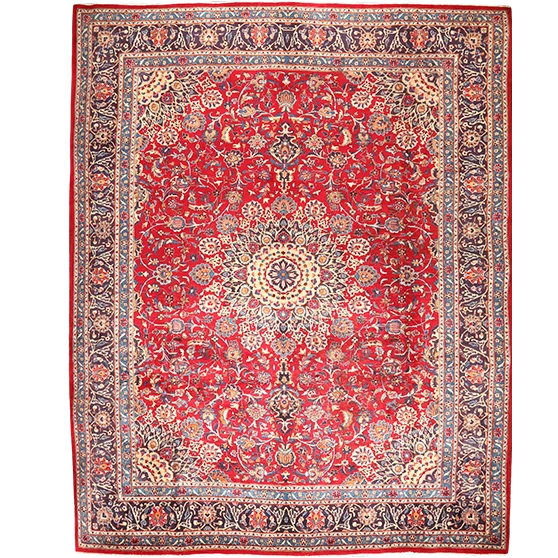
A Nain medallion rug in crimson, cream, and navy blue wool and silk - Nain Persian Rug 12x9 ft - Medallion Semi Antique Wool Silk Hand Knotted
Isfahan
Isfahan, the Safavid capital, enjoyed a revival of fine weaving in the twentieth century. Master workshops produced rugs of exceptional quality with classical designs inspired by the city's architecture, often signed in the border. Some Isfahan workshops became internationally famous names, and their signed rugs are now sought by collectors. See our articles on the legacy of Isfahan rugs and Isfahan's women weavers.
Tabriz
Tabriz continued as a major center throughout the century, home to master designers and workshops producing everything from classical medallion carpets to elaborate pictorial rugs. Designers such as Rassam Arabzadeh became celebrated figures, and Tabriz workshops developed great technical refinement. See our article on the art of Tabriz rugs.
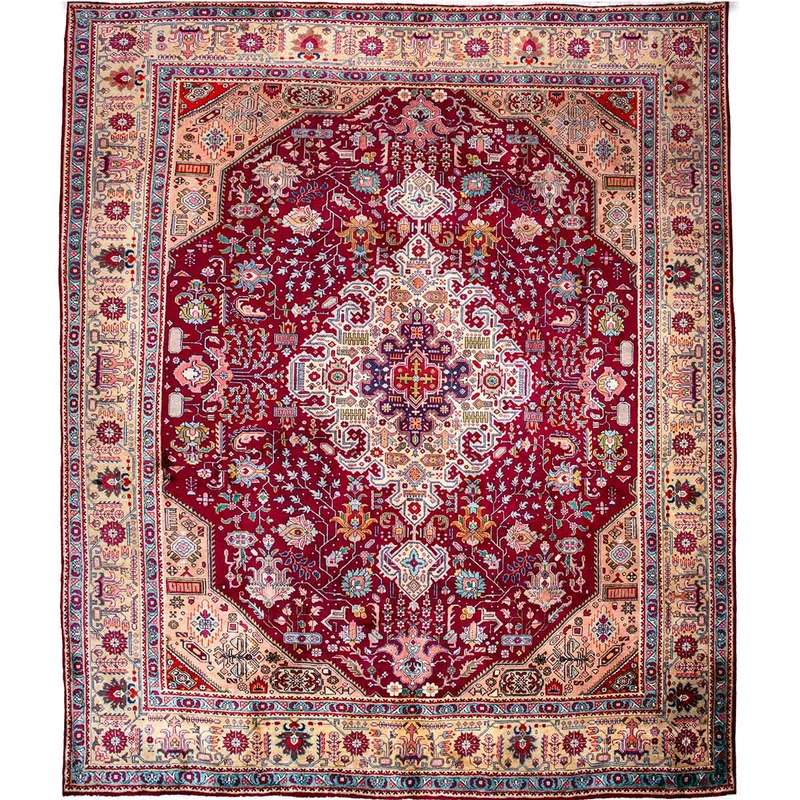
A Tabriz medallion rug in madder red, cream, and navy blue - Tabriz Persian Rug 12x9 ft - Medallion Semi Antique Wool Silk Hand Knotted
4
Village and Regional Weaving in the Modern Era
While the fine city workshops drew much attention, village weaving remained the backbone of Persian rug production through the twentieth century. The villages around Heriz continued to weave bold, durable room-size carpets; the Hamadan region produced vast numbers of sturdy village rugs and runners for export; and the Arak region, the Kurdish areas of Bijar and Sanandaj, and the villages of Khorasan, Azerbaijan, and Fars all kept their own styles. Many of these rugs were woven by women at home, on commission from merchants in nearby towns.
These village rugs of the mid-twentieth century are among the most practical and appealing Persian rugs on the market today. They combine good wool, sturdy construction, and traditional regional designs with decades of mellowing, and they suit everyday family life beautifully. Our articles on Kurdish rugs, Khorasan rugs, and Arak rugs explore several of these regional traditions.
5
Technology and Tradition
The twentieth century brought new technologies to Persian weaving. Machine spinning produced more uniform yarn, synthetic dyes offered consistent colors, and, later, computers allowed designers to create and modify cartoons quickly. Improved looms made weaving more comfortable and efficient, and modern washing facilities improved finishing.
Yet the essential act of weaving remained unchanged: each knot is still tied by hand, one at a time, by a skilled weaver. This is the defining feature of an authentic hand-knotted Persian rug, and it is why even the most modern Persian rug remains part of a tradition stretching back thousands of years. Our article on how a Persian rug is made describes the process.
6
The Mid-Century Boom
After the Second World War, demand for Persian rugs grew strongly. The 1950s, 1960s, and 1970s were a period of expansion, as rising prosperity in Europe, North America, and later the Persian Gulf states created large markets for Persian rugs. Production increased in cities and villages alike, and Persian rugs became a familiar feature of homes around the world.
This boom also brought changes. Machine-spun wool became more common, workshops became more organized, and designs were adapted to changing fashions in Western interiors. Many of the semi-antique and vintage Persian rugs available today, including many in our own collection, were woven in these decades, and they combine traditional designs and good materials with forty to seventy years of graceful aging. Browse our semi-antique and 25 to 40 year old rugs.
7
Design Trends of the Modern Era
Persian rug design never stood still in the twentieth century. In the early decades, classical Safavid-style medallion and floral designs dominated fine city production, while village rugs continued their bold regional traditions. Pictorial rugs, showing scenes from Persian literature, historical figures, and landscapes, became a specialty of Tabriz and Kashan workshops. In the 1960s and 1970s, softer palettes of ivory, beige, and pastel blue became fashionable for Western interiors, especially in Nain, Isfahan, and Kashan rugs.
Later decades brought new trends. The minimalist Gabbeh appealed to modern tastes, and more recently, designers have embraced vintage rugs in new ways: muted and faded "distressed" looks, over-dyed rugs in bold single colors, and patchwork rugs made from pieces of old Persian rugs stitched together. These trends show how Persian rugs continue to find new life in contemporary design. See our article on patchwork rugs and our patchwork and vintage collections.
8
Persian Rugs in America
For much of the twentieth century, the United States was one of the most important markets for Persian rugs. American importers in New York, Chicago, and Los Angeles brought in rugs by the thousands, and Persian rugs became a symbol of comfort and good taste in American homes, from city apartments to suburban houses.
Los Angeles holds a special place in this story. Since the late 1970s, Southern California has been home to one of the largest Persian communities outside Persia, and with it came a deep knowledge of Persian rugs, a network of experienced dealers, washers, and restorers, and a large collection of fine rugs. Many of the vintage and semi-antique rugs available in America today passed through this community, which continues to play an important role in preserving and sharing Persian weaving culture.
9
Preserving the Heritage
Alongside commercial growth came efforts to preserve and celebrate Persian carpet heritage. The Carpet Museum in Tehran, opened in the late 1970s, brought together an important collection of Persian carpets from many periods and regions, with a building designed to evoke the shape of a carpet loom. Universities established carpet departments to study the history, design, and technology of Persian rugs, and researchers began to document regional weaving and dyeing traditions before they disappeared.
10
Revolution, War, and New Challenges
The revolution of 1979 and the war of the 1980s brought great upheaval to the country and its economy. The carpet industry continued, but it faced new difficulties: disruption of trade, changes in markets, and, at several points since 1987, restrictions on importing Persian rugs into the United States, one of the most important markets. These restrictions have changed several times over the years, which has affected the availability of new Persian rugs in America.
At the same time, competition grew from other weaving countries. India, Pakistan, Nepal, China, Turkey, and Afghanistan expanded their own hand-knotted rug industries, often producing rugs in Persian designs at lower prices. Machine-made rugs imitating Persian designs also became widely available. These changes made it more important than ever for buyers to understand what an authentic Persian rug is. See our article on how to buy a Persian rug.
11
The Tribal Revival and the Gabbeh
One of the most exciting developments of the late twentieth century was the revival of tribal weaving and natural dyes. Gabbeh rugs - simple, thick-piled rugs traditionally woven by Qashqai and Luri women for their own use - were discovered by Western buyers in the 1970s and 1980s. Their bold, minimalist designs, abstract animals and trees, and rich natural colors seemed strikingly modern, and they became popular with designers worldwide. Mohsen Makhmalbaf's 1996 film *Gabbeh* brought the weavers' world to international audiences. See our article on Gabbeh rugs and our Gabbeh collection.
Workshops in Fars, especially around Shiraz, led a broader return to hand-spun wool and natural dyes, rediscovering old recipes and training new dyers. These rugs, with their depth of color and tribal character, have earned international acclaim and inspired a renewed appreciation of traditional methods across the Persian rug world. Our series on Persian rug color, beginning with the master dyer, tells the story of these dyes.
12
World Recognition
In 2010, UNESCO inscribed the traditional skills of carpet weaving in Fars and in Kashan on its list of the Intangible Cultural Heritage of Humanity. This recognition honored not only the rugs themselves but the knowledge and skills of the weavers, dyers, and designers who keep the tradition alive, and it highlighted the importance of passing these skills on to future generations.
13
Persian Weaving Today
Today, Persian rug weaving continues in cities, villages, and tribal areas across the country. Workshops produce fine city rugs in Isfahan, Qom, Nain, Kashan, and Tabriz; villages weave sturdy rugs in Heriz, Hamadan, and many other regions; and tribal weavers continue to create Gabbehs, kilims, and traditional rugs. Designers use computers alongside hand-drawn cartoons, while many workshops return to natural dyes and hand-spun wool for their finest pieces.
The challenges are real: competition from other countries, economic pressures, and the loss of skills as young people move to cities. But Persian rugs remain among the most respected handmade textiles in the world, and the combination of tradition, artistry, and quality that made them famous continues to set them apart. Our article on why Persian rugs are famous around the world explores this enduring appeal.
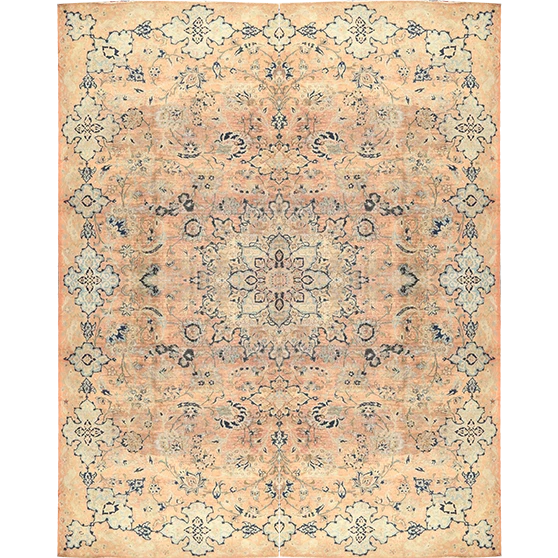
A Kashan medallion rug in beige, navy blue, and rust red wool and silk - Kashan Persian Rug 14x10 ft - Medallion Semi Antique Wool Silk Hand Knotted
14
The Weavers in a Changing Country
The lives of weavers changed greatly over the century. Rural families continued to weave at home, but urbanization drew many young people to cities, and fewer girls learned to weave from their mothers. In many regions, weaving became more organized through workshops, cooperatives, and contracts with merchants. Reforms aimed to improve working conditions and reduce child labor, and education gave many young women new opportunities beyond the loom.
At the same time, weaving remained an important source of income in many villages and an essential part of cultural identity, especially among tribal communities. Cooperatives and development programs have helped some weavers sell their rugs more directly and at fairer prices. The future of Persian weaving depends on making the craft rewarding enough that new generations choose to continue it.
15
A Timeline from 1925 to Today
•
1925 - the Pahlavi dynasty begins; modernization programs follow.
•
1935 - a national carpet company is established to promote quality and exports.
•
1930s to 1940s - Qom and Nain emerge as famous centers of fine weaving.
•
1950s to 1970s - a long boom in demand from Europe, America, and the Persian Gulf region.
•
1970s to 1980s - Gabbeh rugs and tribal weaving win international popularity.
•
Late 1970s - the Carpet Museum opens in Tehran.
•
1979 onward - revolution, war, and changing trade conditions, including periods of US import restrictions from 1987 onward.
•
1990s to today - a revival of hand-spun wool and natural dyes, led by workshops in Fars.
•
2010 - UNESCO recognizes the carpet weaving traditions of Fars and Kashan.
16
What This History Means for Buyers
•
Antique rugs (before about 1925) - natural dyes, mature patina, and historic designs; the most collectible pieces. See our antique rugs.
•
Semi-antique and vintage rugs (about 1925 to 1980s) - excellent materials, traditional designs, and decades of graceful aging; often outstanding value. See our semi-antique rugs.
•
Modern rugs - fresh colors and contemporary designs, including fine city rugs, natural-dye Gabbehs, and revived tribal pieces.
•
Authenticity - with many imitations on the market, documentation of origin, materials, and age is essential.
Every Persian rug carries a piece of this history. A semi-antique Heriz woven in the 1960s, a silk Qom from the 1970s, or a natural-dye Gabbeh from Fars all tell part of the story of how a traditional craft adapted to a changing world without losing its soul.
When you choose a rug from this era, you are also choosing a piece of modern history: a rug woven in the decades when Persian weaving adapted to a new world, by weavers whose skills connect directly to the centuries before them.
17
Caring for Twentieth-Century Persian Rugs
Many of the Persian rugs in homes today were woven in the twentieth century, and with good care they will last well into the twenty-second. Their wool and dyes are generally sturdy, but older rugs benefit from gentle treatment: regular vacuuming without a beater bar, rotation to even out wear and sun exposure, prompt blotting of spills, and professional washing every few years. Fringes and side cords are the parts most likely to need attention as a rug ages, and small repairs made early prevent bigger problems later. Our guides to cleaning a Persian rug at home and professional rug cleaning explain everything you need to know.
18
Frequently Asked Questions
When did Qom become famous for silk rugs?
Qom developed as a major weaving center in the 1930s and 1940s and soon became famous for very fine silk rugs.
What is a semi-antique Persian rug?
Generally a rug roughly twenty to eighty years old, old enough to have mellowed but not yet old enough to be considered antique.
Are Persian rugs still handmade today?
Yes. Authentic Persian rugs are still hand-knotted in cities, villages, and tribal areas, often using traditional methods.
Why are many vintage Persian rugs from the mid-twentieth century?
The decades after the Second World War were a period of very high production and export, so many good rugs from that era are now on the market with forty to seventy years of graceful aging.
Where can I see modern Persian carpets in a museum?
The Carpet Museum in Tehran holds an important collection, and many museums worldwide include twentieth-century Persian rugs alongside older pieces.
What is the Gabbeh revival?
The renewed popularity, from the 1970s onward, of simple tribal Gabbeh rugs from Fars, together with a broader return to hand-spun wool and natural dyes.
19
A Living Tradition
From the reforms of the 1930s to the natural-dye revival of today, the modern history of Persian rugs shows a tradition that has repeatedly renewed itself. It has survived wars, economic crises, and fierce competition, and it continues to produce rugs that are admired around the world. Each rug woven today adds a new chapter to a story that began thousands of years ago with the earliest nomadic weavers.
At Los Angeles Home of Rugs, our collection includes antique, semi-antique, and vintage Persian rugs from across the country, each with a Certificate of Authenticity documenting its origin, materials, and age. If you have questions about the history of a particular rug, please ask our experts.
Explore the Collection
Semi-Antique Rugs
Antique Rugs
Nain Rugs
Tabriz Rugs
Kashan Rugs
Gabbeh Rugs
Vintage Rugs
Persian Rug FAQ