


Qom Rugs: Silk Rugs, Designs, and a Buyer's Guide
Los Angeles Home of Rugs on Nov 17th 2026
Among the great carpet cities of Persia, Qom is one of the youngest - and one of the most famous. In less than a century, this city south of Tehran has become known around the world for exquisite silk rugs: finely knotted, richly colored, and luminous in the light. Qom also weaves fine wool rugs, often with silk highlights, in an extraordinary variety of designs.
This article explains how Qom became a weaving center, what makes its rugs special, how Qom rugs are made, which designs to look for, and how to choose and care for a Qom rug. Along the way we will look at how Qom rugs compare with their famous neighbors from Kashan, Isfahan, and Nain.
1
The City of Qom
Qom lies on the edge of the central desert, about 130 kilometers south of Tehran. It is one of the most important religious centers of Persia, home to a famous shrine and to great seminaries that draw scholars and pilgrims from around the world. For centuries, the city's life revolved around pilgrimage, learning, and trade.
Unlike Kashan or Tabriz, Qom did not have a long history as a carpet city. Weaving was practiced in the surrounding region, but Qom itself became an important weaving center only in the twentieth century. This makes its rise to fame all the more remarkable.
2
How Qom Became a Weaving Center
Rug weaving in Qom grew in the decades before and after the Second World War. According to the original text of this article, weaving on commercial grounds started after the war, and the city's fame increased rapidly because the colors, fibers, and dyes used were of good quality. Weavers and designers from nearby Kashan played an important role, bringing their skills, designs, and standards to the new workshops of Qom.
The timing was fortunate. In the mid-twentieth century, demand was growing for fine Persian rugs in Persia and abroad, and Qom weavers responded with rugs of high quality and attractive designs. Workshops multiplied, and Qom quickly built a reputation that rivaled much older weaving cities. By the second half of the century, Qom had become one of the most important centers in the country for producing silk rugs. See our article on Persian rugs from 1925 to today for the wider story of this period.
Qom's success was so great that rugs from neighboring areas were sometimes sold under its name. The original text of this article noted that rugs woven in nearby cities such as Saveh and Shahreza were sometimes traded as Qom rugs. Today, buyers should look at structure and quality rather than relying on a label alone. See our article on Saveh rugs.
3
Silk: The Signature of Qom
More than any other material, silk defines the reputation of Qom. Qom silk rugs usually have silk pile on a silk foundation - silk warps and silk wefts - which allows extremely fine knotting and very precise drawing. The original text of this article noted that in silk rugs the weft is also of silk, and that silk rugs are knotted even more densely than wool ones.
Silk has a natural sheen that changes with the light and the direction from which the rug is viewed. A Qom silk rug can look deep and rich from one side and bright and shimmering from the other. Silk also takes dye beautifully, giving clear, vivid colors. Our article on silk in Persian rugs explains the properties of silk in more detail.
Because silk is strong but less resilient than wool, silk rugs are best for low-traffic areas or as wall hangings. Many Qom silk rugs are woven in small sizes - mats, prayer rugs, and rugs of about 3 by 5 feet - which makes them ideal for displaying in a living room, a bedroom, or on a wall.
A pure silk Qom rug has silk pile and a silk foundation. The silk foundation allows very fine knotting, which is why Qom silk rugs can show such precise, delicate detail.
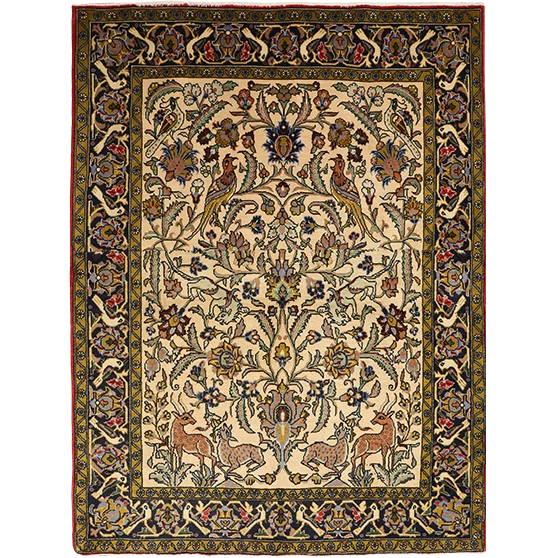
A Qom silk rug with a medallion design - Qom Persian Rug 5x3 ft - Medallion Semi Antique Silk Hand Knotted
4
Wool Qom Rugs
Qom also weaves fine wool rugs, often from high-quality wool and frequently with silk highlights that outline motifs and add sparkle. Some Qom rugs use kurk wool, the soft, fine wool from the neck and shoulders of the lamb, which gives a beautiful, silky handle. The original text of this article mentioned "down" rugs - a reference to this exceptionally soft wool. Wool Qom rugs are usually woven on cotton foundations, which keeps them flat and stable. See our article on Persian rug wool.
Wool and silk Qom rugs offer a lovely balance: the warmth and durability of wool with the luster and detail of silk. They are suitable for living rooms, dining rooms, and bedrooms, and they come in a wider range of sizes than pure silk rugs.
5
How Qom Rugs Are Made
The Knot
Qom weavers use the asymmetrical (Persian, or Senneh) knot, which allows a smooth, fine pile and curvilinear drawing. The original text of this article noted that Qom rugs are woven with knots ranging from about 2,500 up to 10,000 knots per square decimeter, and silk rugs even more. Our article on how a Persian rug is made explains the different knots and how they affect a rug.
Foundation
As mentioned, silk rugs are woven on silk foundations, while wool rugs are woven on cotton foundations. The original text noted that warps and wefts are mainly of very finely spun cotton. Fine, tightly spun cotton keeps the rug straight and flat and allows a high knot density.
Pile
The pile of a Qom rug is usually clipped short to keep the fine designs crisp and clear. This is especially important in silk rugs, where every tiny detail of the drawing should be visible.
6
Colors of Qom Rugs
Qom rugs are known for clear, harmonious colors. The original text of this article described the colors as being as vast and varied as the designs, with dyers preferring pastel shades, turquoise, mustard, golden yellow, bright red, dark blue, and beige. Ivory and cream grounds are also very popular, especially for silk rugs, giving them a light, elegant feel.
Qom dyers use both natural dyes and stable modern dyes. What matters most is that the colors are well balanced, clear, and colorfast. Our articles on natural dyes and mordants explain how dyers achieve lasting color.
7
The Designs of Qom
Qom weavers are famous for the range of their designs. Rather than developing a single local style, they adapted designs from the great weaving centers of Persia and refined them in their own way. The original text of this article listed the most common designs: repeated panels, paisley (boteh) profusion, tree designs, Shah Abbasi medallion and corner, all-over Shah Abbasi, open-ground medallions, and prayer (mihrab) designs. Here are the main families:
•
Medallion and corner - elegant central medallions with matching corners, often on ivory or red grounds. See our medallion designs.
•
Shah Abbasi - large palmettes and scrolling vines in the classical Safavid tradition. See our Shah Abbasi designs.
•
Garden and panel designs - the field divided into compartments, each with a tree, vase, or flowers, a design known as kheshti. See our article on Persian garden rugs.
•
Tree of life - a tall tree with birds and flowers, one of the most beloved Qom designs. See our article on the tree of life in Persian rugs.
•
Vase designs - a vase with flowering branches, often called the Zel-e Soltan design. See our vase designs.
•
Hunting and animal scenes - riders and animals in a landscape, inspired by Safavid hunting carpets. See our hunting designs.
•
Prayer rugs - an arch (mihrab) design, often with a tree, lamp, or vase. See our mihrab designs.
•
Boteh - the teardrop-shaped paisley motif repeated across the field. See our boteh designs.
•
Pictorial designs - scenes from Persian poetry and history. See our article on pictorial rugs.
The original text of this article made an interesting point: instead of creating new patterns, Qom weavers often adapt designs that are in great demand in other weaving centers. As a result, a Qom rug may at first glance be mistaken for a Kashan or Isfahan rug. Structure, materials, and color are what tell them apart. Our guide to Persian rug motifs explains the meaning of many of these designs.
8
Qom and Its Neighbors
Because Qom borrowed designs from older weaving cities, it helps to compare it with them:
•
Qom vs Kashan - Kashan has a much longer history and is famous for wool rugs with deep red and navy palettes, as well as historic silk carpets. Qom is younger and best known for silk rugs and lighter, clearer colors. See our article on Kashan rugs.
•
Qom vs Isfahan - both produce very fine rugs with silk foundations. Isfahan is known for classical designs and refined drawing, often on ivory grounds; Qom offers a broader range of designs and a higher proportion of pure silk rugs. See our article on Isfahan rugs.
•
Qom vs Nain - Nain rugs are fine wool rugs with silk highlights, usually in ivory, beige, and blue. Qom rugs offer more color variety and more pure silk pieces. See our article on Nain rugs.
•
Qom vs Tabriz - the original text noted that a Tabriz rug can always be distinguished from a Qom because Tabriz weavers use the symmetrical (Turkish) knot, while Qom weavers use the asymmetrical (Persian) knot. Turning the rug over and examining the knots is the surest test. See our Tabriz buyer's guide.
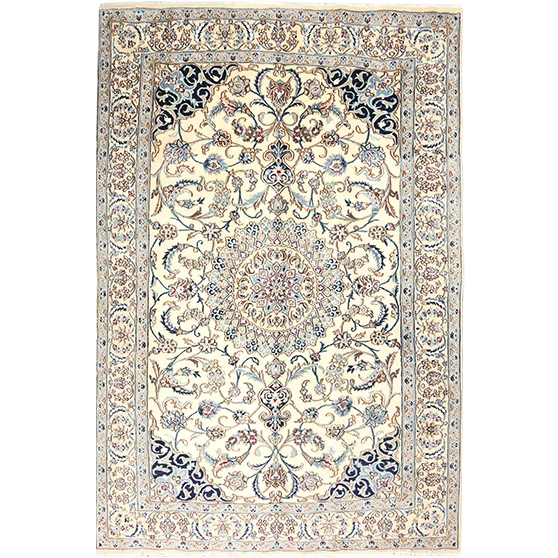
A Nain rug in wool and silk, a fine neighbor of Qom - Nain Persian Rug 9x6 ft - Medallion Semi Antique Wool Silk Hand Knotted
9
Signatures and Workshops
Many fine Qom rugs carry a signature woven into the border, naming the workshop, the master weaver, or the designer. Signatures are usually woven in Persian script in a small cartouche at one end of the rug. A signature can indicate a well-known workshop and add to a rug's value, but it should always be consistent with the rug's quality. A signature alone does not guarantee that a rug is fine.
Qom workshops range from large establishments to small family operations. In many homes, women weave on vertical looms, following detailed cartoons supplied by workshops or merchants. This combination of skilled home weaving and organized workshop production has allowed Qom to maintain high standards while producing many rugs.
10
The Weavers of Qom
Weaving a fine silk rug is slow, patient work. A small Qom silk rug can take many months to complete, and larger pieces can take a year or more. Weavers must tie each tiny knot precisely, keeping the tension even and following the cartoon exactly. The fineness of silk thread makes mistakes easy and corrections difficult, so experience and concentration are essential.
Many Qom weavers learned their craft from their mothers and grandmothers, and weaving remains an important source of income for families in the city and surrounding villages. Every Qom silk rug represents not only artistic skill but also a great investment of time and care. Our article on the women weavers of Isfahan gives a sense of the life of weavers in central Persia.
11
Quality and Value
Qom rugs vary in quality, and several factors affect value:
•
Material - pure silk rugs on silk foundations are generally the most valuable; wool rugs with silk highlights come next, then all-wool rugs.
•
Knot density - finer knotting allows more detail and usually takes much longer to weave.
•
Design and drawing - crisp, balanced drawing and harmonious colors are signs of a skilled workshop.
•
Signature and workshop - well-known workshops can command higher prices.
•
Condition - silk is more delicate than wool, so check for wear, stains, and repairs.
Our article on investing in hand-knotted rugs discusses how fine rugs hold their value over time.
12
How to Recognize a Qom Rug
•
Asymmetrical knots - visible on the back as fine, slightly offset knots.
•
Silk or fine cotton foundation - silk in pure silk rugs, cotton in wool rugs.
•
Short, crisp pile - fine drawing with clear detail.
•
Clear, harmonious colors - often ivory, turquoise, gold, beige, red, and blue.
•
Wide range of designs - garden, tree of life, vase, hunting, Shah Abbasi, medallion, and prayer designs.
•
Signature - common, but not universal.
Our article on how to read a Persian rug's secret language explains how to examine the back of a rug, the fringes, and the edges.
13
Real Silk and Imitations
Because silk rugs are valuable, imitations exist. Some rugs sold as silk are made with mercerized cotton or synthetic fibers, sometimes called "art silk" or "silk touch." These materials can look shiny but do not have the depth, softness, or durability of real silk. A trusted seller will tell you exactly what a rug is made of, and a certificate of authenticity gives you added confidence. Real silk feels cool and smooth, and its luster has a deep, changing quality that imitations rarely match.
14
Sizes and Formats
Qom rugs are woven in many sizes. Pure silk rugs are most often small, from mats and pillow-size pieces to prayer rugs and rugs of about 3 by 5 or 4 by 6 feet, because a large silk rug requires an enormous investment of time and material. Larger silk rugs exist, but they are rare and costly. Wool and silk Qom rugs are available in a wider range, including room sizes, and runners are woven as well. Pairs of matching small rugs are also popular, and they look beautiful on either side of a bed or a doorway.
15
Qom Rugs in the Home
Qom rugs bring elegance and light to any room. Here are a few ideas:
•
Display pieces - a small silk Qom on a wall or in a low-traffic corner becomes a work of art.
•
Bedrooms - a wool and silk Qom adds softness and refinement where foot traffic is light.
•
Living rooms - a wool Qom in a medium size works well in front of a sofa or by a fireplace.
•
Entrance halls - a small rug with a garden or tree of life design welcomes guests.
•
Modern interiors - ivory and pastel Qom rugs suit light, contemporary spaces.
Our rug size guide will help you choose the right size, and our article on giving your home timeless elegance with a Persian rug has more decorating ideas.
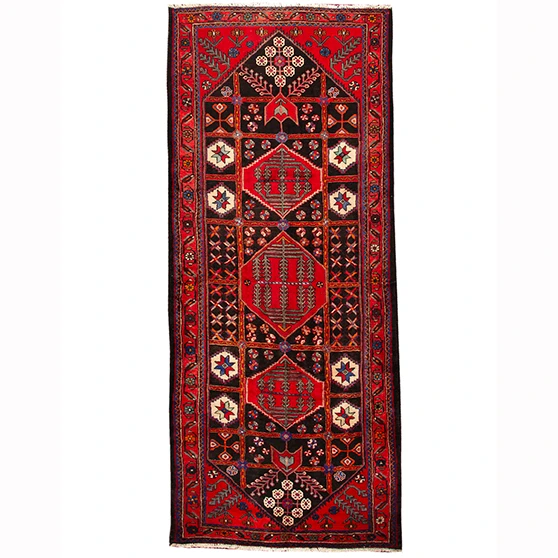
A Saveh rug from the Qom region with a medallion design - Saveh Persian Rug 10x4 ft - Medallion Semi Antique Wool Hand Knotted
16
Hanging a Silk Rug on the Wall
Many owners choose to display a fine Qom silk rug on the wall, where it can be admired like a painting and protected from foot traffic. The best way to hang a rug is with a sleeve of fabric sewn to the back along the top edge, through which a rod is passed. This spreads the weight evenly and avoids damage. Avoid nails, staples, or glue, and keep the rug out of direct sunlight to protect the colors. A specialist can attach a sleeve for you.
17
Caring for a Qom Rug
Silk rugs need gentle care. Vacuum carefully with low suction and no beater bar, or simply shake out small rugs and brush them gently in the direction of the pile. Blot spills immediately with a clean, dry cloth - do not rub - and avoid home cleaning products. Silk rugs should be professionally washed by specialists experienced with silk. Wool Qom rugs are more forgiving and can be cared for like other fine wool rugs. Our guides to cleaning a Persian rug at home and professional rug cleaning explain the details.
18
Common Misunderstandings
"Qom rugs are old."
Qom is a relatively young weaving center, and most Qom rugs on the market were woven in the second half of the twentieth century or later. Their value lies in quality and craftsmanship rather than great age.
"Every shiny rug is silk."
Mercerized cotton and synthetic fibers can look shiny too. Ask the seller exactly what the pile and foundation are made of.
"A Qom rug cannot be used on the floor."
Wool Qom rugs are perfectly suitable for floors. Pure silk rugs can also be used on floors in low-traffic areas, though many owners prefer to protect them on the wall.
19
Frequently Asked Questions
What are Qom rugs famous for?
Fine silk rugs with silk foundations, as well as fine wool rugs with silk highlights, in a wide range of classical designs.
How old is weaving in Qom?
Qom became an important weaving center in the twentieth century, especially after the Second World War.
What knot do Qom weavers use?
The asymmetrical (Persian, or Senneh) knot.
How can I tell a Qom from a Kashan or Isfahan rug?
The designs can be similar, so look at the structure, materials, and colors. Qom rugs often have lighter, clearer colors and are more often pure silk.
Are Qom silk rugs a good investment?
Fine, well-made Qom silk rugs from good workshops can hold their value well, especially when kept in good condition.
How should I clean a Qom silk rug?
Gently, and leave deep cleaning to specialists experienced with silk.
20
Silk Treasures From a Young City
In a few generations, Qom has transformed itself from a pilgrimage city into one of the most celebrated carpet centers of Persia. Its silk rugs, with their delicate drawing and shimmering colors, are prized by collectors and admired around the world, and its wool rugs bring the same refinement to everyday living.
At Los Angeles Home of Rugs, you can explore our Qom collection, our silk rugs, and fine rugs from Nain, Kashan, and Saveh. If you have questions about any rug, please contact us.