


Isfahan Rugs: A Buyer's Guide to the City and Region
Los Angeles Home of Rugs on Nov 17th 2026
Isfahan - "half the world," as an old Persian saying puts it - is one of the most beautiful cities on earth, and its rugs are among the most refined Persian rugs ever made. Under Shah Abbas the Great, Isfahan became the capital of Safavid Persia and the home of royal carpet workshops. In the twentieth century, master weavers revived that tradition, and today a fine Isfahan rug, with its crisp drawing, silk highlights, and harmonious colors, is one of the most recognizable luxuries of the Persian rug world.
We have written several articles about Isfahan: on the legacy of Isfahan rugs, on Isfahan rugs as a tale of timeless artistry, and on the city's women weavers. This article takes a practical approach. It explains how Isfahan rugs are made, how to recognize them, what determines their quality and price, and how the weaving towns around Isfahan - from Najafabad to Joshaqan and Golpayegan - fit into the picture.
1
The City and Its Carpets
Isfahan lies on the banks of the Zayandeh Rud river in central Persia. When Shah Abbas moved his capital here in 1598, he transformed the city with grand avenues, bridges, palaces, gardens, and the magnificent Naqsh-e Jahan Square, surrounded by the Shah Mosque, the Sheikh Lotfollah Mosque, the Ali Qapu Palace, and the entrance to the great bazaar. The square is inscribed on UNESCO's World Heritage List.
Royal workshops in Isfahan produced luxurious carpets, including silk carpets brocaded with gold and silver thread - the so-called Polonaise carpets - for the court and as diplomatic gifts. After the fall of the Safavids in 1722, the city's fine weaving declined for a long period, but it revived in the twentieth century, when master workshops began producing carpets that consciously returned to Safavid standards of design and craftsmanship. See our article on the Safavid golden age.
Look up into the dome of the Sheikh Lotfollah Mosque and then down at a fine Isfahan medallion rug: the radiating medallion, arabesques, and floral scrolls are the same artistic language, created by the same culture.
2
A City of Many Crafts
Carpets are only one of Isfahan's celebrated crafts. The city's bazaar, stretching for more than a mile from Naqsh-e Jahan Square, is filled with workshops and shops selling:
•
Qalamkar - cotton textiles hand-printed with carved wooden blocks in rich natural colors, often with designs related to carpets.
•
Minakari - brilliant enamel work on copper and silver, with intricate floral and bird designs.
•
Khatam - delicate inlay work in wood, bone, and metal, forming tiny geometric patterns.
•
Metalwork - engraved copper and brass trays, vessels, and lamps.
•
Miniature painting - continuing the great tradition of the Safavid court painters.
These crafts share the same visual language as Isfahan carpets: arabesques, palmettes, flowers, birds, and perfectly balanced symmetry. Walking through the bazaar, you can see how carpet design belongs to a much larger world of Persian art.
3
The Twentieth-Century Revival
The modern golden age of Isfahan rugs began in the early twentieth century, when master weavers and designers set out to recreate the standards of Safavid court weaving. They studied classical carpets, tilework, and manuscripts, drew new cartoons inspired by these sources, and organized workshops with skilled weavers, often women working at home under the supervision of a master. They used the finest materials available: kurk wool, silk foundations, and carefully dyed yarns.
Over the following decades, several Isfahan workshops became famous for their quality, and their signed rugs were sought by collectors in Persia and abroad. The rugs of this period, especially from the 1940s to the 1970s, combine superb craftsmanship with classical designs and are among the most admired Persian rugs of the twentieth century. Our article on Persian rugs from 1925 to today places this revival in its wider context.
4
How Isfahan Rugs Are Made
Foundations
The finest Isfahan rugs are woven on silk foundations - silk warps, and sometimes silk wefts - which allow extremely fine and even knotting. Many good Isfahans use cotton foundations instead, which are also strong and stable. A silk foundation can often be seen in the fringe, which looks smooth and shiny rather than matte.
Knot and Density
Isfahan weavers use the asymmetrical (Persian) knot, tied very densely. Quality is often expressed in raj - the number of knots along about seven centimeters of width - and fine Isfahans commonly range from around 60 to 80 raj or more, which corresponds to several hundred knots per square inch. This density allows the extraordinary detail for which Isfahan rugs are known.
Pile
The pile is usually high-quality wool, often the soft, lustrous wool known as kurk, with silk used for outlines and highlights so that details sparkle. Some Isfahans are woven entirely in silk. The pile is clipped short, keeping the design crisp and precise.
Design
Isfahan rugs are woven from detailed cartoons drawn by master designers. Many workshops sign their rugs, weaving the name of the workshop or master into a cartouche in the border, and signed rugs from respected workshops are particularly sought after. Our article on how a Persian rug is made explains cartoons, raj, and knot density.
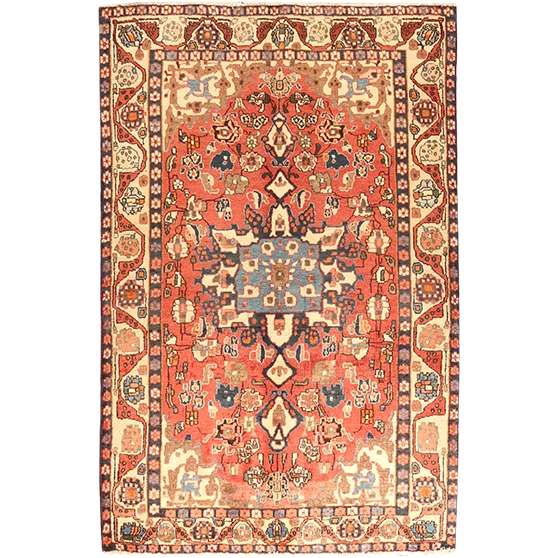
An Isfahan medallion rug in madder red, cream, and navy blue wool and silk - Isfahan Persian Rug 6x4 ft - Medallion Semi Antique Wool Silk Hand Knotted
5
The Weavers Behind the Rugs
Behind every fine Isfahan rug stand many skilled people. The designer draws the cartoon, often spending months on a single design. The dyer prepares yarns in dozens of carefully matched shades. The weavers - very often women working at home on vertical looms - tie the knots, sometimes several hundred per square inch, following the cartoon square by square. A supervisor visits regularly to check quality, and after weaving, the rug is washed, clipped, and finished by specialists. A large, fine Isfahan can take a team of weavers well over a year to complete. Our article on Isfahan's women weavers tells their story in depth.
6
Wool, Silk, and Color
Isfahan workshops have always been demanding about materials. The finest rugs use kurk wool, soft and lustrous, from the first shearing of young lambs, combined with silk for highlights and foundations. Dyers prepare a wide range of carefully graded shades so that floral details can be shaded subtly, giving the designs depth. Many twentieth-century Isfahans use high-quality modern dyes, while some workshops have returned to natural dyes for special pieces. Our articles on Persian rug wool and natural dyes explain why these materials matter.
7
Designs and Colors
Isfahan designs are classical and harmonious. The most characteristic composition is a central medallion - often round or lobed, filled with arabesques and palmettes - surrounded by a field of scrolling vines, Shah Abbasi palmettes, and flowers, with matching corner pieces and an elegant border. All-over designs, vase designs, tree-of-life designs, and hunting scenes also appear.
Isfahan palettes tend to be lighter and more delicate than those of Kashan. Ivory and cream grounds are very common, often combined with soft blues, turquoise, rose, and gold, while some rugs use deep blue or red fields. The overall effect is airy, refined, and elegant. Browse our Shah Abbasi, islimi, and medallion designs.
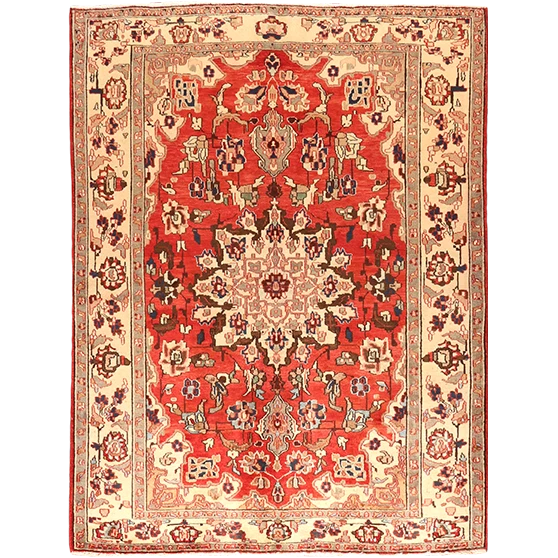
An Isfahan medallion rug in crimson, cream, and navy blue - Isfahan Persian Rug 6x5 ft - Medallion Semi Antique Wool Silk Hand Knotted
8
Isfahan and the Persian Garden
The gardens of Isfahan have also shaped its carpets. Safavid Isfahan was a city of gardens: palace gardens along the Chahar Bagh avenue, pavilions surrounded by pools and flower beds, and orchards along the river. Many Isfahan rug designs - tree-of-life rugs, vase designs, and fields of flowering vines - bring this garden world indoors. Chehel Sotoun and Hasht Behesht, two Safavid garden pavilions that still stand in the city, show how architecture, water, and planting were combined into a single vision of paradise. Our article on Persian garden rugs explores this connection.
9
Quality Grades and Price
Isfahan rugs vary widely in quality and price. The main factors are:
•
Knot density (raj) - finer rugs take much longer to weave and command higher prices.
•
Foundation - silk foundations are a sign of the finest grades.
•
Materials - kurk wool and generous silk highlights add value.
•
Workshop and signature - rugs signed by respected workshops are prized.
•
Drawing and color - crisp, balanced drawing and harmonious colors distinguish the best pieces.
•
Age and condition - older Isfahans in fine condition, with mellow colors, are especially desirable.
Because of their fineness, Isfahan rugs are among the more expensive Persian rugs per square foot. Smaller sizes are popular, and they make beautiful accents in living rooms, bedrooms, and studies.
10
Reading a Signature
Many fine Isfahan rugs carry a woven signature, usually in a small cartouche at one end of the border, written in Persian script. The signature typically gives the name of the workshop or master, sometimes followed by the word for "Isfahan." Collectors value signed rugs from respected workshops, but a signature alone does not guarantee quality: some rugs carry signatures of famous workshops without being their work, and many excellent rugs are unsigned. Always judge a rug by its weaving, materials, and design, and ask a specialist if a signature is important to your decision.
11
Isfahan Compared With Other Fine Rugs
•
Isfahan - very fine, classical medallion and arabesque designs, light palettes, often silk foundations.
•
Nain - also very fine, with ivory and blue grounds and silk outlines; designs often a little more open and airy. See our Nain collection.
•
Kashan - classic medallions with deep red and navy palettes, firmer structure, cotton foundations. See our article on Kashan rugs.
•
Qom - extremely fine, often pure silk, with a very wide range of designs. See our article on weaving in Qom.
•
Tabriz - very versatile, with the symmetrical knot and many grades of fineness. See our Tabriz collection.
All of these are city rugs woven from cartoons, but each has its own character. Isfahan's hallmarks are its classical elegance, its light palettes, and its exceptional precision.
12
Sizes and Formats
Isfahan rugs are woven in many sizes, but smaller and medium sizes are especially common because of the time required to weave them at such fineness. Pairs of matching rugs, small rugs around three by five feet, and medium rugs around five by seven feet are popular, while large room-size Isfahans are rarer and highly valued. Fine silk Isfahans are often small enough to hang on a wall as works of art.
13
The Weaving Towns Around Isfahan
Isfahan Province is home to many weaving towns and villages, each with its own character:
•
Najafabad - a large town west of Isfahan producing medallion rugs in Isfahan style, often in larger sizes and at more accessible prices.
•
Josheghan - a town north of Isfahan known for its famous diamond lattice design filled with stylized flowers, woven since at least the eighteenth century. See our article on weaving in Joshaqan.
•
Golpayegan - a town to the northwest with its own village weaving traditions. See our article on weaving in Golpayegan.
•
Shahreza - a town south of Isfahan, formerly known as Qomsheh, with a long weaving tradition and rugs often in Isfahan-inspired designs.
•
Nain - technically in Isfahan Province, east of the city, famous for very fine wool-and-silk rugs on ivory and blue grounds. See our article on weaving in Nain.
•
Meymeh - a town to the north known for village rugs with geometric and floral designs.
To the west lies the Bakhtiari region of Chaharmahal, whose famous panel rugs are often marketed through Isfahan. See our Bakhtiari collection and our article on Persian garden rugs.

A large Najafabad medallion rug in wool and silk - Najafabad Persian Rug 14x10 ft - Medallion Semi Antique Wool Silk Hand Knotted
14
How to Recognize an Isfahan Rug
•
Very fine, even knotting - crisp, precise drawing with smooth curves.
•
Silk foundation in top pieces - visible as a shiny fringe.
•
Classical medallion and arabesque designs - closely related to Safavid art.
•
Light, refined palettes - ivory, cream, soft blue, and rose, often with silk highlights.
•
Short, dense pile - and often a signature in the border.
Isfahan designs are widely copied, so structure and drawing are important clues. A true fine Isfahan shows precision in every detail, from the border corners to the smallest flower.
15
Investing in an Isfahan
Fine Isfahan rugs have long been considered among the most collectible modern Persian rugs. Rugs from respected workshops, in excellent condition, with fine knotting, silk foundations, and harmonious colors, tend to hold their appeal well. As with any rug, condition is critical: look for even pile, intact fringes and sides, no moth damage, and stable colors. A rug you love and care for well will give you decades of enjoyment, whatever happens to market prices. See our article on investing in hand-knotted rugs.
16
Questions to Ask When Buying an Isfahan
•
Is the foundation silk or cotton? - silk foundations indicate the finest grades.
•
What is the knot density or raj? - a reliable seller can tell you approximately.
•
Is the rug signed, and by whom? - and is the signature consistent with the quality of the rug?
•
How old is the rug? - older pieces often have softer, more mellow colors.
•
Has the rug been repaired, cleaned, or retouched? - small professional repairs are common; extensive work reduces value.
•
Which materials are used for the highlights? - real silk highlights add sparkle and value.
Our article on how to buy a Persian rug offers a complete checklist for any Persian rug.
17
Isfahan Weaving Today
Isfahan remains one of the most important centers of fine weaving in Persia. Workshops continue to produce classical designs at high standards, and many weavers in the city and surrounding towns work at home on commission. The city's universities and art schools teach carpet design and related arts, helping to train new generations. At the same time, Isfahan faces the same challenges as other weaving centers, from competition to changing lifestyles, which makes the finest pieces ever more special.
18
Isfahan Rugs in Your Home
Isfahan rugs bring elegance and light to any room. Their light grounds and refined designs suit formal living rooms, dining rooms, and bedrooms, and they work beautifully in both traditional and transitional interiors. Because of their fineness, they are best in areas with moderate traffic. Smaller Isfahans make exquisite accents beside a bed, in an entryway, or even on a wall. Our rug size guide will help you choose the right size.
A pair of matching small Isfahans on either side of a bed, or a single fine piece in a study or reading corner, can transform a room with quiet luxury.
19
Caring for Isfahan Rugs
Fine Isfahan rugs reward gentle care. Vacuum them regularly with suction only, rotate them to even out wear and light exposure, and protect them from strong direct sunlight, which can fade delicate colors and silk. Blot spills immediately with cool water. Because of their silk content and fineness, Isfahans should be cleaned only by specialists experienced with fine and silk rugs. See our guides to cleaning a Persian rug at home and professional rug cleaning.
20
A Walk Through Isfahan for Rug Lovers
For anyone who loves Persian rugs, a walk through Isfahan is an education in design. Start in Naqsh-e Jahan Square and look at the tilework of the Shah Mosque and the Sheikh Lotfollah Mosque, whose medallions and arabesques reappear in carpets. Walk into the bazaar, where carpet dealers display rugs from Isfahan and across Persia alongside the city's other crafts. Visit the Chehel Sotoun palace, with its long reflecting pool and wall paintings showing Safavid courtiers seated on carpets, and cross the historic Khaju and Si-o-se-pol bridges over the Zayandeh Rud. Every step reveals the same love of pattern, symmetry, and color that defines an Isfahan rug.
21
Frequently Asked Questions
How can I tell if an Isfahan has a silk foundation?
Look at the fringe and the back. A silk foundation gives a smooth, shiny fringe and very fine, even rows of knots on the back.
What does raj mean for Isfahan rugs?
Raj is the number of knots across about seven centimeters of width. Higher raj means finer knotting; fine Isfahans often range from about 60 to 80 raj.
Are signed Isfahan rugs more valuable?
Often, yes. A genuine signature from a respected workshop adds to a rug's value, along with quality and condition.
Are Isfahan rugs durable?
Yes, when used appropriately. Their dense knotting makes them strong, but their fine, short pile is best suited to areas with moderate traffic.
Why are Isfahan rugs often small?
Because weaving at such fineness takes a very long time. A small fine Isfahan can require as much work as a much larger village rug.
Are Najafabad rugs the same as Isfahan rugs?
Najafabad is a separate town near Isfahan. Its rugs often use Isfahan-style designs but are usually larger and more accessible in price.
22
The Elegance of Isfahan
An Isfahan rug brings into your home the refinement of one of the world's most beautiful cities. Its designs echo the domes and tiles of Safavid mosques, its colors recall the gardens and light of central Persia, and its craftsmanship represents the highest standards of Persian weaving.
At Los Angeles Home of Rugs, you can explore our Isfahan, Najafabad, and Nain collections, each rug with a Certificate of Authenticity documenting its origin, materials, and age. If you have questions, please ask our experts.
Explore the Collection
Isfahan Rugs
Najafabad Rugs
Nain Rugs
Josheghan Rugs
Shah Abbasi Designs
Silk Rugs
Persian Rug FAQ