


Joshaghan Rugs: The Lattice Design, History, and Buying Guide
Los Angeles Home of Rugs on Nov 17th 2026
In the mountains between Isfahan and Kashan lies a small town with a very large place in the history of Persian rugs. Joshaghan (also written Josheghan or Joshaqan) has been weaving carpets for centuries, and its signature design - a lattice of diamond-shaped compartments, each filled with a stylized flowering plant - is one of the most recognizable patterns in the Persian tradition.
The original text of this article described Joshaghan as important in the history of Persian weaving, famous for its old-style weaving, its interesting designs, and its fast, clear colors. In this expanded guide we explore where Joshaghan rugs come from, how the Joshaghan design works, how the rugs are made, how they compare with their neighbors, and how to choose one for your home.
1
The Town of Joshaghan
Joshaghan is a small town in Isfahan Province, set in a mountainous area north of the city of Isfahan, not far from Kashan and the town of Meymeh. The climate is dry, with hot summers and cold winters, and the surrounding hills provide pasture for sheep. Like many towns of central Persia, Joshaghan grew up around farming, herding, and crafts, and weaving has long been one of its most important sources of income.
The town's full name is often given as Joshaghan-e Qali - "Joshaghan of the carpets" - a sign of how closely its identity is tied to weaving. For generations, families have woven rugs in their homes, passing down designs and techniques from mother to daughter.
2
A Long Weaving History
Joshaghan is one of the oldest continuously active weaving centers in central Persia. Tradition links the town to the great age of Safavid carpet weaving in the sixteenth and seventeenth centuries, when Isfahan was the capital and royal workshops produced some of the finest carpets ever made. Whether or not Joshaghan housed royal workshops, the town clearly absorbed the sophisticated design language of that era and preserved it for centuries afterward. See our article on the Safavid golden age of Persian carpets.
Carpets attributed to Joshaghan from the eighteenth and nineteenth centuries are found in museum collections, and they show the lattice design already fully developed. What is remarkable is how little the essential design has changed: a Joshaghan woven a century ago and one woven recently are clearly members of the same family. This continuity is what the original text meant by "old-style weaving" - a living tradition that has kept its classical roots. Our article on Persian rug history from 1722 to 1925 covers this period.
3
The Joshaghan Design
The heart of a Joshaghan rug is its design. Let us look at its main elements.
The Diamond Lattice
The field of a classic Joshaghan rug is divided into a lattice of diamond-shaped (lozenge) compartments. The lattice is not drawn with heavy lines; instead, it is formed by the arrangement of the motifs themselves and by thin outlines that create a sense of order across the field. The effect is like looking at a garden through a trellis.
The Flowering Plants
Inside each diamond is a stylized flowering plant or bush, often with a small vase or rosette at its base and leaves and blossoms branching upward and outward. These plants are drawn in a crisp, slightly angular style that sits between the curving drawing of city rugs and the bold geometry of village rugs. Colors change from compartment to compartment, creating a lively rhythm across the field.
The Central Medallion
Many Joshaghan rugs also have a central medallion, often itself diamond-shaped, which echoes the lattice. Some have smaller medallions at the ends or corner pieces. Others have no medallion at all, allowing the lattice to cover the whole field. See our medallion designs and geometric designs.
The Borders
Joshaghan borders usually feature a main band of stylized flowers and leaves, framed by narrow guard stripes with small repeating motifs. The borders are balanced and orderly, matching the calm structure of the field.
The Joshaghan design is a lattice of diamond-shaped compartments, each holding a stylized flowering plant - like a garden seen through a trellis. Its order and rhythm have made it one of the most recognizable designs in Persian weaving.
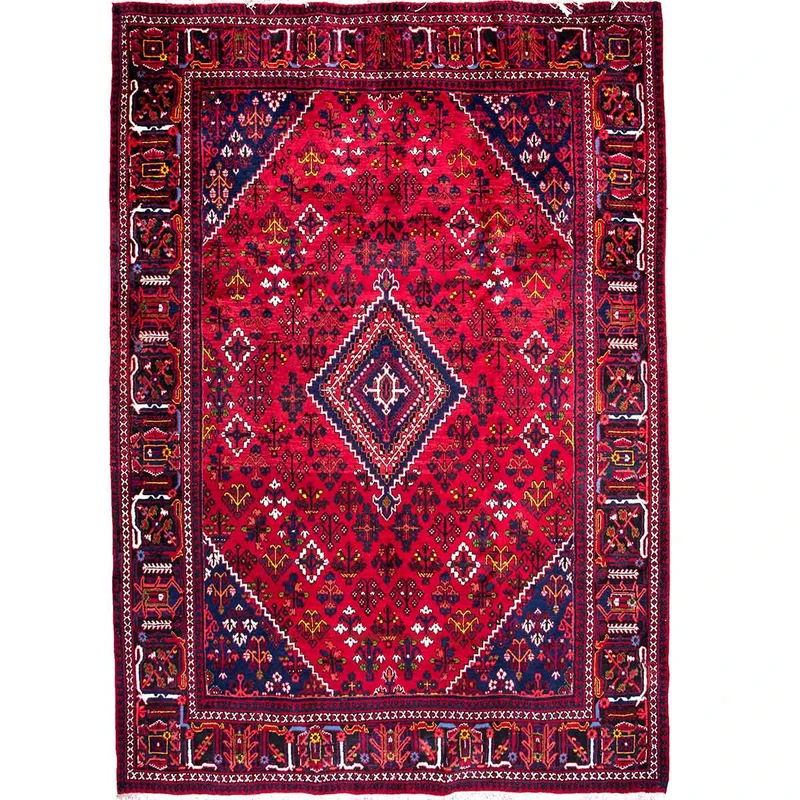
A Joshaqan rug with the classic diamond lattice of flowering plants - Joshaqan Persian Rug 10x7 ft - Geometric Semi Antique Wool Hand Knotted
4
A Day at a Joshaghan Loom
In a Joshaghan home, the loom usually stands against a wall in a quiet room, its warps stretched tight between two beams. The weaver sits on a plank in front of it, raising the plank as the rug grows. She takes a strand of colored wool from the balls hanging above her, wraps it around a pair of warps, cuts it with a small knife, and moves on to the next knot - thousands of times a day. After each row, she passes the weft through the warps and beats it down firmly with a heavy metal comb.
Often two or more members of the family weave side by side, chatting, singing, or listening to the radio as they work. Children watch and learn, first by winding wool and later by tying their own knots. Over months, the lattice slowly rises from the bottom of the loom, one compartment at a time. When the rug is finished, it is cut from the loom, its pile is sheared evenly, and it is taken to be washed and sold.
5
Finishing and Washing
A newly woven Joshaghan is not yet ready for the floor. The pile is first trimmed with shears to an even height, revealing the crisp outlines of the design. The rug is then washed to remove dust, loose fibers, and excess dye, and to soften the wool and brighten the colors. Finally it is stretched and dried to make sure it lies flat and square. Our article on washing a new rug after weaving explains this process in detail.
6
The Meaning Behind the Lattice
Like many Persian designs, the Joshaghan lattice can be read as an image of a garden. In Persian culture, the garden is a symbol of paradise: an ordered, enclosed space of water, trees, and flowers protected from the harsh world outside. The orderly compartments of a Joshaghan rug, each with its blossoming plant, recall the flower beds of a Persian garden. Our article on Persian garden rugs explores this tradition, and our article on the tree of life looks at the symbolism of flowering plants.
The lattice also expresses a love of balance and pattern that runs through Persian art, from tilework and brickwork to textiles and manuscripts. Each compartment is complete in itself, yet all are part of a greater whole. Our guide to Persian rug motifs explains many of these ideas.
7
Colors of Joshaghan Rugs
The original text of this article praised the "fast and limpid colors" of Joshaghan rugs - colors that are both colorfast and clear. The classic palette is rich and warm:
•
Deep red - the most common field color, from madder red to crimson. See our red rugs.
•
Navy and dark blue - used in borders and to outline motifs. See our navy blue rugs.
•
Ivory - for highlights, medallions, and some borders.
•
Green, gold, orange, and light blue - accents in the flowering plants, giving each compartment its own personality.
The original text noted that the fresh and vivid colors are chosen from the best natural dyestuffs. Our articles on natural dyes, the principal sources of natural colors, and mordants explain how dyers achieve such lasting color.
8
How Joshaghan Rugs Are Made
Structure
Joshaghan rugs are woven on cotton foundations with good, strong wool pile. The original text of this article noted a knot density of about 500 to 2,000 knots per square decimeter - a medium to fine range that allows clear drawing while keeping the rug sturdy. The pile is usually medium in height. Our article on how a Persian rug is made explains these structural terms.
Wool
The wool of the Joshaghan region is strong and lustrous, well suited to dyeing in clear colors. Good wool is essential to the durability and beauty of a Joshaghan rug. See our article on Persian rug wool and our article on spinning wool.
Home Weaving
Most Joshaghan rugs are woven in homes on vertical looms. Because the design is so well known in the town, experienced weavers can work from small samples or from memory, though more complex pieces may follow a cartoon. Each weaver brings small variations of drawing and color, so no two rugs are exactly alike.
9
The Quality of Joshaghan Rugs
The original text of this article described the quality of Joshaghan rugs as very good. Several factors contribute to this reputation:
•
Strong, well-dyed wool - giving durability and clear color.
•
Balanced knot density - fine enough for clear drawing, sturdy enough for daily use.
•
A classical design - refined over centuries, with a pleasing balance of order and variety.
•
Careful finishing - well-made edges and ends that help the rug last.
As with any rug, quality varies from piece to piece, so it is always worth examining the drawing, colors, wool, and condition. Our complete buyer's guide explains what to look for.
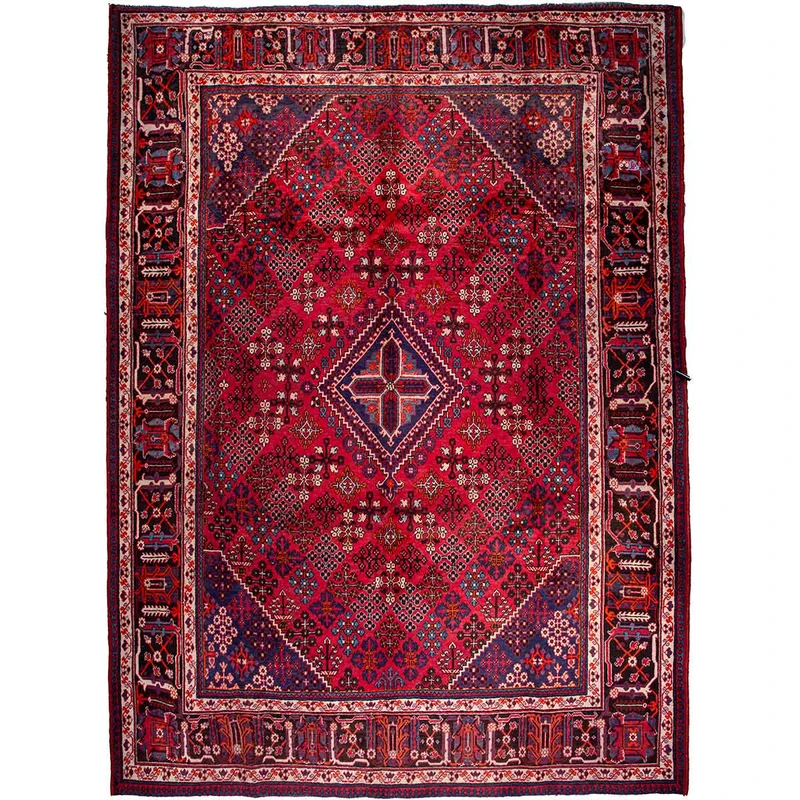
A large Joshaqan rug with stylized flowering plants in diamond compartments - Joshaqan Persian Rug 13x9 ft - Geometric Semi Antique Wool Hand Knotted
10
Antique and Older Joshaghan Rugs
Older Joshaghan rugs, woven in the nineteenth and early twentieth centuries, are especially admired. Their colors have mellowed into soft reds, warm golds, and deep blues, and their drawing often shows more variety and spontaneity than recent pieces. Some have unusual proportions or rare color combinations. Because Joshaghan rugs were woven to last, many older pieces survive in good condition and continue to serve as practical floor rugs. See our antique collection.
11
The Joshaghan Lattice Compared With Other Designs
The Joshaghan lattice is one of several Persian designs that divide the field into a repeating structure. It helps to compare it with its relatives:
•
Kheshti (garden panels) - square or rectangular compartments, each with a tree, vase, or flowers, typical of Bakhtiari rugs. Joshaghan compartments are diamond-shaped.
•
Herati (Mahi) - a small repeating unit of a rosette framed by curved leaves, forming a dense all-over pattern rather than distinct compartments. See our Herati designs.
•
Mina Khani - a network of flowers linked by vines, creating a lattice of circles and diamonds, common in Varamin and Kurdish rugs.
•
Boteh - rows of teardrop-shaped paisleys, sometimes arranged in a diagonal grid. See our boteh designs.
Each of these designs organizes the field in its own way, but the Joshaghan lattice is unique in combining a clear diamond structure with a different flowering plant in every compartment.
12
Why the Design Has Lasted
Why has the Joshaghan design endured for so long? Part of the answer is beauty: the combination of order and variety is deeply satisfying to the eye. Part is practicality: the all-over lattice looks good from every direction and does not depend on a central focal point. And part is identity: for the people of Joshaghan, the design is a source of pride and a link to their ancestors. As long as there are weavers in the town, the lattice will continue to bloom.
13
Neighbors and Relatives
Joshaghan sits within a rich weaving region, and its design has influenced and been influenced by its neighbors:
•
Meymeh and Murcheh Khort - nearby towns that weave rugs closely related to Joshaghan, often with similar lattice and floral designs.
•
Isfahan - the great city to the south, famous for fine classical rugs with silk foundations. See our article on Isfahan rugs.
•
Kashan - the historic city to the northeast, known for curvilinear city rugs with deep reds and navies. See our article on Kashan rugs.
•
Bakhtiari - the weavers of Chaharmahal and Bakhtiari use a related garden-compartment design called kheshti. See our article on Bakhtiari weaving and our kheshti designs.
•
Golpayegan and Najafabad - other weaving towns of Isfahan Province, each with its own style. See our article on Golpayegan rugs and our Najafabad rugs.
14
Joshaghan Designs Around the World
The Joshaghan design is so admired that it has been copied by weavers in many places. The original text of this article noted that many Joshaghan designs are copied and produced abroad. Copies can be attractive, but they usually lack the depth of color, the quality of wool, and the subtle variations of a genuine Joshaghan. Within Persia, the design has also been adopted by weavers in other towns, so the term "Joshaghan design" is sometimes used for rugs woven elsewhere in the same style. A knowledgeable seller will tell you where a rug was actually woven.
15
How to Recognize a Joshaghan Rug
•
Diamond lattice - a field divided into diamond-shaped compartments, each with a flowering plant.
•
Slightly angular floral drawing - between city curves and village geometry.
•
Deep red field - with navy, ivory, green, and gold accents.
•
Diamond-shaped medallion - often present, echoing the lattice.
•
Cotton foundation and good wool - with a medium pile and a firm handle.
•
Natural variation - small changes of color and drawing from compartment to compartment.
Our article on how to read a Persian rug's secret language explains how to examine a rug's structure and materials.
16
Sizes and Formats
The original text of this article noted that Joshaghan rugs range from small to larger pieces. Medium sizes such as 4 by 6 and 5 by 8 feet are common, along with room sizes from about 7 by 10 to 10 by 13 feet. The lattice design adapts well to any size, since the number of compartments simply increases or decreases with the dimensions of the rug. Our rug size guide will help you choose.
17
Joshaghan Rugs in the Home
The orderly beauty of a Joshaghan rug makes it remarkably versatile:
•
Living rooms - the all-over lattice looks good from every angle and works well under furniture, because no single focal point is hidden.
•
Dining rooms - the repeating pattern frames a dining table beautifully, and the sturdy wool stands up to chairs.
•
Bedrooms - a medium-size Joshaghan adds warmth and color beside or under the bed.
•
Traditional interiors - deep red and navy Joshaghan rugs suit classic furniture and wood paneling.
•
Modern spaces - the geometric lattice has a surprisingly contemporary feel and pairs well with clean lines.
Our article on giving your home timeless elegance with a Persian rug has more ideas.
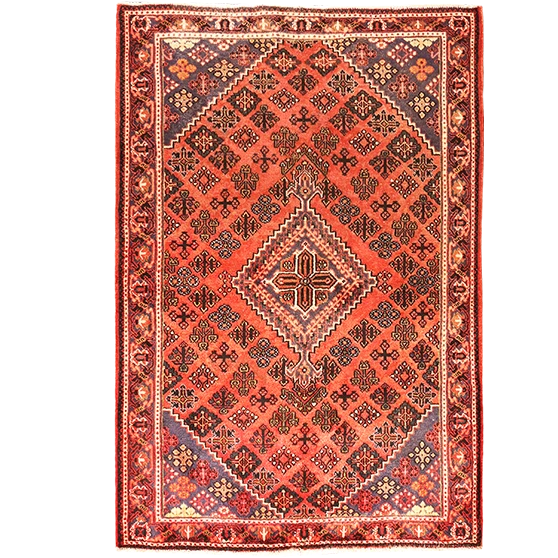
A Joshaqan rug in a medium size with a red lattice field - Joshaqan Persian Rug 7x4 ft - Geometric Semi Antique Wool Hand Knotted
18
Choosing a Joshaghan Rug
When choosing a Joshaghan, consider these points:
•
Design balance - look for a lattice that is even and well proportioned, with clear, lively plants in each compartment.
•
Color - choose a palette that suits your room; deep red is classic, while lighter grounds feel more relaxed.
•
Wool and handle - the pile should feel springy and the rug should have a firm, even body.
•
Condition - check the edges, ends, and pile, especially in older pieces.
•
Age - semi-antique pieces offer mellow color and proven durability; newer rugs offer fresh condition. Explore our semi-antique rugs.
Our article on investing in hand-knotted rugs discusses how good rugs hold their value.
19
Common Misunderstandings
"Joshaghan rugs are tribal rugs."
Joshaghan rugs are town rugs from central Persia. Their drawing is somewhat geometric, but they belong to a refined, classical tradition, not to nomadic weaving.
"Every lattice rug is a Joshaghan."
Lattice designs appear in many weaving centers. A true Joshaghan has its own characteristic plants, colors, and proportions.
"Old style means old-fashioned."
The Joshaghan design is classical, but its order and geometry look fresh in contemporary interiors.
20
Caring for a Joshaghan Rug
Joshaghan rugs are durable and easy to care for. Vacuum regularly without a beater bar, rotate the rug every year or so to even out wear and sun exposure, use a quality rug pad, and blot spills quickly with cold water. Have the rug professionally washed every few years. Our guides to cleaning a Persian rug at home and professional rug cleaning explain these steps in detail.
21
Frequently Asked Questions
Where is Joshaghan?
In the mountains of Isfahan Province, north of Isfahan and not far from Kashan and Meymeh, in central Persia.
What is the Joshaghan design?
A lattice of diamond-shaped compartments, each containing a stylized flowering plant, often with a diamond-shaped central medallion.
Are Joshaghan rugs durable?
Yes. They are woven with good wool on cotton foundations, with a sturdy medium pile suitable for everyday use.
What colors are typical of Joshaghan rugs?
Deep red fields with navy, ivory, green, gold, and light blue accents.
How is Joshaghan spelled?
You will see Joshaghan, Josheghan, Joshaqan, and Jowshaqan; they all refer to the same weaving town and style.
Do all Joshaghan rugs have a medallion?
No. Many have a central diamond medallion, but others let the lattice of flowering plants cover the entire field, which works especially well under furniture.
Do Joshaghan rugs work in modern homes?
Very well. The orderly geometric lattice has a timeless, almost contemporary quality.
22
A Garden in Every Compartment
Joshaghan rugs carry centuries of Persian design in a form that is both orderly and full of life. Each compartment holds its own small garden, each rug its own rhythm of color, and each piece reflects the patient work of weavers in a mountain town that has never stopped weaving.
At Los Angeles Home of Rugs, you can explore our Joshaqan collection along with rugs from Isfahan, Najafabad, and Bakhtiari. If you have questions about a rug, please contact us.