


Kurdish Rugs of Persia: Senneh, Bijar, and Village Weaving
Los Angeles Home of Rugs on Nov 17th 2026
In the mountains of western Persia, where high pastures, deep valleys, and cold winters have shaped life for thousands of years, the Kurdish people have created one of the most admired weaving traditions in the world. Persian Kurdistan has produced rugs of astonishing contrast: the delicate, finely knotted rugs and kilims of Sanandaj, known to the trade as Senneh, and the massive, almost indestructible carpets of Bijar, famous as the "iron rugs of Persia." Around them, Kurdish villages and tribes weave bold, colorful rugs full of character.
This article explores the weaving of Persian Kurdistan: its landscape and people, the two great centers of Senneh and Bijar, the village and tribal traditions of the region, the designs and colors that define Kurdish rugs, and how to recognize and care for them. For a broader look at Kurdish weaving across the region, see our article on Kurdish rugs.
1
A Land Made for Weaving
Kurdistan Province lies along Persia's western border, in the Zagros Mountains. Its high meadows are ideal for raising sheep, and the cold mountain climate produces wool that is thick, strong, and naturally lustrous - perfect for durable rugs. Rivers and springs provide water for dyeing and washing, and the oak forests of the Zagros supply galls, acorns, and bark rich in tannin, while walnut trees grow in many valleys. In short, the land itself provides almost everything a weaver needs.
The Kurds have woven for as long as they have kept flocks. Traditionally, many were nomadic or semi-nomadic, moving between summer and winter pastures, and they wove tent bands, bags, kilims, and pile rugs for their own use. Over time, settled towns and villages became centers of more organized production, and two of them - Sanandaj and Bijar - became world famous.
2
A Short History of Kurdish Weaving in Persia
Kurdish weaving is far older than any surviving rug, but its documented history becomes clearer from the Safavid period onward. For several centuries, Sanandaj was the seat of the Ardalan family, the hereditary rulers of Persian Kurdistan, and the refined court culture that grew up around them is believed to have encouraged the fine weaving for which Senneh became known. Rugs and kilims of great delicacy from the eighteenth and nineteenth centuries reflect this patronage.
In the nineteenth century, Bijar and the surrounding Garrus district developed their reputation for heavy, durable carpets, some of them large room-size pieces woven for wealthy households in Persia and later for export. As Western demand for Persian rugs grew in the late nineteenth and early twentieth centuries, Kurdish rugs reached Europe and America in increasing numbers, and the names Bijar and Senneh became established in the international trade. Throughout this period, village and tribal weaving continued alongside town production, preserving older designs and techniques.
3
Women, Family, and the Loom
In Kurdish villages and tribal households, weaving has traditionally been women's work, learned by girls from their mothers and grandmothers from an early age. A family's favorite designs and color combinations were passed down in this way, so that rugs from the same household or village often share a recognizable style. Weaving was woven into the rhythm of daily life: work at the loom alternated with caring for children, animals, and the home, and was often shared among sisters, cousins, and neighbors.
Rugs, kilims, and bags were also part of a bride's dowry, and many young women wove special pieces in preparation for marriage. Songs, sayings, and beliefs accompanied the work, as our article on Kolyai weavers' folk beliefs describes. These personal and family connections are part of what gives Kurdish village rugs their warmth and individuality.
4
Senneh - The Art of Fineness
A Town and a Knot
Sanandaj, the capital of Kurdistan Province, is known in the rug trade by its older name, Senneh. Ironically, the town gave its name to the Persian or asymmetrical knot, often called the "Senneh knot," yet Senneh weavers traditionally use the symmetrical (Turkish) knot. This is one of the small curiosities of rug terminology that experts enjoy pointing out.
Fine, Thin, and Precise
Senneh rugs are famous for their fineness. They are typically thin, with a very short pile, and woven with a single weft after each row of knots, which gives the back a distinctive, slightly granular texture that experts recognize by touch. Because the knots are so finely packed, Senneh rugs can carry small, intricate patterns that would be impossible in a coarser rug.
Designs of Senneh
The most characteristic Senneh designs are small-scale all-over patterns: tiny Herati units, rows of delicate boteh, and, in the nineteenth century, small diamond-shaped medallions on fields filled with fine repeating motifs. Senneh weavers also adopted European-inspired floral designs, the gol farang or "foreign flower," with naturalistic roses and bouquets. Colors are often subtle: soft reds, light and deep blues, ivory, and gentle yellows.
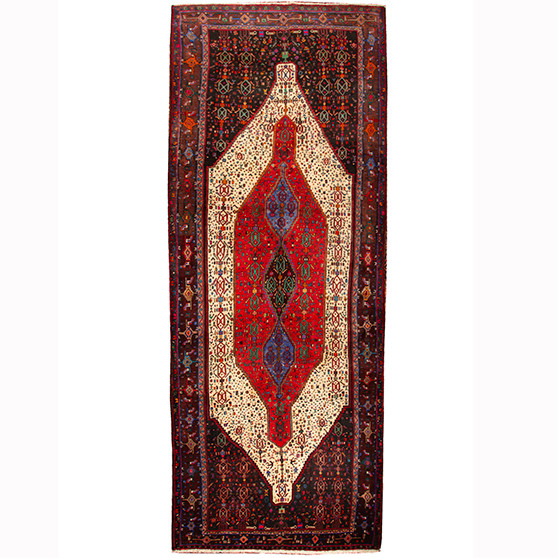
A Senneh rug with a medallion design in crimson, cream, and navy blue - Senneh Persian Rug 13x5 ft - Medallion Semi Antique Wool Hand Knotted
The Famous Senneh Kilims
Sanandaj is also renowned for its kilims - flatwoven rugs of exceptional fineness, with small-scale designs that echo the pile rugs, especially boteh and Herati motifs and small medallions. Fine antique Senneh kilims are among the most admired flatweaves in the world, prized by collectors for their delicacy and precision. Explore our kilim and Senneh collections.
A City of Music and Craft
Sanandaj is also a center of Kurdish music and culture. The city is famous for the daf, the large frame drum used in Kurdish music, and for the spectacular performances of hundreds of daf players. Our article on the 1000-daf performance in Sanandaj describes this remarkable tradition, and our article on Persian rug music explores the connection between weaving and song.
5
Bijar - The Iron Rugs of Persia
Unmatched Density
About a hundred miles northeast of Sanandaj lies the town of Bijar, in the historic district of Garrus. If Senneh is famous for fineness, Bijar is famous for strength. Bijar rugs are among the heaviest and densest hand-knotted rugs ever made, and they are often called the "iron rugs of Persia." A Bijar rug is so stiff that it should be rolled rather than folded, since folding can crack the foundation.
How Bijar Rugs Are Made
The secret of Bijar's density lies in its weaving technique. Bijar weavers use the symmetrical knot and pass two or more wefts after each row of knots - traditionally sometimes three or more - including a thick weft that is pulled very tight. Weavers often keep the yarns damp and beat each row down with exceptional force, traditionally using a metal tool to compress the knots and wefts further. As the wool dries, the rug becomes extremely compact. The result is a rug that can withstand generations of heavy use. Our article on Persian iron rugs explains the technique in more detail.
Designs and Colors
Bijar designs include bold medallions, dense Herati fields, Mina Khani lattices, boteh, garden designs, and European-style floral bouquets. Colors are deep and saturated: madder reds, dark blues, ivory, and greens, often with dark browns and blacks for outlines. Antique Bijars sometimes show the relief effect created when iron-mordanted dark areas wear lower than the surrounding pile - a feature we describe in our article on inlaying and embossing in Bijar rugs.
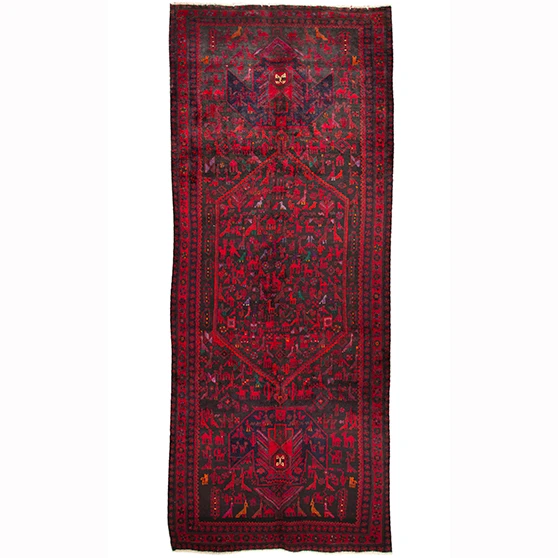
A Bijar with a dense Herati design in dark red, navy blue, and crimson - Bijar Persian Rug 14x5 ft - Herati Semi Antique Wool Silk Hand Knotted
Bijar Through the Centuries
Bijar weaving is old and well established, and nineteenth-century Bijar carpets, sometimes woven for wealthy patrons, are among the most respected Persian carpets of their era. Small Bijar sample rugs called vagireh, which show sections of field and border designs for weavers to copy, are also highly collectible. Read more in our article on weaving in Bijar and explore our Bijar collection.
6
Village and Tribal Weaving in Kurdistan
Beyond Senneh and Bijar, the villages and tribes of Persian Kurdistan and neighboring Kermanshah Province weave a wide variety of rugs. These are usually bolder and more spontaneous than city rugs, woven from memory on wool foundations, with strong colors and geometric designs.
Kolyai
The Kolyai Kurds of Kermanshah Province, around Sonqor, weave sturdy village rugs, often long runners and medium-size rugs, with geometric medallions, bold colors, and strong wool. Kolyai weaving is also rich in folk beliefs and customs, which we explore in our article on folk beliefs among Kolyai rug weavers. See also our article on weaving in Kolyai and our Kolyai collection.
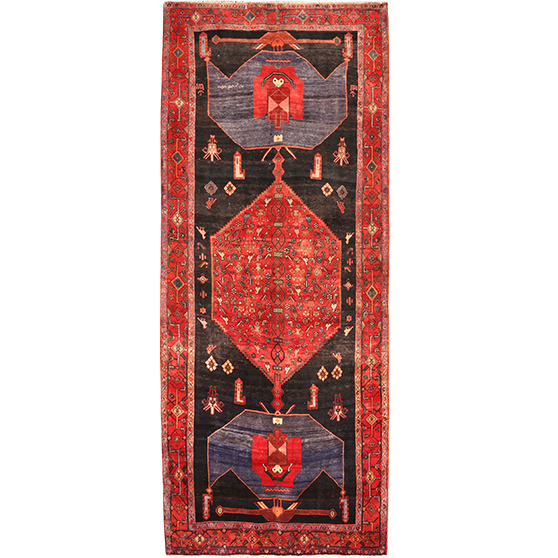
A Kolyai runner with geometric medallions in red, black, and navy blue - Kolyai Persian Rug 12x5 ft - Geometric Semi Antique Wool Hand Knotted
Songhor and Other Villages
The town of Songhor and many other villages in the region produce rugs with their own local styles, from stylized floral designs to bold geometric patterns. Rugs from these villages are often sold under the general name "Kurdish," which covers a remarkable range of qualities and designs.
Tribal Weavers
Kurdish tribes such as the Jaf, Sanjabi, and others are known for bags, bag faces, kilims, and small rugs with bold geometric patterns, especially diamond lattices and hooked motifs. Jaf bag faces, with their brilliant colors and lustrous wool, are particularly admired by collectors.
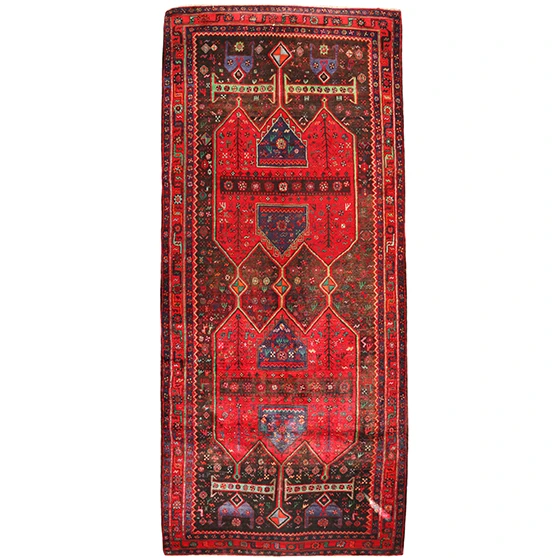
A Kurdish runner with a geometric diamond lattice in madder red and navy blue - Kurdish Persian Rug 12x4 ft - Geometric Semi Antique Wool Hand Knotted
7
Kurds Across Persia - A Wider Weaving World
Kurdish weaving is not confined to Kurdistan Province. Kurdish communities live across western Persia, in Kermanshah, West Azerbaijan, and Ilam, and in North Khorasan, where the Kurmanj Kurds weave their own bold rugs and kilims. Our article on Khorasan rugs and our article on the Kurmanj tribes explore these eastern Kurdish traditions.
Across this wide area, certain features recur: strong, lustrous wool, the symmetrical knot, deep and saturated colors, and a love of geometric patterns. At the same time, each community developed its own local designs, so that a Kurmanj rug from Quchan looks quite different from a Kolyai runner or a Jaf bag face. The common thread is a weaving culture that values durability, color, and personal expression.
8
Designs of Kurdish Rugs
Across Senneh, Bijar, and the village and tribal traditions, a number of designs appear frequently in Kurdish weaving:
•
Herati (mahi) - in fine scale in Senneh and Bijar, and in bolder forms in village rugs. See our Herati designs.
•
Boteh - small and delicate in Senneh, larger and bolder elsewhere. See our boteh designs.
•
Mina Khani - a lattice of flowers linked by vines, popular in Bijar and Kurdish village rugs. See our Mina Khani designs.
•
Medallion - from the small diamond medallions of Senneh to the bold, dramatic medallions of Bijar. See our medallion designs.
•
Gol farang - European-style floral bouquets, used in Senneh and Bijar from the nineteenth century. See our gol farang designs.
•
Geometric and diamond lattice - the favorite patterns of village and tribal weavers. See our geometric designs.
9
Colors and Materials
Kurdish rugs are woven with some of the best wool in Persia: thick, strong, and naturally lustrous, from sheep raised in the cold mountain pastures. Foundations are traditionally wool in village and tribal rugs and cotton in many town rugs, including many Senneh and Bijar pieces from the later nineteenth century onward. Senneh rugs sometimes have colored silk warps in their finest examples.
The Kurdish palette is rich and saturated. Madder reds, deep indigo blues, ivory, and greens are common, with yellows and oranges adding brightness in village rugs. Kurdish dyers have long been admired for their skill, and many old Kurdish rugs show excellent natural dyes. Our series on Persian rug color, beginning with the master dyer, explains how these colors were made.
A quick way to tell Senneh from Bijar: a Senneh rug is thin, flexible, and short-piled, with a grainy back from its single weft. A Bijar is thick, heavy, and stiff, and feels almost like a board. Both use the symmetrical knot, but they could hardly feel more different in the hand.
10
Senneh and Bijar Side by Side
•
Weight and feel - Senneh is thin, light, and flexible; Bijar is thick, heavy, and stiff.
•
Wefts - Senneh uses a single weft after each row of knots; Bijar uses two or more, tightly packed.
•
Pile - Senneh is clipped very short; Bijar has a dense, medium pile.
•
Designs - Senneh favors tiny, intricate repeating patterns; Bijar favors bold medallions and dense Herati and Mina Khani fields.
•
Best use - Senneh suits quiet rooms and walls; Bijar suits the busiest areas of a home.
•
Shared traits - both use the symmetrical knot, excellent Kurdish wool, and rich natural colors in older examples.
11
How to Recognize a Kurdish Rug
•
Strong, lustrous wool - Kurdish wool is easy to recognize by its sheen and resilience.
•
Symmetrical knots - used in Senneh, Bijar, and most Kurdish village weaving.
•
Distinctive handle - very thin and supple (Senneh) or very heavy and stiff (Bijar), with village rugs in between.
•
Saturated colors - deep reds and blues, often with bright accents.
•
Bold geometry or fine small-scale patterns - depending on whether the rug is tribal, village, or town work.
For more on how experts read these details, see our article on how a Persian rug is made.
12
Kurdish Rugs in Your Home
Kurdish rugs are among the most practical Persian rugs you can choose. Bijars are ideal for hallways, entryways, dining rooms, and other high-traffic areas, where their extraordinary durability shines; a Bijar runner can last for generations on a busy staircase landing or corridor. Senneh rugs, with their delicate patterns, suit bedrooms, studies, and quieter spaces, and fine Senneh kilims make beautiful wall hangings. Kolyai and other village runners are a classic choice for long hallways.
The deep colors of Kurdish rugs pair well with warm woods and traditional furniture, while their bold geometry also complements modern and rustic interiors. Our rug size guide will help you find the right size.
Kurdish rugs also make wonderful gifts and heirlooms. Because a well-made Bijar or Kurdish village rug can last for many decades, families often pass them down from one generation to the next, and the rug gains character and meaning with every year of use.
13
Caring for Kurdish Rugs
Kurdish rugs are tough, but a few points deserve attention. Bijars should always be rolled, never folded, when moved or stored, because their dense foundation can crack. Thin Senneh rugs and kilims should be kept on a good rug pad to prevent slipping and reduce wear. Old rugs with dark brown or black areas may show natural iron corrosion; this is normal and is explained in our article on mordants. For cleaning, see our guides to washing at home and professional washing.
14
Collecting Kurdish Rugs
Collectors prize several kinds of Kurdish weaving: nineteenth-century Bijars with excellent natural dyes, fine antique Senneh rugs and kilims, Bijar vagireh sample rugs, and Jaf and other tribal bag faces. When evaluating a Kurdish rug, look for good wool and natural dyes, original ends and sides, a sound foundation, and confident drawing. Antique and semi-antique pieces in good condition offer excellent long-term value. See our article on investing in hand-knotted rugs.
15
Kurdish Weaving Today
Weaving continues to be an important part of life in Persian Kurdistan. Bijar remains a center of heavy, durable carpets, and Sanandaj is still known for fine weaving and kilims. Many villages in Kurdistan and Kermanshah provinces weave rugs and runners for domestic and international markets, and some weavers and workshops have returned to hand-spun wool and natural dyes, reviving the deep, glowing colors of older Kurdish rugs.
For buyers, this means that Kurdish rugs are available across a wide range of ages and prices, from antique Bijars and Senneh kilims for serious collectors to sturdy semi-antique and newer village rugs for everyday living.
16
Frequently Asked Questions
Why is the Persian knot called the Senneh knot if Senneh weavers use the Turkish knot?
The name is a historical convention of Western rug terminology. In practice, Senneh weavers have traditionally used the symmetrical knot.
Why are Bijar rugs so heavy?
Bijar weavers use multiple wefts, pack the rows extremely tightly, and compress the weave with great force, often while the yarn is damp. The rug becomes very dense as it dries.
Can a Bijar rug be folded?
It is better not to. A Bijar's stiff foundation can crack when folded, so it should always be rolled.
What is a vagireh?
A vagireh is a small sample rug that shows sections of a field and border design, used by weavers as a reference. Bijar vagirehs are especially well known and are now collected for their own sake.
Are Senneh kilims suitable for floors?
Fine Senneh kilims are thin and delicate. They are better used in low-traffic areas, on a good rug pad, or displayed on a wall.
Are Kurdish rugs good for homes with children and pets?
Yes. Sturdy Kurdish village rugs and Bijars are among the most durable Persian rugs, and their rich colors and busy patterns hide everyday wear well.
17
The Spirit of Kurdish Weaving
From the fine kilims of Sanandaj to the iron-hard carpets of Bijar and the bright village runners of Kolyai, Kurdish weaving combines skill, strength, and an unmistakable sense of color. It reflects a mountain people whose craft has adapted to every way of life, from nomadic camps to busy town workshops, and who continue to weave today.
At Los Angeles Home of Rugs, you can explore authentic Kurdish rugs in our Bijar, Senneh, Kolyai, Songhor, and Kurdish collections. Every rug comes with a Certificate of Authenticity documenting its origin, materials, and age. If you have questions, ask our experts.
Explore Kurdish Rugs
Bijar Rugs
Senneh Rugs
Kolyai Rugs
Kurdish Rugs
Songhor Rugs
Runners
Kilims
Persian Rug FAQ