


Bijar Rugs: The Iron Rugs of Persia and How to Choose One
Los Angeles Home of Rugs on Nov 17th 2026
Among all Persian rugs, few have a reputation as formidable as the Bijar. Dealers call them the "iron rugs of Persia," and for good reason: a Bijar is so dense, heavy, and stiff that it can feel more like a board than a textile, and it can withstand generations of heavy use with little sign of wear. Yet Bijars are not merely tough. At their best they are works of great beauty, with deep, saturated colors, bold and confident designs, and lustrous Kurdish wool that glows with age.
Our article on Kurdish rugs of Persia introduces Bijar alongside Senneh and the village weaving of Kurdistan. This article focuses on Bijar alone: the town and its district, the unique weaving technique behind its density, the different types of Bijar rugs, their designs and colors, and practical advice on choosing, using, and caring for a Bijar. For the special carved relief effect seen in some Bijars, see our article on inlaying and embossing in Bijar rugs.
1
Bijar and the Garrus District
Bijar is a town in the east of Kurdistan Province, in a high, cold, mountainous region historically known as Garrus. Its villages lie among rolling uplands where flocks of sheep graze in summer, producing the strong, lustrous wool that is the foundation of Bijar's reputation. Winters are long and harsh, and for centuries weaving has been one of the main occupations of the region, practiced in both the town and the surrounding villages.
The people of the Bijar region are mainly Kurdish, with long traditions of weaving, music, and craftsmanship. Their weaving combines the durability of tribal and village work with a level of refinement and design sophistication that sometimes rivals city workshops - a combination that makes Bijar rugs unique.
2
The Secret of Bijar's Strength
What makes a Bijar so dense and heavy? The answer lies in a weaving technique developed and refined in the region over generations.
Wet Weaving
Bijar weavers traditionally keep the warps and wefts damp while weaving. Wet wool is more pliable, so it can be packed together much more tightly than dry wool. As the rug dries, the fibers tighten and lock together, producing an extremely compact structure.
Multiple Wefts
After each row of knots, Bijar weavers pass several wefts - often a thick weft and one or more thinner wefts. One weft is pulled very tight, which depresses alternate warps and pushes the knots upright and close together. Historically, some Bijars were woven with three or even more weft passes per row.
Heavy Packing
Each row is beaten down with exceptional force, first with the heavy metal comb used by all Persian weavers, and then, traditionally, with a long metal tool like a large nail or rod, which is driven between the warps to compress the knots and wefts even further. This extra packing is the source of the rug's legendary density.
The result is a rug that is thick, heavy, stiff, and almost indestructible. Because of this structure, a Bijar should always be rolled, never folded: folding can crack the tightly packed foundation. Our article on Persian iron rugs explores the technique further, and our article on how a Persian rug is made explains the basic structure of all Persian rugs.
A quick test: try to fold the corner of a genuine Bijar. It resists strongly and feels almost like cardboard. This stiffness is a sign of the dense weave, not a defect.
3
A Day at a Bijar Loom
Imagine a village house in the Garrus highlands on a winter morning. A large vertical loom stands against the wall, its warps stretched tight from top to bottom, and two or three women sit side by side on a plank, each responsible for a section of the rug. A bowl of water sits nearby for dampening the yarn. The weavers tie row after row of knots from memory or from a small vagireh hanging beside them, then pass the wefts and beat them down hard with the heavy metal comb.
Every so often, one of the weavers takes up the long metal packing tool and drives it between the warps, row by row, to compress the weave further. The work is physically demanding, and progress is slow: a dense room-size Bijar may take many months to complete. But the result is a rug that will outlast its makers, carrying their skill and effort into homes for generations.
4
The Wool of Bijar
The Garrus region's cold, high pastures produce excellent wool: long, strong, resilient, and naturally lustrous. Bijar weavers have traditionally used this local wool for the pile, and its quality is one reason Bijars wear so well and age so beautifully. In antique pieces, hand-spun wool takes natural dyes richly and develops a soft, glowing patina. Our article on Persian rug wool explains why mountain wool is so prized.
5
Sizes and Formats
Bijars are woven in a wide range of sizes. Long, narrow runners are among the most popular, ideal for hallways and stairs. Room-size carpets, often with large medallions or all-over designs, suit living and dining rooms. Bijar weavers also produced long, relatively narrow rugs sometimes called kelleh, small mats and sample rugs, and occasionally very large carpets for grand houses. Because of their weight, large Bijars are substantial objects, and moving them requires care.
6
Types of Bijar Rugs
Town and Village Bijars
Bijar rugs are woven both in the town itself and in the surrounding villages. Town Bijars are often finer, with more precise drawing and more elaborate designs, while village Bijars are typically bolder and more rustic, with strong colors and simpler compositions. Both share the characteristic dense structure.
Halvai Bijars
The finest Bijars are traditionally associated with the village of Halvai (Halvaei). Halvai Bijars are known for their exceptionally fine knotting, precise drawing, elegant designs, and beautiful wool. They are thinner and finer than typical Bijars while retaining great strength, and antique Halvai pieces are among the most sought-after Bijars.
Tekab and Other Bijars
Rugs from the area around Tekab, northeast of Bijar, and other villages of the region are often grouped with Bijars. They share the region's structure and wool but may have their own local designs and slightly different character.
Bijar Vagirehs
A vagireh is a sample rug that shows sections of a field design, a corner, and part of a border, used by weavers as a model. Bijar vagirehs are especially famous: often small, crowded with different motifs, and woven with the same density as full-size rugs. They are highly collectible today for their charm and as documents of the weaver's repertoire. Browse our vagireh designs.
7
Designs of Bijar
Bijar weavers use a rich variety of designs, from tribal geometry to sophisticated floral compositions:
•
Garrus design - a bold, large-scale arabesque or palmette pattern named after the district, with strong, curving forms that read clearly across a room.
•
Herati (mahi) - the classic all-over pattern of rosettes and leaves, densely drawn in many Bijars. See our Herati designs.
•
Mina Khani - a lattice of flowers linked by vines. See our Mina Khani designs.
•
Medallion and corner - from bold geometric medallions in village rugs to elegant floral medallions in town and Halvai pieces. See our medallion designs.
•
Zell-e Sultan - a design of repeating vases filled with roses, named after a Qajar prince, Zell-e Sultan, and associated with fine Bijars and other centers.
•
Gol farang - naturalistic European-style roses and bouquets, popular in nineteenth-century Bijars. See our gol farang designs.
•
Boteh - rows of teardrop motifs. See our boteh designs.
Our article on Persian rug motifs explains these motifs in more detail.
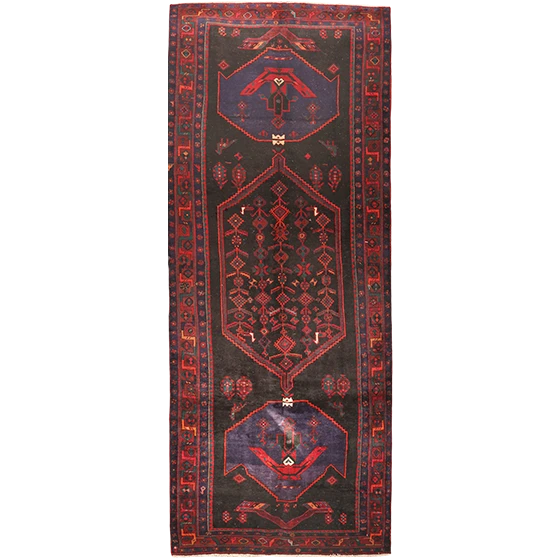
A Bijar runner with a medallion design in crimson, navy blue, and madder red - Bijar Persian Rug 13x4 ft - Medallion Semi Antique Wool Silk Hand Knotted
8
Colors of Bijar
Bijar rugs are famous for their deep, saturated colors. Rich reds - from madder red to deep crimson - and dark indigo blues dominate, often with ivory, soft celadon or sea green, gold, and rose accents. Dark browns and blacks outline motifs, and in older rugs these areas may have worn lower than the surrounding pile because of iron mordants, creating a subtle relief. Some antique Bijars have unusual ground colors such as camel, light blue, or ivory, which are especially prized.
Bijar's dyers were highly skilled, and older Bijars with natural dyes have mellowed into remarkably harmonious palettes. Our series on Persian rug color, beginning with the master dyer, and our article on mordants explain these colors and their aging.
9
Bijar Through History
Weaving in the Bijar region is old and well established, and by the nineteenth century, Bijar rugs had a strong reputation in Persia for their quality and durability. Large Bijar carpets were woven for wealthy households, and fine pieces were commissioned for important clients. In the late nineteenth and early twentieth centuries, as Western demand for Persian rugs grew, Bijars became popular in Europe and especially in America, where their durability made them ideal for busy homes.
Many of the finest antique Bijars available today date from about 1870 to 1930. They combine natural dyes, excellent wool, and the classic Bijar structure, and they have aged into beautifully mellow pieces. Twentieth-century Bijars continued the tradition, though some later pieces are less densely woven than the great antique examples. See our article on Persian rug history from 1722 to 1925.
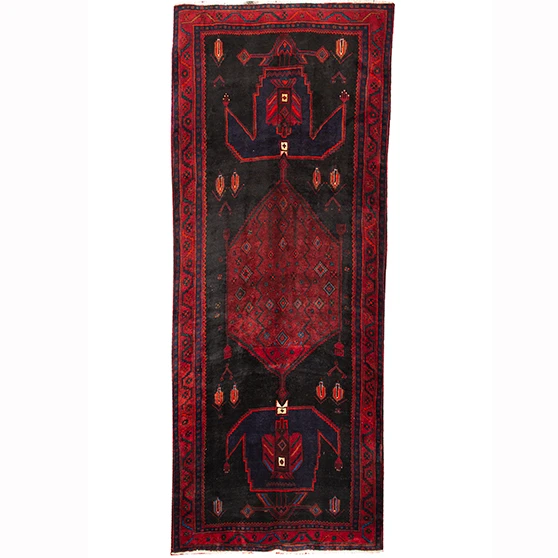
A Bijar with a medallion design in dark red, black, and crimson - Bijar Persian Rug 13x5 ft - Medallion Semi Antique Wool Silk Hand Knotted
10
How to Recognize a Bijar
•
Exceptional weight and stiffness - a Bijar feels heavy and resists folding.
•
Dense, compact back - with tightly packed knots and depressed warps.
•
Symmetrical knots - like most Kurdish rugs.
•
Medium-height, dense pile - with lustrous wool.
•
Saturated colors - deep reds and blues with ivory, green, and gold accents.
•
Bold, confident designs - Garrus, Herati, Mina Khani, medallions, and floral designs.
Because Bijar designs are sometimes copied elsewhere, the weight and structure are the most reliable clues. A rug that looks like a Bijar but folds easily and feels light is probably not one.
11
Bijar Compared With Other Durable Rugs
•
Bijar vs Heriz - both are famously durable. Heriz rugs are thick and heavy with bold geometric medallions woven from memory, while Bijars are even denser and stiffer, with designs ranging from geometric to refined floral. See our Heriz collection.
•
Bijar vs Senneh - both are Kurdish and use the symmetrical knot, but Senneh rugs are thin, light, and flexible, while Bijars are thick, heavy, and stiff. See our Senneh collection.
•
Bijar vs Hamadan village rugs - Hamadan rugs are usually single-wefted and more flexible; Bijars are multi-wefted and far denser. See our Hamadan collection.
If durability is your top priority, a Bijar is hard to beat. If you prefer a softer, more flexible rug, a Heriz or Hamadan may suit you better.
12
Bijar Weaving Today
Weaving continues in Bijar and the surrounding villages, though like many traditional crafts it faces challenges as younger people move to cities. Some modern Bijars are woven with the traditional dense structure, while others are lighter and less compact. For buyers, this means that the weight and feel of a Bijar remain important clues to its quality. Antique and semi-antique Bijars from periods when the traditional technique was universal are especially valued for their density and durability.
13
Reading the Back of a Bijar
The back of a Bijar tells you a great deal about its quality. Turn a corner over and look closely: in a fine Bijar, the knots form a tight, even grid, almost like fine beadwork, with the rows packed so closely that the wefts are barely visible. Because alternate warps are depressed, each knot appears as a single small bump rather than two, and the surface feels hard and smooth to the touch.
Coarser village Bijars show larger, more visible knots, but the same dense packing. If the back looks loose, with clearly visible wefts and an open grid, the rug may be a lighter, later piece or not a true Bijar at all. Experienced buyers often judge a Bijar first by its back and its weight, and only then by its design. Our article on how to read a Persian rug's secret language explains more about reading a rug's structure.
14
Bijars and the Relief Effect
Some Bijars show a fascinating feature: their dark brown or black outlines and motifs sit slightly lower than the rest of the pile. This happens naturally in older rugs, because dark colors made with iron mordants gradually weaken the wool and wear faster. The result is a carved, three-dimensional look that collectors admire. Some Bijar weavers also clip certain areas deliberately to create this effect. Our article on inlaying and embossing in Bijar rugs explains the craft in detail.
15
Where to Use a Bijar
Bijars are among the most practical Persian rugs you can own. Their density makes them ideal for the busiest parts of a home:
•
Entryways and hallways - Bijar runners can handle constant foot traffic for decades.
•
Dining rooms - chairs slide easily over the firm surface, and the dense pile resists wear.
•
Family rooms - durable enough for children and pets, with rich colors that hide everyday marks.
•
Offices and studies - Bijars handle rolling chairs better than softer rugs, though a chair mat is still recommended.
At the same time, the beauty of a fine Bijar makes it equally at home in a formal living room. Its rich colors pair beautifully with wood, leather, and classic furniture, and its bold designs also suit modern interiors. Browse our runners and use our rug size guide to find the right size.
16
Caring for a Bijar
•
Roll, never fold - when moving or storing a Bijar, always roll it, pile side out, to avoid cracking the foundation.
•
Use a good rug pad - it reduces slipping and wear and protects the floor.
•
Vacuum regularly - without a beater bar; the dense pile releases dirt well.
•
Rotate occasionally - to even out wear and sun exposure.
•
Professional cleaning - Bijars are heavy and dense, and they take a long time to dry. Always use specialists who can dry them thoroughly. See our guide to professional rug cleaning.
17
Buying a Bijar - What to Look For
When choosing a Bijar, consider these points:
•
Condition of the foundation - check for cracks or splits, especially along fold lines in rugs that were folded in the past.
•
Pile condition - even wear is normal; look for areas worn to the foundation.
•
Ends and sides - original ends and well-kept side cords add value.
•
Dyes - stable, harmonious colors without bleeding.
•
Weight and density - a genuine Bijar should feel heavy and firm.
•
Repairs - small, well-done repairs are common in older pieces; extensive repairs reduce value.
Our article on how to buy a Persian rug offers a complete checklist, and our article on investing in hand-knotted rugs explains how condition and age affect value.
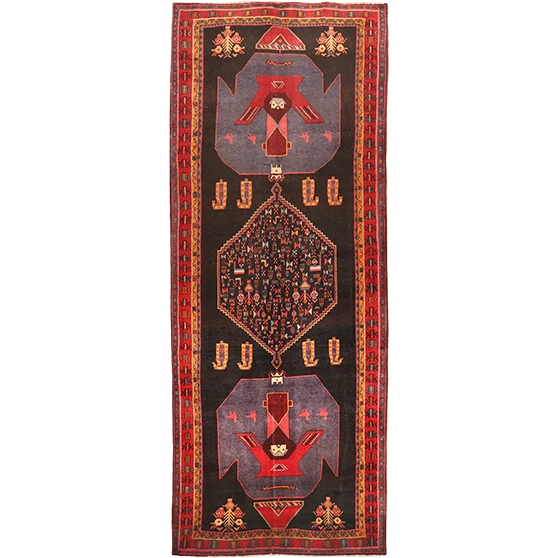
A Bijar runner with a medallion design - Bijar Persian Rug 13x4 ft - Medallion Semi Antique Wool Silk Hand Knotted
18
The Kurdish Spirit of Bijar
Bijar's rugs are an expression of Kurdish culture: its resilience, its love of strong color, and its deep traditions of craft passed down through families. Weaving in the Garrus highlands has long been part of the rhythm of life, alongside herding, farming, music, and the long winters that keep families indoors. Each rug carries something of that world - the patience of the weaver, the strength of the mountain wool, and the boldness of a design woven from memory or from a cherished vagireh.
This cultural depth is part of why Bijars are loved by collectors and homeowners alike. They are not only practical, durable rugs, but also authentic expressions of a living tradition. Our article on Kurdish rugs explores Kurdish weaving more broadly.
19
Frequently Asked Questions
Why are Bijars called iron rugs?
Because their wet-weaving technique, multiple wefts, and heavy packing make them extremely dense, heavy, and durable.
Can I fold my Bijar?
No. Always roll a Bijar. Folding can crack its tightly packed foundation.
What is a Halvai Bijar?
A Bijar from the village of Halvai, traditionally considered the finest type, with exceptionally fine knotting and elegant designs.
What is a Bijar vagireh?
A small sample rug showing parts of a field, corner, and border design, used by weavers as a model. Bijar vagirehs are now collected for their charm.
How heavy is a Bijar?
Noticeably heavier than most Persian rugs of the same size. Large Bijars can take two or more people to move comfortably.
Do Bijars shed?
Like all new wool rugs, a newer Bijar may shed a little at first. The dense structure holds the knots firmly, and shedding decreases with regular vacuuming.
Are Bijars good for homes with pets and children?
Yes. Their density and rich colors make them one of the best choices for busy homes.
20
The Strength and Beauty of Bijar
A Bijar rug is a rare combination of strength and artistry. Woven with remarkable effort by the weavers of the Garrus highlands, it can serve a family for generations while growing more beautiful with age. Few objects in a home offer such lasting value.
At Los Angeles Home of Rugs, you can explore our Bijar collection, including runners and room-size rugs, each with a Certificate of Authenticity documenting its origin, materials, and age. If you have questions, please ask our experts.
Explore the Collection
Bijar Rugs
Runners
Herati Designs
Mina Khani
Vagireh Designs
Antique Rugs
Persian Rug FAQ