


Few motifs are as recognizable as the boteh, the teardrop shape known in the West as paisley. It appears on rugs all over Persia, from the tribal weavings of Fars to the city rugs of Kerman. But one region made the boteh its signature: the Saraband district of the Arak region in central Persia, where villages wove rugs covered with rows of small, neat boteh, a design known in the trade as the boteh-mir.
Our Boteh collection gathers rugs from this tradition and from the wider Arak village world. This guide explains what the boteh-mir is, how Saraband and Mir rugs are built and recognized, how to read their characteristic borders, which other designs you will find in the collection, and how to choose and care for one. For the history and meanings of the boteh itself, see our article on the boteh.
1
The Saraband District
Saraband (also written Serabend or Sarabend) is a district south-west of Arak, the capital of Markazi province, in the mountains of central Persia. Its villages are part of the great weaving region around Arak, which also includes Farahan, Sarouk, Mahal, and Lilihan. For centuries, these villages have woven rugs for local use, and from the late nineteenth century they also wove in large numbers for export.
The name Mir is attached to the finest rugs of the Saraband type. It is traditionally linked to a village of the district, and in the market it came to mean the best, most finely woven Saraband rugs, especially older pieces. Today, dealers sometimes use the names Saraband and Mir almost interchangeably, with Mir suggesting a finer or older rug.
Saraband is a weaving district south-west of Arak in central Persia. Its rugs, and the finest of them known as Mir rugs, are famous for fields of small boteh in rows, the design called boteh-mir.
2
What Is the Boteh-Mir?
The boteh-mir is a field of small boteh arranged in neat horizontal rows. In most rugs, the direction of the boteh alternates from row to row: in one row the tips curl to the left, in the next to the right. This alternation gives the field a gentle, rippling rhythm, like wheat moving in the wind.
Each boteh is small, often only a few inches tall, and filled with tiny flowers or geometric details. The colors of the boteh vary from row to row, while the field color stays the same, usually a deep red or a navy blue. The overall effect is calm and even, rich in detail when seen up close, and quiet and harmonious from a distance.
The boteh-mir is one of the most practical designs for a home. Because it has no central medallion, it looks good from any direction, and furniture can stand anywhere on it without interrupting the design.
3
How to Recognize a Saraband or Mir Rug
•
Boteh field - Rows of small boteh, often alternating direction, on a red or navy field.
•
Multiple border stripes - Many narrow borders, sometimes seven or more, framing the field.
•
Ivory main border - Often an ivory or light main border with a meandering vine or small boteh.
•
Small medallion option - Some rugs add a small central medallion and corners to the boteh field.
•
Symmetric knot - Most Saraband rugs use the symmetric knot.
•
Cotton foundation - Cotton warps, with a firm, flat weave.
•
Low to medium pile - Clipped low, so the small motifs stay clear.
If a rug has a field of small boteh in rows and a frame of many narrow border stripes, it is very likely a Saraband.
4
Reading the Borders
The borders of a Saraband rug are one of its most distinctive features. Instead of a single wide border with a guard stripe on each side, many Saraband rugs have a whole sequence of narrow stripes, each with its own small motif: tiny flowers, rosettes, running vines, or miniature boteh. The stripes alternate in color, red, ivory, navy, and gold, building a rich frame around the field.
The main border, often in ivory, may carry a meandering vine with small flowers, or a row of small boteh. The many stripes around it make the field appear to sit deep inside the rug, like a picture inside a layered frame.
When you judge a Saraband, look at the borders closely. In a well-made rug, each stripe is straight and even, and the motifs turn the corners neatly. In a hurried rug, stripes may wander or be cut off at the corners.
Many narrow border stripes framing a field of small boteh are the hallmark of a Saraband rug. Look at the corners to see how carefully the borders were planned.
5
Other Designs in Our Boteh Collection
The weavers of the Arak region work in many designs, and our Boteh collection includes several of them alongside the boteh-mir.
Herati fields
The Herati or mahi design, a small repeating unit of diamond, rosette, and curling leaves, is a favorite of the Arak villages. Like the boteh-mir, it creates an even, allover field that suits any room. See our Herati designs.
Banded or vaghireh designs
A vaghireh is a rug that combines sections of different field and border patterns, like a sampler. Weavers originally made vaghireh as models to remember designs, and later the style became popular in its own right. A vaghireh rug is lively and full of variety. See our vaghireh designs.
Scattered (afshan) designs
In afshan designs, small flowers and motifs are scattered across the field, sometimes over a Herati network. The effect is rich and decorative. See our afshan designs.
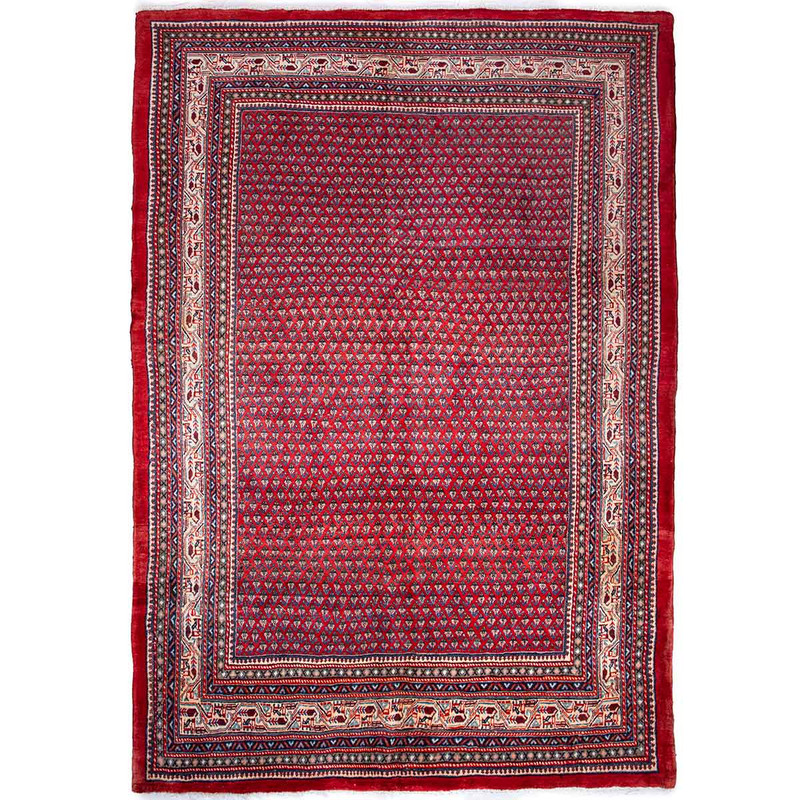
A rug of about 10.5 by 7 feet from our Boteh collection, with a banded vaghireh design and Herati motifs in madder red, cream, and navy - Boteh Persian Rug 10x6 ft - Vaghireh Semi Antique Wool Hand Knotted
6
How a Boteh Field Is Woven
Weaving a boteh-mir field looks simple but demands careful planning. The weaver works row by row from the bottom of the rug to the top, so each row of boteh is built up gradually, a few knots at a time. To keep the boteh the same size and evenly spaced, the weaver counts knots carefully or follows a cartoon or a model rug. When the direction of the boteh changes from row to row, the weaver must reverse the drawing of each motif, which requires concentration over hundreds of motifs.
The colors of the boteh are often changed in a regular sequence, so that diagonal lines of color appear across the field. Look at a boteh-mir rug from a distance and you may see these diagonals, a hidden pattern within the pattern. In village rugs, the sequence is sometimes broken, with a boteh in an unexpected color, a small sign of the weaver's own choice.
7
The Boteh and the Paisley
The boteh traveled far beyond Persia. In the eighteenth and nineteenth centuries, shawls woven in Kashmir with boteh designs became fashionable in Europe. Weavers in the Scottish town of Paisley produced large numbers of imitation shawls with the same motif, and the town's name became the English word for the design. Today, many people know the boteh as paisley without knowing its Persian roots.
This shared history makes boteh rugs easy to combine with Western fabrics. A Saraband rug sits naturally next to a paisley throw, a patterned cushion, or a classic printed curtain, because they share a common ancestor.
8
Weaving for Two Markets
The villages of the Arak region wove for their own homes long before the export trade, but from the late nineteenth century much of their output went to Europe and America. Foreign and Persian firms in Arak, then called Sultanabad, supplied wool and designs and bought finished rugs. Saraband rugs, with their small, regular boteh and refined borders, suited Western taste well, and they became popular in Britain and America. Read more in our article on Sultanabad rugs and our Arak collection guide.
9
How These Rugs Are Built
•
Knot - Mostly the symmetric (Turkish) knot.
•
Foundation - Cotton warps and wefts.
•
Wefts - Often two wefts between rows, giving a firm, flat rug.
•
Pile - Good-quality wool, clipped low to medium.
•
Density - Medium to fine, finer in Mir rugs.
•
Sides and ends - Overcast sides and cotton fringes.
The low pile and firm weave make these rugs flat, crisp, and durable. They lie well on the floor and are easy to maintain.
10
Colors
The classic Saraband palette is built on a madder red or rose red field, or a navy field, with ivory borders and boteh in navy, light blue, green, gold, cream, and red. The many colors of the boteh and border stripes give the rug a jewel-like quality, while the single field color keeps it calm.
Other rugs in the collection use crimson, rust red, and forest green, with gold and black accents. In semi-antique rugs, these colors have mellowed into a soft, warm harmony.
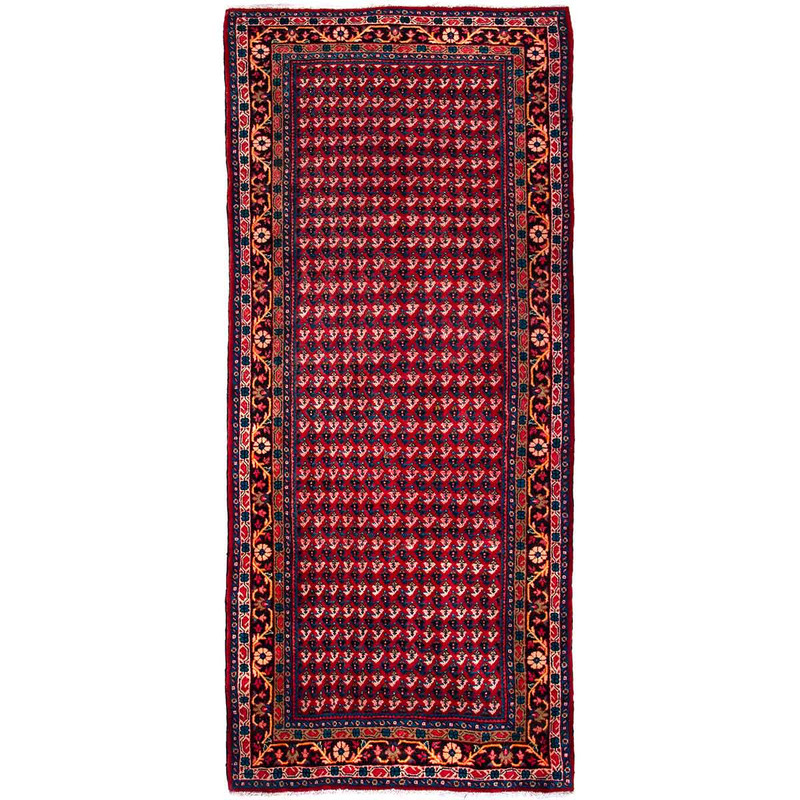
A long rug of about 10 by 4 feet from our Boteh collection, with Herati and scattered afshan motifs in crimson, navy, and cream - Boteh Persian Rug 10x4 ft - Herati Semi Antique Wool Hand Knotted
11
Boteh Rugs and Their Neighbors
Saraband and Farahan
Farahan rugs, from the plain north-east of Arak, are famous for fine Herati fields and characteristic greens. Older Farahan and Saraband rugs are often fine and similar in feel. See our Farahan collection.
Saraband and Sarouk
Sarouk rugs are denser and more often floral, with deep reds and navies. Saraband rugs are lighter in feel and focused on the boteh. See our Sarouk collection.
Saraband and Arak
Rugs sold as Arak come from the same region and may share designs. The Saraband name points specifically to the boteh tradition. See our Arak collection.
Saraband and Kerman boteh rugs
Kerman rugs also use the boteh, but in a larger, more curvilinear form and often in pastel colors. See our Kerman collection.
Saraband and Qashqai
Qashqai tribal rugs use the boteh too, but in a freer, more geometric way, mixed with many other motifs. See our Qashqai collection.
12
Sizes and Placement
Saraband and Arak village rugs come in many sizes. Our Boteh collection includes medium rugs around 7 by 10 feet, long rugs around 4 by 10 feet, and smaller rugs around 4 by 7 feet. Saraband weavers were especially known for long rugs and runners, which suit the allover boteh design perfectly.
•
Living rooms - An allover design works well under furniture.
•
Dining rooms - The boteh-mir looks good from every chair.
•
Hallways - Long rugs and runners with boteh rows create a gentle rhythm.
•
Bedrooms - A calm, even field suits a restful room.
•
Studies - Small boteh rugs add warmth to a home office.
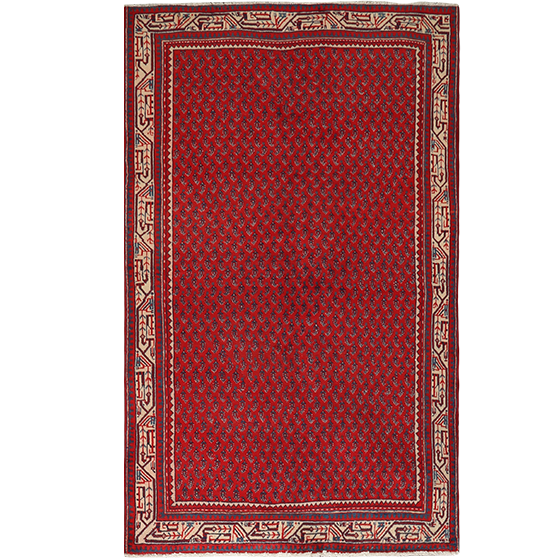
A rug of about 7 by 4 feet from our Boteh collection, with a Herati design in madder red, navy, and cream - Boteh Persian Rug 6x4 ft - Herati Semi Antique Wool Hand Knotted
13
Boteh Rugs in Your Home
The small, repeating motifs of a boteh rug make it one of the easiest Persian rugs to live with. It suits traditional rooms, with wood furniture, bookshelves, and patterned fabrics, and it suits modern rooms, where its fine pattern reads almost like a texture. Because paisley is familiar from fabrics and fashion, a boteh rug also pairs easily with paisley cushions or throws.
A navy-field boteh rug looks elegant and calm, especially with white walls and light wood. A red-field rug feels warmer and cozier, ideal for libraries and dining rooms.
14
Grades and How to Judge Them
•
Drawing - Small, crisp boteh in straight rows indicate skilled weaving.
•
Borders - Straight stripes and neat corners.
•
Density - Finer rugs show more detail inside each boteh.
•
Wool - Lustrous, springy wool.
•
Color - Clear colors without bleeding.
•
Condition - Even pile, intact sides and ends.
15
The Many Faces of the Boteh
Within a single Saraband rug, the boteh can take many forms. Some are plump and rounded, with a gently curling tip. Others are slender and upright, almost like flames. Some are filled with a single small flower; others contain a smaller boteh inside, a "mother and child" form. In some rugs, each boteh is outlined in a contrasting color, so it seems to float on the field; in others, the outline is the same as the field, and the boteh blend into a quiet texture.
Taking time to look at these variations is one of the pleasures of owning a boteh rug. Children often enjoy finding the boteh that point the "wrong" way or that have an unusual color, the small surprises a village weaver leaves in a carefully planned design.
16
Reading the Back
Turn the rug over and look at the rows of boteh from behind. In a good rug, the boteh are clearly visible, with small, even knots and straight rows. The many border stripes should also be clear and straight. Check for repairs, especially near the ends and sides.
17
Combining a Boteh Rug with Other Patterns
Because the boteh-mir is small and regular, it combines easily with other patterns in a room. A few guidelines help:
•
Vary the scale - Pair the small boteh with larger patterns, such as a big floral print or a bold stripe, rather than another small repeat.
•
Share a color - Repeat the rug's field color, red or navy, in one or two other pieces.
•
Let it breathe - In a room with many patterns, keep the walls and large furniture plain.
•
Use solids - Solid velvet, linen, or leather upholstery lets the rug's detail shine.
A boteh rug can also anchor a gallery wall of framed prints or textiles, whose varied shapes echo the many small motifs of the rug.
18
Questions to Ask Before You Buy
•
Is it a true Saraband or Mir? - Ask how the dealer attributes the rug.
•
How many border stripes are there? - A rich border frame is a sign of the tradition.
•
Has it been repaired? - Ask especially about the ends and sides.
•
What are the exact measurements? - Check both ends of long rugs.
•
Has it been washed? - A fresh wash shows the true colors.
19
Semi-Antique Boteh Rugs
Our Boteh rugs are semi-antique, woven roughly forty to sixty years ago. They carry the classic Arak village style, with settled colors and good condition, and they have many years of life ahead. See our semi-antique rugs.
20
What Affects the Price
•
Fineness - Finer rugs, especially those sold as Mir, are more valued.
•
Design - Well-drawn boteh-mir fields and many-striped borders are sought after.
•
Size - Larger rugs cost more.
•
Condition - Even pile and intact edges add value.
•
Age - Older Saraband and Mir rugs are collectible.
21
Caring for a Boteh Rug
Vacuum regularly without a beater bar. Rotate the rug every six months. Blot spills at once. Use a good rug pad. Keep it out of strong direct sunlight. Have it professionally washed every few years. Because the pile is low, these rugs are easy to keep clean. See our care instructions and our guide to professional washing.
22
Common Buying Mistakes
•
Confusing printed paisley with knotted boteh - Check the back for knots.
•
Ignoring the borders - The borders show the weaver's skill.
•
Expecting a medallion - Most boteh rugs have allover designs, which is part of their charm.
•
Skipping the pad - A pad protects the rug and keeps it in place.
23
Frequently Asked Questions
What is a boteh?
A teardrop or paisley-shaped motif, one of the most widespread designs in Persian weaving.
What is the boteh-mir?
A field of small boteh arranged in rows, usually alternating direction from row to row.
What is Botemir?
A trade name formed from boteh and Mir, referring to the boteh-mir design and the Saraband tradition.
Where is Saraband?
A district south-west of Arak in central Persia.
What is a Mir rug?
A name used for the finest Saraband rugs, especially older pieces.
Why do Saraband rugs have so many border stripes?
It is a local tradition that frames the field with many narrow, decorated bands.
What other designs are in the collection?
Herati, banded vaghireh, and scattered afshan designs from the Arak region.
What knot is used?
Mostly the symmetric or Turkish knot.
Are boteh rugs easy to place?
Yes. Their allover designs look good from any direction.
Do boteh rugs suit modern homes?
Yes. The small pattern reads like a texture in modern rooms.
Why is the boteh called paisley in English?
After the Scottish town of Paisley, which made imitation Kashmir shawls with the motif in the nineteenth century.
Are boteh rugs good for dining rooms?
Yes. The allover design looks the same from every chair and hides small spills.
What is a mother and child boteh?
A boteh with a smaller boteh drawn inside it, one of the many variations of the motif.
What should I pair with a boteh rug?
Larger patterns and solid fabrics, with one or two colors repeated from the rug.
Why do the boteh change direction from row to row?
It is a traditional way of giving the field a gentle, rippling rhythm.
How should I clean a boteh rug?
Vacuum regularly, blot spills, and have it professionally washed every few years.
24
Choose Your Boteh Rug
Each rug in our Boteh collection is hand-knotted, one of a kind, and inspected before it is listed. Browse our Boteh collection, compare it with our Arak, Farahan, and Sarouk rugs, or ask our experts for help.