


Leave Tehran and drive south-east toward Semnan, and within an hour or two the land opens into a wide plain at the foot of the Alborz mountains. To the south lies the great central desert of Persia, the Dasht-e Kavir. At the meeting point of mountain, river, and desert stands the town of Garmsar. Its name means "warm place," and its mild winters have long drawn farmers and herders to its fields and pastures.
The villages of the Garmsar district weave rugs that are seldom seen outside Persia. They are honest, sturdy village rugs, made for daily use, with bold geometric designs and warm colors. This guide explains where they come from, how to recognize them, how they relate to their neighbors, and how to choose, place, and care for one. For the crafts of the wider province, see our article on needlework and rug weaving in Semnan.
1
Garmsar and Its Landscape
Garmsar lies in the west of Semnan province, about 100 kilometers south-east of Tehran, on the old route that leads from the capital toward Semnan, Damghan, and Mashhad. The town sits on the plain watered by the Hableh Rud, a river that flows down from the Alborz mountains and spreads into fields before disappearing into the desert.
The district has a long history of farming. Its fields produce wheat, cotton, and melons, and its orchards pomegranates and other fruit. Its warm winters made it a natural winter ground for herders from the colder mountains to the north, who brought their flocks down to graze on the plain. This mix of settled farmers and seasonal herders shaped the district's crafts, including its rugs.
Garmsar means "warm place." The town lies on the Hableh Rud plain between the Alborz mountains and the central desert, about 100 kilometers south-east of Tehran.
2
Weaving in the Garmsar District
Like many districts on the edge of the desert, Garmsar has a weaving culture that combines village and tribal traditions. Women in the villages weave on upright looms, usually through the cool months, and many of the designs they use have been handed down from mother to daughter rather than drawn on paper. The influence of herding communities, who traditionally wove flat-weaves, bags, and small pile rugs, shows in the bold, geometric drawing and the strong colors.
Because the district lies on the main road between Tehran and the east, its weavers have also been exposed to many outside influences, from the city rugs of Tehran and Varamin to the village rugs of Khorasan. Garmsar rugs reflect this crossroads: their designs are mostly geometric and tribal in spirit, but their structure and finish are those of settled village rugs.
Weaving here has always been closely tied to the farming calendar. When the harvest is in and the days grow shorter, the looms come out; when spring returns, the fields take priority again. A rug of medium size may therefore take a whole winter, or even two, to finish.
In the market, Garmsar rugs are uncommon. Many have been sold under broader names, and only a small number reach the West labeled with the town's name. Our pieces offer a rare chance to own a rug from this little-known weaving district.
3
How to Recognize a Garmsar Rug
•
Geometric drawing - Straight lines, steps, and diagonals rather than curves.
•
Diamond lattice - A network of diamonds across the field, each holding a small motif.
•
Stepped medallions - Central or linked medallions with stepped or hooked outlines.
•
Bold borders - Wide borders with geometric motifs, framed by contrasting guard stripes.
•
Strong palette - Madder red and burgundy, navy, ivory, black, with ochre and green accents.
•
Sturdy village structure - A cotton foundation and thick, resilient wool.
A Garmsar often looks like a cousin of the village rugs of Varamin and Khorasan, with a simpler, bolder drawing.
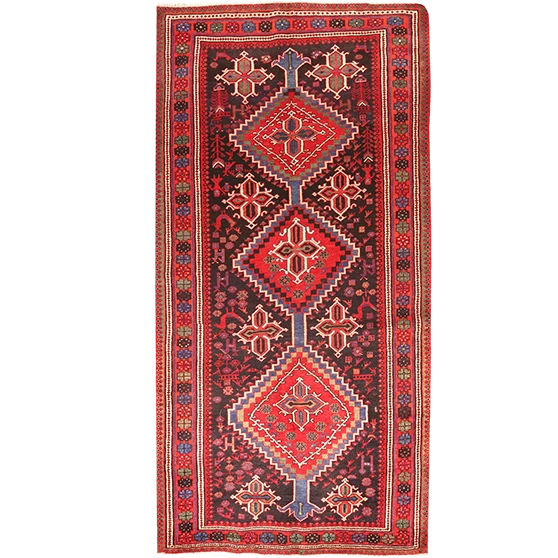
A Garmsar rug of about 10 by 5 feet with a diamond lattice in madder red, burgundy, navy, and ivory - Garmsar Persian Rug 9x4 ft - Geometric Semi Antique Wool Hand Knotted
4
Designs of Garmsar
The diamond lattice
The most striking Garmsar design is the diamond lattice. Lines cross the field diagonally, forming a grid of diamonds, and each diamond holds a small motif: a star, a rosette, a stylized flower, or a tiny animal. The lattice gives the field a strong, regular rhythm, and the changing colors of the small motifs bring it to life. See our lattice designs.
Stepped medallions
Other rugs have one or more medallions with stepped outlines, sometimes hooked at the edges, set on a field filled with small motifs. In long rugs, two or three medallions may be linked along the center line.
Small motifs
Garmsar weavers scatter small motifs everywhere: in the field, in the medallions, and in the borders. Stars, combs, birds, and small human figures appear in some rugs. These motifs, many of them drawn from memory, give each rug its own personality.
Borders
Borders are bold, often with a running geometric pattern such as a zigzag, a chain of diamonds, or a reciprocal design, framed by narrow guard stripes in contrasting colors.
5
How Garmsar Rugs Are Built
•
Knot - Village rugs of the region use both the symmetric and asymmetric knots, depending on the weaver.
•
Foundation - Cotton warps and wefts in semi-antique rugs.
•
Pile - Thick local wool, clipped to a medium height.
•
Density - Coarse to medium, typical of village rugs.
•
Sides and ends - Overcast sides and cotton fringes.
The result is a sturdy, flexible rug with good resilience. Its thick wool hides wear and recovers well from pressure, which makes it a practical rug for daily use.
6
Garmsar and Its Neighbors
Garmsar and Varamin
Varamin, closer to Tehran, is famous for its tribal and village rugs with dense, small-scale geometric designs, especially the mina khani. Garmsar rugs share the geometric spirit but often use larger, bolder motifs. See our Varamin collection.
Garmsar and Semnan
Semnan rugs, from the provincial capital further east, are town rugs, often finer, with floral and Shah Abbasi designs. Garmsar rugs are village rugs with a more geometric look. See our Semnan collection.
Garmsar and Khorasan village rugs
Village rugs from Khorasan, such as those of Ferdows, share long formats and geometric designs. Garmsar rugs are often a little brighter, with more ivory. See our Ferdows collection.
Garmsar and Baluch
Baluch rugs are darker and softer, with camel accents and kilim ends. Garmsar rugs are brighter, with more red and ivory. See our Baluch collection.
7
Colors of Garmsar
The Garmsar palette is warm and strong. Madder red and burgundy fill fields and medallions. Navy outlines motifs and fills borders. Ivory lights the design, and black gives definition. Ochre, rust, and forest green appear as accents.
In semi-antique rugs, these colors have mellowed. The reds have softened toward rust and rose, the ivories have warmed, and the overall effect is harmonious and inviting.
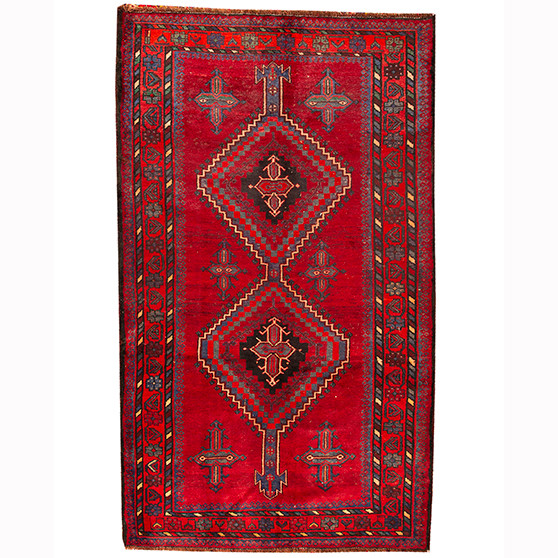
A Garmsar rug of about 9 by 5 feet with a geometric medallion on a madder red field, framed by ivory and navy - Garmsar Persian Rug 9x5 ft - Geometric Semi Antique Wool Hand Knotted
8
The Long Rug Format
Both of our Garmsar rugs are long rugs of about 9 to 10 feet by 5 feet. This format, longer than a standard rug but wider than a runner, is very practical:
•
Wide hallways - A 5 foot width fills a generous hall.
•
In front of a sofa - A long rug parallel to a sofa defines a seating area.
•
At the foot of a bed - Across the foot of a king bed, extending on both sides.
•
Kitchens - Along an island or in a farmhouse kitchen.
•
Entrance halls - Leading guests into the home.
9
Placing a Geometric Rug
Geometric rugs like Garmsar pieces work in a surprising range of interiors. Their straight lines and clear color blocks echo modern furniture and art, so they look at home in contemporary rooms. Their warm colors and handmade character also suit rustic, farmhouse, and traditional interiors.
•
Modern rooms - Pair with simple furniture in wood, leather, or metal. Let the rug be the main pattern.
•
Rustic rooms - Pair with stone, wood, and natural textiles.
•
Traditional rooms - Pair with dark wood and other tribal or village rugs.
•
Color - Repeat the rug's red or navy in one or two accessories.
10
Reading the Back
On the back of a Garmsar rug, the knots are relatively large and the design clearly visible. Look for even rows and straight sides. Small irregularities, such as a row of slightly larger knots or a motif drawn a little differently, are normal in village rugs and show the hand of the weaver.
Check the sides and ends for wear. The overcasting along the sides and the fringes at the ends should be secure. Small, well-made repairs are normal in semi-antique rugs.
11
Grades and How to Judge Them
•
Wool - Thick, springy, lustrous wool is the main sign of quality.
•
Drawing - A balanced design with well-formed motifs.
•
Color - Clear colors without bleeding, especially between red and ivory.
•
Shape - Straight sides and a flat lie.
•
Condition - Even pile, intact sides and ends.
12
Village Life on the Desert Edge
Life in the villages of the Garmsar district has always followed the seasons. In spring and autumn, the fields and orchards demand attention; in summer, the heat on the plain is intense. Winter, mild compared with the mountains, is the season of the loom. Women set up their looms inside the house and weave through the cool months, often with daughters or neighbors working beside them.
Village weavers usually work from memory or from an older rug rather than from a paper cartoon. This explains why no two Garmsar rugs are exactly alike, and why each one carries small, personal touches: a color changed mid-row, a motif added in a corner, a border that shifts rhythm. Read more about the people behind rugs in our article on the craft from shepherd to dealer.
13
Collecting Rare Village Rugs
For collectors, rugs from less-known districts like Garmsar have a special appeal. They show how weaving traditions vary from place to place, even within a single province, and they offer designs and color combinations that are rarely seen in the more common market names. A Garmsar rug placed beside a Varamin, a Semnan, or a Khorasan village rug invites comparison and conversation.
Because such rugs are rare in the market, each one is worth looking at carefully. Note its size, design, colors, and structure, and keep a photograph and a note of its origin. Over time, these records become part of the rug's story.
14
Our Two Garmsar Rugs Compared
Our two Garmsar rugs show the range of the district's weaving within a single format. The first, about 10 by 5 feet, is built on a diamond lattice: a strong network of diagonal lines in navy and black, with small motifs in each compartment against madder red and burgundy. Its effect is rhythmic and even, almost like a tiled floor, and it looks the same from every direction.
The second, about 9 by 5 feet, is organized around a central medallion on a madder red field, framed by ivory and navy borders, with ochre and forest green accents. It has a clear focal point and a calmer, more formal look.
Choosing between them depends on the room. The lattice rug is ideal where furniture covers part of the field or where people walk across it from different directions, such as a kitchen or a wide hall. The medallion rug suits a place where the whole rug can be seen, such as the foot of a bed or the front of a sofa, so its center can be appreciated.
15
Dyes of the Desert Edge
The warm palette of Garmsar rugs reflects the classic dye traditions of central Persia. Madder root gives the reds, from bright crimson to deep burgundy, depending on the mordant and the length of dyeing. Indigo gives the navies. Walnut husks and iron give browns and blacks, and plants such as weld and pomegranate rind give yellows and ochres. In mid-twentieth-century village rugs, synthetic dyes were also used alongside natural ones, often with skill.
When you look closely at a semi-antique Garmsar, you may see slight changes of shade within one color, called abrash, where the weaver moved from one batch of wool to the next. These bands give the field movement and are a sign of handwork. Read more in our articles on natural dyes and traditional dyeing.
16
Questions to Ask Before You Buy
•
What are the exact measurements? - Check both ends, since village rugs can vary slightly in width.
•
Has it been repaired? - Ask where and how.
•
Has it been washed recently? - A fresh wash shows the true colors.
•
Is the red stable? - Check the edges between red and ivory for any running.
•
How old is it? - Semi-antique rugs have softer, settled colors.
17
Combining a Garmsar with Other Rugs
A Garmsar works well alongside other geometric rugs. In a home with a Heriz or a Hamadan in the living room, a Garmsar long rug in a hallway or bedroom shares the warm reds and bold drawing. With a finer city rug, it adds a rustic contrast. When combining rugs, keep one color in common, usually madder red, and vary the scale of the patterns.
18
Keeping a Long Rug Flat and in Place
Long rugs sometimes ripple, curl at the ends, or creep across the floor. A good non-slip pad, cut slightly smaller than the rug, solves most of these problems. If an end curls after shipping, roll it gently the other way for a day or place a heavy book on it; it will usually settle within a week. If a ripple persists, lift the rug, smooth the pad, and lay it again. Persistent waves in an older rug can be corrected by a professional, who washes and stretches it.
In a hallway, turn the rug end to end every few months so wear is shared between both ends. In a kitchen, shake or vacuum it often, since grit from shoes wears the wool fastest.
19
Semi-Antique Garmsar Rugs
Our Garmsar rugs are semi-antique, woven roughly forty to sixty years ago. They have settled colors, good wool, and sturdy construction, and they have many years of life ahead. See our semi-antique rugs.
20
What Affects the Price
•
Rarity - Rugs from less-known districts are seldom seen and often appeal to collectors.
•
Size - Larger rugs cost more.
•
Wool - Lustrous wool adds value.
•
Design - Well-drawn, unusual designs are sought after.
•
Condition - Even pile, intact sides and ends.
21
Caring for a Garmsar Rug
Vacuum regularly without a beater bar. Rotate the rug every six months. Use a good pad. Blot spills at once. Keep it out of strong direct sunlight. Have it professionally washed every few years. Keep the sides and ends in good repair. See our care instructions and our guide to washing a rug at home.
22
Common Buying Mistakes
•
Expecting city-rug fineness - Garmsar rugs are village rugs, valued for their boldness and warmth.
•
Skipping the pad - Long rugs can slip.
•
Placing on a dark floor - The red and ivory show best on lighter floors.
•
Ignoring the sides - Keep the overcasting in good repair.
23
Frequently Asked Questions
Where is Garmsar?
In the west of Semnan province, about 100 kilometers south-east of Tehran, on the edge of the central desert.
What does Garmsar mean?
"Warm place," a reference to its mild winters.
Are Garmsar rugs common?
No. They are rarely seen in the Western market.
What designs are typical?
Diamond lattices, stepped medallions, and many small geometric motifs.
What colors are typical?
Madder red, burgundy, navy, ivory, and black, with ochre and green accents.
How are Garmsar rugs built?
With a cotton foundation and thick local wool, in a sturdy village weave.
How do Garmsar rugs differ from Varamin rugs?
Both are geometric, but Garmsar rugs often use larger, bolder motifs.
What sizes are common?
Our pieces are long rugs of about 9 to 10 by 5 feet.
Where should I place a long Garmsar rug?
In a wide hallway, in front of a sofa, at the foot of a bed, or in a kitchen.
Did Garmsar weavers use cartoons?
Village weavers usually worked from memory or from an older rug.
Do Garmsar rugs suit modern homes?
Yes. Their geometric designs echo modern furniture and art.
Why does my new long rug curl at the ends?
Because it was rolled for shipping. Roll the end the other way for a day; it will settle within a week.
Which Garmsar suits the foot of a bed?
A medallion design, whose center can be seen and enjoyed.
Is a Garmsar a good rug for a collector?
Yes. Rugs from less-known districts are rare in the market and show how weaving varies from place to place.
What is abrash?
Slight changes of shade within one color, caused by wool dyed in different batches.
Which Garmsar suits a kitchen?
A lattice design, which looks the same from every direction and hides small marks well.
How should I clean a Garmsar rug?
Vacuum regularly, blot spills, and have it professionally washed every few years.
24
Choose Your Garmsar Rug
Each Garmsar rug in our collection is hand-knotted, one of a kind, and inspected before it is listed. Browse our Garmsar collection, compare it with our Varamin, Semnan, and Ferdows rugs, or ask our experts for help.