


High in the Alborz mountains, between the snowy peak of Alam Kuh and the forests that run down to the Caspian Sea, lies the green valley of Kelardasht. It is a place of meadows, orchards, and wooded slopes, popular today as a summer retreat. It is also home to a weaving tradition that surprises many visitors: bold, geometric rugs that look more like the Kurdish rugs of western Persia than anything else in the north.
This guide explains where Kelardasht rugs come from, the different theories about their origin, how they compare with the Kurdish rugs of Senneh and other regions, how they are designed and built, and how to choose, place, and care for one.
1
The Kelardasht Valley
Kelardasht is a district in the west of Mazandaran province, in the high valleys of the central Alborz. It lies at an altitude of over 1,000 meters, surrounded by mountains, with cool summers, snowy winters, and abundant rain. The valley is famous for its natural beauty, including mountain lakes such as Valasht, and for its views of Alam Kuh, the second-highest peak in Persia.
The valley is crossed by streams that flow down from the high peaks, and its villages are surrounded by fields, fruit orchards, and pastures that turn green with the spring rains.
The land supports farming, orchards, and herding. Sheep and goats graze the high pastures in summer, providing wool for weaving. The valley's isolation has helped preserve traditions that differ from those of the Caspian lowlands below.
Kelardasht is a high mountain valley in western Mazandaran, near the peak of Alam Kuh. Its weaving tradition is closely linked to a Kurdish community settled in the valley.
2
Who Weaves Kelardasht Rugs?
An important part of the population of the Kelardasht valley is Kurdish. These Kurdish families are generally described as descendants of tribes resettled in the north of Persia in earlier centuries, far from their homelands in the west. They brought with them their language, their customs, and, according to many accounts, their weaving.
Today, Kelardasht weaving is a household craft, practiced mainly by women at looms in their homes. Rugs are woven for family use and for sale, and some families also weave flat-weaves and other textiles.
3
Theories of Origin
How did Kelardasht come to have its distinctive weaving? A study published in the handicrafts studies journal of the University of Kashan reviews four main theories:
•
The Tabari theory - That Kelardasht rugs descend from the "Tabari carpets" of the old province of Tabarestan, mentioned in the tenth-century geography book Hudud al-Alam as fine carpets known at the Abbasid court.
•
The Kurdish migration theory - That the tradition developed with the migration of Kurdish tribes to the region, independently of any older local weaving.
•
The mixed influence theory - That Kurdish weaving and older Tabari weaving influenced each other.
•
The western cultural theory - That the tradition blends cultural elements brought by immigrants from western Persia.
The study notes that the Kelardasht carpet is the oldest surviving pile carpet tradition of the Tabarestan region, and that the question of its origin is still open. For buyers, these theories add depth to the rug's story: a Kelardasht may carry echoes of both the Kurdish west and the ancient weaving of the Caspian north.
4
The Tabari Carpets of Old Tabarestan
The Caspian region has a long textile history. In the tenth century, the anonymous Persian geography book Hudud al-Alam, "The Regions of the World," described the province of Tabarestan, today's Mazandaran, as a source of fine carpets known as Tabari carpets, some of which reached the court of the Abbasid caliphs. No securely identified Tabari carpets survive, and their appearance is unknown, but their mention shows that weaving in the region is very old.
Whether Kelardasht weaving descends from that tradition, or arrived later with Kurdish settlers, or combines both, is the question the researchers discuss. For buyers, it is enough to know that a Kelardasht belongs to a region with more than a thousand years of recorded weaving.
5
Kurdish Weaving Across Persia
Kurdish weaving is one of the great traditions of Persian rugs. In the west, the Kurdish regions of Kurdistan, Kermanshah, and West Azerbaijan produce rugs ranging from the fine, thin rugs of Senneh to the dense, heavy rugs of Bijar and the bold village rugs of many districts. Kurdish communities also live in Khorasan in the north-east, where they weave rugs and flat-weaves of their own, and in the Alborz, as in Kelardasht. Each community has adapted its weaving to local wool, climate, and markets, while keeping a shared love of bold geometry, rich color, and sturdy construction.
A Kelardasht rug is therefore part of a much larger family. Placed beside a Kurdish village rug from the west, it shows both the shared roots and the local differences that make each tradition distinctive.
6
Kelardasht and Senneh
The same study compared Kelardasht carpets with those of Senneh (Sanandaj), the most refined Kurdish weaving center of western Persia. It found notable similarities: a similar general structure and design, some shared individual designs, the same number of borders, a symmetrical structure, a similar arrangement of motifs, and a similar number of colors in the field and borders.
These similarities support the idea of a strong Kurdish connection. At the same time, Kelardasht rugs are usually coarser and bolder than fine Senneh rugs, with larger motifs and a more rustic character. See our Senneh collection.
A University of Kashan study found Kelardasht and Senneh carpets share structure, border counts, symmetry, motif arrangement, and color counts, supporting a strong Kurdish connection.
7
How to Recognize a Kelardasht Rug
•
Bold geometric drawing - Stepped medallions, hooked diamonds, and angular motifs.
•
Central medallion - Often a large diamond or stepped medallion with corners.
•
Strong borders - Several borders with geometric motifs, framed by guard stripes.
•
Warm, earthy palette - Red, rust, brown, cream, ochre, and black.
•
Thick wool - A full pile from mountain sheep.
•
Village character - Small irregularities and personal touches.
If a rug from northern Persia looks strongly Kurdish in design, with bold medallions and earthy colors, it may well be a Kelardasht.
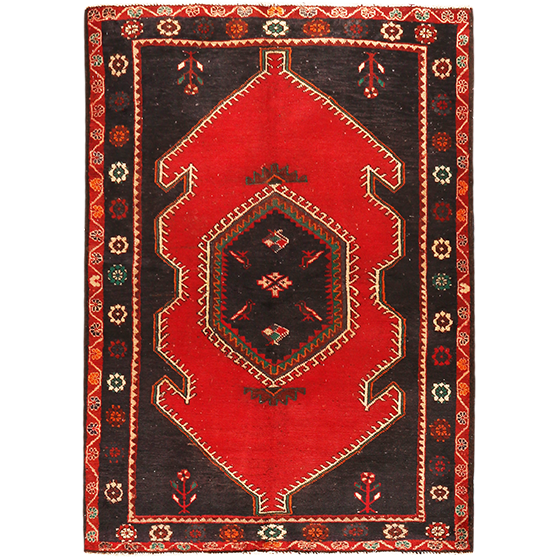
A Kelardasht rug of about 6.5 by 4 feet with a central medallion in red, black, cream, ochre, and brown - Kelardasht Persian Rug 6x4 ft - Medallion Semi Antique Wool Hand Knotted
8
Designs of Kelardasht
Medallion rugs
The most common Kelardasht layout is a central medallion, usually a stepped or hooked diamond, set on a field of small geometric motifs, with corners and several borders. The design is bold and balanced, readable from a distance. See our medallion designs.
Geometric fields
Small stars, rosettes, combs, and stylized plants fill the field around the medallion, often scattered freely in the manner of village weaving.
Borders
As the Senneh comparison suggests, Kelardasht rugs often have several borders, each with its own motif, creating a strong frame.
See our geometric designs for other rugs in this spirit.
9
How Kelardasht Rugs Are Built
•
Foundation - Cotton in our semi-antique piece; wool or goat hair may appear in older or more rustic rugs.
•
Pile - Thick wool from mountain flocks, clipped to a medium height.
•
Density - Coarse to medium, typical of village rugs.
•
Sides and ends - Overcast sides and fringes.
Kelardasht rugs are sturdy and comfortable. Their thick pile is warm underfoot, which suits the cold winters of the mountains.
10
Colors of Kelardasht
The Kelardasht palette is warm and earthy: red and rust red fields and medallions, brown and black outlines, cream for light, and ochre for warmth. These colors recall the landscapes of the valley in autumn, with its golden fields and dark forests.
In semi-antique rugs, these colors have mellowed into a warm, harmonious whole.
11
Kelardasht and Its Neighbors
Kelardasht and Kurdish rugs
Kurdish village rugs of western Persia share the bold geometry, the earthy colors, and the thick wool. Kelardasht rugs are their northern cousins. See our Kurdish collection and our article on Kurdish rugs.
Kelardasht and Senneh
Senneh rugs are much finer and thinner, with small, intricate designs, but share structural features with Kelardasht. See our Senneh collection.
Kelardasht and Bijar
Bijar rugs, another Kurdish tradition, are extremely dense and heavy. See our Bijar collection.
Kelardasht and Mazandaran textiles
The Caspian provinces are better known for flat-weaves and textiles than for pile rugs. Read about the region's culture in our articles on Mazandaran folk music and Gilan's chadorshab.
12
Wool from Mountain Flocks
The high pastures around Kelardasht provide summer grazing for sheep and goats, and their wool and hair have long supplied local weaving. Mountain wool tends to be strong and resilient, which gives Kelardasht rugs their full, springy pile. Goat hair, stronger and coarser than wool, has traditionally been used in some flat-weaves and in the foundations or edges of rustic pieces, where its toughness is valuable.
13
Small Rugs Through the Seasons
A small rug like a Kelardasht can move around the home with the seasons. Its warm reds and browns are especially welcoming in autumn and winter, at a bedside or in front of a fireplace. In summer, it can move to a study or a cool hallway, out of strong sunlight. When you store a rug, roll it with the pile facing outward, wrap it in cotton fabric, and keep it in a dry place off the floor, checking it now and then for moths.
14
Placing a Small Village Rug
Our Kelardasht rug, about 6.5 by 4 feet, is a versatile small rug:
•
Entry - Just inside the front door, where its bold design makes a strong first impression.
•
Bedside - Beside a bed, for a warm first step in the morning.
•
Study - Under a desk or in front of a bookcase.
•
Fireplace - In front of a hearth, where its warm colors glow.
•
Cabin or mountain home - Its earthy palette and rustic character suit wood, stone, and natural textiles.
See our 4x6 rugs.
15
A Rug for Rustic and Modern Homes
The earthy colors and bold geometry of a Kelardasht suit rustic interiors especially well: log cabins, farmhouses, and homes with exposed wood and stone. In modern interiors, its strong medallion and clear color blocks echo the lines of contemporary furniture and art, and it adds warmth and texture to neutral spaces.
16
Grades and How to Judge Them
•
Wool - Thick, springy, lustrous wool.
•
Drawing - A balanced medallion and well-planned borders.
•
Color - Clear colors without bleeding.
•
Shape - Small irregularities are normal in village rugs.
•
Condition - Even pile, intact sides and ends.
17
Reading the Back
On the back of a Kelardasht, the knots are relatively large and the design clear. Look for even rows and check the sides and ends for wear. Small repairs are normal in semi-antique village rugs.
18
Village Life in the Mountains
In the Kelardasht valley, weaving has traditionally been a winter craft. When snow covers the mountains and the fields rest, women set up their looms inside the house and weave through the cold months. Designs are passed from mother to daughter, often woven from memory rather than from paper cartoons. This is why each Kelardasht rug has its own small variations: a motif drawn slightly differently, a color changed mid-row. Read more about the people behind rugs in our article on the craft from shepherd to dealer.
19
The Colors and Their Dyes
The warm reds of Kelardasht rugs come from madder root, browns and blacks from walnut husks and iron, and ochres and yellows from plants such as weld. Undyed wool provides creams and natural browns. In mid-twentieth-century rugs, synthetic dyes were also used alongside natural ones. In semi-antique pieces, you may see abrash, slight changes of shade within one color, which add life to the field. Read more in our articles on natural dyes and traditional dyeing.
20
Collecting Rugs from Unexpected Places
Kelardasht shows how weaving traditions can travel. A Kurdish weaving culture, carried across Persia to a mountain valley above the Caspian, developed there into something of its own. For collectors, such rugs are fascinating: they connect regions, peoples, and histories that might otherwise seem unrelated. A Kelardasht placed beside a Senneh or a Kurdish village rug invites comparison and conversation.
21
Visiting Kelardasht
Today, Kelardasht is one of the most popular mountain retreats in northern Persia. Visitors come for its cool summers, its forests and meadows, and its lakes, and many leave with a handmade souvenir. Local shops and homes sell rugs, flat-weaves, and other crafts, and in some villages visitors can still see looms at work. Buying a Kelardasht rug from abroad connects you with this mountain landscape and its people.
22
Why Small Village Rugs Matter
A small village rug like a Kelardasht may seem modest next to a room-size city carpet, but it holds the full design language of its community in a compact form: the medallion, the borders, the colors, the small personal touches of the weaver. For many families, small rugs were the most personal weavings, made for their own homes or as gifts. Owning one is a way of bringing a piece of that household tradition into your own home.
23
Combining a Kelardasht with Other Rugs
A small Kelardasht pairs naturally with other Kurdish and tribal rugs. Next to a larger Bijar or Kurdish village rug, it shares the bold geometry. With a finer city rug in another room, it adds a rustic contrast. Keep one color in common, usually red, and vary the scale of the patterns.
24
Questions to Ask Before You Buy
•
What are the exact measurements? - Village rugs vary slightly.
•
Has it been repaired? - Ask where and how.
•
Has it been washed recently? - A fresh wash shows the true colors.
•
What is the foundation? - Cotton, wool, or goat hair.
•
How old is it? - Semi-antique rugs have settled colors.
25
Signs of a Well-Kept Semi-Antique Rug
•
Even pile - No bald patches or deep marks.
•
Supple foundation - Bends without cracking when a corner is gently folded.
•
Intact sides and ends - Overcasting and fringes in good condition.
•
Clean colors - No red running into the cream areas.
•
No moth damage - Check the back and under the edges.
26
Semi-Antique Kelardasht Rugs
Our Kelardasht rug is semi-antique, woven roughly forty to sixty years ago. It has settled colors, good wool, and sturdy construction, with many years of life ahead. See our semi-antique rugs.
27
What Affects the Price
•
Rarity - Kelardasht rugs are seldom seen in the Western market.
•
Wool - Lustrous wool adds value.
•
Design - Bold, well-balanced designs are attractive.
•
Condition - Even pile, intact sides and ends.
28
Caring for a Kelardasht
Vacuum regularly without a beater bar. Shake small rugs outdoors from time to time. Rotate every few months. Use a non-slip pad. Blot spills at once. Have it professionally washed every few years. See our care instructions and our guide to washing a rug at home.
29
Common Buying Mistakes
•
Expecting Caspian lowland styles - Kelardasht rugs are Kurdish in spirit.
•
Expecting Senneh fineness - Kelardasht rugs are bolder and coarser.
•
Skipping the pad - Small rugs slip easily.
•
Placing in wet areas - Wool rugs should not stay wet.
30
Frequently Asked Questions
Where is Kelardasht?
In a high valley of western Mazandaran, in the Alborz mountains near Alam Kuh.
Who weaves Kelardasht rugs?
Largely a Kurdish community settled in the valley.
What are the theories of their origin?
Descent from old Tabari carpets, Kurdish migration, a mix of both, or broader western influences.
What are Tabari carpets?
Carpets of the old province of Tabarestan, mentioned in the tenth-century book Hudud al-Alam.
How do Kelardasht rugs relate to Senneh rugs?
A university study found similar structure, borders, symmetry, and color counts.
What designs are typical?
Stepped or hooked medallions with corners, geometric fields, and several borders.
What colors are typical?
Red, rust, brown, cream, ochre, and black.
Are Kelardasht rugs common?
No. They are seldom seen in the Western market.
What size is your Kelardasht rug?
About 6.5 by 4 feet.
Where should I place a small Kelardasht?
In an entry, beside a bed, in a study, or in front of a fireplace.
Does a Kelardasht suit a rustic home?
Yes. Its earthy palette suits wood, stone, and natural textiles.
Was goat hair used in Kelardasht weaving?
Traditionally, goat hair has been used in some flat-weaves and in the foundations or edges of rustic pieces.
How high is the Kelardasht valley?
Over 1,000 meters, surrounded by the peaks of the central Alborz.
Is Kelardasht a tourist area?
Yes. It is a popular mountain retreat known for its forests, meadows, and lakes.
Why are small village rugs special?
They hold the full design language of a community in a compact, personal form.
What is Hudud al-Alam?
A tenth-century Persian geography book that mentions the fine carpets of Tabarestan.
Do Kurds live in other parts of Persia?
Yes. Besides the west, Kurdish communities live in Khorasan and in the Alborz, as in Kelardasht.
How should I store a small rug?
Roll it with the pile outward, wrap it in cotton fabric, and keep it dry and off the floor.
How should I clean a Kelardasht?
Vacuum regularly, shake it outdoors, and have it professionally washed every few years.
31
Choose Your Kelardasht Rug
Each rug in our Kelardasht collection is hand-knotted, one of a kind, and inspected before it is listed. Browse our Kelardasht collection, compare it with our Kurdish, Senneh, and Bijar rugs, or ask our experts for help.