


Indigo is both a dye and a color. As a dye, it is the plant blue that gave Persian weavers almost every blue they used for centuries. As a color, indigo means a deep blue with a faint violet glow, slightly warmer than navy and slightly lighter than midnight. When we call a rug indigo, we mean that its blue has that deep, living quality.
This guide focuses on indigo. For the whole blue family, see our guide to blue Persian rugs, and for all colors, our guide to Persian rug colors.
1
Where Indigo Comes From
Indigo comes from the leaves of indigo plants, mainly Indigofera tinctoria. The leaves are soaked and fermented, and the blue that forms is dried into cakes. For centuries, Persian dyers bought indigo from India and from the warm southern regions where it could be grown. Indigo was a precious trade good, and a dyer's skill with the indigo vat was a mark of mastery.
Since the late nineteenth century, indigo has also been made synthetically. Synthetic indigo is the same molecule as plant indigo, so it behaves the same way in the vat and has the same lightfastness. Many fine rugs of the twentieth century use synthetic indigo, and that is not a sign of low quality.
Indigo is the source of nearly every traditional blue in a Persian rug. As a color, it means a deep blue with a faint violet glow, warmer than navy and lighter than midnight.
2
How the Indigo Vat Works
Indigo does not dissolve in water. To dye with it, the dyer prepares a fermented vat in which the indigo changes into a soluble form that is pale yellow-green. Wool dipped into this vat comes out yellow-green, then turns blue in the air as oxygen changes the dye back. Each dip adds another layer. A few dips give sky blue; more give royal blue and navy; many give indigo and midnight blue. Our article on the dyeing process follows wool through the dye house.
Because the blue builds up on the surface of the fiber in layers, indigo wool often shows slight differences in depth from one skein to the next. In a rug, those differences become abrash, the soft bands of lighter and darker blue that give an indigo field its life.
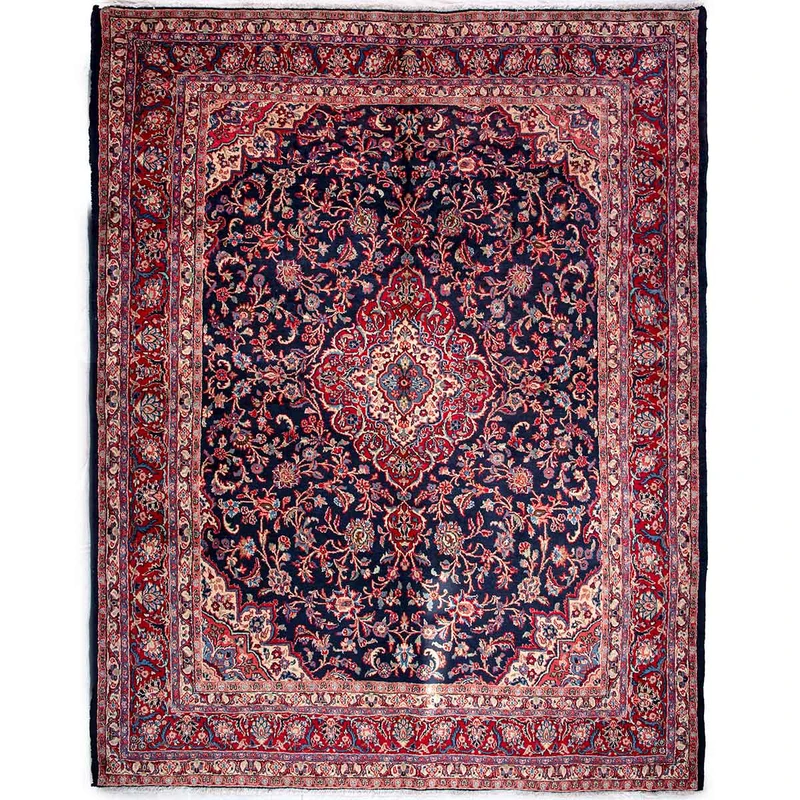
A Hamadan rug of about 12.25 by 9.25 feet with a deep indigo field, an ivory medallion, and ivory corners - Hamadan Persian Rug 12x9 ft - Medallion Semi Antique Wool Hand Knotted
3
Indigo, Navy, and Purple
•
Indigo - Deep blue with a faint violet glow.
•
Navy blue - A steadier, cooler deep blue.
•
Midnight blue - So dark it reads almost black.
•
Persian blue - Brighter and clearer, closer to the blue of tiles.
When indigo-dyed wool is also dipped in madder, it turns purple, aubergine, or plum. Many Persian rugs show these colors in small details. A faint violet cast in an indigo field may come from the wool itself, from the indigo, or from a light madder dip, and it is part of what makes indigo look warm.
4
Indigo Fields in Village Rugs
Indigo fields are a strength of the village rugs of western and northwestern Persia. In the Hamadan region, many rugs have deep indigo grounds with ivory or red medallions and corners. In Zanjan and the Khamseh region, indigo fields carry geometric medallions framed in red. These rugs are sturdy, bold, and easy to live with, and their indigo often shows strong abrash. Our Hamadan rug guide and Zanjan rug guide describe the villages.
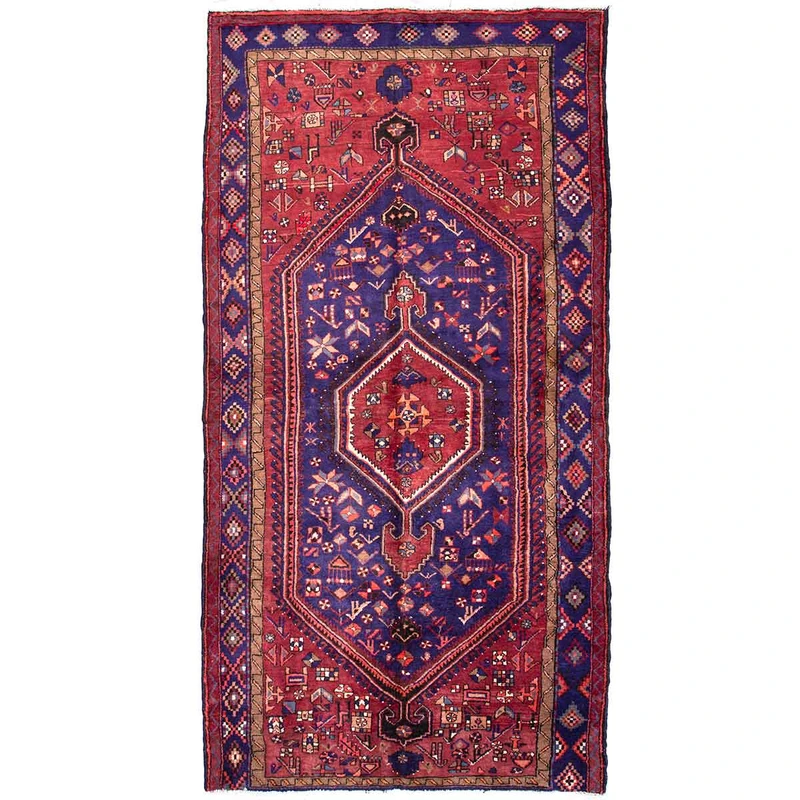
A Zanjan rug of about 9.25 by 4.9 feet with an indigo-purple diamond medallion framed in red - Zanjan Persian Rug 9x4 ft - Medallion Semi Antique Wool Hand Knotted
5
Indigo in City Rugs
In city and workshop rugs, indigo appears as deep fields and borders. Mahal, Sarouk, and Kashan rugs often have indigo or navy grounds with red medallions, and many Tabriz and Isfahan rugs use indigo borders around ivory or red fields. In these rugs, indigo is planned, even, and refined.
6
Indigo in Tribal Rugs
Tribal weavers prized indigo as much as city dyers did. In Qashqai and Shiraz rugs, indigo medallions sit on madder red fields, often with small animals and flowers scattered around them. In Baluch rugs, indigo joins dark red and brown in a deep, glowing palette. In tribal rugs, indigo often varies more, because the wool was dyed in small batches.
7
Indigo and Madder: The Classic Pair
The two great natural dyes of Persian weaving are indigo for blue and madder for red. Together they make the classic Persian palette: red fields with blue borders, blue fields with red medallions, and every combination in between. When you choose an indigo rug, you are choosing one half of that pair, and most indigo rugs carry some red as well.
8
Reading Abrash in an Indigo Field
Abrash is easiest to see in blue, and indigo fields show it best of all. Stand at one end of the rug and look along its length: you may see broad bands where the blue turns a little lighter or a little deeper. Each band marks a new batch of wool. In a village rug, the bands are often strong and irregular; in a city rug, they are faint and even. Many buyers come to love these bands, because they show that the wool was dyed by hand in small batches and that the rug grew row by row on the loom.
Abrash can also look different from each end of the rug. Because the pile leans in one direction, a field seen from the top looks darker and richer, and from the bottom lighter and shinier. Try both directions before you decide which way to lay your rug.
9
Indigo in Older Rugs
In older rugs, indigo is usually the color that has changed least. Reds may have softened and yellows faded, but the blue often looks almost as it did when the rug was new. That is why many antique rugs look bluer than they once did: the blue has stayed while the warmer colors have mellowed. A well-kept indigo field is a good sign of quality dyeing and careful use.
10
Indigo Rugs in Living Rooms
An indigo rug brings depth and calm to a living room. It works with white, cream, and pale gray walls, and with light or dark wood. Indigo has a slightly warmer feel than navy, so it also pairs well with warm woods, brass, and terracotta. A Hamadan or Zanjan rug with an indigo field suits a relaxed family room; a fine Kashan or Mahal suits a formal one.
11
Indigo Rugs in Bedrooms and Hallways
In a bedroom, indigo feels restful and grounded. In a hallway or entry, an indigo runner hides dirt well and looks rich in both daylight and lamplight. Our size guide explains how to choose the right size for each room.
12
Pairing Colors with an Indigo Rug
•
Ivory and cream - Echo the medallion and corners.
•
Madder red - Indigo's oldest partner.
•
Plum and aubergine - Draw out the violet glow.
•
Natural wood - Oak and walnut warm the blue.
•
Brass and copper - Warm metals balance the deep field.
13
Indigo and Light
In cool north light, indigo can look dark and almost navy. In warm light, its violet side appears and the color looks richer. Under warm bulbs at night, indigo can read nearly black, so in a dim room choose an indigo rug with an ivory or red medallion to keep the design visible.
14
Indigo and Sunlight
Indigo is one of the most lightfast natural dyes. After many years in strong sun, an indigo field may soften slightly toward a grayer blue. Rotate the rug every six to twelve months and limit long hours of direct sun.
15
Caring for an Indigo Rug
Vacuum regularly with suction only. Blot spills with cold water and never rub. Avoid bleach and strong cleaners, which can leave pale spots on blue wool. Have the rug washed by a professional every few years. Our care instructions explain each step.
16
Frequently Asked Questions
Is indigo a natural dye?
Yes. It comes from indigo plants. Synthetic indigo, made since the late 1800s, is the same molecule.
What is the difference between indigo and navy?
Indigo has a faint violet glow; navy is a steadier, cooler deep blue.
Which Persian rugs have indigo fields?
Hamadan, Zanjan, Mahal, Sarouk, and Kashan rugs, among others.
How is purple made in Persian rugs?
By dyeing wool with indigo and madder.
17
Choose Your Indigo Rug
Browse our indigo rugs, compare them with navy blue and midnight blue, and ask our experts if you would like help choosing.