


Ask a Persian rug dealer which size he sells most often, and he may well say the Dozar. This is the size of about 4 by 6 feet, and it has been woven in enormous numbers in villages, towns, tribes, and city workshops for generations. It is big enough to show a full design with real grandeur, and small enough to fit into almost any home.
This guide explains what a 4x6 rug measures in our collection, the Persian names for the size, where it works best, how to choose one, and how to care for it. For a full overview of rug sizes and Persian size names, see our Persian rug size guide.
1
What Size Is a 4x6 Rug?
Our 4x6 group holds rugs of about 4 feet on the short side and 6 to 7 feet on the long side, roughly 120 to 150 cm by 180 to 215 cm. Because our size names are rounded down to whole feet, a rug of 6 feet 11 inches by 4 feet 7 inches is listed as 6x4 and appears in this group, so many of our 4x6 rugs are closer to 4.5 by 6.5 feet. Rugs with a short side of 5 feet or more move up to our 5x8 group. Every listing gives the exact measurements in feet and inches.
A 4x6 rug in our collection measures roughly 4 by 6 to 4 by 7 feet (about 120 x 180 to 150 x 215 cm), the classic Persian Dozar or Sajadeh size.
2
Dozar and Sajadeh: The Persian Names
Dozar means "two zar". The zar is an old Persian measure of about 104 cm, and a Dozar rug is about two zar long, roughly 120 by 180 to 140 by 210 cm. It is also called Sajadeh, which means a prayer rug, because many rugs of this size were woven for prayer, with a niche at one end. Not every Sajadeh carries a prayer design; the name is often used simply for the size. In the Persian trade, the Dozar sits between the smaller Zar-O-Nim (about 100 by 150 cm) and the larger Pardah (about 150 by 250 cm). Read our size guide for the full list.
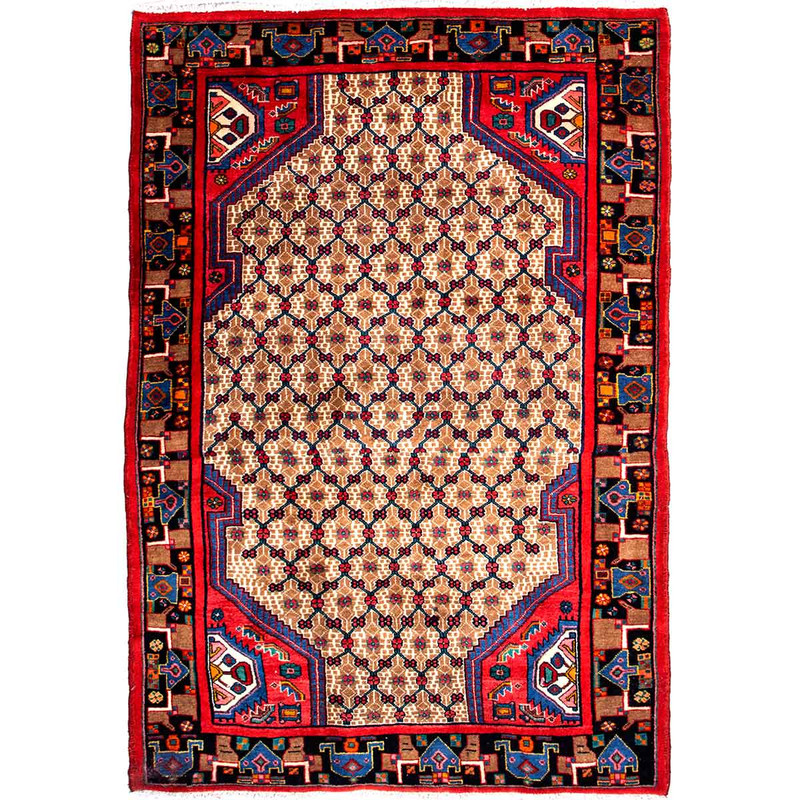
A Songhor rug of about 6.5 by 4.5 feet with a lattice design in cream, madder red, and navy blue - Songhor Persian Rug 6x4 ft - Geometric Semi Antique Wool Hand Knotted
3
Why the Dozar Is So Common
The Dozar fits the life of the weaver as well as the needs of the buyer. A loom for a Dozar can stand in a village house, and one or two weavers can complete a rug in a few months, which makes it a practical size for a family workshop. The size also suited the traditional Persian room, where a Dozar might lie at the head of the room or be used for prayer. For the market, it was a size that buyers everywhere wanted. As a result, almost every weaving center in Persia produced Dozars, and it is the best size in which to compare the styles of many different places.
4
Where a 4x6 Rug Works Best
•
In a foyer - Fills a medium foyer and welcomes guests with a full design.
•
In front of a loveseat or small sofa - Holds a small seating group in a den or study.
•
Under a round center table - In a foyer, a hall, or a library, where no chairs are pulled out.
•
At the foot of a queen bed - Or along one side of a king bed.
•
In a home office - Under a desk and chair, or in front of a reading chair.
•
In a dressing room or large bathroom - A fine rug brings comfort and color.
•
On a wall - Large enough to make a real statement above a sofa or bed.
•
As a layer - On top of a larger plain or sisal rug, to bring a Persian center to a room.
5
A 4x6 in a Small Living Room
In a small living room, a den, or a study, a 4x6 rug can hold a loveseat and one or two chairs. Place the rug so the front legs of each seat rest on it, and center it on the coffee table. If the furniture is too far apart for the front legs to reach the rug, a larger rug such as a 5x8 will look better. In a larger living room, a 4x6 is best used as a secondary rug, in front of a fireplace or a window seat, rather than under the main seating group.
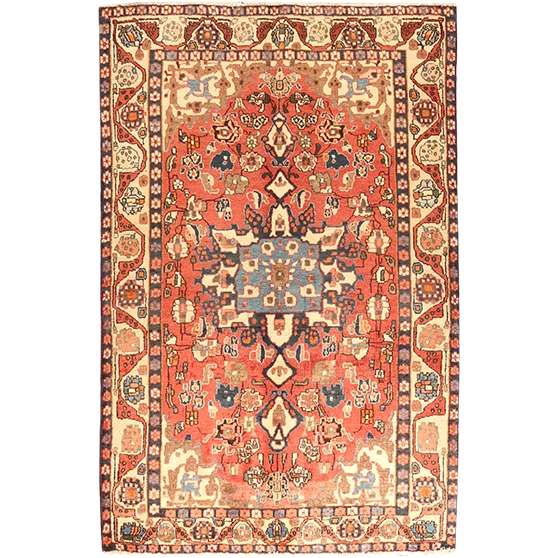
An Isfahan rug of about 7 by 4.5 feet in madder red, cream, and navy blue - Isfahan Persian Rug 6x4 ft - Medallion Semi Antique Wool Silk Hand Knotted
6
A 4x6 in a Bedroom
In a bedroom, a 4x6 rug has several good placements. Across the foot of a queen bed, it gives a soft place to stand while dressing and adds color where it is most seen. Along one side of a king bed, it gives a generous landing where you get up. Under a reading chair or a dressing table, it creates a small, comfortable corner. For a rug under the bed itself, choose a larger size; our size guide suggests an 8x10 or 9x12 under a queen bed.
7
A 4x6 Under a Table
A 4x6 rug looks handsome under a round center table in a foyer, a hall, or a library, where nobody pulls out a chair. Under a dining table it is a different story. The rule for a dining rug is that the chairs must stay on the rug when they are pulled out, which means the rug should reach about 24 inches beyond the table on every side. Even a small table for four of about 3 by 4 feet needs a rug of at least 6 by 9 feet by that rule, so a 4x6 is too small for dining. See our 6x9 rugs and the dining table chart in our size guide.
8
Weaving Traditions in Our 4x6 Group
•
Songhor and Kolyai - Kurdish village rugs with bold lattices and medallions. See our Songhor collection.
•
Bakhtiari - Village rugs of the Zagros, with garden panels and geometric fields. See our Bakhtiari collection.
•
Hamadan, Malayer, and Mazlaghan - The great village family of west Persia. See our Hamadan collection.
•
Isfahan, Nain, and Qom - Fine city rugs with classical floral designs. See our Isfahan collection.
•
Tabriz and Kashan - Workshop rugs with medallions and corners. See our Tabriz collection.
•
Arak and Sarouk - Rich rugs from the Arak region. See our Arak collection.
•
Qashqai and Shiraz - Tribal rugs from Fars. See our Qashqai collection.
9
Kurdish Village Rugs at 4x6
The Kurdish weavers of Songhor, Kolyai, Bijar, and the villages of west Persia wove many Dozars, with bold medallions, diamond lattices, and strong colors on sturdy foundations. These rugs are made to last, and they suit busy rooms such as foyers, family rooms, and studies. The lattice designs of Songhor, with small flowers inside a diamond grid, are especially easy to live with, because they look good from every side. Read our Songhor collection guide and our Kurdish collection guide.
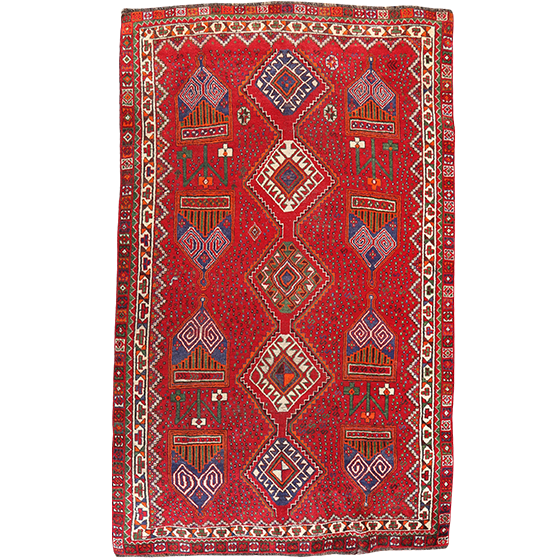
A Bakhtiari rug of about 6.75 by 4.5 feet with a geometric design in madder red, cream, and navy blue - Bakhtiari Persian Rug 6x4 ft - Geometric Semi Antique Wool Hand Knotted
10
Bakhtiari Rugs at 4x6
Bakhtiari rugs from the villages of Chaharmahal, in the Zagros mountains, are among the sturdiest and most characterful rugs of Persia. They are known for their Kheshti or garden design, which divides the field into panels, each with a tree, a flower, or a vase, and for their bold geometric medallions. A Bakhtiari 4x6 brings a strong, warm look to a room and stands up to heavy use. Read our Bakhtiari collection guide and our Kheshti design guide.
11
City Rugs at 4x6
The Dozar is also one of the favorite sizes of the city workshops. A 4x6 from Isfahan, Nain, Qom, Tabriz, or Kashan can show a full classical composition, with a medallion, corners, a floral field, and several borders, drawn with great detail. These rugs are finely knotted, often on cotton or silk foundations, and they suit formal rooms, bedrooms, and walls. A fine city 4x6 is one of the most rewarding ways to own a rug from a great workshop at a manageable size. See our Isfahan, Nain, and Kashan collections.
12
Designs That Work at 4x6
The Dozar is large enough for almost any Persian design. A medallion with corners gives a formal, centered look and suits a foyer or a wall. An all-over design, such as a Herati, a lattice, a Shah Abbasi field, or an Afshan, suits a room where furniture covers part of the rug. A prayer design, the original meaning of Sajadeh, has a niche at one end and works well at a doorway or on a wall. A garden design divides the field into panels and gives a rich, tile-like effect. See our Medallion, Lattice, Shah Abbasi, and Mihrab designs.
13
Comparing Rugs from Many Places
Because the Dozar was woven nearly everywhere, it is the best size for comparing the styles of different weaving centers. Put a Songhor, an Isfahan, and a Bakhtiari Dozar side by side and you see three different worlds: the bold lattice of a Kurdish village, the flowing floral drawing of a city workshop, and the strong geometry of the Zagros. Looking at many rugs of the same size, one after another, is one of the best ways to learn what you like. Our collection guides, such as those for Hamadan, Isfahan, and Bakhtiari, explain how to recognize each one.
14
Choosing Colors
At 4x6, a rug begins to set the color of a room. A red ground, the most traditional Persian color, gives warmth and works with wood floors and furniture. A navy or dark blue ground is calm and sophisticated. An ivory or cream ground, common in Isfahan, Nain, and Qom rugs, brightens a room and suits lighter, modern interiors. When you choose, look at the rug's secondary colors as well as its ground, because these are the colors you can pick up in cushions, curtains, and art. Read our article on the nine ranges of Persian colors.
15
How to Measure for a 4x6 Rug
Mark the space with painter's tape at 4 by 6 feet and again at 5 by 8 feet, and live with the marks for a day. In a foyer, leave at least 6 inches of floor on each side, more in a wide space. In front of a sofa, the rug should reach under the front legs of the seats or come close to them. Under a table, the chairs should stay on the rug when pulled out. At the foot of a bed, the rug should be about as wide as the bed or a little narrower. Once you know the size range, compare the exact measurements in each listing.
16
4x6 or 5x8?
The step from a 4x6 to a 5x8 is the step from an accent rug to a small area rug. A 4x6 marks a spot and holds a small group; a 5x8 holds a full small seating group. If you are between the two, think about how the room is used. In a busy space where furniture is moved, the smaller rug may be easier. In a living room where the rug should tie the furniture together, the larger rug usually looks better. See our 5x8 rugs and our 3x5 rugs.
17
Layering a 4x6 Rug
A popular way to use a 4x6 Persian rug in a large room is to layer it on top of a larger, simple rug, such as a plain wool, jute, or sisal rug. The larger rug covers the floor under all the furniture, and the Persian rug sits on top, in the center, as the focus of the room. This gives the room the warmth and color of a Persian rug without the cost of a very large one. Use a thin rug-on-rug pad between the two so the Persian rug stays in place.
18
A 4x6 Rug on a Wall
A 4x6 rug makes a striking wall hanging above a sofa, a bed, or a long sideboard. Sew a cotton sleeve or a strip of webbing to the back along the top edge, slide a wooden rod through it, and hang the rod from sturdy brackets. Hang the rug so its warp threads run vertically, in the direction it was woven, and keep it out of direct sunlight. A fine city rug, a prayer rug, or a rug with a strong medallion looks especially good on a wall.
19
Older 4x6 Rugs
Many of the 4x6 rugs in our collection are several decades old, and some are older. A well-made Dozar from the middle of the twentieth century often has rich, mellow colors and a pile that has settled into a soft, supple handle. When you look at an older 4x6, check that the pile is even, that there are no holes or weak spots, that the sides are firmly wrapped, and that the ends are secured. Careful old repairs are acceptable if they are well done and do not affect the design. Read our notes on what to know before you buy.
20
Pads and Placement
A 4x6 rug needs a good pad on any hard floor. Choose a pad of natural rubber or felt with a rubber backing, cut about an inch smaller than the rug on every side. A pad stops the rug from sliding, keeps it flat, cushions the pile so it wears more slowly, and allows air to circulate underneath. On wall-to-wall carpet, use a pad designed to keep a rug from creeping. Avoid pads with adhesives or PVC, which can stain floors and damage rugs.
21
Which Way Should a Prayer Rug Point?
A Dozar with a prayer niche has a clear top and bottom, and it looks best when it is placed with that in mind. At a doorway, the niche usually looks best pointing into the room, so that it greets you as you enter. In front of a sofa or a bed, the niche can point away from the furniture, toward the open floor. On a wall, the niche points up, as it would in a mosque or a home. An all-over design has no direction, which is one reason it is easier to place.
22
The 4x6 in a Home Office
A home office is one of the best places for a 4x6 Persian rug. It softens the sound of a hard room, warms the floor under your feet, and gives a working space the character of a library. Place the rug under the desk so the chair stays on it when you push back, or in front of the desk as a reading area. If your chair has wheels, place a clear chair mat on top of the rug where the chair rolls, so the wheels do not crush the pile. A rug with an all-over design and deep colors suits an office best.
23
A Pair of 4x6 Rugs
Two 4x6 rugs can furnish a long room that a single rug would not fit, such as a living room with two seating areas, or a long hall with a sitting area at each end. They can also frame a king bed, one on each side. A pair does not need to match exactly; two rugs from the same weaving center, or with the same ground color, make a harmonious pair. Keep a little floor between them so each rug can be seen.
24
Questions to Ask Before You Buy
•
What are the exact measurements? - Size labels are rounded down.
•
What will sit on the rug? - Choose an all-over design if furniture covers part of it.
•
How busy is the room? - Choose a sturdy village or tribal rug for heavy use.
•
Is the pile even and healthy? - Check older rugs carefully.
•
Is it a prayer design? - Decide which way the niche should point.
Read our notes on what to know before you buy and our guide on how to buy a Persian rug.
25
Caring for a 4x6 Rug
Vacuum regularly without the beater bar, in the direction of the pile. Rotate the rug every six months so that it wears and fades evenly. Blot spills at once with a clean, white cloth and cold water. Keep it out of strong, direct sunlight. Have it professionally washed every few years, and never fold a rug for storage; roll it with the pile facing out and wrap it in cotton, not plastic. See our care instructions and our article on professional washing.
26
Frequently Asked Questions
How big is a 4x6 rug?
Roughly 4 by 6 to 4 by 7 feet, about 120 x 180 to 150 x 215 cm. Check each listing for exact measurements.
What is a Dozar rug?
The Persian name for a rug about two zar long, roughly 120 x 180 to 140 x 210 cm.
What does Sajadeh mean?
A prayer rug; the name is also used for the Dozar size.
Is a 4x6 big enough for a living room?
For a small seating group, yes; for a full living room, choose a larger rug or layer it.
Can a 4x6 go under a dining table?
Usually not. The chairs need about 24 inches of rug beyond the table on every side, so even a table for four needs a 6x9 or larger.
27
Choose Your 4x6 Rug
Each rug in our collection is hand-knotted, one of a kind, and inspected before it is listed. Browse our 4x6 rugs, compare with our 3x5 and 5x8 rugs, read our size guide, or ask our experts for help.