


A Persian runner turns a corridor into a room. Laid along a hallway, it softens footsteps, brings color into a space that is often plain, and leads the eye from one end of the house to the other. Runners are also among the most practical rugs a home can have: they protect the floors that are walked on most, and they fit the long, narrow spaces that no other rug can.
This guide explains what a runner is, how the Persian runner sizes are named, how to measure a hallway, kitchen, or stair, which weaving traditions make the best runners, how to choose a design and colors, and how to care for a runner that sees daily traffic. For a full overview of rug sizes, see our Persian rug size guide.
1
What Is a Runner?
A runner is any rug that is much longer than it is wide, usually at least twice as long and often four, five, or six times as long. Most of our runners are about 2 feet 6 inches to 3 feet 10 inches wide (about 75 to 115 cm) and from about 6 feet to more than 17 feet long (about 180 to 520 cm). Every listing gives the exact measurements in feet and inches. Our runner group also includes some long rugs: rugs of about 4 to 5 feet wide and 12 to 14 feet long, a traditional Persian format between a runner and a room-size rug. If you need a true hallway runner, filter by width as well as length.
A Persian runner is usually 2.5 to 3.5 feet wide and 6 to 20 feet long (about 75 to 105 cm by 180 to 600 cm). Always check the exact width and length in the listing.
2
Kenare and Kharak: The Persian Names
In a traditional Persian room, the floor was covered by a set of carpets: a large central carpet, a wide rug at the head of the room called the Kellegi, and two long, narrow side carpets called Kenare, which means "edge" or "side". The Kenare ran along the walls, where people sat on cushions, and the central carpet lay between them. These side carpets are the ancestors of today's runners. A shorter runner of about 70 by 180 cm (2.5 by 6 feet) is called a Kharak. Because every family needed a pair of Kenare for its main room, runners have been woven for generations in almost every weaving region of Persia. Read our size guide for the full set of Persian size names.
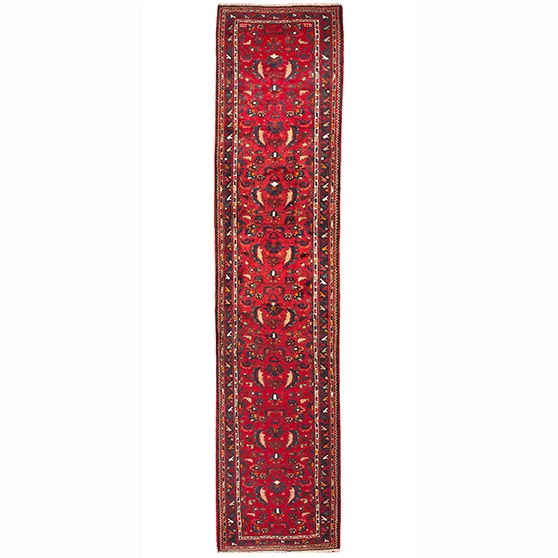
A Hamadan runner of about 17 by 3.75 feet with an all-over design in madder red, navy blue, and ivory - Hamadan Persian Rug 16x3 ft - Afshan Semi Antique Wool Hand Knotted
3
Where a Runner Works Best
•
In a hallway - The classic place for a runner, from front door to bedrooms.
•
In a galley kitchen - Along the counter or between two counters, where you stand and walk.
•
On a landing - At the top or bottom of a staircase.
•
Beside a bed - A long runner along one side of a large bed.
•
In front of a long counter or island - In an open kitchen.
•
In an entry - A long, narrow foyer or a mudroom.
•
On stairs - Professionally installed, without cutting the rug.
•
On a wall - A long runner can be hung like a tapestry in a tall space.
4
How to Measure a Hallway for a Runner
Start with the width. A runner should leave a strip of bare floor on each side, usually about 4 to 6 inches in a narrow hall and up to 8 to 12 inches in a wide one. For a hall of about 3.5 feet, a runner of about 2.5 to 2.75 feet wide looks right; for a hall of about 4 feet, a runner of about 3 feet. Then measure the length. Leave about 12 to 18 inches of bare floor at each end, and check that doors along the hall can open over the runner or that the runner stops short of them. In a very long hall, a single long runner looks best, but two runners of the same family with a short gap between them also work well. Mark the space with painter's tape before you choose.
5
Runners in the Kitchen
A kitchen runner sits where you stand: in front of the sink, along the counter, or between the counters of a galley kitchen. Choose a runner with a dense wool pile, a medium knot count, and a design with many small motifs and deep colors, which hide spills and crumbs. Leave a few inches of floor between the runner and the base of the cabinets, so the dishwasher and cabinet doors open freely. A thin, non-slip pad is essential on tile or wood. Blot spills at once with cold water and a clean cloth, and have the runner professionally washed when needed. Wool is more forgiving than many people expect, because its fibers are naturally coated.
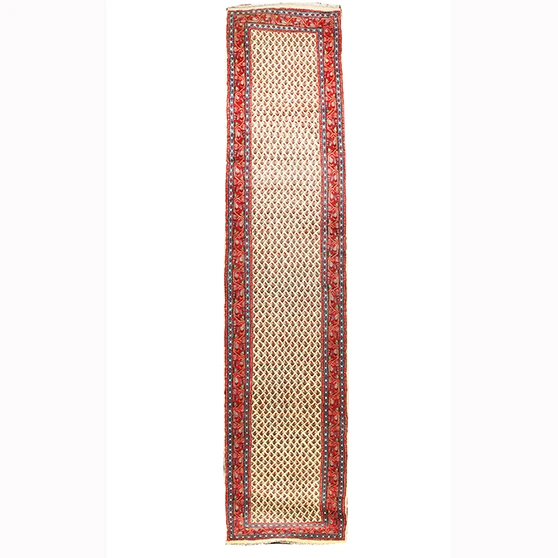
An Arak runner of about 14.5 by 2.75 feet with a Herati design in cream, crimson, and navy blue - Arak Persian Rug 14x2 ft - Herati Semi Antique Wool Hand Knotted
6
Runners on Stairs
A hand-knotted runner can dress a staircase beautifully, but it should be installed by a professional who has experience with hand-knotted rugs. The runner is usually held with stair rods or fixed carefully at the back of each tread, so it can be removed later without damage. A hand-knotted runner should never be cut to fit a staircase: cutting breaks the foundation and releases the knots. Choose a runner that is long enough for your stairs as it is, or ask the installer to fold any extra length at the top or bottom. A sturdy, dense village runner wears best on stairs. Measure each tread and riser, multiply by the number of steps, and add a little for the landing.
7
Weaving Traditions in Our Runner Group
•
Hamadan - Long village runners with Herati and all-over designs. See our Hamadan collection.
•
Sarab - Famous runners with hooked medallions, often on camel grounds. See our Sarab collection.
•
Karaja and Heriz - Medallion-chain runners from the Heriz region. See our Karaja collection.
•
Arak and Mahal - Narrow runners with Herati fields. See our Arak collection.
•
Ardabil and Meshkin - Geometric runners with Caucasian-style medallions. See our Ardabil collection.
•
Bijar and Senneh - Dense Kurdish long rugs and runners. See our Bijar collection.
•
Baluch - Dark tribal long rugs. See our Baluch collection.
8
Sarab Runners
Sarab, a town on the high plateau between Tabriz and Ardabil, is among the most famous sources of Persian runners. Sarab runners are known for a chain of hooked, angular medallions running down the length of the rug, often on a field of natural undyed camel wool, with red, rust, and blue accents. They are sturdy, handsome, and especially well suited to hallways, where their chain of medallions leads you along. Read our Sarab collection guide.
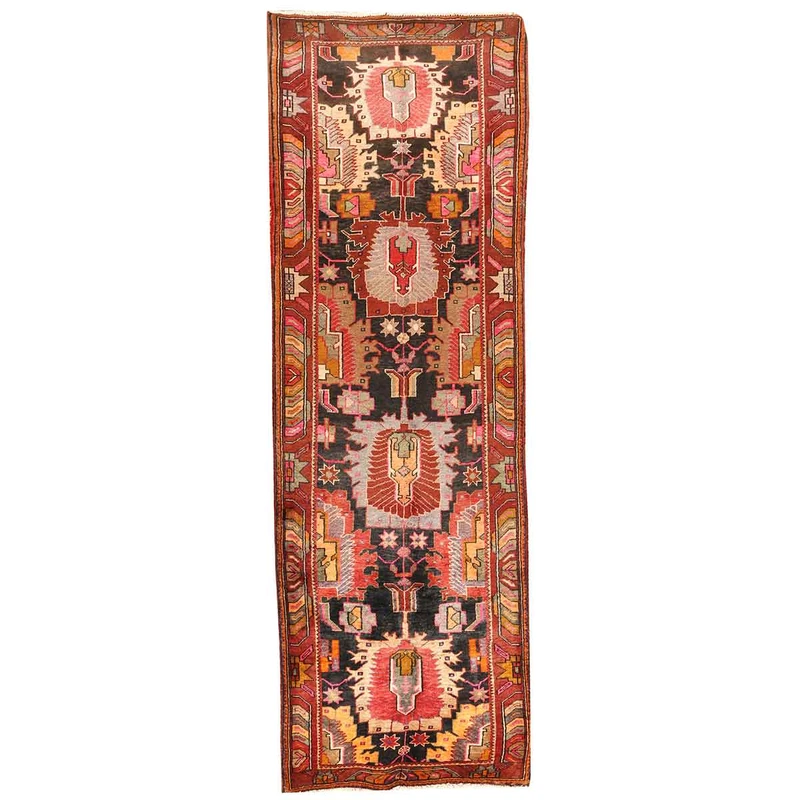
A Sarab runner of about 12.75 by 3.75 feet with a chain of medallions in madder red, rust red, and camel - Sarab Persian Rug 12x3 ft - Medallion Semi Antique Wool Hand Knotted
9
Hamadan and Arak Runners
The villages of the Hamadan region in west Persia have woven runners in great numbers, often with an all-over Herati or Afshan field in madder red, navy, and ivory. These runners are sturdy, single-wefted, and practical, and they come in a wide range of lengths. The Arak region in central Persia also produced many narrow runners with fine Herati fields, often in softer colors. Both are excellent choices for busy hallways and kitchens. Read our Hamadan and Arak collection guides.
10
Heriz Region and Karaja Runners
Runners from the Heriz region east of Tabriz, including the village of Karaja, bring bold geometry to a long space. Karaja runners are known for a chain of medallions, often alternating hooked octagons and smaller diamonds, on a red or blue field. Their thick, durable weave makes them some of the best runners for heavy traffic. Read our Karaja and Heriz collection guides.
11
Designs That Work in a Runner
Runner designs fall into two families. All-over designs, such as the Herati, the Afshan, the boteh, or a lattice, repeat along the whole length and look the same from either end, which makes them easy to place and easy to rotate. Medallion chain designs, with a row of medallions down the center, give a hallway a sense of rhythm and direction. A third, less common family is the striped or banded runner, with bands of color across or along the rug. All three can be beautiful; choose the one that suits the length and character of your space. See our Herati, Afshan, Boteh, and Medallion designs.
12
Choosing Colors for a Runner
A runner in a hallway is seen in passing and walked on constantly, so practical colors matter. Red and madder grounds are warm and forgiving, and they are the most common colors in Persian runners. Navy grounds look calm and elegant. Camel grounds, typical of Sarab runners, give a natural, earthy look and suit modern interiors. Ivory grounds brighten a dark hall but show soil sooner. A runner with many small motifs in several colors hides daily wear best. Read our article on the nine ranges of Persian colors.
13
One Runner or Two?
In a long hallway, you may wonder whether to use one long runner or two shorter ones. One continuous runner gives the most elegant, unified look. If the hallway is interrupted by a door, a turn, or a change of floor, two runners may fit better. Two runners do not need to match, but they should share a color or a weaving family, and they should be about the same width. Leave a gap of 6 to 12 inches between them. In a very long gallery, three runners of the same family can look magnificent.
14
Runners in Pairs
Because Persian families traditionally needed two side carpets for their main room, runners were often woven in pairs. A pair of runners can still be used the traditional way, on each side of a large room, or on each side of a bed, or in two matching hallways. True pairs are rare in the market today, but two runners of the same region, width, and color family make a very good substitute.
15
Older Runners
Many of our runners are semi-antique, woven several decades ago. An older runner often has softened colors and a supple pile that lies flat on the floor. Because runners are walked on so much, check the condition carefully: the pile along the center line, the ends, which take the most wear when a runner is vacuumed and walked over, and the sides, which should be firmly wrapped. Small, careful repairs are normal in a runner that has been used. Read our notes on what to know before you buy.
16
Pads for Runners
A runner on a hard floor needs a good non-slip pad more than any other rug, because it is walked on lengthwise and tends to creep. Choose a thin pad of felt with a natural rubber backing, or natural rubber alone, cut about an inch narrower and shorter than the runner. On carpet, use a pad made to keep a rug from creeping. A pad also cushions the pile, so the runner wears more slowly. Avoid pads with sticky adhesives or PVC, which can damage floors and rugs.
17
Rotating a Runner
Most hallways have one end that gets more traffic, near the front door or a busy room. Turn the runner end to end every three to six months, so that both ends wear evenly. If a runner lies in sunlight from a window at one end, rotation also evens out fading. In a kitchen, the spot in front of the sink takes the most wear; rotating the runner moves that spot along the rug.
18
Long Rugs: Between a Runner and a Room Rug
Some of the rugs in our runner group are long rugs rather than true runners: about 4 to 5 feet wide and 10 to 14 feet long. Persian weavers made this format for the head or side of a room, and the trade sometimes calls the wider ones gallery rugs. Bijar and Senneh weavers, in particular, made many long rugs of this kind, densely knotted and built to last. A long rug suits a wide hallway, a gallery, the space in front of a long sofa or bookcase, or the foot of a large bed, where a standard runner would look too thin. If your hall is 5 feet or wider, a long rug may suit it better than a narrow runner. See our Bijar and Senneh collections.
19
Runners Beside a Bed
A runner along one side of a large bed is an elegant alternative to a pair of small rugs. It gives a soft landing along the whole length of the bed, from the head to the foot, and it frames the bed without covering the floor beneath it. For a king or queen bed, a runner of about 2.5 by 8 to 10 feet works well. A pair of matching runners, one on each side, gives a balanced, hotel-like look; a single runner on the side you get up from is practical and simple.
20
Runners in an Entry or Mudroom
A long, narrow entry or mudroom is a natural place for a runner. Choose a sturdy, dense village runner in deep colors, and place a plain outdoor mat outside the door to catch most of the dirt before it reaches the Persian runner. Leave enough clear floor for the door to swing open, and use a non-slip pad, because people step onto an entry runner quickly, often with wet shoes. A runner here works hard, so rotate it and wash it more often than one in a quiet upstairs hall.
21
The Beauty of a Long, Narrow Design
Weaving a runner is its own art. The designer must keep a pattern interesting along a great length without losing its rhythm, and the weaver, working from one end to the other, must keep the width even over many feet of knotting. A well-made runner has straight sides, a consistent width from end to end, and a design that flows without crowding at either end. When you look at a runner, check that it lies flat and straight when unrolled; a slight curve is common in hand-knotted rugs and usually settles with use, but a strong bow can make a runner hard to place in a straight hall.
22
Lighting and Runners
Hallways are often dim, lit only by a ceiling fixture or the light from a doorway. A runner with a lighter ground or bright accents of ivory, gold, or sky blue can lift a dark hall, while a deep red or navy runner adds warmth to a bright one. Look at the runner in the light of your own hallway if you can, or compare the listing photos with the light in your space.
23
A Runner as a First Persian Rug
For many homes, a runner is the first Persian rug that is truly used every day. It is walked on morning and night, and it shows quickly how well a hand-knotted wool rug holds up to real life. Living with a good runner is one of the best introductions to Persian rugs.
24
Questions to Ask Before You Buy
•
What is the exact width? - A runner that is too wide covers the whole hall.
•
What is the exact length? - Leave 12 to 18 inches of floor at each end.
•
Is it a true runner or a long rug? - Our runner group includes both.
•
Is the pile healthy along the center? - The center line takes the most wear.
•
Are the ends and sides secure? - Important for a rug that is walked over daily.
Read our notes on what to know before you buy and our guide on how to buy a Persian rug.
25
Caring for a Runner
Vacuum a runner often, without the beater bar, working along the length in the direction of the pile, and vacuum across the fringe from the rug outward, never along it. Blot spills at once with a clean, white cloth and cold water, working from the outside in. A runner can be taken outdoors and shaken gently, but never beaten. Have it professionally washed every year or two in a busy hallway or kitchen. To store a runner, roll it with the pile facing out and wrap it in cotton. See our care instructions, our article on washing at home, and our article on professional washing.
26
Frequently Asked Questions
How wide is a Persian runner?
Usually about 2.5 to 3.5 feet; some long rugs in our runner group are 4 to 5 feet wide.
How long should a hallway runner be?
Leave about 12 to 18 inches of bare floor at each end of the hall.
What is a Kenare?
The Persian name for the long side carpets of a traditional room, the ancestors of today's runners.
Can a Persian runner be used on stairs?
Yes, installed professionally with rods or careful fixing, and never cut.
Can I use a runner in a kitchen?
Yes. Choose a dense wool runner with deep colors, use a non-slip pad, and blot spills at once.
27
Choose Your Runner
Each runner in our collection is hand-knotted, one of a kind, and inspected before it is listed. Browse our runners, compare with our 3x5 and 4x6 rugs, read our size guide, or ask our experts for help.