


Persian Garden Rugs: From Paradise Gardens to Khesti Panels
Los Angeles Home of Rugs on Nov 17th 2026
Few ideas run deeper in Persian culture than the garden. In a land of high plateaus and deserts, a walled garden filled with running water, shade trees, and flowers was the most vivid image of paradise on earth. It is no surprise that this ideal found its way onto the floors of Persian homes and palaces. The garden design - known in its later form as the panel or khesti design - is one of the oldest and most meaningful compositions in the Persian rug tradition.
This article traces the garden design from its roots in the classical Persian garden to the famous garden carpets of the 17th century and the panel rugs still woven by the Bakhtiari today.
1
The Persian Garden - A Model of Paradise
The classic Persian garden, called chahar bagh or "four gardens," divides a rectangular enclosure into four parts with crossing water channels. At the center, where the channels meet, there is often a pool or pavilion. Trees, flower beds, and fruit orchards fill each quarter. The plan represents order, abundance, and the life-giving power of water.
The English word "paradise" itself comes from the ancient Persian word pairidaeza, meaning a walled enclosure or garden. Persian gardens such as those of Isfahan, Shiraz, and Kashan are today recognized as world heritage, and their geometry shaped Persian architecture, poetry, and carpet design alike.
A garden rug is, in a sense, a portable paradise. Laid on the floor, it brings the shade, water, and flowers of the Persian garden into the home, even in the depths of winter.
2
Famous Persian Gardens That Inspired Weavers
The gardens that shaped Persian carpet design still exist, and many can be visited today. In 2011, nine historic Persian gardens were inscribed together on UNESCO's World Heritage List, recognized as a garden tradition that influenced garden design from India to Spain. A few of them show especially clearly how the garden and the carpet share the same vocabulary:
•
Pasargadae - the garden of Cyrus the Great, from the sixth century BCE, where archaeologists have found stone water channels that are among the earliest known evidence of the four-part garden plan.
•
Fin Garden, Kashan - a Safavid garden fed by a natural spring, with turquoise channels and pools that run between ancient cypress trees. Kashan is also one of Persia's great carpet cities, and the connection between the two arts is easy to feel there. See our Kashan rugs.
•
Chehel Sotoun, Isfahan - a royal pavilion whose long reflecting pool doubles its twenty columns, set in the heart of the Safavid capital where many of the finest court carpets were designed.
•
Eram Garden, Shiraz - famous for its tall cypresses and flowers, in a city long associated with poets, gardens, and nearby Qashqai weaving.
•
Shazdeh Garden, Mahan near Kerman - a terraced garden of cascading water in the desert, close to the important weaving center of Kerman.
Walking through any of these gardens, you see the same elements that appear in garden rugs: water channels dividing the space, rows of cypress and plane trees, flower beds in geometric compartments, and a central pool or pavilion.
3
The Classic Garden Carpets
The idea of a garden carpet is very old. Persian tradition remembers the legendary "Spring of Khosrow," a vast Sassanian carpet said to represent a garden in springtime, with paths, streams, and flowering trees worked in silk and precious materials. Nothing of it survives, but the story shows how long the garden ideal has been tied to carpets.
The earliest surviving garden carpets date from the 17th century. In these rugs the field is laid out like a bird's-eye view of a garden: wide channels of water, often drawn in blue with zigzag lines to suggest rippling movement, divide the field into rectangles. Fish swim in the channels, and the compartments are filled with trees, flowers, birds, and animals. The central pool, or hoz, is a key feature, which is why the design has also been called the pool design. One of the finest surviving examples, the Wagner Garden Carpet, is held in the Burrell Collection in Glasgow.
Surviving Masterpieces
A small number of great Safavid-era garden carpets survive in museum collections, and they show the design at its most ambitious. One of the best known is the Wagner Garden Carpet, woven in the seventeenth century, probably in Kerman, and now in the Burrell Collection in Glasgow. It shows a complete garden from above, with water channels, fish, ducks, trees, flowering shrubs, birds, and animals, all arranged around a central pavilion. Another famous group of garden carpets was preserved in the palace collections of Jaipur in India, where Persian carpets were highly prized by the Mughal-era rulers. These carpets are rare, fragile, and extremely valuable, and they remain the starting point for anyone studying the garden design.
4
From Naturalism to Geometry
Over time, the naturalistic garden of the court carpets gradually became more stylized. The water channels turned into thin lines, often dark blue or navy, and the overall plan became a regular grid of rectangles and sometimes diamonds. The water itself was often suggested only by zigzag patterns that keep the design lively. Eventually the garden became so abstract that a viewer might not recognize it at first glance, yet its structure remained.
This stylized version is known in Persian as the khesti design, from khesht, meaning a brick or tile. The field is divided into square or rectangular compartments like tiles, each holding its own motif.
5
The Khesti Rugs of the Bakhtiari
The panel design is most closely associated with the Bakhtiari people and the villages of Chaharmahal and Bakhtiari province, south of Isfahan. Persian carpet research describes several local styles of khesti rugs in this region, among them the styles of Chaleshtor, Shalamzar, and Babaheydar, each with its own preferred motifs and colors.
The Bakhtiari and Their Homeland
The Bakhtiari are one of the great tribal peoples of Persia, traditionally migrating with their flocks across the Zagros Mountains between winter pastures in the lowlands of Khuzestan and summer pastures in the high valleys of Chaharmahal. Over the past two centuries, many Bakhtiari families settled in villages in Chaharmahal and Bakhtiari province, and it is in these villages, rather than in nomadic tents, that most Bakhtiari panel rugs have been woven.
Settled village life allowed weavers to use larger, fixed looms and to weave room-size carpets, which is why Bakhtiari panel rugs are often found in generous sizes. At the same time, the weavers kept the bold colors, strong wool, and lively drawing of their tribal heritage. Our articles on Bakhtiari rugs, weaving in Chaharmahal, and the Qashqai and Bakhtiari tribes tell more of this story.
Each panel is decorated with a single motif, and the combination of panels creates a rich, rhythmic field. Common motifs include:
•
Cypress trees - symbols of eternal life and resilience.
•
Weeping willows - suggesting water, shade, and sometimes mourning.
•
Flowering shrubs and bushes - the abundance of the garden.
•
Vases of flowers - perhaps the most frequent motif in the panels, appearing in many varieties.
•
Palmettes and floral sprays - echoing the classical Persian floral vocabulary.
•
Birds and animals - peacocks, songbirds, deer, and other creatures of the garden.
Bakhtiari panel rugs are known for their strong colors, especially a warm laki red and a distinctive green that sets them apart from other Persian rugs. They are woven with sturdy wool and are valued for their durability as well as their beauty.
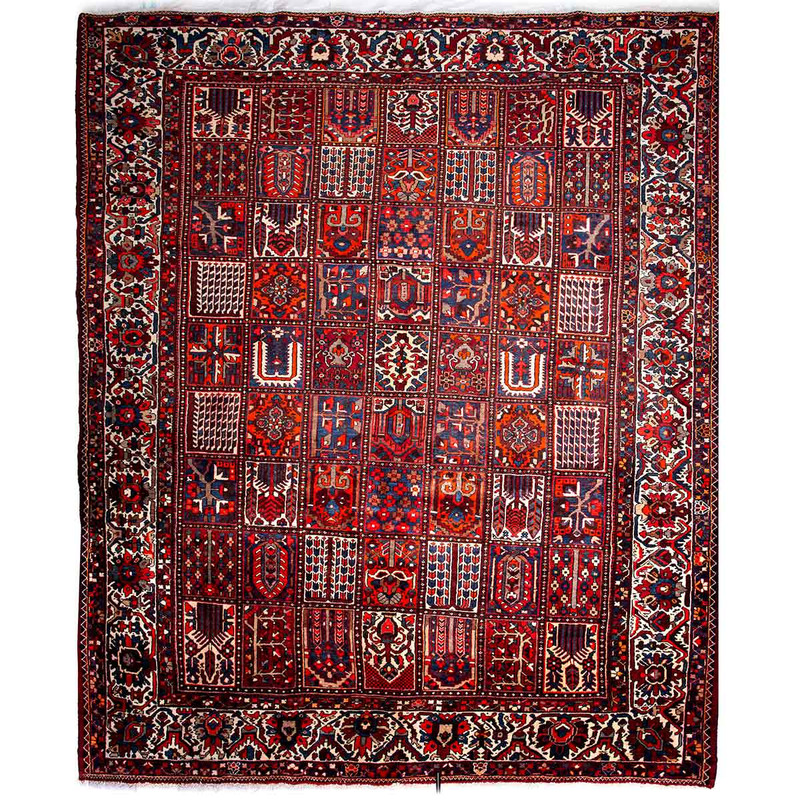
A Bakhtiari khesti (panel) rug in madder red, navy blue, and cream - Bakhtiari Persian Rug 12x10 ft - Kheshti Semi Antique Wool Hand Knotted
Reading the Symbols in the Panels
Beyond the cypresses, willows, and vases, panel rugs contain a rich vocabulary of smaller symbols, each with its own associations in Persian culture:
•
Pomegranate trees - fertility, abundance, and the richness of the orchard.
•
The boteh - the teardrop motif, interpreted as a flame, a seed, or a bending cypress.
•
Peacocks - beauty, immortality, and the gardens of paradise.
•
Songbirds and nightingales - love and the poetry of the garden.
•
Stars and rosettes - small geometric flowers that fill spaces and add rhythm.
•
Lions and deer - strength and grace, sometimes drawn in simple, charming forms in village rugs.
Not every weaver intended these meanings, and many motifs are simply beloved shapes passed down through families. But knowing the traditional associations adds another layer of enjoyment to a garden rug. For more, see our article on Persian rug design motifs.
How Weavers Plan a Panel Rug
Weaving a panel rug requires careful planning. The weaver first establishes the grid: how many panels across and how many along the length, and how wide the dividing lines will be. In village weaving this is often done by counting knots rather than following a drawn cartoon, so the weaver must keep the grid consistent across thousands of rows. The motifs inside each panel are then woven from memory or from a small sample, and the ground colors of the panels are alternated in a planned sequence.
Because each panel is a small, complete composition, the panel design gives weavers a wonderful opportunity for variety. Some rugs repeat the same few motifs in a strict diagonal rhythm; others seem almost like a sampler of the weaver's whole repertoire, with no two panels exactly alike. Collectors often enjoy studying a panel rug section by section, discovering small birds, animals, or unusual flowers hidden in the compartments.
The Colors of the Garden
Garden and panel rugs have a characteristic palette. Warm madder reds and deep blues usually dominate, with ivory, yellow, and especially green - the color of the garden itself - used more generously than in many other Persian rugs. The blue or dark lines that divide the panels recall water channels, and alternating red, ivory, and blue grounds give the field its checkerboard rhythm. Our series on Persian rug color, beginning with the master dyer, explains how these colors were made.
6
Garden Designs Beyond the Bakhtiari
Although the panel design is most strongly linked to the Bakhtiari, it has been woven in many other regions, including Qum, Birjand, Kerman, and Tabriz. In fine city rugs such as silk Qum pieces, the panels are drawn with great delicacy and filled with intricate floral details. In village rugs, the panels are bolder and more geometric. Each version interprets the same idea - a garden divided into ordered compartments - in its own regional language.
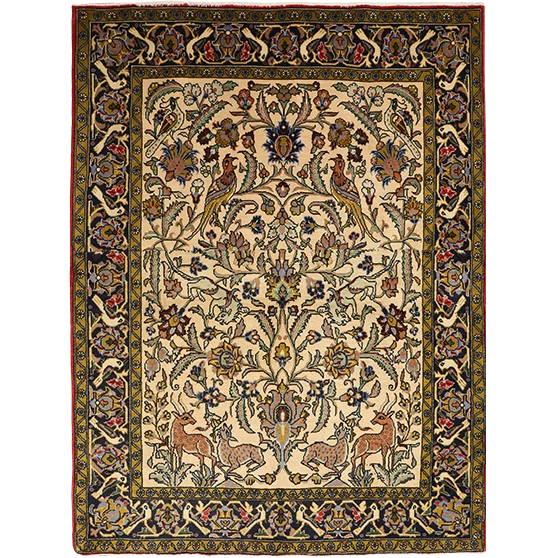
A finely woven Qom rug with a medallion design - Qom Persian Rug 5x3 ft - Medallion Semi Antique Silk Hand Knotted
7
How to Recognize a Fine Panel Rug
Panel rugs vary widely in quality. When evaluating one, look at these points:
•
Consistency of the grid - in a well-made rug the panels are evenly sized and aligned, and the lines between them run straight across the field.
•
Variety within order - the best panel rugs combine a strict grid with lively variety inside the compartments, so that motifs repeat in a rhythm without becoming monotonous.
•
Color balance - look for a pleasing alternation of grounds from panel to panel, often red, ivory, blue, and green, arranged diagonally or in repeating sequences.
•
Quality of wool and dyes - Bakhtiari panel rugs are traditionally woven with strong, lustrous wool. Natural dyes give soft, harmonious tones and gentle abrash.
•
Drawing of the motifs - even in geometric village versions, the trees, vases, and birds should be drawn with confidence and character.
8
Decorating with Garden Rugs
Because the panel design spreads its interest evenly across the field rather than focusing on a single medallion, it works especially well in rooms where furniture covers part of the rug, such as living rooms and dining rooms. The grid structure brings a sense of order and calm, while the individual motifs reward close attention. A garden rug in rich laki red pairs beautifully with warm woods and traditional furnishings, while lighter or more faded examples suit modern and transitional spaces. Our Inspiration Gallery shows ideas for every room.
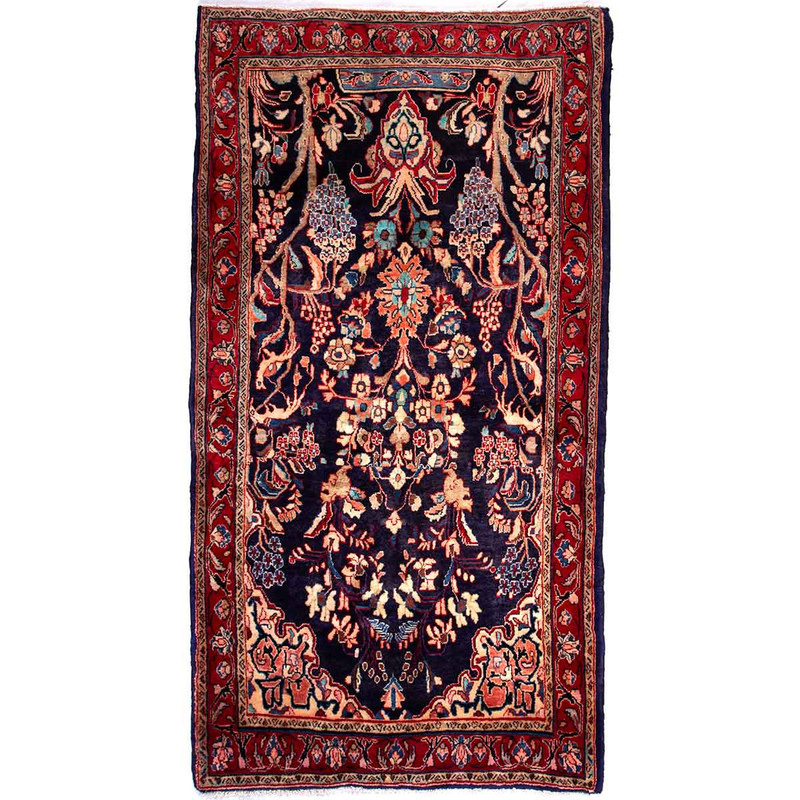
A tree of life design in an Arak rug, an echo of the Persian garden - Arak Persian Rug 8x4 ft - Tree of Life Semi Antique Wool Hand Knotted
9
The Garden Design Beyond Persia
The Persian garden design traveled far beyond Persia's borders. Mughal emperors in India, admirers of Persian culture, built four-part gardens across their empire, and Persian-style garden carpets were woven in Mughal workshops, sometimes by Persian craftsmen. In the Caucasus and Anatolia, weavers also adapted garden and panel layouts into their own geometric styles. Even today, many weaving centers around the world produce panel designs inspired by the Bakhtiari tradition.
Yet the garden design remains deeply Persian at its heart. Its origins lie in the irrigated gardens of the Persian plateau, its symbols in Persian poetry and belief, and its finest expressions in the carpets of Kerman, Isfahan, and the Bakhtiari villages. When you choose a garden rug, you are bringing home a design that has carried the Persian idea of paradise across three thousand years.
10
The Garden in Persian Poetry and Art
The garden is everywhere in Persian literature. Saadi named his famous thirteenth-century masterpiece the *Golestan*, "The Rose Garden," and Hafez filled his poems with roses, nightingales, cypresses, and flowing streams. For Persian readers, the garden is a place of beauty, love, reflection, and spiritual meaning, and poets often compared a beloved's stature to a cypress or a face to a rose.
The same images appear in miniature painting, tilework, textiles, and carpets. Persian miniatures frequently show princes and poets seated on carpets in gardens, and the borders of manuscripts are decorated with the same scrolling vines and blossoms found in carpet borders. A garden rug therefore belongs to a much larger artistic world, and part of its appeal is the way it brings the imagery of Persian poetry into everyday life. Our article on the romantic relationship between Persian rugs and traditional music explores another side of this cultural connection.
11
Garden Rugs Through the Seasons of a Home
One of the special pleasures of a garden rug is the way it changes the feeling of a room through the year. In winter, the warm reds and deep blues of a Bakhtiari panel rug bring warmth and color indoors, recalling the Persian custom of evoking spring in the home during the cold months. In summer, the greens, cypresses, and flowering shrubs feel fresh and cooling, especially in rooms filled with natural light.
Garden rugs also respond beautifully to the way they are lit. Because each panel holds its own small composition, side lighting from a window brings out the texture of the pile and the subtle variation in the dyes, while evening lamplight deepens the reds and softens the grid. Many owners find that they keep discovering new details years after a rug has entered their home.
Practical care is simple. Bakhtiari wool is strong and resilient, and panel rugs hide everyday wear well thanks to their busy, evenly distributed pattern. Rotate the rug once or twice a year so that sunlight and foot traffic are shared evenly, vacuum gently, and have it professionally washed every few years. Our care instructions explain the details, and our rug size guide will help you choose a size that lets the grid of panels show to full advantage.
12
Collecting Garden and Panel Rugs
For collectors, garden and panel rugs offer an attractive combination of artistic interest and practicality. Antique and semi-antique Bakhtiari panel rugs are durable, decorative, and full of character, and they remain more accessible than the rare court garden carpets. When considering a panel rug, look for good condition of the pile and foundation, natural or well-made dyes, a confident and lively drawing of the motifs, and a pleasing rhythm of colors across the panels.
Size also matters. Panel designs work best in larger rugs, where the grid has room to develop, but smaller rugs and runners with a few rows of panels can be charming as well. Our article on investing in hand-knotted rugs discusses the broader factors that shape long-term value.
13
Frequently Asked Questions
What is the difference between a garden rug and a khesti rug?
A garden rug shows a recognizable garden, often with water channels, trees, and pools. A khesti rug is the stylized form, with the field divided into tile-like panels, each holding a motif.
Where are panel rugs woven today?
Mainly in the Bakhtiari region of Chaharmahal, but also in other centers such as Qum, Tabriz, and Birjand.
Are garden rugs suitable for modern interiors?
Yes. Their grid structure feels orderly and architectural, which suits both modern and traditional rooms.
What does the cypress mean in a garden rug?
The cypress, which stays green all year, is a traditional symbol of eternal life, freedom, and dignity in Persian culture.
14
The Meaning of the Garden Rug
The garden design carries many layers of meaning. It speaks of paradise and of the Persian love for nature. It reflects the Islamic image of a heavenly garden with flowing rivers. It records the practical knowledge of irrigation that made life possible on the Persian plateau. And it offers a calm, balanced composition that suits almost any interior, traditional or modern.
For other classical compositions, see our overview of Persian rug design families and our article on the many faces of the Tree of Life. To browse panel rugs, explore our khesti designs and Bakhtiari collection.
At Los Angeles Home of Rugs, every garden and panel rug comes with a Certificate of Authenticity documenting its origin, materials, and age. Whether you are drawn to the bold panels of a Bakhtiari village rug or the refined drawing of a fine city piece, our specialists are happy to help you find the right rug - simply ask our experts.
Explore Garden and Panel Rugs
Khesti Designs
Bakhtiari Rugs
Vase Designs
Tree Designs
Cypress Tree
Qum Rugs
Persian Rug FAQ