


On the road from Yazd to Nain, at the edge of the great central desert of Persia, lies the town of Ardekan. It is a place of mud-brick lanes, wind towers, and old caravan routes, and it is also a quiet but productive center of hand-knotted rugs. Ardekan rugs follow the elegant city style of central Persia, especially the style of Kashan, but they have their own character and offer excellent value.
This guide is written for buyers. It explains where Ardekan rugs come from, how they are designed and built, how they compare with their better-known neighbors, and how to judge and care for one. For the wider weaving culture of the province, see our article on weaving in Yazd.
1
Ardekan and Its Setting
Ardekan lies in the north-west of Yazd province, about 60 kilometers north-west of the city of Yazd, on the main road toward Nain and Isfahan. The land around it is dry and flat, broken by mountains to the west and by desert to the east. Summers are long and hot, winters short and cold at night.
Life in such a climate has always depended on careful use of water. The town's old districts were built around qanats, the underground channels that carry water from distant mountains, and its houses are cooled by badgirs, the tall wind towers that catch the breeze. The same patience and craft that built these systems went into the town's textiles.
Ardekan was historically known for camel breeding and for its place on the caravan routes linking Yazd with the north and west of the country. Caravans brought wool, dyes, and ideas, and took finished goods to the markets of Isfahan, Kashan, and beyond. Close by stand some of the most important Zoroastrian sites in Persia, such as the mountain shrine of Chak Chak, and the old town of Meybod, famous for its pottery and for the flat-woven zilou. Read our article on the zilou of Meybod.
2
A Short History of Ardekan Weaving
Weaving of pile rugs in Ardekan in its present form is relatively recent. Persian sources date the growth of the town's rug production to roughly the last 150 years, when the demand for central Persian city rugs grew in both national and foreign markets and weaving spread from the major centers to smaller towns.
Ardekan's weavers looked above all to Kashan, the great rug city to the north-west. Designers and merchants carried Kashan patterns to Ardekan, and the town adopted not only Kashan designs but also many of its standards of size, color, and structure. Over time, Ardekan rugs developed a recognizable identity of their own: Kashan-like in design, sometimes Nain-like in color, but with a slightly bolder hand and a more accessible price.
In the Persian market, rugs from many workshops across Yazd province are often sold under the Ardekan name, much as the name Arak covers many villages of Markazi province. A rug labeled Ardekan is therefore best understood as a central Persian rug of the Yazd region, woven in the Kashan manner.
Ardekan rugs follow the classical design language of Kashan, adapted by the weavers of Yazd province. They offer the look of a central Persian city rug at a lower price than Kashan or Nain rugs of similar size.
3
How to Recognize an Ardekan Rug
•
Classical city design - Curvilinear medallions, palmettes, and flowering vines, drawn with smooth curves rather than steps.
•
Medallion and corners - Most rugs have a central medallion, often lobed or star-shaped, and four matching corner pieces.
•
Dense floral field - The field around the medallion is filled with flowers, vines, and sometimes grapevine-like tendrils.
•
Herati main border - The main border often uses the Herati motif, while the guard borders carry small rosettes.
•
Red, navy, and ivory - The classic palette, sometimes with Nain-style light blue and ivory combinations.
•
Persian knot - The asymmetric knot, typical of central Persian city rugs, gives smooth outlines to curved motifs.
If a rug has a Kashan-like design but a slightly lower knot density, a somewhat bolder drawing, and a Yazd origin, it is very likely an Ardekan.
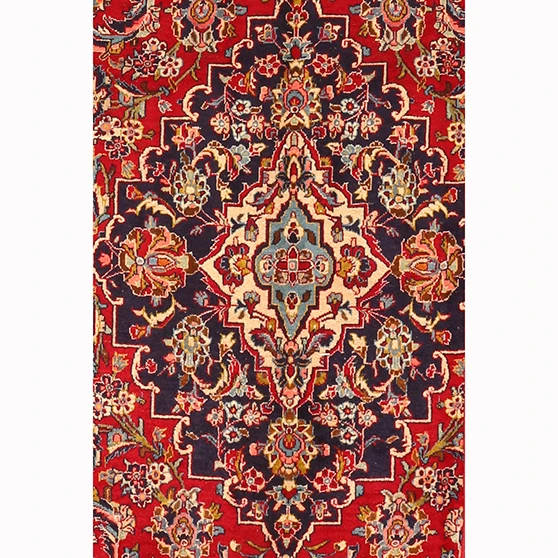
A large Ardekan rug with a classical floral medallion, Shah Abbasi palmettes, and a red and navy palette - Ardekan Persian Rug 13x9 ft - Medallion Semi Antique Wool Silk Hand Knotted
4
Designs You Will Meet
The Kashan medallion
The most common Ardekan design is the classical Kashan medallion: a large, lobed medallion in the center, a pendant at each end, four corners echoing the medallion, and a field of palmettes, flowers, and arabesque vines. The design is formal and balanced, ideal for living and dining rooms.
Shah Abbasi palmettes and Eslimi arabesques
Within this layout, the main motifs are Shah Abbasi palmettes, large stylized flowers named after the Safavid king, and Eslimi arabesques, spiraling vines with split leaves. These motifs give the field rhythm and movement. See our Shah Abbasi designs and Eslimi designs.
Allover floral designs
Some Ardekan rugs repeat flowers and palmettes across the field without a medallion. These rugs have a more relaxed look and work well where furniture will cover part of the rug.
Herati fields
A smaller group uses the Herati repeat across the field, sometimes around a central medallion. The Herati gives a fine, even texture that hides wear and suits busy rooms.
Light-ground rugs
Ardekan weavers also make rugs with ivory or cream fields and blue and light blue motifs, in a style close to Nain. These rugs look fresh and airy and are popular in modern homes.
5
How Ardekan Rugs Are Built
•
Knot - The asymmetric or Persian knot, which allows smooth curves and fine detail.
•
Foundation - Cotton warps and wefts in most rugs. Rare pieces have a silk foundation.
•
Pile - Wool, clipped short to medium so that the floral drawing stays sharp. Silk is sometimes used for small highlights.
•
Density - Usually around 30 to 40 raj in the Persian measure, about 120 to 200 knots per square inch, lower than most Kashan and Nain rugs.
•
Dyes - Persian sources describe the traditional use of plant dyes such as madder for reds.
•
Finish - Sides overcast in wool, cotton fringes, and often a small plain band at each end.
The cotton foundation and medium density make Ardekan rugs stable and durable, with a firm, flat handle. They are well suited to everyday living spaces.
6
Ardekan Compared with Its Neighbors
Ardekan and Kashan
Kashan rugs are the model for most Ardekan designs. A fine Kashan rug is usually more densely knotted, with more detailed drawing and a wider range of shades. An Ardekan rug has a slightly bolder hand and is usually less expensive. For a buyer who loves the Kashan look but wants a lower price, an Ardekan is often the ideal choice. See our Kashan collection and our Kashan weaving guide.
Ardekan and Nain
Nain rugs, from the town just north-west of Ardekan, are famous for very fine knotting, short pile, and ivory and blue palettes, often with silk outlines. Some Ardekan rugs borrow Nain colors, but they are generally coarser and less expensive. See our Nain collection and our article on weaving in Nain.
Ardekan and Yazd
Rugs sold simply as Yazd come from the provincial capital and nearby workshops and share the same Kashan-inspired design language. In practice the line between Yazd and Ardekan rugs is often a matter of labeling rather than style. See our Yazd collection.
Ardekan and Kerman
Kerman rugs, from the south-east, are also curvilinear and floral, but they often have softer pastel palettes, wider color ranges, and a different structure. They tend to feel softer and more painterly. See our Kerman collection.
Kashan for the finest classical drawing, Nain for fine ivory and blue rugs, and Ardekan for the classical look at a gentler price.
7
Colors of Ardekan
The traditional palette of Ardekan rugs is built on madder red, navy blue, and ivory. Burgundy, rust, gold, green, and light blue appear as accents. A red field with a navy medallion and ivory corners is the most classic combination.
Lighter rugs, with cream or camel fields and red, blue, and brown motifs, are also common, especially among semi-antique pieces whose colors have mellowed. Over forty to sixty years, the bright reds of a new rug soften toward rust and rose, and ivory warms toward cream. These settled colors are one reason many buyers choose semi-antique rugs.
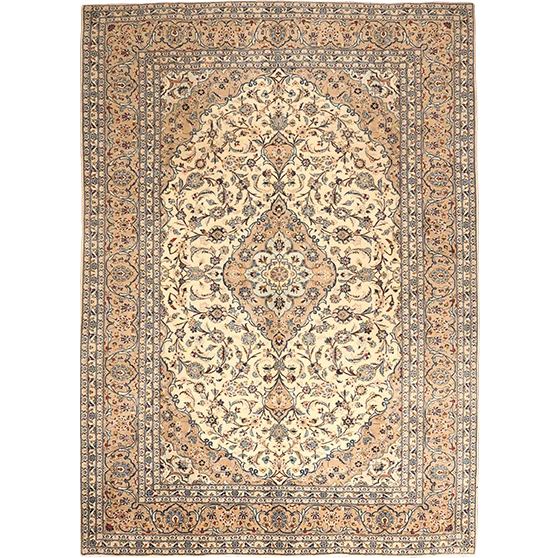
A room-size Ardekan rug in cream, camel, and rust red, a lighter take on the classical Kashan style - Ardekan Persian Rug 11x8 ft - Medallion Semi Antique Wool Silk Hand Knotted
8
Grades and Quality
Persian sources note that rugs from the larger workshops in Yazd province are generally of a higher standard than village rugs, though village rugs can still be very good. When judging an Ardekan rug, look at:
•
Drawing - Smooth, symmetrical curves and well-matched corners show skilled weaving.
•
Knot density - Turn the rug over. Smaller, more even knots give a clearer image.
•
Wool - Lustrous, springy wool wears better than dry wool.
•
Color - Clear, harmonious colors with no bleeding.
•
Flatness - The rug should lie flat with straight sides.
•
Pairs - Ardekan rugs were often woven in pairs for matching rooms or the two sides of a room. A matched pair is worth more than two single rugs.
9
Reading the Back
On the back of an Ardekan rug, the Persian knots appear as small, slightly offset bumps, giving the back a fine texture. The design should be clear, and the rows of knots should run straight. Because most rugs are double-wefted, the back feels firm and smooth.
Check the ends and sides. The fringe should be the continuation of the warp threads. The overcasting on the sides should be secure, and there should be no loose rows near the ends. On semi-antique rugs, small repairs are normal, but they should be well done and in matching colors.
10
Sizes
Ardekan rugs follow Kashan sizes. Common sizes include about 3 by 5, 5 by 7, 6 by 9, 7 by 10, and 8 by 10 to 8 by 11 feet. Larger room-size pieces of 10 by 13 or 10 by 14 feet are also woven, especially in semi-antique production.
•
Large living rooms - A 10 by 13 or 10 by 14 foot rug can hold an entire seating area.
•
Dining rooms - An 8 by 11 or 9 by 12 foot rug suits a table for six to eight.
•
Bedrooms - A 6 by 9 or 7 by 10 foot rug fits well under a queen or king bed.
•
Entries and studies - A 3 by 5 rug is a charming introduction to the style.
11
The Ardekan Carpet Museum
In the old quarter of Ardekan stands the historic Malek Afzali house, a traditional desert mansion with courtyards and wind towers that has been restored as a carpet museum. The museum shows rugs and carpets of the region and gives visitors a sense of how weaving fitted into the life of a desert town. For anyone traveling in Yazd province, it is a fine place to see the local style in its own setting.
12
Ardekan Rugs in Your Home
The classical design of an Ardekan rug makes it at home in traditional rooms, with dark wood furniture, books, and rich fabrics. A red and navy rug gives warmth to a formal living or dining room. In a modern home, a semi-antique Ardekan with softened colors adds depth and history without overwhelming clean lines.
Light-ground Ardekan rugs are especially versatile. Cream and camel tones sit easily with white walls, natural wood, and neutral upholstery, while the floral drawing adds softness to modern interiors.
Because the design is centered on a medallion, place the rug so the medallion sits under a coffee table or dining table. In a bedroom, the medallion can sit just below the bed, with the corners and borders framing the space.
13
The Weavers Behind the Rugs
Most Ardekan rugs are woven by women, either at home on upright looms or in small workshops. In a typical arrangement, a merchant or workshop owner supplies the design, a cartoon drawn on squared paper, together with dyed wool and the cotton for the foundation. The weaver, often working with a daughter or a neighbor, follows the cartoon knot by knot. A medium-size rug may take many months to finish, and a large room-size carpet can occupy a team of weavers for a year or more.
Persian accounts also describe how weavers from small towns and villages of the province moved to larger centers for seasonal work, carrying techniques and ideas back home with them. This exchange helps explain why rugs from across Yazd province share a common standard of structure and design, and why the best Ardekan rugs can stand comparison with rugs from more famous centers.
Designers play an equally important role. The patterns used in Ardekan are not improvised; they are drawn by specialist designers, often adapted from classic Kashan cartoons. A good cartoon, well executed, is what gives an Ardekan rug its balanced, finished look. Read more about the people who make a Persian rug in our article on the craft from shepherd to dealer.
14
Combining an Ardekan with Other Rugs
If you are furnishing several rooms, an Ardekan rug combines well with other central Persian rugs. A red Ardekan in the living room pairs naturally with a Kashan or Isfahan in the dining room, since they share the same design language. For contrast, a geometric tribal rug, such as a Qashqai or an Afshar, in a study or hallway adds energy without clashing, as long as the reds and blues are in a similar range.
In an open-plan space, use rugs with related colors to tie the areas together. Two Ardekan rugs, or an Ardekan with a Nain of similar palette, can define a seating area and a dining area while keeping the room unified. Avoid placing two busy medallion rugs right next to each other; separate them with a stretch of floor or a quieter piece.
15
Why Many Buyers Choose a Semi-Antique Ardekan
Semi-antique Ardekan rugs, woven roughly forty to sixty years ago, combine several advantages. Their colors have softened naturally, without the harshness some new rugs show. Their wool has been walked on enough to develop a gentle sheen. Their foundation is still strong, so they are ready for many more decades of use. And because the Ardekan name is less famous than Kashan or Nain, they are often priced well below what a comparable rug from those centers would cost. See our semi-antique rugs.
16
What Affects the Price
•
Size - Larger rugs cost more because they take longer to weave.
•
Density - Finer rugs take more time and command higher prices.
•
Condition - Even pile, intact ends and sides, and few repairs raise value.
•
Age - Well-kept semi-antique rugs are often sought after for their settled colors.
•
Pairs and matching sets - Matching rugs are rarer and more valuable.
Compared with Kashan and Nain rugs of the same size, Ardekan rugs usually offer a lower price, making them one of the best-value classical Persian rugs on the market.
17
Common Buying Mistakes
•
Expecting Kashan density - An Ardekan is not a cheaper Kashan of the same fineness. Judge it on its own merits.
•
Ignoring the back - The back shows knot size and repairs more honestly than the front.
•
Choosing too small a rug - A medallion rug looks best when the whole medallion is visible and the borders frame the space.
•
Overlooking sun damage - Check for faded areas, especially on one side of the rug.
18
Caring for an Ardekan Rug
Vacuum regularly without a beater bar. Rotate the rug every six months so wear and light are even. Blot spills at once and never rub. Use a good rug pad. Have the rug professionally washed every few years. See our care instructions and our guide to professional washing.
19
Frequently Asked Questions
Is it Ardekan or Ardakan?
Both spellings are used for the same town in Yazd province.
Where is Ardekan?
In the north-west of Yazd province, about 60 kilometers from Yazd, on the road toward Nain.
What style do Ardekan rugs follow?
Mainly the classical city style of Kashan, sometimes with Nain-style colors.
What knot is used?
The asymmetric or Persian knot.
How fine are Ardekan rugs?
Usually about 30 to 40 raj, or 120 to 200 knots per square inch.
Are Ardekan rugs cheaper than Kashan rugs?
Generally yes, because they are usually less densely knotted.
What colors are typical?
Red, navy, and ivory, with burgundy, gold, green, and light blue accents.
Are Ardekan rugs durable?
Yes. Their cotton foundation and good wool make them sturdy for everyday use.
Is there a carpet museum in Ardekan?
Yes. The historic Malek Afzali house has been restored as a carpet museum.
Were Ardekan rugs woven in pairs?
Often, yes. Matching pairs are prized.
What sizes are common?
From 3 by 5 to room-size pieces of 10 by 14 feet.
Who weaves Ardekan rugs?
Mostly women, at home or in small workshops, following cartoons drawn by specialist designers.
Do Ardekan rugs suit modern homes?
Yes, especially semi-antique and light-ground pieces with softened colors.
How should I clean an Ardekan rug?
Vacuum regularly, blot spills, and have it professionally washed every few years.
20
Choose Your Ardekan Rug
Each Ardekan rug in our collection is hand-knotted, one of a kind, and inspected before it is listed. Browse our Ardekan collection, compare it with our Kashan, Nain, and Yazd rugs, or ask our experts for help.
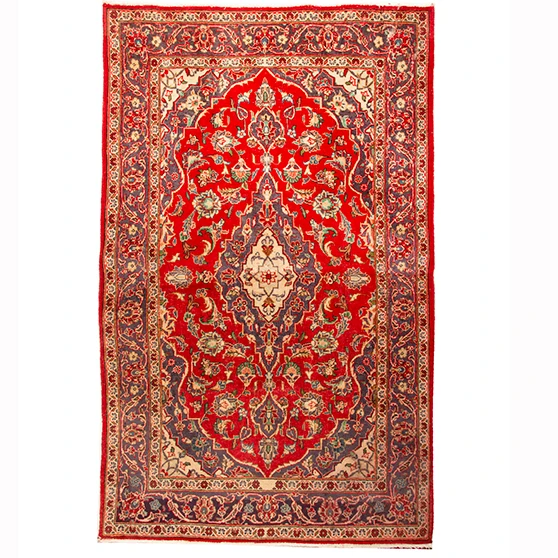
A small Ardekan rug in madder red, cream, and navy, an easy way to bring the style into an entry or study - Ardekan Persian Rug 5x3 ft - Medallion Semi Antique Wool Silk Hand Knotted