


Yazd Rugs: Weaving in the Desert City of Yazd and Ardakan
Los Angeles Home of Rugs on Nov 17th 2026
Rising from the desert in the very heart of Persia, the ancient city of Yazd is one of the most remarkable places in the country: a labyrinth of sun-baked mud-brick lanes, domed roofs, and tall windcatchers that funnel cool air into the houses below. For more than a thousand years, Yazd has been a city of merchants, craftsmen, and weavers, famous across Asia for its silks and textiles long before its rugs became known in the West.
This article explores the weaving traditions of Yazd and its neighboring town of Ardakan: the city's history and textile heritage, the desert madder fields that supplied red dye to much of Persia, the related crafts of termeh, ikat, and zilou, and the rugs themselves - their designs, structure, colors, and how to recognize them.
1
A City Built Against the Desert
Yazd sits between two great deserts, the Dasht-e Kavir to the north and the Dasht-e Lut to the southeast. Its survival has always depended on ingenuity. The city's builders developed thick mud-brick walls that keep houses cool, windcatchers (badgir) that capture the slightest breeze, and an extensive network of qanats - ancient underground channels that carry water from distant mountains to the city and its fields. In 2017, the historic city of Yazd was inscribed on UNESCO's World Heritage List in recognition of this extraordinary desert architecture.
Yazd is also the historic heart of the Zoroastrian community of Persia. The city's fire temple, according to tradition, houses a sacred flame that has been kept burning for many centuries, and the surrounding desert holds the ancient Zoroastrian "towers of silence." This long and continuous history has made Yazd a living museum of Persian culture.
2
Yazd Through the Centuries
Yazd's history stretches back to antiquity. The city grew under the Sasanians and became an important stop on caravan routes linking central Persia with Kerman, Khorasan, India, and the Persian Gulf. Its isolation in the desert protected it from many invasions, and when other cities suffered during the Mongol conquests, Yazd remained relatively safe, attracting scholars, artists, and craftsmen.
In the fourteenth century, under the local Muzaffarid dynasty, Yazd flourished. Its magnificent Friday Mosque, with one of the tallest portals in Persia and exquisite tilework, dates largely from this period. Later, under the Safavids and Qajars, Yazd remained a prosperous center of trade and manufacturing, especially for silk, and its merchants traded across Persia and beyond. This long commercial tradition, built on caravans, bazaars, and skilled crafts, laid the foundation for the city's later carpet industry.
3
Pattern and Symbol in a Zoroastrian City
Yazd's Zoroastrian heritage adds another layer to its artistic traditions. Fire, light, and the evergreen cypress hold deep significance in Zoroastrian culture, and some scholars connect the boteh motif - so common in Yazd's termeh fabrics - with the image of a flame or a bending cypress. Whether or not that interpretation is correct, the boteh is everywhere in Yazd's textiles, and it links the city's fabrics to the wider vocabulary of Persian rug design described in our article on Persian rug motifs.
The ancient cypress of Abarkuh, in Yazd Province, is said to be one of the oldest living trees in the world, estimated by some to be several thousand years old. For many Persians, it is a powerful symbol of endurance, and the cypress motif in rugs carries some of that meaning.
4
A Center of Silk and Textiles
Long before rugs, Yazd was famous for textiles. Medieval travelers praised the fine silk cloth made in the city, and the Venetian traveler Marco Polo, passing through in the thirteenth century, described Yazd as a large and noble city with a great trade in silk fabrics that were carried to many places. Silk weaving remained a major industry in Yazd for centuries, and the city's weavers developed sophisticated techniques for patterned and brocaded fabrics.
Termeh
Yazd is the most important center of termeh, a luxurious woven fabric with intricate patterns, especially the boteh (paisley), woven in fine wool or silk on traditional looms. Termeh has long been used for tablecloths, wall hangings, clothing, and ceremonial covers, and it shares much of its design vocabulary with Persian rugs, particularly the boteh.
Ikat
Yazd is also known for ikat (daraei), a technique in which threads are tie-dyed before weaving to create softly blurred patterns. Our article on ikat weaving in Yazd explores this beautiful craft.
Zilou
In the nearby town of Meybod, weavers produce zilou, a sturdy flatwoven cotton floor covering traditionally used in mosques and homes, often in blue and white with simple geometric patterns. Our article on zilou weaving tells its story. Meybod is also famous for its pottery, described in our article on Persian pottery.
This deep textile culture shaped Yazd's rug weaving. Designers and weavers in Yazd grew up surrounded by pattern, color, and technical skill, and the transition to carpet weaving came naturally.
5
The Madder Fields of Yazd and Ardakan
Yazd's contribution to Persian rugs goes far beyond the rugs woven in the city itself. The dry desert soils around Yazd, Ardakan, and Bafgh have long been famous for growing madder (runas), the root that provides the classic reds of Persian rugs. Madder from this region was traded throughout Persia and beyond, and many experts consider desert-grown madder especially strong.
Persian research on madder confirms the region's importance: studies have compared madder roots of different ages from Bafgh, Ardakan, Kharanaq, and nearby Nain, and Ardakan remains a center of madder processing today. So when you admire the warm red field of a rug from Kashan, Kerman, or Heriz, there is a good chance its color began in the madder fields of Yazd. Our article on the principal natural dyes describes madder in detail.
Madder roots are usually harvested after three years or more. Persian studies note that color strength tends to rise from around the third year, with older roots giving deeper, more purple-red tones - knowledge that the dyers and farmers of Yazd have practiced for centuries.
6
The Bazaar of Yazd
Like every great Persian city, Yazd grew around its bazaar, a long network of vaulted, shaded lanes where merchants, craftsmen, and traders worked side by side. Dyers, spinners, cloth merchants, and carpet dealers each had their place, and caravanserais along the edges of the bazaar housed traveling traders and their goods. Raw materials such as madder, cotton, and wool were bought and sold here, finished textiles were traded, and news of new designs and markets passed from merchant to merchant.
The bazaar was also where the city's carpet industry was organized in the twentieth century. Merchants supplied weavers with wool, dyed yarn, and cartoons, collected the finished rugs, and arranged for washing and export. Many of these family firms continue today, and the bazaar remains a lively place to see carpets, termeh, and other crafts of the region.
7
The Rise of Yazd Rug Weaving
Although Yazd had long woven textiles, its carpet industry developed most strongly in the twentieth century. In the 1920s and 1930s, merchants from neighboring Kerman, one of Persia's greatest carpet centers, began organizing rug production in Yazd and exporting Yazd rugs to European and American markets. As a result, early Yazd rugs show strong Kerman influence in their structure and designs.
Over the following decades, Yazd developed its own production, and workshops in Yazd and Ardakan began weaving rugs in a range of styles, borrowing designs from Kashan and Tabriz as well as Kerman. Today the province produces a wide variety of rugs, from medium-quality decorative carpets to fine workshop pieces in wool and silk.
8
Weaving in a Desert Climate
Weaving in Yazd has always adapted to the desert climate. In traditional houses, weavers often set up looms in cooler rooms and basements, where thick walls and windcatchers kept temperatures bearable in summer, and many worked in the early morning and evening to avoid the midday heat. The dry air helps wool and dyed yarn dry quickly, while water from the qanats supplied the dye houses and rug washers. These practical adaptations are part of the rhythm of craft life in the city.
The desert also shaped materials. Sheep raised on the sparse desert pastures produce wool that is generally shorter and drier than mountain wool, so Yazd workshops have often brought in wool from other regions for their better rugs. Cotton for foundations was grown in the region and traded through the city's bazaars.
9
Yazd and Its Neighbors
Yazd sits between several of Persia's great weaving centers, and comparing them helps clarify its character:
•
Kerman - Yazd's most important influence. Kerman rugs share Yazd's multiple-weft structure but often have softer wool, wider palettes, and more naturalistic floral designs. See our article on weaving in Kerman.
•
Nain - to the northwest, famous for very fine wool-and-silk rugs on ivory and blue grounds. Nain and Yazd share access to the same madder country.
•
Isfahan - to the northwest, the source of many classical designs that Yazd and Ardakan weavers adapted.
•
Kashan - whose medallion designs and red-and-blue palettes inspired many Yazd rugs.
Yazd rugs therefore sit at a crossroads, combining Kerman structure with Kashan and Isfahan design ideas and the red of their own madder fields.
10
Characteristics of Yazd Rugs
Structure
Yazd rugs are typically woven with the asymmetrical (Persian) knot on cotton foundations. Following the Kerman tradition, many use multiple wefts, often three passes of weft between rows of knots, which gives the rug a firm, flat structure. Pile height is usually short to medium, suited to detailed floral designs. Our article on how a Persian rug is made explains these structural terms.
Designs
Older Yazd rugs often feature the Herati pattern and medallion-and-corner compositions on grounds and borders adapted from Kashan rugs. Later production adopted Tabriz-style medallions, Kerman-style floral designs, and Shah Abbasi palmettes. Yazd and Ardakan versions of these designs often have their own slightly different drawing and proportions, which experts can recognize. Browse our medallion and Herati designs.
Colors
Given the region's madder heritage, it is no surprise that reds are central to the Yazd palette: madder red, crimson, and rose, often combined with navy blue, ivory, and soft greens and golds. Some Yazd and Ardakan rugs follow Kerman's softer, wider palette with pastel shades, while others use the classic red-and-blue scheme of Kashan.
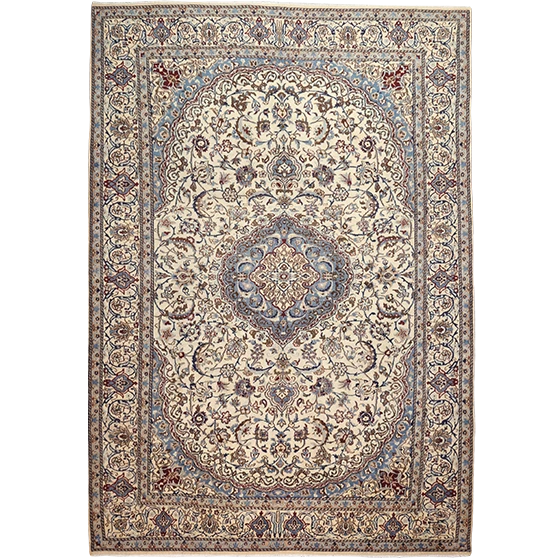
A Yazd medallion rug from our collection - Yazd Persian Rug 11x8 ft - Medallion Semi Antique Wool Hand Knotted
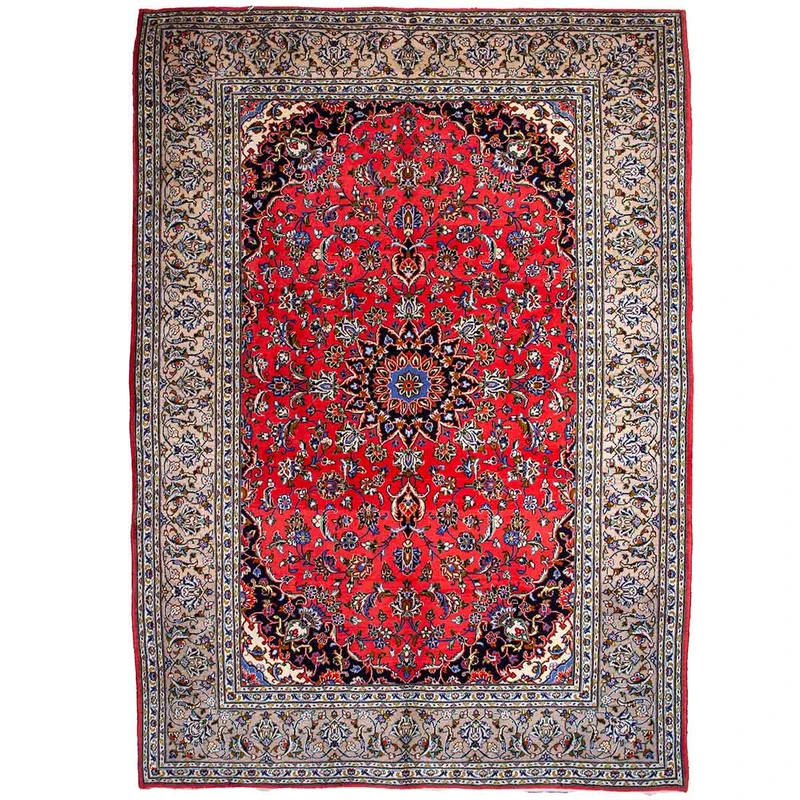
A smaller Yazd rug with a medallion design - Yazd Persian Rug 9x6 ft - Medallion Semi Antique Wool Hand Knotted
11
Ardakan - A Town of Fine Weaving
About forty miles northwest of Yazd lies Ardakan, a desert town with its own weaving reputation. Ardakan rugs are often finely woven, sometimes with silk highlights, and many follow Kashan and Tabriz designs, especially medallion compositions with dense floral fields. The town's long association with madder processing gives its weavers easy access to excellent red dyes.
Ardakan rugs are usually woven on cotton foundations with the asymmetrical knot, and they are known for good, even construction. In the trade, they are sometimes grouped with Yazd rugs, but fine Ardakan pieces stand on their own. Explore our Ardakan collection.
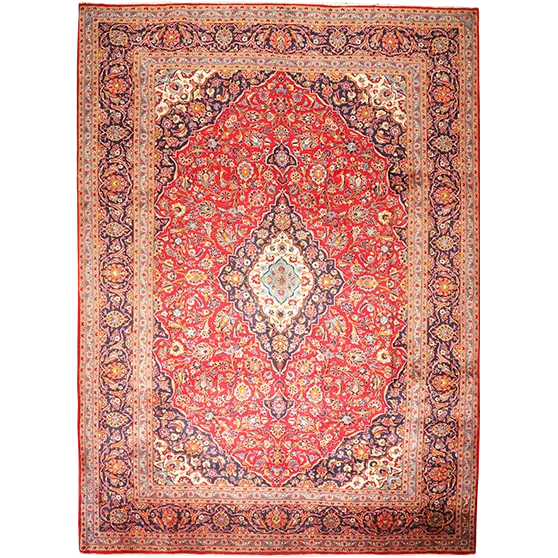
A large Ardekan medallion rug in wool with silk highlights - Ardekan Persian Rug 14x10 ft - Medallion Semi Antique Wool Silk Hand Knotted
12
Other Weaving Centers of Yazd Province
Beyond Yazd and Ardakan, several towns in the province contribute to its weaving traditions. Meybod is famous for zilou and pottery, Bafgh is known for madder, and towns such as Taft and Mehriz have their own crafts and agricultural traditions. Village weavers across the province produce rugs and flatweaves for local use as well as the market. The province's location between Kerman, Isfahan, and Khorasan has always made it a meeting point of influences, which is reflected in its diverse rug styles.
13
Inside a Yazd Workshop Today
A visit to a carpet workshop in Yazd or Ardakan today shows how tradition and modern practice meet. Looms of different sizes stand in rows, each with one or more weavers seated on a bench, tying knots from colored yarn hanging above them and following a cartoon pinned in front of them. Experienced weavers work with remarkable speed, tying and cutting each knot in a single smooth motion, then passing the wefts and beating them down with a heavy metal comb.
Nearby, other craftsmen trim finished rugs, check the backs for faults, and prepare rugs for washing. Many workshops now use machine-spun wool for consistency, while some return to hand-spun wool and natural dyes for special pieces. The designs on the looms range from classic Kashan-style medallions to Tabriz and Kerman patterns, each interpreted with the workshop's own touch. Our article on how a Persian rug is made explains every step of this process.
14
How to Recognize a Yazd Rug
•
Kerman-like structure - cotton foundation, asymmetrical knot, and often multiple wefts, giving a firm, flat handle.
•
Borrowed designs with a local accent - Kashan, Tabriz, and Kerman designs drawn with slightly different proportions.
•
Strong madder reds - often combined with navy blue and ivory.
•
Herati and medallion compositions - especially in older pieces.
•
Short to medium pile - suited to detailed floral designs.
Because Yazd rugs borrow designs from other centers, careful attention to structure and drawing helps distinguish them. Our article on reading a Persian rug's secret language explains how specialists approach attribution.
15
Yazd Rugs in Your Home
Yazd and Ardakan rugs offer the look of classic Persian city rugs - medallions, floral fields, rich reds and blues - often at more accessible prices than their famous models from Kashan or Tabriz. They suit traditional living and dining rooms beautifully and also work well in transitional interiors when paired with neutral walls and simple furniture. Their firm structure and short pile make them practical for everyday use, and they are easy to place under furniture. Our rug size guide will help you choose the right dimensions.
16
Collecting Yazd and Ardakan Rugs
Yazd rugs are not yet as widely collected as rugs from Kashan, Kerman, or Tabriz, which makes them an interesting area for buyers who appreciate quality and value. Older Yazd rugs from the early export period, with natural dyes and Herati or medallion designs, have a gentle, mellow beauty. Fine Ardakan pieces with silk highlights offer refined design at accessible prices.
When choosing a Yazd or Ardakan rug, look for good wool, stable natural or high-quality dyes, even construction, and attractive, confident drawing. Semi-antique pieces in good condition are often a particularly good choice. Our article on how to buy a Persian rug offers a complete checklist.
17
A Tradition Worth Discovering
For many rug lovers, Yazd is a discovery. Its name is less familiar in the West than Kashan, Tabriz, or Kerman, yet its weavers have produced attractive, well-made rugs for a century, and its desert fields have quietly colored rugs across Persia for far longer. Choosing a Yazd or Ardakan rug is a way of connecting with one of Persia's oldest and most resilient cities - a place where craft has always been the answer to the hardships of the desert.
Yazd rugs also tell a story of cooperation between cities. Kerman merchants, Kashan and Tabriz designs, Isfahan influences, and local madder all came together in the workshops of Yazd, creating rugs that reflect the connected world of Persian weaving rather than a single isolated tradition. That breadth is part of their charm and part of what makes each piece interesting to study.
Because Yazd and Ardakan rugs are less famous than their models, they often represent excellent value for the quality of materials and workmanship they offer.
18
Caring for Yazd Rugs
Yazd rugs are sturdy and easy to care for. Vacuum them regularly with suction only, rotate them once or twice a year, and keep them out of strong, direct sunlight to protect their reds. Blot spills promptly with cool water. For deeper cleaning, see our guides to cleaning a Persian rug at home and professional rug cleaning.
19
Frequently Asked Questions
Are Yazd rugs good quality?
Yazd rugs range from medium to fine quality. Well-made Yazd and Ardakan rugs are durable, attractive, and good value.
How are Yazd rugs related to Kerman rugs?
Kerman merchants organized much of Yazd's early export weaving, so many Yazd rugs share Kerman's structure and design ideas.
Why is Yazd important for Persian rug dyes?
The deserts around Yazd, Ardakan, and Bafgh are among the most famous madder-growing areas in Persia, supplying red dye to weavers across the country.
Is Ardakan the same as Yazd?
Ardakan is a separate town in Yazd Province with its own weaving tradition. Its rugs are often grouped with Yazd rugs in the trade but have their own character.
Do Yazd rugs use natural dyes?
Many older Yazd rugs were dyed with natural dyes, especially madder from the surrounding desert. Newer rugs may use natural or high-quality synthetic dyes; a reputable seller can tell you which.
What is termeh?
Termeh is a luxurious patterned fabric woven in Yazd, often featuring the boteh motif, used for tablecloths, covers, and decorative textiles.
20
The Spirit of the Desert City
Yazd shows how a city can turn the challenges of the desert into a source of creativity. Its madder fields, silk looms, termeh weavers, and rug workshops are all part of a single, continuous tradition of craftsmanship that has lasted for more than a thousand years. A rug from Yazd or Ardakan carries a little of that tradition - and, very often, the red of the desert madder in its wool.
At Los Angeles Home of Rugs, you can explore authentic rugs from our Yazd and Ardakan collections, each with a Certificate of Authenticity documenting its origin, materials, and age. If you have questions, please ask our experts.
Explore the Collection
Yazd Rugs
Ardakan Rugs
Kerman Rugs
Kashan Rugs
Madder Red
Medallion Designs
Persian Rug FAQ