


Persian Pottery: From Tepe Sialk to Lalejin and Meybod
Los Angeles Home of Rugs on Nov 20th 2026
Long before the first Persian rug was woven, potters in Persia were shaping clay into vessels and painting them with animals, plants, and geometric patterns. Some of these early pots, made seven or eight thousand years ago, still survive, their painted goats and birds as lively as the day they were drawn. Persian pottery is one of the oldest continuous arts in the world.
Pottery is a time-honored craft of shaping clay into dishes by hand or on a potter's wheel, and Persian pottery reflects both everyday needs and the artistic sensibilities and cultural heritage of its makers. In this article we trace the long history of Persian pottery, explore its great centers and techniques, from ancient painted wares to glazed lusterware and living village traditions, and look at the surprising connections between the art of the potter and the art of the rug weaver. For an overview of all Persian crafts, see our article on Persian handicrafts.
1
The Ancient Roots of Persian Pottery
Scholars trace pottery production in Persia back to the eighth to fifth millennium BC, and regions such as Baluchestan, Kurdistan, and Gilan played important roles in its emergence. Archaeological sites across the country have produced some of the earliest painted pottery known anywhere.
Tepe Sialk
Near Kashan lies Tepe Sialk, one of the oldest known settlements in Persia. Excavations there uncovered thousands of years of history, including fine painted pottery decorated with animals, birds, and geometric bands. The leaping goats and long-legged birds of Sialk pottery show a remarkable feeling for movement and design.
Shahr-e Sukhteh
In the southeast, in Sistan, the ancient city of Shahr-e Sukhteh, the "Burnt City", flourished in the third millennium BC. It is now a UNESCO World Heritage Site. Among its treasures is a famous painted goblet showing a goat leaping toward a tree in a series of images. When the goblet is turned, the images appear to move, and it is sometimes described as one of the earliest examples of animation.
Other Early Centers
Sites such as Tepe Hissar, Susa, and others have also produced important ancient pottery. Each region developed its own forms and decorations, but many share a love of animals, especially goats, ibexes, and birds, and of bold geometric patterns.
Persian pottery goes back seven or eight thousand years. Painted goats and birds from sites like Tepe Sialk and Shahr-e Sukhteh share motifs still found in Persian rugs today.
2
Materials and Techniques
Persian earthenware pots are typically made from reddish-brown clays or blends of clay with other materials, producing a range of natural colors. The basic steps of pottery have remained much the same for thousands of years.
Preparing the Clay
Clay is dug from local deposits, cleaned of stones and roots, mixed with water, and kneaded to remove air bubbles. Potters often add sand or other materials to make the clay stronger and easier to shape.
Shaping
Pots can be shaped by hand, by building up coils of clay, or on a potter's wheel, which allows round, even forms. Both methods are used. In some village traditions, such as Kalpurgan in Baluchestan, pots are still made entirely by hand, without a wheel.
Drying and Firing
Shaped pots are dried slowly in the shade, then fired in a kiln at high temperature. Firing turns soft clay into hard, durable ceramic. The color of the fired clay depends on its minerals and on the conditions in the kiln.
Glazing
Persian potters experimented with glazes, creating stunning finishes that enhance both the beauty and the durability of the ware. A glaze is a thin layer of glassy material applied to the surface and fused in a second firing. Glazes can be clear, colored, or opaque, and they can be painted with designs.
3
The Golden Age of Persian Ceramics
In the Islamic period, Persian potters created some of the most admired ceramics in the world. Several great styles are associated with Persian centers.
Nishapur Slipware
In the ninth and tenth centuries, potters in Nishapur in Khorasan made elegant bowls covered with white slip and decorated with Arabic inscriptions in black or brown. These bowls, with their beautiful calligraphy and simple elegance, are treasured by museums today.
Kashan Lusterware and Minai
In the twelfth and thirteenth centuries, Kashan became one of the greatest pottery centers of the world. Its potters produced lusterware, painted with metallic glazes that shimmer like gold, and minai ware, painted in many colors over the glaze, with scenes of courtly life, horsemen, and legends. Kashan tiles decorated mosques and shrines across Persia, and the Persian word for tile, kashi, comes from the name of the city. See our article on Kashan rugs.
Sultanabad Ware
In the thirteenth and fourteenth centuries, a style known as Sultanabad ware was made in western Persia, with birds, animals, and lush plants painted in soft grey, blue, and white. Interestingly, Sultanabad is also the old name of Arak, one of the great rug centers of Persia. See our article on Sultanabad rugs.
Safavid Ceramics
Under the Safavids, from the sixteenth century, Persian potters made blue and white wares inspired by Chinese porcelain, as well as colorful tiles that covered the great mosques and palaces of Isfahan. The same period saw the golden age of Persian carpet weaving, and the arts of the potter and the weaver flourished side by side. See our article on the art of weaving from 1499 to 1722.
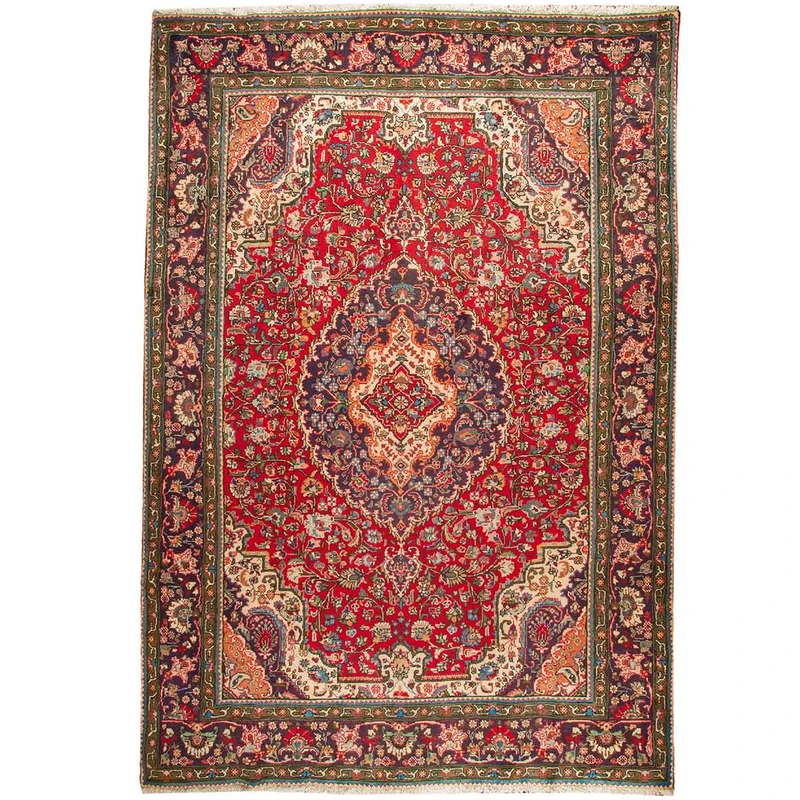
A Tabriz rug with a central medallion, sharing the floral language of Persian ceramics - Tabriz Persian Rug 10x6 ft - Medallion Semi Antique Wool Silk Hand Knotted
4
Tiles: Pottery on Architecture
Persian ceramics are not only vessels; they also cover buildings. From the twelfth century onward, glazed tiles became one of the glories of Persian architecture. Two great techniques developed.
Mosaic Tile
In mosaic tilework, called moarragh, the craftsman cuts small pieces from tiles of single colors and fits them together like a jigsaw puzzle to form patterns of stars, flowers, and calligraphy. The colors are brilliant and pure, because each piece is fired separately at the best temperature for its glaze. Mosaic tilework is slow and costly, and it produces some of the most beautiful surfaces in Islamic art.
Seven-Color Tile
In the haft rangi, or seven-color, technique, many colors are painted onto a single square tile before firing. This method is faster, allowing large areas to be covered with complex designs. The Safavid mosques and palaces of Isfahan used both techniques, covering domes, portals, and walls with blue, turquoise, yellow, and white patterns.
Many tile patterns, with their medallions, arabesques, and floral borders, are close relatives of carpet designs. In fact, it is often said that a Persian mosque is like a carpet in tile, and a Persian carpet like a garden in wool. See our article on garden designs.
5
The Potter in Persian Poetry
The potter and his clay appear in some of the most famous Persian poetry. In the quatrains attributed to Omar Khayyam, the poet visits a potter's workshop and imagines the jars and cups speaking, reminding him that they too were once living people, now turned to clay. The image of the potter shaping clay became a symbol of creation, change, and the passing of time.
This poetic tradition shows how deeply pottery was woven into Persian culture. A simple clay jar could become a meditation on life itself.
6
A Day in a Pottery Workshop
In a traditional workshop in Lalejin or Meybod, the day begins early. The potter prepares the clay, kneading it on a stone floor until it is smooth and even. He sits at the wheel, which may still be turned by foot, centers a lump of clay, and draws it up into a bowl or jar with steady hands.
Shaped pieces are set on wooden boards to dry in the shade. Later, they are decorated: painted with brushes, carved, or dipped in glaze. When enough pieces are ready, the kiln is loaded and fired, sometimes for many hours. The next day, the kiln is opened, revealing the finished pottery, its colors transformed by the heat. Every opening of the kiln brings a moment of excitement, because fire always adds a touch of the unexpected.
7
Motifs and Meanings
The motifs of Persian pottery are diverse, drawing inspiration from nature, mythology, and history. Floral patterns, arabesques, and geometric shapes are common, each with its own symbolic meaning. Persian pottery often tells a story or carries a deeper cultural meaning, making it an expression of Persian identity and heritage.
•
Goats and ibexes - among the oldest motifs, linked with fertility, abundance, and the mountains.
•
Birds - freedom, the soul, and good news.
•
Fish - water, life, and plenty; the fish is a favorite motif in Meybod pottery.
•
Flowers and arabesques - the garden and paradise.
•
Geometric bands - order, rhythm, and protection.
•
Calligraphy - poetry, blessings, and wisdom.
Many of these motifs appear in Persian rugs too. Goats and birds walk across tribal rugs, arabesques wind through city carpets, and geometric bands frame their borders. See our article on Persian rug design motifs.
8
Living Pottery Traditions
Persian pottery continues to thrive today as a revered art form, with skilled artisans carrying forward knowledge passed down through generations. Several towns are especially famous.
Lalejin
The town of Lalejin, near Hamadan, is one of the most important pottery centers of Persia today, with hundreds of workshops producing glazed pottery in bright turquoise, blue, green, and brown. Lalejin has been recognized internationally as a city of pottery, and its colorful bowls, vases, and plates are sold across the country. See our article on Hamadan rugs.
Meybod
Meybod, near Yazd, is famous for its earthenware painted with fish, birds, and sunbursts in blue, green, and yellow on a light background. Meybod potters use traditional kilns, and the town is also known for its zilou flatweaves. See our articles on Yazd rugs and zilou.
Kalpurgan
In the village of Kalpurgan, in Sistan and Baluchestan, women make pottery entirely by hand, without a wheel, and decorate it with dark geometric patterns painted with a mineral pigment. The forms and designs are believed to continue an ancient tradition, and Kalpurgan has been called a living museum of pottery. See our article on Baluch rugs.
Other Centers
Pottery is also made in Shahreza near Isfahan, in Kashan, in Mashhad, and in many villages, each with its own forms and colors.
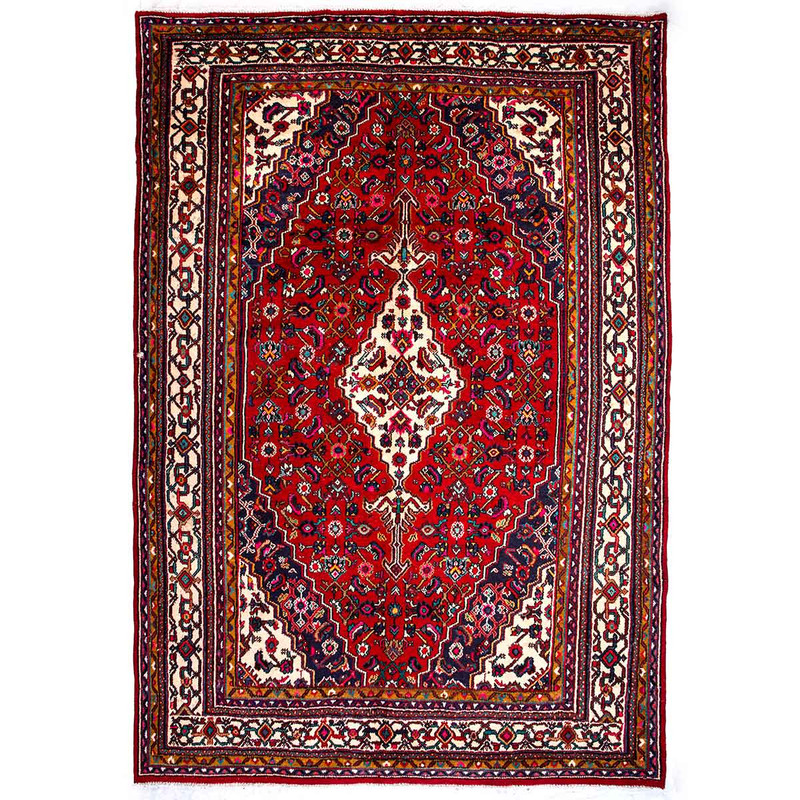
A Hamadan rug with a central medallion, from the region of the Lalejin potters - Hamadan Persian Rug 10x6 ft - Medallion Semi Antique Wool Hand Knotted
9
Pottery and Rugs: Shared Roots
Pottery and rug weaving are among the oldest Persian arts, and they share many features.
•
Natural materials - clay and wool, both taken from the land and the flock.
•
Natural colors - mineral and plant pigments for pottery; plant and insect dyes for rugs.
•
Shared motifs - animals, birds, flowers, and geometric bands.
•
Regional styles - each town has its own forms, colors, and patterns.
•
Family traditions - knowledge passed from parents to children over generations.
In the bazaars of Persian cities, the potter's shop and the rug dealer's shop often stand side by side. In Persian homes, a glazed bowl on a low table often sits above a rug, the two crafts complementing each other in color and pattern.
10
The Colors of Persian Pottery
Color is one of the great strengths of Persian pottery. Over the centuries, potters learned to make glazes in a wide range of hues from minerals and metals.
•
Turquoise - from copper, the most beloved color of Persian ceramics, also seen on domes across the country.
•
Cobalt blue - deep blue from cobalt, used in blue and white wares and tiles.
•
Green - from copper in different glazes.
•
Yellow and brown - from iron and other minerals.
•
White - from tin or a white slip, used as a ground for painting.
•
Luster - metallic gold and copper sheens from silver and copper compounds.
Many of these colors echo those of Persian rugs: the turquoise of Ardabil and Nain rugs, the deep blues of Kashan, and the warm browns and golds of tribal pieces. When a potter and a weaver from the same region work with similar palettes, their crafts naturally harmonize.
11
Handmade or Factory-Made?
As with rugs, it is useful to know how to recognize handmade pottery.
•
Slight irregularities - handmade pieces show small variations in shape and thickness.
•
Brush marks - hand painting shows lively, varied strokes rather than perfectly printed lines.
•
Signatures and marks - some potters sign their work or mark it with a workshop sign.
•
Weight and feel - handmade earthenware often feels more substantial and less uniform than factory ware.
These qualities give handmade pottery, like handmade rugs, a warmth and individuality that mass production cannot match.
12
Pottery in the Persian Home
For thousands of years, pottery was part of everyday life in every Persian home. Large clay jars stored water, grain, oil, and pickles. Earthenware bowls held yogurt and stews. Clay ovens baked bread, and unglazed water jugs kept water cool through evaporation in the hot summer. Even today, many families keep a clay water jug, and pottery is used for serving traditional foods.
Decorative pottery, such as painted plates and glazed vases, was displayed on shelves and in wall niches, called taghcheh, where it added color to the room. Below, on the floor, the family's rugs completed the picture, creating interiors where every surface showed the work of skilled hands.
13
Collecting and Decorating With Persian Pottery
•
Mix with rugs - a turquoise Lalejin bowl looks wonderful against a red Hamadan rug.
•
Group by color - blues and greens of Meybod and Lalejin pair well with blue and ivory rugs.
•
Display on shelves - a collection of small pots adds character to a room.
•
Use everyday pieces - glazed bowls and plates are made to be used.
•
Respect antiques - old and archaeological pottery should be handled carefully and displayed safely.
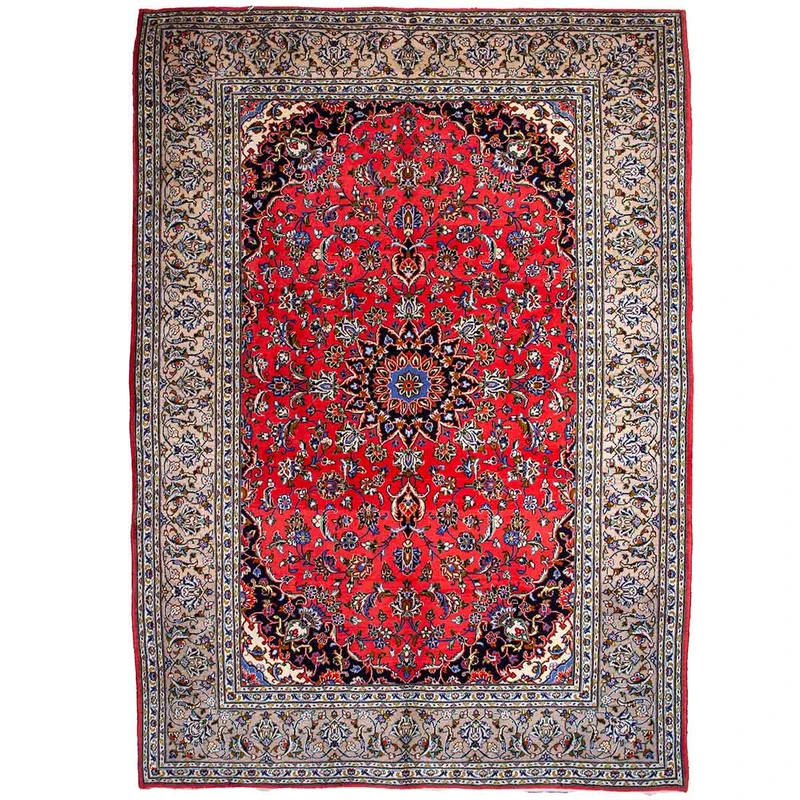
A Yazd rug with a central medallion, from the region of the Meybod potters - Yazd Persian Rug 9x6 ft - Medallion Semi Antique Wool Hand Knotted
14
Caring for Pottery and Rugs Together
•
Pottery - wash glazed ware by hand; avoid sudden temperature changes.
•
Plants and vases - always use a waterproof saucer under pots placed on or near rugs.
•
Rugs - vacuum gently, rotate, and wash professionally. See our guide to professional washing.
•
Spills - blot water spills on rugs quickly to avoid stains and mildew.
15
Frequently Asked Questions
How can I tell handmade Persian pottery from factory-made pieces?
Look for small irregularities: slight differences in thickness, brush marks in the painted designs, and tiny variations between pieces in a set. Handmade pottery usually feels heavier and more individual in the hand. Turn the piece over: many handmade pieces have an unglazed foot and sometimes the mark of the potter or workshop, while factory pieces look perfectly uniform.
How old is Persian pottery?
Pottery production in Persia dates back to the eighth to fifth millennium BC.
What is Tepe Sialk?
An ancient settlement near Kashan, one of the oldest in Persia, famous for early painted pottery with goats, birds, and geometric bands.
What is Shahr-e Sukhteh?
The "Burnt City" in Sistan, a UNESCO site whose painted goblet with a leaping goat is often called an early animation.
What is lusterware?
Pottery painted with metallic glazes that shimmer like gold, famously made in Kashan.
Why is a tile called kashi?
The word comes from Kashan, a great center of tile and pottery making.
Where is pottery made in Persia today?
In Lalejin near Hamadan, Meybod near Yazd, Kalpurgan in Baluchestan, Shahreza, Kashan, Mashhad, and many villages.
What is special about Kalpurgan pottery?
It is made by women entirely by hand, without a wheel, and painted with dark geometric designs in a mineral pigment.
What motifs appear on Persian pottery?
Animals, birds, fish, flowers, arabesques, geometric bands, and calligraphy.
How are pottery and rugs related?
They share natural materials, natural colors, motifs, regional styles, and family traditions.
What is Sultanabad ware?
A style of pottery from the thirteenth and fourteenth centuries, named after Sultanabad, the old name of Arak.
What is the difference between mosaic tile and seven-color tile?
Mosaic tile is made from small pieces cut from single-color tiles and fitted together; seven-color tile has many colors painted on one tile before firing.
Which poet wrote about the potter?
The quatrains attributed to Omar Khayyam famously describe a potter's workshop, where the clay jars speak of the passing of life.
What gives Persian pottery its turquoise color?
Copper in the glaze produces the famous turquoise blue.
How can I tell handmade pottery?
Look for slight irregularities in shape, lively brush marks, and a substantial feel.
16
Earth, Fire, and Wool
Persian pottery is an art of earth and fire, Persian rugs an art of wool and color. Both began thousands of years ago, both grew through the great ages of Persian history, and both continue today in the hands of skilled artisans. A Persian bowl and a Persian rug, placed together in a room, tell the same story of beauty, patience, and heritage. Together they remind us that the oldest arts of Persia are still alive, still made by hand, and still bringing color and warmth into homes around the world, from the villages of Hamadan and Yazd to a living room in Los Angeles.
At Los Angeles Home of Rugs, you can explore rugs from the pottery regions of Persia in our Hamadan, Yazd, and Tabriz collections. If you have questions about any rug, please contact us.