


The north-west of Persia, known as Azerbaijan, is the largest and busiest rug-weaving region of the country. Its towns and villages produce everything from the fine workshop rugs of Tabriz to the bold geometric pieces of Heriz and the Caucasian-style rugs of Ardabil and Meshkin. Persian writers have long called the region the capital of Persian carpet weaving, and in numbers of looms and weavers it has few rivals.
When a rug is sold simply as Azerbaijan, it usually comes from this region but is not attributed to a particular town. Our Azerbaijan collection consists mainly of runners, long, narrow rugs with a proud history in the Persian home. This guide explains what the regional name means, how runners were used, how to recognize their designs and structure, and how to choose and care for one. For the region's wider history, see our article on weaving in Azerbaijan.
1
What the Azerbaijan Name Means
Persian rugs are usually named after the town, village, or tribe that wove them: Tabriz, Heriz, Ardabil, Sarab, and so on. Sometimes, however, a rug clearly belongs to the north-west but cannot be tied with certainty to a single place. It may come from a small village whose name is not known in the market, or it may combine features of several neighboring towns. Such rugs are often sold under the regional name Azerbaijan.
The Persian region of Azerbaijan today covers the provinces of East Azerbaijan, with its capital at Tabriz, West Azerbaijan, with its capital at Urmia, and Ardabil, together with neighboring weaving areas such as Zanjan. The people of the region mostly speak Azerbaijani Turkish, and they share a culture of music, poetry, food, and craft that reaches across the Aras River into the Caucasus.
Azerbaijan is a regional name. It tells you that a rug was woven in north-western Persia, the land of Tabriz, Heriz, Ardabil, and Sarab, without naming a single town.
2
A Map of Weaving in Azerbaijan
To understand an Azerbaijan rug, it helps to know the main weaving centers around it:
•
Tabriz - The great city of fine workshop rugs, curvilinear medallions, and expert designers. See our Tabriz collection.
•
Heriz and its villages - Mountain villages east of Tabriz, famous for large, angular medallions and tough construction. See our Heriz collection and the related Bakhshaiesh and Mehraban rugs.
•
Ardabil and Meshkin - Towns near the Caucasus, known for geometric, Caucasian-style designs. See our Ardabil and Meshkin collections.
•
Sarab - A town between Tabriz and Ardabil, famous for long runners with camel-colored fields. See our Sarab collection.
•
Ahar and Karaja - Towns north of Tabriz with sturdy rugs and distinctive geometric motifs. See our Ahar and Karaja collections.
•
Azarshahr and the Urmia shore - Towns south-west of Tabriz that weave in the Tabriz tradition. See our Azarshahr collection.
An Azerbaijan rug may show the influence of any of these centers. A runner with a camel field and linked medallions may recall Sarab; one with stepped, angular medallions may recall Heriz; one with Caucasian motifs may recall Ardabil.
3
The Runner in the Persian Home
In English, a long, narrow rug is called a runner. In Persian it is called a kenareh, which means "side" or "edge." The name tells its original purpose.
In a traditional Persian house, the main room was furnished not with one large carpet but with a set of four rugs. A large central carpet, the mian farsh, covered the middle of the room. At its head, along the short wall, lay the kellegi, a rug placed where the most honored guests sat. Along each long side lay a kenareh, a narrow rug on which family and guests sat with their backs to the wall, leaning on cushions. The four rugs together framed the room, and the narrow kenareh carried people, tea trays, and conversation along its length.
In this setting, runners were not afterthoughts. They were woven with the same care as the main carpet, often in matching colors and designs. Many villages in Azerbaijan specialized in long, narrow rugs, and the region remains one of the best sources of runners in Persia.
A kenareh, the Persian runner, was originally one of four rugs in a traditional room: the central mian farsh, the kellegi at its head, and two kenareh along the sides.
4
How to Recognize an Azerbaijan Runner
•
Long, narrow proportions - Often about 2.5 to 4 feet wide and 9 to 15 feet long, or longer.
•
Medallions along the length - A series of medallions, or one long medallion, running down the center line.
•
Geometric or semi-geometric drawing - Stepped, angular, or hooked forms typical of the north-west.
•
Bold borders - Strong borders that frame the long field and stand up to wear on the edges.
•
Symmetric knot - The Turkish knot used throughout the region.
•
Sturdy construction - Cotton or wool foundation with a firm weave, built to take foot traffic.
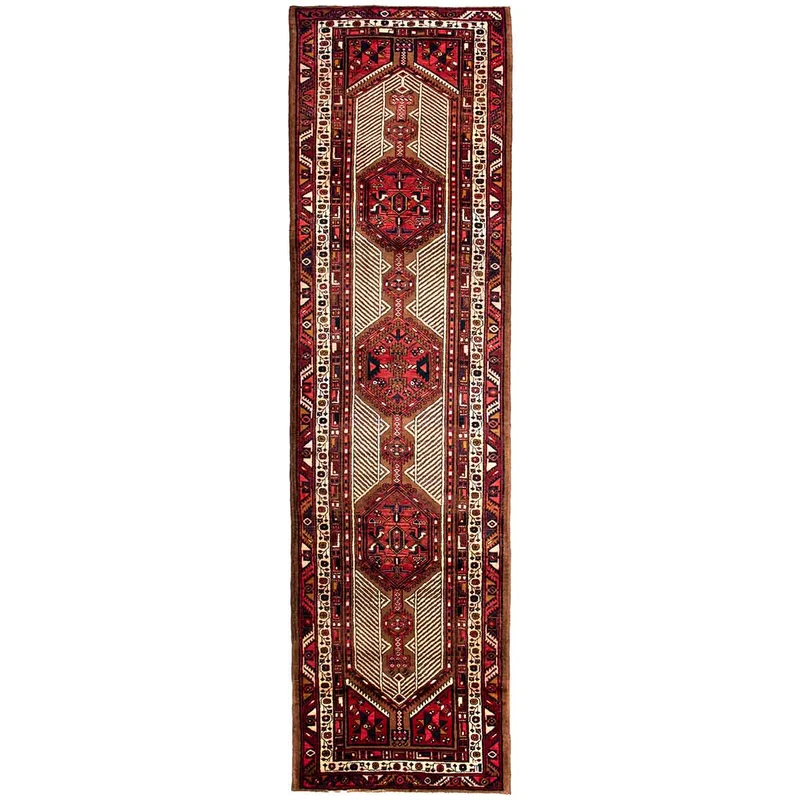
A long Azerbaijan runner of about 14 feet, with medallions in madder red, cream, and navy - Azerbaijan Persian Rug 14x3 ft - Medallion Semi Antique Wool Silk Hand Knotted
5
Runner Designs You Will Meet
Linked medallions
The most common runner design is a chain of medallions, diamonds, or hexagons linked along the center line. The medallions may be identical or alternate in color, creating a rhythm that leads the eye along the rug. This design is ideal for hallways, where the rug is seen from one end.
A single long medallion
Some runners have one elongated medallion, with pendants reaching toward each end and corners framing the field. This layout gives a calm, formal look and suits wider runners and the sides of beds.
Repeated small motifs
Other runners repeat small motifs, such as stars, rosettes, or boteh, across the whole field. These allover designs hide wear and look good from any direction, which makes them practical for stairs and busy passages.
Herati and floral runners
Runners in the Tabriz manner use the Herati pattern or floral vines around a series of small medallions. They are more refined and suit formal hallways and dining rooms.
6
How Azerbaijan Runners Are Built
•
Knot - The symmetric knot, standard in the region.
•
Foundation - Usually cotton in semi-antique and new pieces. Older village runners may have wool foundations.
•
Wefts - Often two wefts between rows, giving a firm, flat rug.
•
Pile - Local wool, clipped to a medium height for comfort and durability.
•
Sides - Strongly overcast, since the long edges of a runner are the parts most exposed to wear.
•
Ends - Cotton fringes with a small woven band to hold the last rows of knots.
A well-made runner should lie flat along its whole length, with straight, parallel sides. Weaving a long, narrow rug straight is a real skill, because any small error in tension adds up over many feet.
7
Colors of Azerbaijan Runners
The palette of Azerbaijan runners is warm and strong: madder red and rust red fields, navy and royal blue medallions, and ivory or cream details, with accents of gold, green, orange, brown, and black. Darker colors, such as burgundy and navy, are often used in borders, where they frame the field and hide dirt along the edges.
In semi-antique runners, these colors have mellowed over forty to sixty years. Reds have softened toward rust and rose, and creams have warmed. This gentle patina makes them easy to combine with older wood floors and furniture.
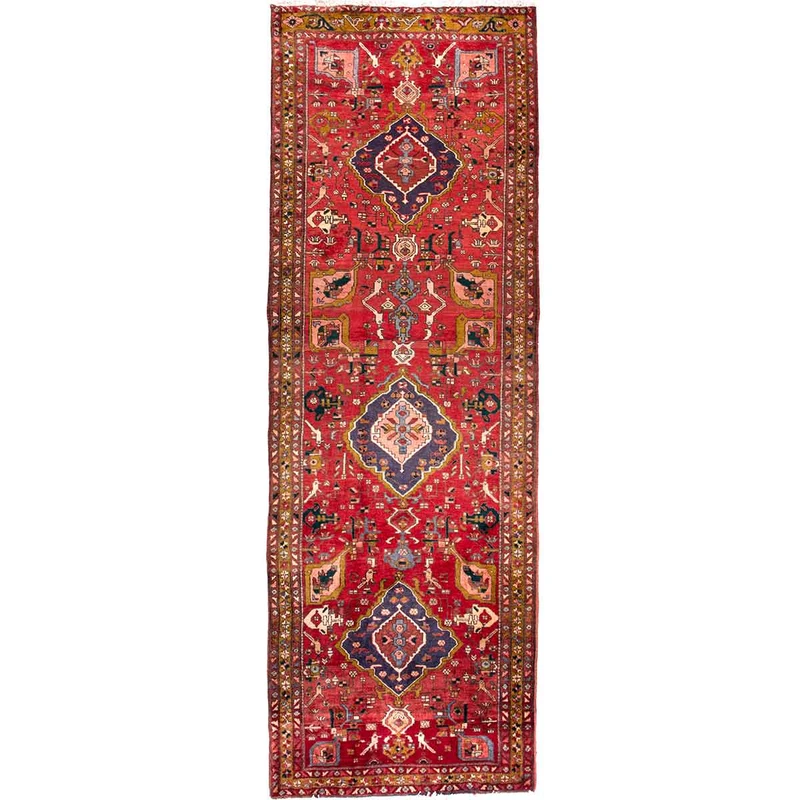
An Azerbaijan runner of about 11 feet with a red field, navy and gold medallions, and a strong border - Azerbaijan Persian Rug 11x3 ft - Medallion Semi Antique Wool Silk Hand Knotted
8
Choosing the Right Runner
A runner must fit its space well. These guidelines help:
•
Hallways - Leave about 4 to 6 inches of floor visible on each side of the runner, and 6 to 12 inches at each end. A hallway of 3.5 to 4 feet wide suits a runner about 2.5 to 3 feet wide.
•
Long corridors - If one runner is not long enough, use two runners of matching style and color, with a small gap between them.
•
Beside a bed - A runner along each side of a bed gives soft footing in the morning. Choose a length close to the length of the bed.
•
Kitchens - A runner in front of the counter adds warmth. Choose a darker or busier design that hides spills.
•
Stairs - Runners can be fitted to stairs by a professional. Choose a sturdy rug with a strong foundation and an allover design.
•
Entries - A runner leading from the door into the house welcomes guests and protects the floor.
Measure your space carefully before you buy. Runners come in many lengths, and the right length makes a great difference. See our runners.
9
Why Villages Wove Runners
There were practical as well as social reasons why so many runners were woven in the villages of Azerbaijan. A narrow loom takes little space in a village house and can be set up against a wall through the winter. One or two weavers can work it comfortably, without needing the team of weavers a wide carpet requires. A long, narrow rug can also be rolled tightly and carried easily to market.
Because the kenareh was used in pairs, one along each side of the room, many runners were woven two at a time or one after the other on the same warp, with the same design and wool. Matching pairs of runners are therefore part of the region's tradition. Today, when one long hallway or two sides of a bed need runners, a matched pair is especially valuable, and a pair that has stayed together over decades is a lucky find.
Runners were also woven for specific spaces in larger houses, such as long verandas, corridors around courtyards, and the steps leading to upper rooms. This long familiarity with narrow formats explains why the weavers of the region handle the special challenges of the runner, keeping the sides straight and the design balanced over many feet, so well.
10
A Worked Example: Measuring a Hallway
Suppose your hallway is 3 feet 6 inches wide and 16 feet long, with a door at one end. Subtract about 5 inches from each side for visible floor, which gives a runner width of about 2 feet 8 inches. For length, leave 6 to 12 inches at each end and allow for the door to swing clear, which gives a runner of about 13 to 14 feet. A runner of about 2 feet 8 inches by 14 feet, like several in our collection, would fit this hallway well.
If the hallway has doors along its side, check that the runner does not block them and that the doors clear the pile. If the hallway turns a corner, use two runners, one for each straight section, rather than trying to fit one long piece.
11
Keeping a Runner Flat and Safe
Runners in busy passages can slip, curl at the ends, or develop ripples. A good non-slip pad, cut slightly smaller than the rug, solves most of these problems. If a corner curls, gently roll it in the opposite direction for a day or place a heavy book on it. If ripples appear, they may come from uneven tension in the floor or pad; lift the runner, smooth the pad, and lay it again. Persistent waves in an old runner can be corrected by a professional who can wash and stretch it.
On stairs, a runner must be firmly fixed by a professional installer, with rods or concealed fastenings. Never lay a loose runner on stairs, as it can slip underfoot.
12
Grades and Quality
•
Straightness - The sides should be straight and parallel along the whole length.
•
Flatness - The rug should lie flat with no ripples or waves.
•
Wool - Springy, lustrous wool wears better.
•
Drawing - Medallions should be evenly spaced and well formed.
•
Edges - Secure overcasting on the sides.
•
Ends - Secure fringes and woven bands at the ends.
13
Reading the Back
On the back of an Azerbaijan runner, the design should be clear and the rows of knots straight. Symmetric knots show two even bumps per knot. Look for any areas where the rows wander or where the knots change size, which can indicate uneven weaving or repairs.
Check the sides especially. On a runner, the long edges take most of the wear. The overcasting should be complete and secure. If it is worn, it can be renewed by a professional before damage reaches the knots.
14
Azerbaijan Runners in Your Home
A good runner transforms a hallway. It adds color and pattern to a space that is often overlooked, softens footsteps, and leads guests through the house. The bold medallions of an Azerbaijan runner give energy to a long passage, while its warm colors make it feel welcoming.
In modern homes, a semi-antique runner adds character to a plain corridor or a minimalist kitchen. In traditional homes, it ties together wood floors, paneling, and older furniture. Because runners are narrow, they are also an easy way to introduce a Persian rug into a home for the first time.
If you have a main rug from the same region, such as a Heriz or Tabriz, an Azerbaijan runner in a nearby hallway can echo its colors and create a sense of continuity, just as the kenareh once framed the mian farsh in a traditional room.
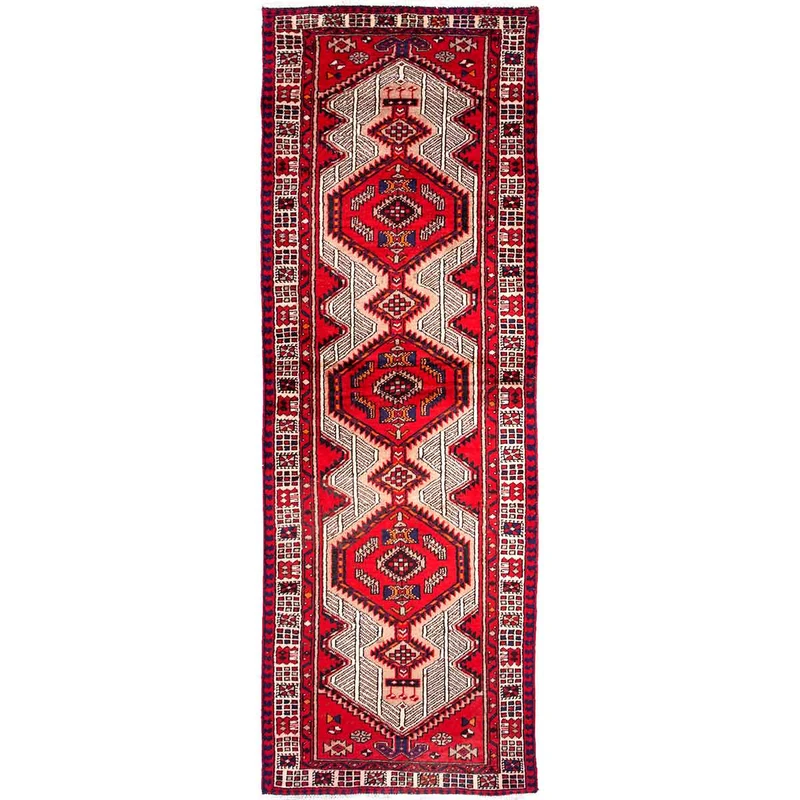
A 10 foot Azerbaijan runner in red, cream, and navy, a classic choice for a hallway - Azerbaijan Persian Rug 10x3 ft - Medallion Semi Antique Wool Silk Hand Knotted
Runners also work well in less expected places: along the foot of a long sofa, in front of a bookcase, under a console table, or in a narrow walk-in closet. In each case, the long format draws the eye along the space and makes it feel more finished.
15
Semi-Antique Runners
Most Azerbaijan runners in our collection are semi-antique, woven roughly forty to sixty years ago. They offer settled colors, good wool, and strong foundations. Their pile has been gently worn to a pleasing, even height, and they still have many years of life ahead. See our semi-antique rugs.
16
What Affects the Price of a Runner
•
Length - Longer runners take longer to weave and cost more.
•
Straightness and quality - Straight, flat, well-woven runners are worth more.
•
Condition - Intact sides and ends add value.
•
Design - Well-drawn, balanced designs are more desirable.
Runners are often a good value compared with larger rugs, because they offer the beauty and craftsmanship of a Persian rug in a smaller, more affordable size.
17
Common Buying Mistakes
•
Buying too wide - A runner that touches the walls looks crowded. Leave floor visible on each side.
•
Buying too short - A runner that stops far from the ends of a hallway looks lost.
•
Ignoring the pad - Runners can slip. Use a good pad cut to size.
•
Overlooking the edges - Check the overcasting on the long sides before you buy.
18
Caring for an Azerbaijan Runner
Runners in hallways see heavy traffic, so they need regular care. Vacuum often without a beater bar. Turn the runner end to end every few months so wear is even. Use a non-slip pad. Blot spills at once. Have the runner professionally washed every year or two in busy areas. Check the sides and ends from time to time and have small problems repaired early. See our care instructions and our guide to maintaining rug fringes.
19
Frequently Asked Questions
What does Azerbaijan mean on a rug?
That the rug was woven in the north-western region of Persia, without naming a single town.
Which provinces make up the region?
Mainly East Azerbaijan, West Azerbaijan, and Ardabil, with neighboring areas such as Zanjan.
What is a kenareh?
The Persian word for a runner, meaning "side." It was one of the two long rugs placed along the sides of a traditional room.
What were the other rugs in a traditional set?
The central mian farsh and the kellegi at the head of the room.
What knot is used?
The symmetric or Turkish knot.
What designs are typical?
Linked medallions, single long medallions, repeated small motifs, and Herati or floral designs.
How wide should a hallway runner be?
Leave about 4 to 6 inches of floor on each side.
Can a runner be used on stairs?
Yes, if it is sturdy and fitted by a professional.
Are Azerbaijan runners durable?
Yes. They are built with firm foundations and strong sides for daily use.
Why are runners often woven in pairs?
Because the traditional kenareh was used in pairs, one along each side of the main carpet.
Can I use two runners in one long hallway?
Yes. Choose two of matching style and color and leave a small gap between them.
How do I stop a runner from slipping?
Use a good non-slip pad cut slightly smaller than the rug.
Why do village weavers like narrow looms?
A narrow loom fits against a wall in a village house and can be worked by one or two weavers.
Is an Azerbaijan runner a good first Persian rug?
Yes. Runners are affordable, easy to place, and show the full craftsmanship of the region in a compact size.
How should I care for a runner?
Vacuum often, turn it end to end, use a pad, and have it professionally washed regularly.
20
Choose Your Azerbaijan Rug
Each Azerbaijan rug in our collection is hand-knotted, one of a kind, and inspected before it is listed. Browse our Azerbaijan collection, see all our runners, compare with our Sarab and Heriz rugs, or ask our experts for help finding the right length.