


In the mountain country east of Tabriz, a cluster of villages weaves some of the most powerful rugs in Persia. The market knows most of them by a single name, Heriz, after the district's main town. Yet within this group, one village has a reputation of its own among collectors: Bakhshaiesh. Its rugs, especially older ones, are admired for their bold drawing, glowing colors, and spirited, sometimes surprising designs.
This guide explains where Bakhshaiesh rugs come from, how their designs developed, how they are built, how to tell them from Heriz and other neighbors, and how to choose and care for one. For the wider weaving culture of the district, see our article on weaving in Heriz.
1
The Village of Bakhshaiesh
Bakhshaiesh lies in Heris county in East Azerbaijan province, in the hill and mountain country east of Tabriz. The landscape is one of rolling uplands, valleys, and high pastures, with cold winters and mild summers. Farming and herding have shaped village life for centuries, and sheep from the surrounding pastures provide wool for the looms.
The village belongs to the weaving district of Heris (Heriz), which includes many villages such as Mehraban, Gorevan, and Ahar further north. Weaving here has long been a household craft, practiced by women at upright looms in village homes, and for many families it has been an important source of income.
Because the town of Heris is the main market for the district, rugs from Bakhshaiesh have long been traded and sold under the Heriz name. A study published in the Persian art journal Negareh (Shahed University) points out exactly this: despite the international reputation of Bakhshaiesh rugs, they have usually been sold as Heriz, and their own designs and motifs have received little independent study.
Bakhshaiesh is a village of the Heriz district east of Tabriz. Its rugs are often sold as Heriz, but they have their own designs, motifs, and history.
2
A Short History of Bakhshaiesh Weaving
Little documentary evidence survives about Bakhshaiesh weaving before the nineteenth century. Researchers generally divide its history into an earlier period, about which little is known, and a later period from the nineteenth century to the present.
The most celebrated Bakhshaiesh rugs were woven in the nineteenth century, often for local use or for regional leaders rather than for export. These rugs are famous among collectors for their freedom of design. Medallions may sit off-center, borders may differ in width from one side to another, and motifs are rarely repeated exactly. Some pieces include stylized animals, trees, and figures, and some use undyed camel hair for warm natural tones from sand to coffee. Western collectors long grouped these rugs simply as "north-west Persian" or as Heriz, and it was only in the late twentieth century that they came to be widely recognized under their own name.
From the late nineteenth century, as demand for Persian rugs grew in Europe and America, merchants in Tabriz organized production for export throughout the region. Designs became more standardized and palettes more limited, though the rugs remained strong and handsome. The Negareh study finds that recent Bakhshaiesh rugs show less variety of design than earlier ones, with production focused mainly on the medallion-and-corner layout.
3
How to Recognize a Bakhshaiesh Rug
•
Bold geometric drawing - Medallions, corners, and motifs built from straight lines and angles, with large, clear forms.
•
Medallion and corners - Most rugs have a central medallion with matching corner pieces, the lachak-toranj layout.
•
Open field - The field around the medallion is often more open than in a typical Heriz, with fewer motifs and more space.
•
Deep, saturated colors - Madder reds, indigo blues, and ivory, often with camel or natural tones.
•
Rustic texture - A coarser weave than city rugs, with a thick, hard-wearing pile.
•
Symmetric knot - The Turkish knot used throughout the region.
Older Bakhshaiesh rugs may also show irregular, asymmetrical designs and the use of camel hair. Recent pieces are more regular, with a classic medallion-and-corner layout.
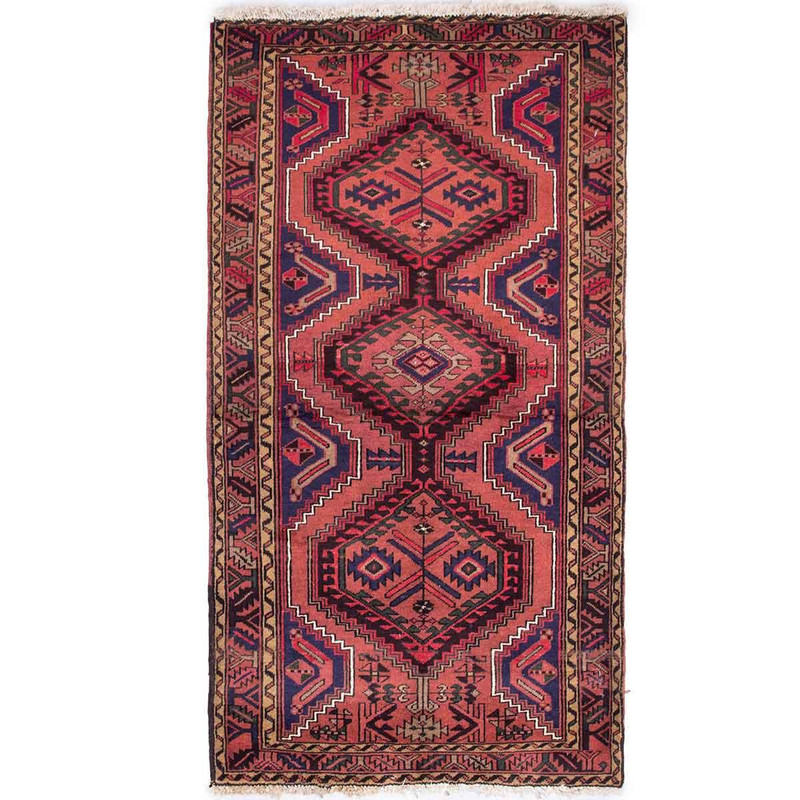
A Bakhshaiesh rug of about 7 by 3.5 feet with a central medallion on a madder red field, framed by navy and camel - Bakhshaiesh Persian Rug 6x3 ft - Medallion Semi Antique Wool Hand Knotted
4
The Lachak-Toranj: Bakhshaiesh's Main Design
The Persian term lachak-toranj describes a rug with a central medallion (toranj) and four corner pieces (lachak). It is one of the oldest and most common layouts in Persian weaving. According to the Negareh study, the main design in contemporary Bakhshaiesh rugs is a medallion-and-corner layout that researchers call the Tajeri type, and recent designs appear in three main variants, known locally as Laleh, Esmat, and Tajeri.
In practice, a Bakhshaiesh medallion is usually large and angular, often a stepped diamond or a star-like form with hooked edges, set on an open field. The corners echo the medallion's shape and color. Small motifs, such as rosettes, stars, and stylized flowers, float in the field. The result is a bold, clear composition that reads well across a room.
How it differs from the classic Heriz medallion
The classic Heriz medallion is also large and angular, but Heriz rugs tend to fill the field more densely with large palmettes and vines, giving a busier, more crowded look. Bakhshaiesh rugs often leave more open ground, so the medallion stands out more strongly. Their drawing can also be a little freer and less regular.
5
How Bakhshaiesh Rugs Are Built
•
Knot - The symmetric (Turkish) knot.
•
Foundation - Cotton warps and wefts in most twentieth-century rugs. Older pieces may have wool foundations.
•
Density - Coarse to medium, typical of village rugs of the district.
•
Pile - Thick, resilient wool from local sheep, clipped to a medium height.
•
Sides and ends - Strongly overcast sides and cotton fringes.
This structure makes Bakhshaiesh rugs very durable. Like other rugs of the Heriz district, they are famous for standing up to heavy wear for generations. The wool of the region is known for its resilience, and the firm weave holds the knots securely.
6
Bakhshaiesh and Its Neighbors
Bakhshaiesh and Heriz
The closest relative of a Bakhshaiesh rug is the Heriz. Both share the symmetric knot, geometric medallions, and sturdy structure. Bakhshaiesh rugs often have a more open field, a freer hand, and, in older pieces, more unusual designs. See our Heriz collection.
Bakhshaiesh and Mehraban
Mehraban rugs, from another village of the district, are often brighter, with strong reds and blues and a slightly looser weave. Bakhshaiesh rugs tend to have deeper, more saturated colors. See our Mehraban collection.
Bakhshaiesh and Gorevan
Gorevan is a name used for rugs of the district with simplified, very angular designs and somewhat coarser weaves. Bakhshaiesh rugs are often more carefully drawn. See our Goravan collection.
Bakhshaiesh and Serapi
Serapi is a trade name for antique rugs of the Heriz district with large, open, angular designs and soft colors. Many antique Bakhshaiesh rugs share these qualities, and the two names overlap in the antique market. See our Serapi collection.
Heriz, Mehraban, Gorevan, Serapi, and Bakhshaiesh all belong to the same mountain district. Bakhshaiesh stands out for its open fields, deep colors, and freer drawing.
7
Colors of Bakhshaiesh
Bakhshaiesh rugs are known for deep, glowing color. Madder red, from brick to deep crimson, is the most common field color. Indigo blue, from navy to a bright, clear blue, is used for medallions, borders, and details. Collectors speak of a characteristic Bakhshaiesh blue, a range of indigo tones that gives many older rugs their special glow.
Ivory, camel, and natural wool tones provide contrast. In older rugs, undyed camel hair gives warm shades from blond to coffee, and some pieces have whole fields in camel tones. Accents of green, gold, and dark brown complete the palette.
In semi-antique rugs, these colors have mellowed into a warm, harmonious whole. The reds have softened, the blues have deepened, and the camel tones have taken on a golden glow.
8
Abrash: The Beauty of Uneven Color
Many Bakhshaiesh rugs show abrash, bands of slightly different shades of the same color running across the rug. Abrash occurs when wool is dyed in small batches, as it was in village households, so that each batch differs slightly from the last. As the weaver moves from one batch to the next, the color shifts.
Far from being a fault, abrash is prized in village rugs. It gives the field depth and movement, and it is a sign of hand-dyed wool. A Bakhshaiesh rug with gentle abrash looks alive, especially in changing light.
9
Antique, Semi-Antique, and New
•
Antique - Rugs from the nineteenth and early twentieth centuries, with free designs, natural dyes, and often camel hair. Highly collectible and rare.
•
Semi-antique - Rugs from the mid twentieth century, with the classic medallion-and-corner design, good wool, and settled colors. Excellent value and durability.
•
New - Recent rugs, with more regular designs and fuller pile.
Our Bakhshaiesh rugs are semi-antique pieces, combining the bold look of the district with practical condition for daily use. See our semi-antique rugs.
10
How to Judge a Bakhshaiesh Rug
•
Overall design - A strong, clear medallion and well-balanced corners.
•
Wool - Thick, springy, lustrous wool is a hallmark of the district.
•
Color - Deep, harmonious colors. Gentle abrash is a plus.
•
Flatness - The rug should lie flat. Small irregularities in shape are normal in village rugs.
•
Back - Even knots and a clear image of the design.
•
Condition - Check the ends, sides, and any repairs.
11
Reading the Back
On the back of a Bakhshaiesh rug, the knots are relatively large, showing a coarse but even texture. The design should be clearly visible. Symmetric knots show two bumps per knot. Look for straight rows and even weft lines.
Check the ends and sides. Village rugs from the Heriz district are often finished with strong overcasting and plain fringes. These areas wear first and should be in good condition or properly repaired.
12
Bakhshaiesh Rugs in Your Home
The bold design and deep colors of a Bakhshaiesh rug give strong character to any room. In traditional interiors, it sits well with dark wood, leather, and books. In modern interiors, its geometric drawing echoes clean lines and simple forms, and its warm colors bring life to neutral spaces.
Because Bakhshaiesh rugs are so durable, they suit busy areas: family rooms, entries, kitchens, and dining rooms. Smaller pieces, such as our rug of about 7 by 3.5 feet, make a strong statement in an entry, beside a bed, or in a study.
A Bakhshaiesh rug also combines well with other rugs of the north-west. Paired with a Heriz or Mehraban in a larger room, it creates a harmonious collection with a shared design language.
13
Why Collectors Value Bakhshaiesh
For collectors, Bakhshaiesh rugs offer something special: the strength and durability of the Heriz district combined with a sense of individuality. Older pieces in particular show the hand of the weaver: a medallion slightly off-center, a border that changes width, a color that shifts unexpectedly. These details remind us that each rug was made by a person, not a machine.
Even in more regular semi-antique pieces, the bold drawing, deep colors, and robust wool of Bakhshaiesh rugs give them a presence that many finer city rugs lack. Read more about how to see beauty in a rug in our article on beauty in Persian hand-knotted rugs.
14
The Weavers of the Heriz District
In the villages of the Heriz district, weaving has long been part of daily life. Women set up their looms inside the house, often in a room kept for the purpose, and weave through the long winter months when there is less work in the fields. Girls learn by sitting beside their mothers and aunts, first passing wefts and later tying knots.
Many village weavers of the district traditionally worked without a full paper cartoon, weaving designs from memory or from a small model or a finished rug. This explains why older rugs show so much variety and freedom, and why no two village rugs are exactly alike. In later periods, when merchants supplied cartoons, designs became more regular. Read more about the life of village weavers in our article on the people in the chain from shepherd to dealer.
15
The Legendary Wool of the District
Rugs of the Heriz district have a reputation for almost unlimited durability, and dealers often say that a good Heriz-district rug will outlast its owner. Much of this reputation rests on the wool. Sheep grazing the high pastures of the district produce a thick, resilient fleece with a good natural oil content, which helps the pile spring back after it is pressed and resist dirt.
Local tradition adds another explanation: that traces of copper in the water and soil of the district strengthen the wool and give the colors their special depth. Whether or not this belief is scientifically exact, it reflects the pride the people of the district take in their materials, and it is part of the lore that surrounds these rugs.
16
Living with a Village Rug
A Bakhshaiesh rug is a village rug, and part of its charm lies in small irregularities that a city workshop rug would not show. A side may be slightly longer than the other, a corner may be drawn a little differently from its partner, a border may narrow at one end, or a band of abrash may cross the field. These are the marks of a rug woven by hand, often without a full paper cartoon, by a weaver working from memory and experience.
When you live with such a rug, these details become familiar and personal. Many owners come to love them, because they make the rug unique. The important thing is to tell the difference between natural character and real problems. Irregular drawing and abrash are character. Loose knots, worn foundations, rotten fringes, or moth damage are problems that need attention. If in doubt, ask a specialist to look at the rug before you buy.
17
Placing a Smaller Bakhshaiesh Rug
•
Entry - A 4 by 7 foot rug in front of the door welcomes guests and takes the brunt of outdoor shoes.
•
Bedside - Placed on one side of a bed, it gives a warm first step in the morning.
•
Study - Under a desk chair or in front of a bookcase, it adds color and comfort.
•
Layering - On top of a larger neutral rug or sisal, a small Bakhshaiesh becomes a focal point.
18
Sizes
Bakhshaiesh rugs are woven in many sizes, from small rugs of about 3 by 5 feet to large room-size carpets. Older pieces often have long, generous proportions. Smaller rugs, such as 4 by 6 and 4 by 7 foot pieces, are practical for entries, bedrooms, and studies. See our 4x6 rugs.
19
What Affects the Price
•
Age - Antique pieces with natural dyes and free designs are highly valued.
•
Size - Larger rugs cost more.
•
Condition - Even pile and intact edges raise value.
•
Design - Unusual, well-drawn designs and beautiful abrash add value.
Semi-antique Bakhshaiesh rugs offer the look and durability of the district at a far more accessible price than antique collector pieces.
20
Common Buying Mistakes
•
Assuming all Heriz rugs are the same - Bakhshaiesh, Mehraban, and other villages each have their own character.
•
Mistaking abrash for damage - Gentle color bands are a natural feature of hand-dyed wool.
•
Ignoring the back - The back shows knot size and repairs.
•
Forgetting the pad - A good pad protects the rug and keeps it in place.
21
Caring for a Bakhshaiesh Rug
Vacuum regularly without a beater bar. Rotate the rug every six months. Blot spills at once. Keep it out of strong direct sunlight. Have it professionally washed every few years. Because the wool of the district is so resilient, a well-cared-for Bakhshaiesh rug can last for generations. See our care instructions and our guide to professional washing.
22
Frequently Asked Questions
How do you spell Bakhshaiesh?
It is also written Bakhshayesh, Bakshaish, and Bakhshaish. All refer to the same village.
Where is Bakhshaiesh?
In Heris county, East Azerbaijan province, in the mountain country east of Tabriz.
Why are Bakhshaiesh rugs sold as Heriz?
Because Heris is the main market town of the district, and the village's rugs have long been traded under its name.
What is a lachak-toranj design?
A layout with a central medallion (toranj) and four corner pieces (lachak).
What knot is used?
The symmetric or Turkish knot.
What colors are typical?
Madder red, indigo blue, ivory, and camel, with green, gold, and brown accents.
What is abrash?
Bands of slightly different shades of one color, caused by hand-dyeing wool in small batches.
Are Bakhshaiesh rugs durable?
Yes. Like other rugs of the Heriz district, they are famous for their durability.
Why are antique Bakhshaiesh rugs so valued?
For their free, individual designs, natural dyes, camel hair, and deep colors.
Do they suit modern interiors?
Yes. Their geometric drawing and warm colors work well in modern rooms.
What are Laleh, Esmat, and Tajeri?
Local names for the three main variants of the medallion-and-corner design in recent Bakhshaiesh rugs, according to research published in Negareh.
Did weavers use paper cartoons?
Older village weavers often worked from memory or a model rug; cartoons became more common when merchants organized production.
Are irregularities a defect?
No. Small irregularities in drawing and color are the natural character of a village rug.
How should I clean a Bakhshaiesh rug?
Vacuum regularly, blot spills, and have it professionally washed every few years.
23
Choose Your Bakhshaiesh Rug
Each Bakhshaiesh rug in our collection is hand-knotted, one of a kind, and inspected before it is listed. Browse our Bakhshaiesh collection, compare it with our Heriz, Mehraban, and Serapi rugs, or ask our experts for help.