


Heriz Rugs: History, Serapi, Designs, and How to Choose One
Los Angeles Home of Rugs on Nov 17th 2026
Few Persian rugs are as instantly recognizable as a Heriz. A huge angular medallion, bold corner pieces, a warm brick-red field, and a confident, almost architectural drawing: once you have seen one, you can spot another across a room. Heriz rugs have been prized for well over a century for exactly these qualities - strong design, beautiful color, and a toughness that lets them survive generations of family life.
Our article on Azerbaijan rugs introduces the Heriz region within the wider weaving world of northwest Persia. This article looks at Heriz in depth: where the rugs come from, how they are woven, what makes their designs so distinctive, how antique Serapi and Bakhshayesh rugs fit into the story, and how to choose the right Heriz for your home.
1
Where Heriz Rugs Come From
Heriz is a small town in the hill country of East Azerbaijan Province, northeast of Tabriz, in a region of high pastures and farming villages. The name "Heriz" is used for rugs from the town itself and from a cluster of roughly thirty nearby villages that share the same weaving tradition. Each village has its own habits of drawing and color, and dealers often use village names - Mehraban, Gorevan, Bakhshayesh, Ahar, and others - to describe particular styles within the Heriz family.
Life in the Heriz villages has long been tied to sheep. The highland pastures produce strong, resilient wool, and in many households weaving was part of the yearly rhythm of farming and herding. Rugs were woven in homes, often by women and girls of the family, and sold through merchants in Tabriz, the great market city of the region. See our Tabriz buyer's guide to learn more about the city that connected Heriz to the world.
2
A Short History of Heriz Weaving
Weaving in the Heriz villages is old, but Heriz rugs became famous internationally in the second half of the nineteenth century. At that time Tabriz merchants were organizing the revival of Persian weaving for export, and European and American buyers were looking for large, durable, decorative carpets for their homes. The village weavers of Heriz could produce exactly that: room-size rugs with bold designs and excellent wool, at prices below the fine city carpets of Tabriz and Kashan.
Heriz rugs were especially popular in the United States in the late nineteenth and early twentieth centuries, and many of the antique Heriz and Serapi rugs found today first came to America during this period. They furnished libraries, living rooms, and country houses, and their reputation for durability was proven by decades of daily use. Our article on Persian rug history from 1722 to 1925 explains this export revival in more detail.
Through the twentieth century, Heriz weaving continued in the villages, and new rugs in the classic style are still woven today. Designs and colors have evolved with the market, but the essential character of a Heriz - bold geometry, strong wool, and solid construction - has remained remarkably consistent. See our article on Persian rugs from 1925 to today.
3
Weaving From Memory
One of the most fascinating features of Heriz weaving is that many weavers worked without a detailed paper cartoon. In city workshops, a designer draws the whole rug on squared paper and weavers follow it knot by knot. In Heriz villages, experienced weavers often worked from memory and from a small sample, carrying the design in their heads and adapting it as they went.
This is one reason why Heriz rugs, as the saying goes, rarely resemble each other exactly. Two rugs with the same basic design will differ in proportions, small motifs, and colors. The medallion may be slightly off-center, a corner may be drawn a little differently from the others, or a color may change partway across the field. Far from being faults, these variations are part of the charm of a village rug and evidence of the human hand behind it.
Weaving from memory also explains why Heriz designs are so geometric. Curving city designs are difficult to reproduce without a cartoon, so village weavers translated them into straight lines and angles. The result is a style that is both disciplined and free, and that suits the bold scale of a room-size carpet perfectly.
Many Heriz weavers carried the design in their memory rather than following a paper cartoon. That is why no two Heriz rugs are exactly alike, and why their drawing is so boldly geometric.
4
How Heriz Rugs Are Made
Knots and Foundation
Heriz rugs are woven with the symmetrical (Turkish) knot on a cotton foundation. The knot count is moderate - coarser than fine city rugs from Tabriz or Kashan - but the knots are tightly packed and firmly beaten down. This creates a dense, heavy rug that lies flat and resists wear. Our article on how a Persian rug is made explains knots, warps, and wefts in more detail.
Thick Wefts and a Firm Handle
Heriz weavers usually pass a thick weft between rows of knots, and the rugs have a firm, solid feel in the hand. When you fold the corner of a good Heriz, it feels substantial rather than floppy. This firmness is part of what keeps the rug flat on the floor and helps it hold up under furniture and foot traffic.
Pile Height
The pile of a Heriz is usually medium in height, thick enough to be comfortable underfoot but short enough to keep the bold design crisp. Antique pieces often show some wear, which softens the surface and gives an attractive, lived-in look.
5
The Wool of Heriz
Much of the durability of Heriz rugs comes from their wool. The sheep of the Azerbaijan highlands produce wool with long, strong fibers and plenty of natural lanolin, the oil that helps wool resist dirt and moisture. Good Heriz wool is springy, lustrous, and remarkably hard-wearing.
Local tradition says that the water of the Heriz region contains traces of copper and other minerals that strengthen the wool and help fix the dyes. Whether or not this is literally true, it reflects a long-held belief among dealers that Heriz wool is unusually tough. Our article on Persian rug wool explains how wool quality affects the look and life of a rug.
6
Colors of Heriz Rugs
The classic Heriz palette is warm and earthy. A field of brick red, rust, or terracotta is the most common choice, framed by borders in navy and deep blue, with an ivory or light-colored medallion and corners. Accents of light blue, green, gold, and soft pink add life to the design. The original text of this article described the predominant colors as ivory, brownish red, dark and bright pink, and blue - a good summary of the traditional range.
Antique Heriz and Serapi rugs often have softer, lighter colors: apricot, salmon, camel, pale blue, and ivory, mellowed by age and use. Many collectors prize these gentle tones, which blend beautifully with both traditional and modern interiors. Our articles on natural dyes and the Persian rug dyeing tradition explain how these colors were made.
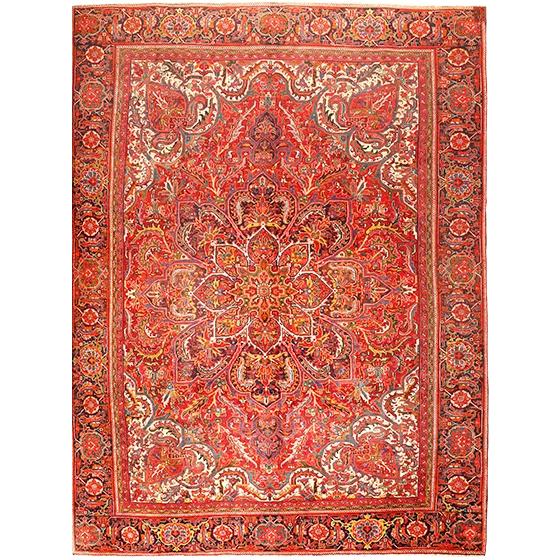
A Heriz rug with a bold angular medallion on a warm red field - Heriz Persian Rug 12x9 ft - Medallion Semi Antique Wool Hand Knotted
7
The Heriz Design
The design most associated with Heriz is the large medallion and corner layout. The original text of this article put it well: the medallion is very big, almost covering the field, and the corners echo the central medallion. Let us look at the main elements.
The Medallion
The Heriz medallion is usually a large, star-like or angular shape with stepped outlines and pendants extending toward the ends of the rug. Inside, it is filled with smaller geometric motifs, rosettes, and stylized leaves. On large rugs the medallion can be enormous, dominating the composition. See our medallion designs for more examples.
The Corners and Field
The corner pieces, or spandrels, repeat the angular language of the medallion, often in contrasting colors. The field between medallion and corners is filled with stylized flowers, vines, and small geometric motifs, drawn in straight lines and angles. These are geometric translations of the floral motifs found in city rugs.
The Borders
Heriz borders are typically wide and strong, with a main band of large angular palmettes and leaves - sometimes called the "turtle" border because the motifs resemble turtle shells - framed by narrower guard stripes. A strong border is essential to balance the bold medallion.
All-Over Designs
Not every Heriz has a medallion. Some have all-over designs, including geometric versions of the Herati pattern or repeating rows of stylized flowers. These all-over rugs are less common but very attractive, especially in rooms where furniture would cover a central medallion. Our guide to Persian rug motifs explains the meaning of many of these shapes.
8
The Villages of the Heriz Family
Within the Heriz family, dealers and collectors distinguish several village types. These are general tendencies, not strict rules:
•
Heriz - the classic style: a large angular medallion, red field, and strong borders, in good, durable wool. Explore our Heriz collection.
•
Mehraban - often brighter, bolder colors, with strong reds and blues and very angular drawing. See our Mehraban rugs.
•
Gorevan - bold, simplified designs with a strong, rustic character, often at more accessible prices. See our Goravan rugs.
•
Bakhshayesh - one of the oldest weaving villages of the region, known for antique rugs with distinctive, sometimes unusual designs, including boteh and all-over patterns. See our Bakhshaiesh rugs.
•
Ahar - a town to the north, whose rugs tend to be finer and more curvilinear, showing the influence of Tabriz. See our Ahar rugs.
•
Sarab - a neighboring district famous for long runners with medallion designs, often in camel and natural tones. See our Sarab rugs.
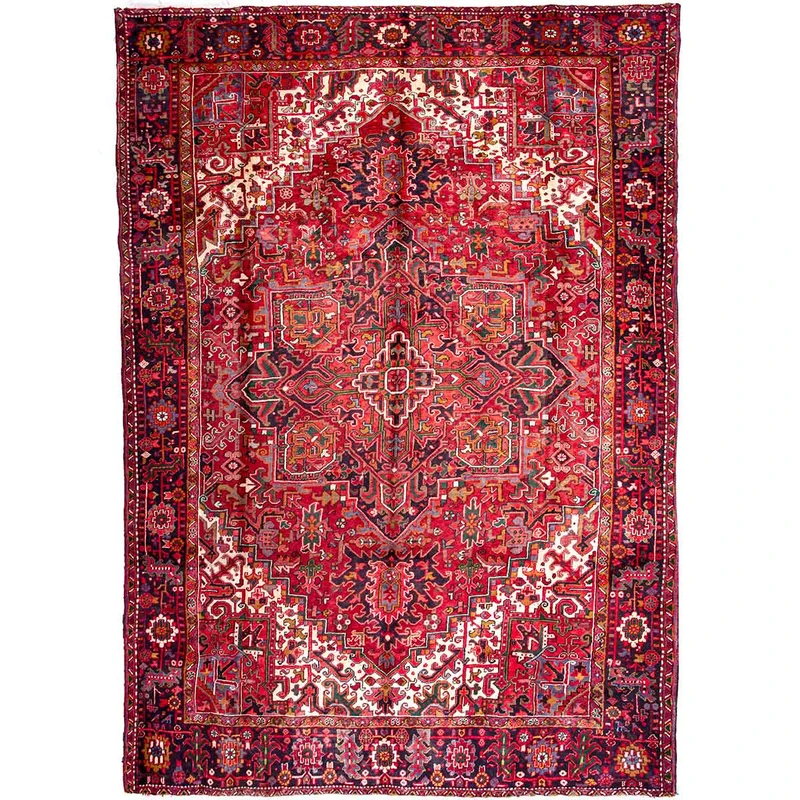
A Goravan rug from the Heriz region with a large geometric medallion - Goravan Persian Rug 12x9 ft - Medallion Semi Antique Wool Hand Knotted
9
Serapi: The Antique Aristocrats of Heriz
Among antique Heriz rugs, the most celebrated are known as Serapi. The term is used in the trade for the finest and oldest Heriz-region rugs, generally woven in the late nineteenth century. The origin of the name is uncertain; it may be connected to the nearby town of Sarab, but over time it has become a quality label rather than a precise place name.
Serapi rugs are admired for their spacious, elegant drawing, with medallions that seem to float on open fields, and for their soft, luminous colors: apricot, ivory, camel, light blue, and pale red. They are often woven in unusual proportions, slightly longer and narrower than modern room sizes. Because of their age, beauty, and relative rarity, fine Serapi rugs are among the most sought-after village rugs of Persia. Explore our Serapi collection.
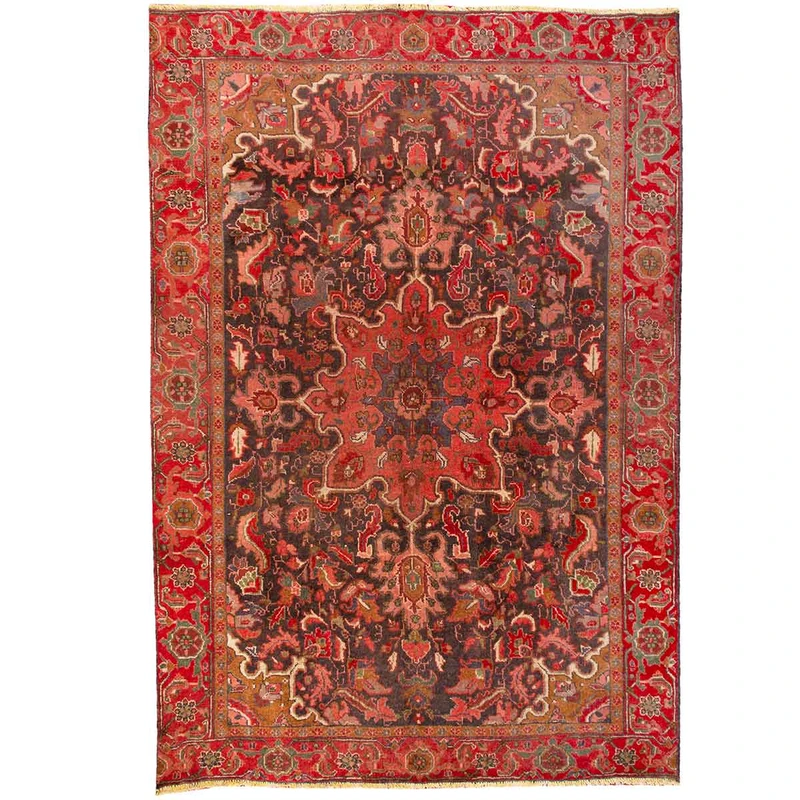
An antique Serapi rug with a spacious medallion design - Serapi Persian Rug 9x6 ft - Medallion Antique Wool Hand Knotted
10
Silk Heriz Rugs
Although Heriz is famous for wool rugs, the region also produced a small number of exceptionally fine silk rugs in the nineteenth century. Silk Heriz rugs are usually small, often prayer rugs or rugs with all-over designs, and they are much more finely knotted than wool Heriz rugs. Their rich colors and silky luster make them treasured collector pieces. The original text of this article mentioned the "long-lasting woolen and silk rugs" of Heriz - a reminder that both traditions belong to the region. Our article on silk in Persian rugs explains how silk rugs differ from wool.
11
Old and New Heriz Rugs
The original version of this article noted that the designs of old Heriz rugs differ radically from those of new pieces. This is true, and it is worth understanding the differences:
•
Antique Heriz (before about 1925) - softer colors, more open and spacious designs, more variation and individuality, and often unusual proportions.
•
Semi-antique Heriz (about 1925 to 1975) - bolder colors, especially brick red and navy, with fuller, denser designs and more standardized sizes. Explore our semi-antique rugs.
•
New Heriz - classic designs with a wide range of colors, including lighter and more muted palettes made for contemporary interiors.
All three can be excellent rugs. Antique pieces offer history and soft, mellow beauty; semi-antique pieces offer strong color and excellent durability; new pieces offer fresh condition and sizes that fit modern rooms. See our antique collection as well.
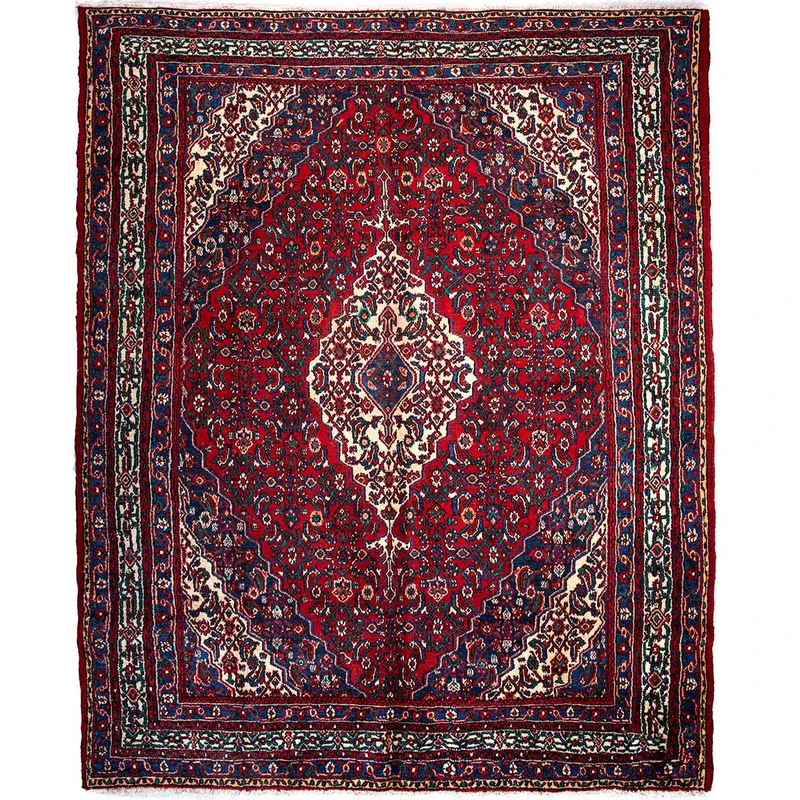
A Mehraban rug from the Heriz family with bold medallion drawing - Mehraban Persian Rug 11x9 ft - Medallion Semi Antique Wool Hand Knotted
12
How to Recognize a Genuine Heriz
The original text of this article warned that Heriz designs are copied by weavers in India, Romania, and elsewhere, but that the copies can be distinguished by their texture and colors. Here are the features to look for:
•
Symmetrical knots on a cotton foundation - visible on the back as a firm, even grid.
•
Firm, heavy handle - a genuine Heriz feels dense and solid, not thin or floppy.
•
Strong, lustrous wool - springy and resilient, with a natural sheen.
•
Geometric drawing with natural variation - the medallion and corners are angular and confident, with small irregularities that show the weaver's hand.
•
Characteristic palette - brick red, rust, navy, ivory, and light blue, or the softer tones of antique pieces.
•
Abrash - natural color variation in the field, a sign of hand-dyed wool in small batches.
Copies made elsewhere often use a different knot or a softer foundation, more uniform colors, and drawing that is either too perfect or slightly awkward. They can be attractive rugs in their own right, but they are not Heriz rugs. Our article on how to read a Persian rug's secret language explains how to examine a rug's back, knots, and materials.
13
Heriz Compared With Other Persian Rugs
•
Heriz vs Tabriz - both come from Azerbaijan, but Tabriz rugs are city rugs woven from cartoons, finer and more curvilinear, while Heriz rugs are bolder, coarser, and geometric.
•
Heriz vs Bijar - both are famous for durability. Bijars are very densely packed and stiff; Heriz rugs are thick and firm but somewhat more flexible, with a more open, angular design. See our article on Bijar rugs.
•
Heriz vs Mahal and Sarouk - rugs from the Arak region often have bold scale too, but with more curvilinear floral drawing. See our article on Arak rugs.
•
Heriz vs Kashan - Kashan rugs are fine city rugs with curvilinear floral medallions and a different knot. See our article on Kashan rugs.
14
Why Heriz Rugs Are So Durable
Heriz rugs have a reputation as some of the most durable rugs in the world, and there are good reasons for it. The combination of strong highland wool, tightly packed symmetrical knots, thick wefts, and a firm cotton foundation produces a rug that can withstand heavy use. Many antique Heriz rugs have spent a century or more on the floor and still have years of life left in them.
The bold geometric design also helps. Small spots and areas of wear are less noticeable in a busy, strong pattern than in a fine, delicate one. This makes Heriz rugs a favorite choice for family homes, busy living rooms, dining rooms, and offices.
15
Heriz Rugs in the Home
Heriz rugs work beautifully in a wide range of interiors. Here are a few ideas:
•
Traditional interiors - a red and navy Heriz in a library, study, or formal living room creates a warm, classic atmosphere.
•
Farmhouse and rustic style - the geometric drawing and earthy colors suit wood, stone, and natural textures.
•
Modern and minimal rooms - a Heriz with softer colors adds warmth and character to a clean, contemporary space.
•
Dining rooms - the durable construction stands up to chairs being moved in and out.
•
Large open spaces - Heriz rugs are woven in big room sizes and have the scale to anchor a large room.
Our article on giving your home timeless elegance with a Persian rug has more decorating ideas, and our rug size guide will help you choose the right dimensions.
16
Sizes and Formats
The original text of this article noted that Heriz rugs are produced in medium and big sizes as well as runners. Room-size carpets are the specialty of the region, from about 8 by 10 feet up to very large rugs for grand rooms. Smaller rugs and runners are also woven, and the neighboring Sarab district is especially known for long runners. Because many Heriz rugs were woven for export, they often come in sizes that fit Western rooms well.
17
Choosing the Right Heriz
When choosing a Heriz, consider these points:
•
Size first - measure your room and decide how much floor you want the rug to cover.
•
Color and mood - deep red and navy for warmth and drama; ivory, camel, and soft blue for a lighter feel.
•
Age - antique for history and soft color, semi-antique for strong color and durability, new for fresh condition.
•
Condition - check for even pile, intact edges and ends, and any repairs. Some wear is natural in older pieces and is not necessarily a problem.
•
Design - a classic medallion makes a focal point; an all-over design works well under furniture.
Our complete buyer's guide explains how to evaluate any Persian rug, and our article on investing in hand-knotted rugs discusses value over time.
18
Common Misunderstandings
"A Heriz is a coarse rug, so it is low quality."
Heriz rugs are coarser than fine city rugs, but quality is not only about knot count. The wool, dyes, design, and construction of a good Heriz are excellent, and its durability is outstanding. Fine city rugs and Heriz rugs simply have different strengths.
"Irregularities mean a rug is badly made."
Small variations in drawing and color are typical of village rugs woven from memory. They are part of a Heriz rug's character and are valued by collectors.
"All antique Heriz rugs are Serapi."
Serapi is a term for the finest antique Heriz-region rugs, not for every old Heriz. A good dealer will explain why a rug deserves the name.
19
Caring for a Heriz Rug
Heriz rugs are easy to care for. Vacuum regularly without a beater bar, rotate the rug every year or so to even out wear and sun exposure, and use a good rug pad to keep it from shifting. Blot spills quickly with a clean cloth and cold water. Every few years, have the rug washed by a specialist. Our guides to cleaning a Persian rug at home and professional rug cleaning explain these steps in detail. For antique pieces, pay special attention to the fringes; see our guide to maintaining antique rug fringes.
20
Frequently Asked Questions
Where are Heriz rugs made?
In the town of Heriz and about thirty surrounding villages in East Azerbaijan Province, northeast of Tabriz, in northwest Persia.
What is the difference between Heriz and Serapi?
Serapi is a trade term for the finest antique Heriz-region rugs, usually from the late nineteenth century, with spacious designs and soft colors.
Are Heriz rugs good for homes with children and pets?
Yes. Their strong wool, dense construction, and bold patterns make them one of the most practical choices for busy family homes.
Why do Heriz rugs look so geometric?
Many Heriz weavers worked from memory rather than from a paper cartoon, translating curving city designs into straight lines and angles.
Do Heriz rugs come in large sizes?
Yes. Room-size and oversize carpets are a specialty of the region, and runners and smaller rugs are also available.
How can I tell a real Heriz from a copy?
Look for symmetrical knots on a cotton foundation, a firm and heavy handle, strong lustrous wool, natural variation in color and drawing, and the characteristic Heriz palette.
21
A Rug Built to Last
Heriz rugs combine bold, unforgettable design with the strength of village craftsmanship. Woven from memory by weavers in the hills of Azerbaijan, each one is a little different, and each carries the character of its maker. Whether you choose an antique Serapi with soft apricot tones or a semi-antique Heriz in deep red and navy, you are choosing a rug that can serve your family for generations.
At Los Angeles Home of Rugs, you can explore our Heriz collection along with rugs from Serapi, Goravan, Mehraban, and Ahar. If you have questions about a particular rug, please contact us - we are happy to help.