


Among Persian rugs, Bijar has a special reputation. Dealers call it the iron rug, because its wool is packed so tightly that the rug feels almost as stiff as a board and lasts for generations. Behind that reputation lies a sophisticated art: Bijar designers and weavers produce some of the most refined designs of western Persia, from delicate Herati fields to bold medallions and elegant prayer arches.
This guide focuses on the format that dominates our Bijar collection: the long rug of about 13 to 14 feet by 5 feet, often called a gallery rug. It explains where the format comes from, which designs suit it, how to judge a Bijar of this kind, and how to place and care for it. For the structure that makes Bijars so strong, see our article on Bijar iron rugs. For the town and its history, see our Bijar weaving guide.
1
Bijar in Brief
Bijar is a town in the province of Kurdistan, in the high, cold country of western Persia, north-east of the provincial capital Sanandaj. It sits at around 1,900 meters, one of the highest towns in the country, and its winters are long and harsh. The people of the town and its villages are mostly Kurds, and weaving has been part of their life for centuries.
Bijar rugs are woven both in the town, in workshops and homes, and in the surrounding villages. Town rugs are usually finer and more carefully drawn; village rugs are bolder and more rustic. Both share the famous dense structure.
Bijar is in Kurdistan province, north-east of Sanandaj, one of the highest and coldest towns in Persia. Its rugs are woven by Kurdish weavers in the town and its villages.
2
The Long Gallery Format
A gallery rug is a long rug, wider than a runner but narrower than a room-size carpet. Typical sizes are about 4.5 to 6 feet wide and 10 to 16 feet long. Bijar weavers have long produced rugs in this format, and many of the finest Bijars on the market are long rugs.
The format comes from the traditional Persian room, which was furnished with several rugs rather than one. A long rug, sometimes called kelleh in the trade after the Persian word for "head," lay at the head of the room, while narrower runners lay along the sides. In Western homes, these long rugs were found to suit halls, galleries, and long living rooms, and the trade name gallery rug came into use.
For modern homes, the gallery format is very practical:
•
Wide hallways - A 5 foot width fills a wide hall generously.
•
Long living rooms - In front of a long sofa or between two seating groups.
•
Dining rooms - Under a long, narrow table, such as a farmhouse or refectory table.
•
Bedrooms - Across the foot of a king bed, extending to both sides.
•
Entrance halls - Leading from the front door to the stairs or the main room.
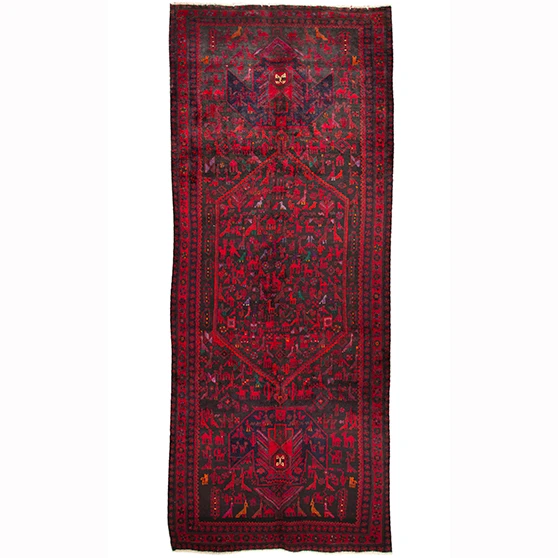
A long Bijar rug of about 14 by 5 feet with a Herati field in dark red, navy, and green - Bijar Persian Rug 14x5 ft - Herati Semi Antique Wool Silk Hand Knotted
3
Designs That Suit the Long Format
The Bijar Herati
The Herati pattern, a diamond with a rosette and four curling leaves, is one of Bijar's great designs. In a fine Bijar, it is drawn with precision and repeated across the field in a dense, even lattice, often with a central diamond medallion. In a long rug, the Herati gives a calm, continuous surface that looks good from any angle. Bijar Heratis are among the most admired versions of this design anywhere. See our Herati designs.
The mihrab or prayer design
Some Bijar long rugs have a mihrab design, an arch or niche at one or both ends, often with a field of flowers, a hanging lamp, or a tree. The prayer arch gives the rug a strong sense of direction, which suits a hallway leading toward a door or window. See our mihrab designs.
Linked medallions
Many long Bijars have a column of medallions, or one long medallion, down the center line. These designs echo the length of the rug and give a strong rhythm.
Garden and vase designs
Older Bijars sometimes show garden layouts or vase designs, with flowering plants arranged in rows. These are rarer and highly valued.
Read about other Bijar designs and the special technique of inlaying in our article on inlaying and embossing in Bijar rugs.
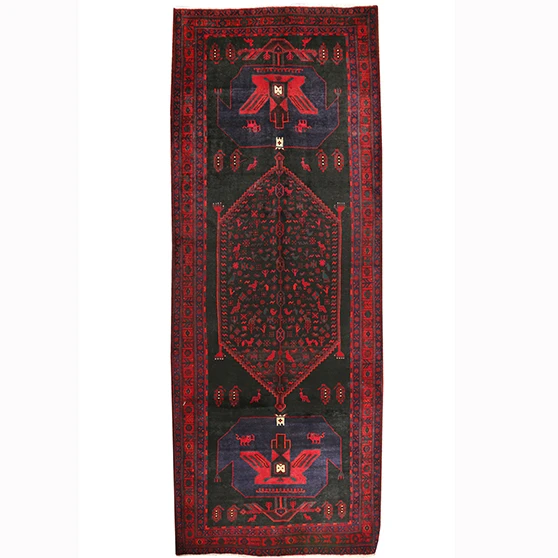
A long Bijar rug of about 14 by 5 feet with a mihrab prayer design in dark red, navy, and crimson - Bijar Persian Rug 14x5 ft - Mihrab Semi Antique Wool Silk Hand Knotted
4
How to Recognize a Bijar Long Rug
•
Stiffness - A Bijar feels heavy and stiff. When you try to fold a corner, it resists.
•
Weight - Even a long, narrow Bijar is surprisingly heavy for its size.
•
Dense pile - The pile is packed tightly, with no gaps between knots.
•
Sharp drawing - Fine Bijars have crisp, precise motifs.
•
Deep colors - Dark red, navy, crimson, and black, with green, gold, and ivory accents.
•
Symmetric knot - Most Bijars use the symmetric (Turkish) knot.
•
Thick wefts - Look at the back: the knots are tightly packed, and the rug is very firm.
If a long rug feels like a board, weighs much more than it looks, and has crisp, deep-colored designs, it is very likely a Bijar.
5
How Borders Turn the Corner on a Long Rug
One sign of a skilled weaver is the way the borders turn the corners. On a long rug, the border must run evenly along two long sides and two short ends, and the motifs must meet neatly at each corner. In a fine town Bijar, the corners are carefully planned, often with a rosette or a special corner motif, and the border pattern flows around them without interruption.
In village rugs, corners are often resolved more freely. A motif may be cut short or squeezed, and the two ends may differ slightly. This is part of the charm of village weaving. When comparing two long Bijars, look at the corners: they tell you a great deal about the care and planning that went into each rug.
6
Town and Village Bijars
Bijar rugs come in several types, and the long format is found in all of them.
•
Town Bijars - Woven in Bijar town, often with the finest drawing and the densest structure. Many long Herati rugs are town rugs.
•
Village Bijars - Woven in surrounding Kurdish villages, often coarser, with bolder designs and a more rustic charm.
•
Afshar and Takab Bijars - Rugs from villages to the north, around Takab, sometimes with slightly different structures and designs.
All are sold under the Bijar name, but their grade, appearance, and price vary. Look at the drawing, the density, and the wool to judge each rug.
7
Grades and How to Judge Them
•
Density - Turn the rug over. Smaller, tighter knots mean a finer rug.
•
Drawing - Crisp, regular motifs and well-matched borders indicate a skilled weaver.
•
Straightness - A long rug should have straight, parallel sides. This is harder to achieve over 14 feet.
•
Flatness - The rug should lie flat. Bijars are stiff, so any distortion is hard to correct.
•
Wool - Look for lustrous wool. Bijar wool is tough and holds its color well.
•
Condition - Check the sides and ends carefully.
8
Never Fold a Bijar
Because Bijars are so dense and stiff, folding them can crack the foundation. This is the one rule every Bijar owner must remember. Always roll a Bijar, with the pile facing outward, along its length. When moving it, keep it rolled and support it along its whole length.
If a Bijar has been folded in the past, you may see a line of broken knots or a crease. Small creases can sometimes be relaxed by a specialist; cracks in the foundation need professional repair. Check for these before you buy.
Always roll a Bijar, never fold it. Its dense, stiff structure can crack along a fold line.
9
Colors of Bijar Long Rugs
Bijar long rugs typically use deep, rich colors. Dark red and crimson fill fields and medallions; navy and black outline motifs and fill borders; green, gold, and ivory add highlights. Some Bijars have a navy field with red motifs, a classic and very elegant combination.
Bijar colors are known for their depth and stability. The tight packing of the wool protects the dyes, and many semi-antique Bijars still show strong, clear colors.
10
Placing a Long Bijar
A long Bijar needs a space that shows off its length.
•
Hallways - Leave about 6 to 12 inches of floor on each side and at each end. A 5 foot wide rug suits a hallway about 6 to 7 feet wide.
•
Under a long table - The rug should extend at least 24 inches beyond the table on each long side, so chairs stay on the rug.
•
In front of a sofa - Place the rug parallel to the sofa, extending slightly beyond each end.
•
Across a bed - A 13 by 5 foot rug across the foot of a king bed extends well on both sides.
Because Bijars are thick and stiff, check that doors can open over them. A low-profile pad keeps the rug from slipping without adding height.
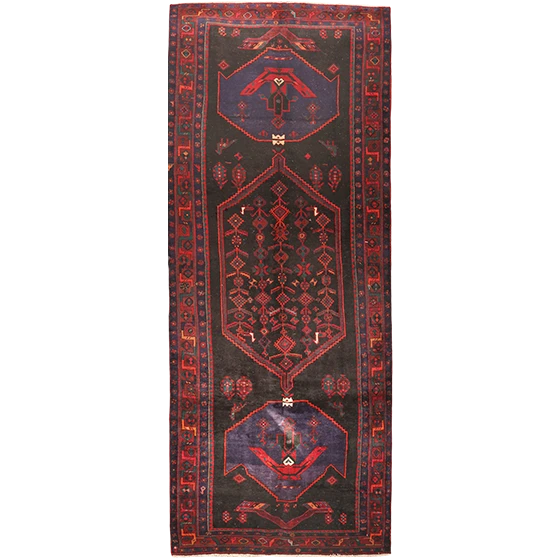
A long Bijar rug of about 14 by 5 feet with a central medallion in crimson, navy, and madder red - Bijar Persian Rug 13x4 ft - Medallion Semi Antique Wool Silk Hand Knotted
11
The First Weeks with a New Bijar
Because Bijars are so stiff, a rug that has been rolled for shipping may not lie perfectly flat at first. The ends may curl slightly, or the rug may hold a gentle wave along its length. This is normal and usually settles on its own.
•
Unroll and wait - Lay the rug flat and leave it for a few days. Its own weight will flatten it.
•
Reverse-roll the ends - If an end curls, roll it gently the other way for a day.
•
Use weight - Place heavy books on a curling corner for a few days.
•
Avoid heat - Do not iron or steam a Bijar yourself. If a wave persists, a specialist can block it.
Once settled, a Bijar stays flat for years, and its weight keeps it firmly in place.
12
Floors, Pads, and Heavy Rugs
A Bijar is heavy, and its weight has advantages and disadvantages. On the plus side, it rarely slips, even on smooth floors. On the minus side, its weight can mark soft floors such as some vinyl or cork, and it traps moisture if laid on a damp surface.
•
Hardwood and stone - Use a thin, breathable pad to protect the floor and let air circulate.
•
Soft floors - Use a firm pad that spreads the weight evenly.
•
Underfloor heating - A thin pad allows heat through. Avoid rubber pads that may react with heat.
•
On carpet - A Bijar can be laid on low-pile wall-to-wall carpet with a special pad that prevents creeping.
Check under the rug a couple of times a year, especially in damp climates, to make sure no moisture is trapped.
13
Buying a Long Rug Online
Long rugs are harder to judge from photographs than standard rugs, because their length can hide small problems. When you buy online, look for or ask for:
•
A full photo from above - So you can see that the sides are straight.
•
Measurements at both ends - The width at each end should be nearly the same.
•
A photo of the back - To check the density and any repairs.
•
Close-ups of the sides and ends - To check the overcasting and fringes.
•
Photos in daylight - To see the true colors.
Every rug in our collection is photographed in detail, and our team is happy to send additional photos or answer questions. Read more in our notes before you buy.
14
Bijar as a Long-Term Purchase
Because a good Bijar can last for generations, it is one of the few rugs that many families buy with their grandchildren in mind. Its value lies less in rapid price changes than in its long working life and its enduring beauty. For a balanced view of rugs as an investment, see our article on whether investing in hand-knotted rugs is profitable.
15
Bijar and Its Neighbors
Bijar and Senneh
Senneh (Sanandaj) rugs, from the provincial capital, are very finely knotted and thin, often single-wefted, with small, intricate designs. Bijars are thicker, heavier, and much stiffer. See our Senneh collection.
Bijar and Hamadan
Hamadan village rugs are usually single-wefted and more flexible. Bijars are much denser and heavier. See our Hamadan collection.
Bijar and Kurdish village rugs
Kurdish village rugs from other areas are often looser, with long pile and bold, simple designs. Bijars represent the most refined and densely woven Kurdish tradition. See our Kurdish collection and our article on Kurdish rugs.
Bijar and Heriz
Heriz rugs share the toughness of Bijars but are less dense, with larger, angular medallions. See our Heriz collection.
16
Bijar Rugs in Different Interiors
The deep colors and precise drawing of a Bijar make it at home in many settings. In a traditional house, a long Herati Bijar in a wood-paneled hall or library looks as if it has always been there. In a modern apartment, a Bijar with a navy or dark red field gives weight and warmth to a space of white walls and simple furniture. In a farmhouse kitchen, a long Bijar under a refectory table adds color and stands up to daily traffic.
Because Bijar designs are usually formal and balanced, they work especially well in symmetrical spaces: a hall with doors at each end, a dining room with a central table, or a bedroom with matching bedside tables. Pair them with solid wood, leather, linen, and brass for a timeless look.
17
Semi-Antique Bijar Long Rugs
Most Bijars in our collection are semi-antique, woven roughly forty to sixty years ago. They have settled colors, firm structures, and many decades of life ahead. Because Bijars are so durable, a semi-antique Bijar in good condition is often as strong as a new rug. See our semi-antique rugs.
18
What Affects the Price of a Bijar
•
Density - Finer, denser rugs cost more.
•
Design - Fine Herati and unusual designs are highly valued.
•
Size - Longer and larger rugs cost more.
•
Straightness - Long rugs with straight sides are worth more.
•
Condition - Intact sides and ends, and no fold damage.
•
Origin - Town Bijars usually command higher prices than village Bijars.
Given their durability, Bijars offer outstanding long-term value. A good Bijar can serve several generations.
19
Caring for a Bijar
•
Vacuum regularly - Use suction without a beater bar.
•
Rotate - Turn the rug end to end every six months.
•
Roll, do not fold - Always roll for moving or storage.
•
Use a pad - A thin, firm pad keeps the rug in place.
•
Blot spills - Blot at once with a clean cloth.
•
Professional washing - Have it washed by a specialist every few years. Bijars dry slowly because of their density, so proper drying is essential.
See our care instructions and our guide to professional washing.
20
Common Buying Mistakes
•
Folding the rug - Never fold a Bijar.
•
Ignoring the straightness - Check the sides of long rugs carefully.
•
Forgetting door clearance - Bijars are thick and stiff.
•
Washing at home - Bijars are hard to dry; leave washing to professionals.
•
Confusing Bijar with Senneh - The two are very different in structure, despite coming from the same province.
21
Frequently Asked Questions
Where is Bijar?
In Kurdistan province, western Persia, north-east of Sanandaj.
Why are Bijars called iron rugs?
Because their wool is packed extremely tightly, making them heavy, stiff, and very durable.
What is a gallery rug?
A long rug wider than a runner, typically 4.5 to 6 feet wide and 10 to 16 feet long.
What is a kelleh?
A trade name for a long rug, after the Persian word for head, referring to the rug that lay at the head of a traditional room.
Can I fold a Bijar?
No. Always roll it; folding can crack the foundation.
What designs are typical of long Bijars?
Herati fields, prayer arches, linked medallions, and garden or vase designs.
What knot is used?
Mostly the symmetric or Turkish knot.
How do Bijars differ from Senneh rugs?
Senneh rugs are fine and thin; Bijars are thick, dense, and stiff.
Are Bijars good for busy areas?
Yes. They are among the most durable rugs in the world.
Can I wash a Bijar at home?
It is better not to. Bijars dry slowly and should be washed by professionals.
Where should I place a long Bijar?
In a wide hallway, under a long table, in front of a sofa, or across the foot of a bed.
Why do the ends of my new Bijar curl?
Because it was rolled for shipping. Lay it flat and it will settle in a few days.
Is a Bijar safe on underfloor heating?
Yes, with a thin, breathable pad.
How long does a Bijar last?
With good care, generations.
22
Choose Your Bijar Rug
Each Bijar in our collection is hand-knotted, one of a kind, and inspected before it is listed. Browse our Bijar collection, compare it with our Senneh and Kurdish rugs, or ask our experts for help choosing the right length.