


On the high plateau north-west of Isfahan, at a crossroads of routes leading to Arak, Hamadan, and Khomein, stands the old town of Golpayegan. It is a place of orchards and wheat fields, of a fine Seljuk mosque, and of villages where weaving has long been part of daily life. Its rugs are less famous than those of Isfahan or Arak, but they have a character of their own, shaped by the meeting of city, village, and tribal traditions.
This guide focuses on the village side of Golpayegan weaving, which is represented in our collection by a long semi-antique runner. It explains where Golpayegan rugs come from, how to recognize them, how they relate to their neighbors, and how to choose, place, and care for a runner. For the history and the wider weaving culture of the district, see our article on weaving in Golpayegan.
1
Golpayegan and Its District
Golpayegan lies in the north-west of Isfahan province, about 180 kilometers north-west of the city of Isfahan, on a plateau at around 1,800 meters. The climate is continental, with cold winters and warm, dry summers. The land around the town is farmed for wheat, fruit, and nuts, and the hills provide pasture for sheep.
The town is old. Its Friday Mosque has a famous brick dome built in the Seljuk period, early in the twelfth century, one of the fine examples of Seljuk architecture in central Persia. Nearby is the town of Khansar, known for its mountain landscapes and its honey, and to the north and west lie the weaving regions of Khomein, Arak, and Hamadan.
This position at a crossroads has always shaped Golpayegan's crafts. Its weavers have looked toward Isfahan for refined city designs, toward Arak for village carpet traditions, and toward the tribes of the Zagros for bold, geometric patterns.
Golpayegan lies in the north-west of Isfahan province, at a crossroads between Isfahan, Arak, and Hamadan. Its weaving combines city, village, and tribal traditions.
2
Two Sides of Golpayegan Weaving
Rugs from the Golpayegan district fall broadly into two groups.
•
Town rugs - Finer rugs woven in workshops, often with curvilinear medallions and floral fields in the manner of Isfahan and Kashan.
•
Village rugs - Sturdier rugs woven in homes around the district, with geometric designs such as lattices, stepped medallions, and small repeating motifs.
The two groups are not completely separate. Village weavers sometimes borrowed motifs from town designs, simplifying their curves into steps and angles, while town workshops drew on the colors and wool of the villages around them. The result is a district with a wide range of rugs, from formal floral carpets to bold geometric runners.
Our Golpayegan runner belongs to the second group. It shows the bold, geometric side of the district's weaving, with a diamond lattice that recalls tribal and village rugs of the Zagros foothills.
3
How to Recognize a Golpayegan Village Rug
•
Geometric drawing - Straight lines, steps, and diagonals.
•
Lattice and medallion designs - Diamond lattices, linked medallions, and small repeating motifs.
•
Warm colors - Red, navy, cream, brown, and camel, with black outlines.
•
Long formats - Runners and long rugs are common among village pieces.
•
Sturdy structure - A cotton foundation and thick wool.
A Golpayegan village rug often looks like a bridge between the village rugs of the Arak region and the tribal rugs of the Zagros: orderly and well finished, but bold and graphic in design.
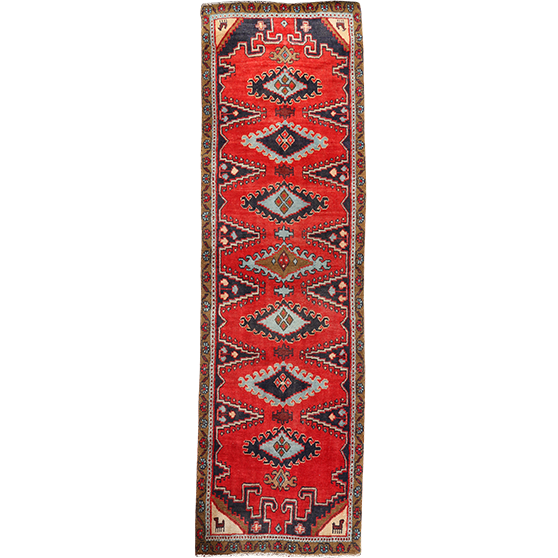
A Golpayegan runner of about 11.5 by 3 feet with a diamond lattice in red, navy, cream, and camel - Golpayegan Persian Rug 11x3 ft - Geometric Semi Antique Wool Hand Knotted
4
The Diamond Lattice
The design of our Golpayegan runner is a diamond lattice: diagonal lines cross the field to form a chain of diamonds, each holding a small motif. In a runner, the lattice runs the whole length of the rug, creating a strong rhythm that leads the eye from one end to the other.
This design has deep roots in Persian weaving. It appears in tribal rugs, village rugs, and even in the tiled floors and brickwork of Persian architecture, including the brick patterns of Seljuk buildings like Golpayegan's own Friday Mosque. The lattice is both decorative and practical: it divides the field into small compartments, so wear and small marks are less visible, and it looks the same from either end. See our lattice designs.
Reading the motifs inside the lattice
Look closely at the motifs inside each diamond. They may be stars, rosettes, small crosses, or stylized flowers, and their colors often change from one diamond to the next in a regular sequence. In village rugs, this sequence is sometimes broken, with a motif in an unexpected color, a small sign of the weaver's own choice.
5
How Golpayegan Village Rugs Are Built
•
Knot - Village rugs of the region use the symmetric or asymmetric knot, depending on the weaver and the village.
•
Foundation - Cotton warps and wefts in semi-antique rugs.
•
Pile - Thick local wool, clipped to a medium height.
•
Density - Coarse to medium.
•
Sides and ends - Overcast sides, cotton fringes.
The result is a sturdy, comfortable rug that lies flat and wears well.
6
Golpayegan and Its Neighbors
Golpayegan and Isfahan
Isfahan rugs are fine city rugs with curvilinear designs and short pile. Golpayegan town rugs sometimes follow Isfahan designs; village rugs are more geometric. See our Isfahan collection.
Golpayegan and Arak
Arak village rugs, from the north, share the sturdy village construction and often use Herati and medallion designs. See our Arak collection.
Golpayegan and Hamadan
Hamadan village rugs, further north-west, are usually single-wefted with geometric designs. Golpayegan village rugs share the bold drawing. See our Hamadan collection.
Golpayegan and Bakhtiari
Bakhtiari rugs, from the Zagros to the south-west, are larger and thicker, often with garden panel designs. See our Bakhtiari collection.
Golpayegan and Joshaqan
Joshaqan rugs, from the district between Golpayegan and Kashan, are known for their diamond-shaped flower motifs arranged in lattices. See our Joshaqan collection.
7
Colors of Golpayegan Village Rugs
The palette is warm and earthy. Red fills the field and the main motifs, navy outlines and borders, cream and ivory light the design, and camel and brown add a natural warmth. Black defines outlines.
In semi-antique rugs, these colors have softened into a gentle harmony. The camel tones, in particular, give the rug a warm, sunny character that suits many interiors.
8
The Runner Format
Our Golpayegan runner is about 11.5 feet long and just over 3 feet wide. This is a classic runner size, ideal for:
•
Hallways - The main use. A 3 foot runner suits a hallway about 3.5 to 4 feet wide.
•
Kitchens - Along a counter or an island.
•
Bedsides - Along the side of a king bed.
•
Stair landings - On a long landing.
•
Entrances - From the front door into the house.
See our runners for other long rugs.
9
Choosing the Right Runner
Measure the hallway carefully. For length, subtract about 12 to 24 inches from the length of the hall, so that 6 to 12 inches of floor show at each end. For width, subtract about 8 to 12 inches, so that 4 to 6 inches of floor show on each side. If the hallway has doors along its length, check that they can open over the rug.
Mark the runner's outline on the floor with painter's tape before you buy, and walk along it. This simple test helps you see how the rug will look and avoid most mistakes.
10
Placing a Lattice Runner
A lattice runner is one of the easiest rugs to place, because it has no top or bottom and looks the same from either end. In a hallway, its diagonal lines lead the eye forward and make the space feel longer. In a kitchen, its small compartments hide crumbs and spills. Beside a bed, its regular pattern is calm and restful.
In modern interiors, the geometric design of a lattice runner echoes clean lines and simple forms. In traditional interiors, it adds warmth and color. Its camel and cream tones make it especially easy to combine with natural wood and stone.
11
Grades and How to Judge Them
•
Straightness - A runner should have straight, parallel sides along its whole length.
•
Drawing - The lattice should be regular, with evenly sized diamonds.
•
Wool - Lustrous, springy wool.
•
Color - Clear colors without bleeding.
•
Condition - Even pile, intact sides and ends.
12
Reading the Back
On the back of a Golpayegan village rug, the knots are of medium size and the lattice shows clearly. Look for even rows and straight sides. Check the overcasting on the long sides, which takes most of the wear in a runner, and the fringes at the ends.
13
Village Life on the Golpayegan Plateau
In the villages around Golpayegan, weaving has long been a winter occupation. When the harvest is in and the cold sets in, women set up their looms inside the house and work through the winter months. Runners were especially practical on village looms: a narrow loom fits against the wall of a village room and can be worked by one weaver.
In a traditional Persian room, runners lay along the sides of the room, where people sat on cushions against the wall. Today, they serve modern homes in halls and kitchens, but their long, narrow shape still recalls that older way of life. Read more about the people behind rugs in our article on the craft from shepherd to dealer.
14
The Colors and Their Dyes
The warm palette of Golpayegan village rugs rests on the classic dye traditions of central Persia. Madder root gives the reds, which range from bright to deep depending on the mordant and the length of dyeing. Indigo gives the navies. Browns and blacks come from walnut husks and iron, and yellows from plants such as weld. The camel tones may come from natural undyed wool, from camel hair, or from wool dyed to a camel shade.
In semi-antique village rugs, you may see slight changes of shade within one color, called abrash, where the weaver moved from one batch of wool to another. These bands give the field movement and are a sign of hand-dyed wool. Read more in our articles on natural dyes and traditional dyeing.
15
Two Runners in One Hall
In a long hallway, or one with a turn, two runners often look better than one. They do not need to match: a Golpayegan lattice runner and another village runner of similar width and color can sit at each end of a hall with a stretch of floor between them. In an L-shaped hall, place one runner in each straight section rather than trying to fit a single rug around the corner. Using two runners also lets you swap their positions from time to time, spreading the wear.
16
Keeping a Hallway Runner Fresh
A hallway runner works harder than almost any other rug in the house. A doormat outside the front door catches much of the grit that would otherwise wear the wool. Vacuum the runner weekly, and once in a while lift it, clean the floor beneath, and turn the rug end to end. Every year or two, have it professionally washed to remove deep dirt. Check the long sides regularly; if the overcasting wears, have it renewed before the knots begin to loosen.
17
Questions to Ask Before You Buy
•
What are the measurements at both ends? - This tells you whether the runner is straight.
•
Has it been repaired? - Especially along the sides and at the ends.
•
Has it been washed recently? - A fresh wash shows the true colors.
•
How thick is the pile? - Important for door clearance.
•
How old is it? - Semi-antique rugs have softer, settled colors.
18
Combining a Golpayegan Runner with Other Rugs
A Golpayegan runner pairs well with larger rugs from central and western Persia. Next to an Isfahan or a Kashan in a living room, it adds a village warmth. Next to a Bakhtiari or a Heriz, it shares the bold, geometric spirit. Keep one color in common, such as red or navy, and vary the scale of the patterns: a small lattice runner next to a large medallion carpet is a natural pairing.
19
Weaving a Runner Straight
A runner is one of the most demanding formats for a weaver. Over 11 feet or more, the tension of the warps must stay even, each row must be beaten down with the same force, and the width must stay constant. Any small difference adds up, and a runner can become wider at one end or curve along its length. Good village weavers check the width as they go and adjust their work, and a straight runner is a sign of real skill.
When you choose a runner, lay it flat and look along its length from one end. Small variations are normal in village work; a runner that is noticeably wider at one end, or that curves, will be harder to place in a narrow hall.
20
A Runner Through the Seasons
A runner can move around the home as the seasons change. In winter, it brings warmth to a cold hallway or the side of a bed. In summer, it can move to a kitchen or a covered porch, out of strong sunlight. Its camel and cream tones make it a good year-round rug, lighter than many deep red village rugs, and its lattice design looks fresh in every season.
If you store a runner for a time, roll it with the pile facing outward, wrap it in cotton fabric, and keep it in a dry place off the floor. Check it now and then for moths.
21
Golpayegan Town Rugs
Although our collection currently holds a village runner, the Golpayegan district is also known for finer town rugs. These are woven in workshops with curvilinear medallions, Shah Abbasi palmettes, and floral fields in the manner of Isfahan and Kashan, often in deep reds and navies, and in room sizes. They are more formal than the village rugs, and they show how closely the district has always been tied to the great city traditions of central Persia.
22
Semi-Antique Golpayegan Rugs
Our Golpayegan runner is semi-antique, woven roughly forty to sixty years ago. It has settled colors, good wool, and sturdy construction, with many years of life ahead. See our semi-antique rugs.
23
What Affects the Price
•
Length - Longer runners cost more.
•
Straightness - Straight runners are worth more.
•
Wool - Lustrous wool adds value.
•
Design - A regular, well-drawn lattice is attractive.
•
Condition - Intact sides and ends.
24
Caring for a Golpayegan Runner
Vacuum regularly without a beater bar. Turn the runner end to end every few months to even out wear. Use a non-slip pad. Blot spills at once. Have it professionally washed every year or two in busy areas. Keep the sides and ends in good repair. See our care instructions and our guide to maintaining rug fringes.
25
Common Buying Mistakes
•
Choosing the wrong length - Measure carefully and mark the floor.
•
Skipping the pad - Runners slip easily.
•
Ignoring door clearance - Check doors along the hallway.
•
Neglecting the sides - The long edges of a runner need regular checks.
26
Frequently Asked Questions
Where is Golpayegan?
In the north-west of Isfahan province, about 180 kilometers north-west of Isfahan.
What is Golpayegan known for?
Its Seljuk-era Friday Mosque, its orchards, and its weaving.
What kinds of rugs come from Golpayegan?
Finer town rugs in the manner of Isfahan and Kashan, and sturdier village rugs with geometric designs.
What is a diamond lattice?
A design of diagonal lines forming a chain of diamonds, each holding a small motif.
What colors are typical?
Red, navy, cream, brown, and camel, with black outlines.
What size is your Golpayegan runner?
About 11.5 by 3 feet.
How wide a hallway suits a 3 foot runner?
A hallway about 3.5 to 4 feet wide.
Does a lattice runner have a top and bottom?
No. It looks the same from either end, which makes it easy to place.
Are Golpayegan village rugs durable?
Yes. Their cotton foundation and thick wool make them sturdy.
Is Khansar near Golpayegan?
Yes. The mountain town of Khansar, known for its honey and landscapes, lies close by.
How can I tell if a runner is straight?
Lay it flat and look along its length, and compare the width at both ends.
Does Golpayegan also produce finer rugs?
Yes. Town workshops weave curvilinear rugs in the manner of Isfahan and Kashan.
How should I store a runner?
Roll it with the pile outward, wrap it in cotton, and keep it dry and off the floor.
Where do the camel tones come from?
From natural undyed wool, camel hair, or wool dyed to a camel shade.
Can I use two runners in one hallway?
Yes. Choose two of similar width and color and leave a stretch of floor between them.
What is abrash?
Slight changes of shade within one color, caused by wool dyed in different batches.
Why are runners common among village rugs?
A narrow loom fits against the wall of a village room and can be worked by one weaver, and runners were traditionally laid along the sides of Persian rooms.
How should I care for a runner?
Vacuum regularly, turn it end to end, use a pad, and have it professionally washed regularly.
27
Choose Your Golpayegan Rug
Each rug in our Golpayegan collection is hand-knotted, one of a kind, and inspected before it is listed. Browse our Golpayegan collection, see all our runners, compare with our Joshaqan and Arak rugs, or ask our experts for help.