


In the mountain villages east of Tabriz, weavers have produced some of the most powerful rugs in Persia for more than a century. The market groups them under the name of the district's main town, Heriz, but within this family each village has its own character. Goravan, often written Gorevan, is known for the boldest and most graphic version of the Heriz style: huge angular medallions, strong outlines, and deep, saturated colors.
This guide explains where Goravan rugs come from, how they fit into the Heriz family, how to recognize them, how they are built, and how to choose, place, and care for one. For the district and its history, see our article on weaving in Heriz and our Heriz collection guide.
1
Goravan in the Heriz District
The Heriz district lies about 60 to 80 kilometers east of Tabriz, on the slopes of the mountains that rise toward Mount Sabalan. Its villages sit in valleys and on hillsides, with cold winters, green summers, and rich pastures. Sheep from these pastures provide the district's famously resilient wool.
Goravan is one of the district's weaving villages, along with Heris itself, Mehraban, Bakhshaiesh, Ahar to the north, and many others. Each produces rugs in the Heriz manner, but with its own preferences in drawing, color, and fineness. In the market, Goravan has long been used as the name for a particular type of Heriz-district rug: one with simpler, bolder, more angular drawing, a coarser weave, and often darker colors.
Goravan is a village of the Heriz district east of Tabriz. In the market, the name stands for the boldest, most angular, and often darkest version of the Heriz style.
2
The Heriz Family at a Glance
Knowing the main names of the Heriz family helps you see where Goravan fits:
•
Heriz - The general name for rugs of the district, from coarse to fine, with large geometric medallions. See our Heriz collection.
•
Serapi - A trade name for older, finer district rugs with open fields and softer colors. See our Serapi collection.
•
Bakhshaiesh - A village known for freer designs and deep colors, especially in older pieces. See our Bakhshaiesh collection.
•
Mehraban - A village whose rugs often have bright reds and blues and a slightly looser weave. See our Mehraban collection.
•
Goravan - The boldest and most angular version, with a coarser weave and often darker colors.
These names are not strict grades, and dealers use them in different ways. But they point to real differences in look and feel, and Goravan sits at the bold, robust end of the family.
3
How to Recognize a Goravan Rug
•
Large angular medallion - A dominant central medallion with straight edges, steps, and hooks, often star-shaped or diamond-shaped.
•
Strong corners - Large corner pieces that echo the medallion's angles.
•
Open field - The field around the medallion is often fairly open, with large stylized palmettes and leaves.
•
Bold outlines - Motifs outlined in dark colors, which makes the design read clearly from a distance.
•
Deep palette - Madder red, dark red, burgundy, and navy, often with ivory medallions and borders.
•
Robust weave - A coarser, sturdy structure with thick wool.
If a rug has the Heriz look but with even simpler, bolder drawing and a darker, more saturated palette, there is a good chance it is a Goravan.
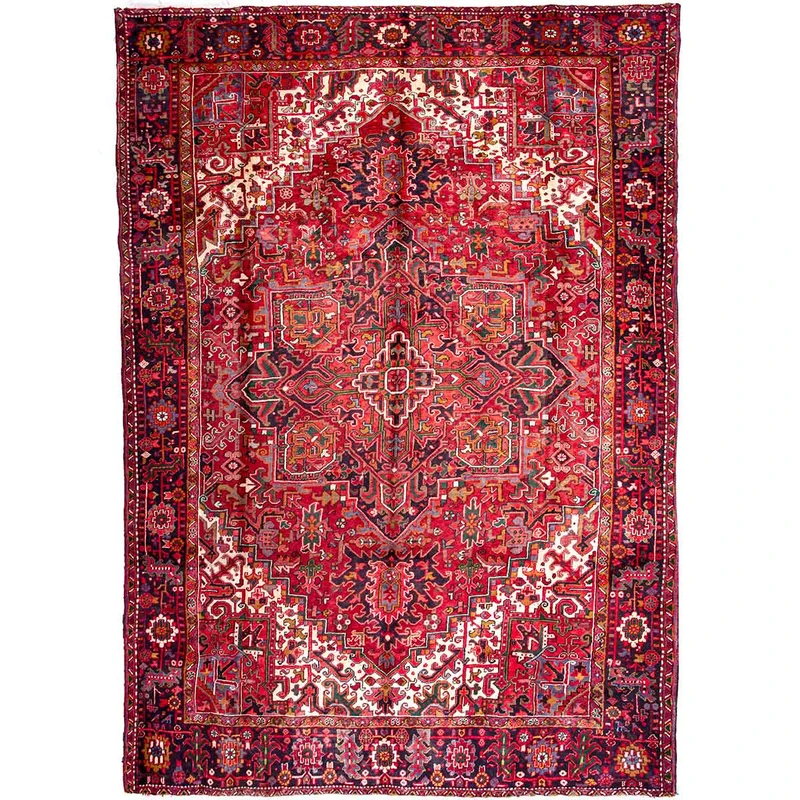
A room-size Goravan rug of about 13 by 9 feet with a large angular medallion in madder red, burgundy, navy, and ivory - Goravan Persian Rug 12x9 ft - Medallion Semi Antique Wool Hand Knotted
4
Why the Drawing Is So Angular
Every motif in a hand-knotted rug is built from tiny squares of color, one for each knot. Curves need many small steps, and the coarser the weave, the more angular the curves become. The weavers of the Heriz district turned this into a style. Instead of fighting the coarse grid, they drew palmettes, vines, and medallions with bold straight lines and angles, creating a strong graphic language of their own.
Goravan rugs take this approach furthest. Their medallions look almost architectural, and their palmettes become geometric shapes. This is why Goravan and other Heriz-district rugs look so at home in modern interiors: their designs share the clarity and strength of modern art and architecture.
5
How Goravan Rugs Are Built
•
Knot - Symmetric (Turkish) knot.
•
Foundation - Cotton warps and wefts in semi-antique rugs.
•
Wefts - Typically two wefts between rows of knots.
•
Pile - Thick, resilient wool from the district's flocks, clipped to a medium height.
•
Density - Coarse to medium, coarser than many Heriz and Serapi rugs.
•
Weight - Heavy and solid, especially in room sizes.
•
Sides and ends - Strongly overcast sides and cotton fringes.
This construction makes Goravan rugs extremely durable. Like other rugs of the district, they are known for surviving generations of heavy use.
6
Colors of Goravan
The Goravan palette is deep and strong. Madder red and dark red fields are the most common, with burgundy, navy, and indigo medallions and outlines. Ivory and cream fill medallion centers, corners, and borders, providing bright contrast. Black, gold, and rust add detail.
Compared with other members of the Heriz family, Goravan rugs are often darker, with more navy and burgundy and less of the soft ivory, pink, and light blue of finer Serapi pieces. In semi-antique rugs, these strong colors have mellowed into a warm, rich harmony.
7
Room Sizes and Planning
Our Goravan collection includes several sizes, from a large carpet of about 13 by 9 feet to medium rugs of about 9 by 6.5 and 8.5 by 6 feet, and long pieces and runners.
•
Large carpets - About 9 by 12 to 9 by 13 feet, ideal for living rooms and dining rooms of about 12 by 16 feet.
•
Medium rugs - About 6 by 9 feet, ideal for bedrooms, studies, and smaller living spaces.
•
Runners and long rugs - About 3 by 7 to 3 by 11 feet, ideal for hallways and beside beds.
Before you choose, measure the room and decide which furniture will sit on the rug. Mark the outline with painter's tape. A large Goravan medallion looks best when it is centered on the main furniture group, such as the coffee table or dining table. See our 9x12 rugs and 6x9 rugs.

A Goravan rug of about 9 by 6.5 feet with a navy and ivory medallion on a madder red field - Goravan Persian Rug 9x6 ft - Medallion Semi Antique Wool Hand Knotted
8
Placing a Bold Rug
A Goravan makes a strong statement, so it helps to plan the room around it.
•
Let it lead - Use the rug as the main source of pattern and color. Keep upholstery and walls fairly plain.
•
Center the medallion - Place the medallion under the coffee table or dining table.
•
Repeat a color - Pick up the red, navy, or ivory in cushions, throws, or art.
•
Mix materials - Leather, linen, wood, and metal all suit the rug's strong character.
•
Light floors - On pale wood or stone, the deep colors stand out beautifully.
In modern interiors, a Goravan's geometric drawing echoes clean lines and simple forms. In traditional interiors, it pairs naturally with dark wood and other tribal rugs. In rustic or farmhouse homes, its toughness and warmth feel right at home.
9
The Goravan Runner
Our collection also includes Goravan runners, such as a piece of about 11 by 3 feet with a madder red field and medallions along its length. In a hallway, the bold medallions create a strong rhythm, and the tough weave stands up to daily traffic. See our runners.

A Goravan runner of about 11 by 3 feet with medallions on a madder red field, in navy and cream - Goravan Persian Rug 10x3 ft - Medallion Semi Antique Wool Hand Knotted
10
Grades and How to Judge Them
•
Wool - Thick, springy, lustrous wool is the most important sign of quality.
•
Drawing - A balanced composition with a well-centered medallion and matching corners.
•
Color - Clear, deep colors without bleeding.
•
Shape - Straight sides and a flat lie. Large village rugs can be slightly out of square; small differences are normal.
•
Condition - Even pile, intact sides and ends.
11
Reading the Back
On the back of a Goravan, the knots are relatively large and the design is very clear, with strong outlines. Look for even rows and straight sides. Because Goravan rugs are double-wefted, the back feels firm. Check for repairs, especially near the ends and along the sides.
12
Goravan Compared with Its Neighbors
Goravan and Heriz
All Goravans are part of the Heriz family. A rug sold simply as Heriz may be finer or coarser; a Goravan points to the boldest, most angular style.
Goravan and Serapi
Serapi rugs are usually older, finer, and softer in color, with more open fields. Goravans are bolder and darker.
Goravan and Karaja
Karaja rugs, from north of Tabriz, share the geometric spirit but are usually smaller, with distinctive linked medallions. See our Karaja collection.
Goravan and Bakhtiari
Bakhtiari rugs, from the Zagros, share the toughness but often use garden panel designs and nearly square proportions. See our Bakhtiari collection.
13
Weaving in the Heriz Villages
In the villages of the Heriz district, weaving has long been part of family life. Women set up looms inside the house and weave through the long winters, often working in pairs or small groups on larger carpets. Many village weavers of the district traditionally worked without a full paper cartoon, weaving the familiar medallion designs from memory or from a model rug. This is one reason why Goravan rugs, though they share a common style, are never exactly alike: one medallion may be slightly larger, one corner drawn a little differently, one color changed mid-row.
These small variations are the marks of handwork and part of the rug's character. Read more about the life of village weavers in our article on the craft from shepherd to dealer.
14
Living with a Goravan
A Goravan is a rug for living. It does not need to be protected or kept out of busy rooms; it thrives on use. Families with children and pets often choose Heriz-district rugs precisely because they hide wear, resist stains, and recover from furniture marks. A Goravan in a family room or dining room will look good for decades with simple care.
Over time, the colors of a well-used Goravan soften and the wool develops a gentle sheen. Many owners find that their rug looks better after twenty years of use than when it first arrived.
15
The Wool of the Heriz District
Much of the Heriz family's legendary durability comes from its wool. Sheep grazing the high pastures of the district produce a thick, springy fleece with a good natural oil content. This wool resists dirt, recovers after pressure, and holds its color well. In a coarser rug like a Goravan, where each knot is made of a generous amount of wool, these qualities are especially valuable.
Local tradition adds another explanation: that traces of copper in the water and soil of the district give the wool extra strength and the colors their depth. Whether or not this belief is exactly true, it reflects the pride the people of the district take in their materials. Read more in our article on wool in Persian rugs.
16
A Goravan Under the Dining Table
A large Goravan is an excellent dining room rug. Its tough wool and deep colors hide spills, and its bold design looks good from every chair. The rule is simple: the rug should extend at least 24 inches beyond the table on every side, so that chairs stay on the rug when they are pulled out. For a table of 4 by 7 feet, look for a rug of at least 8 by 11 feet; a rug of about 9 by 13 feet gives comfortable room.
Center the medallion under the table, and use a thin, firm pad so chairs slide easily. In a dining room, the large medallion of a Goravan often reads beautifully when the table is cleared, giving the room a strong focal point even when it is not in use.
17
Signs of a Well-Kept Semi-Antique Goravan
•
Even pile - Worn evenly, without bald spots or deep furrows.
•
Supple foundation - The foundation bends without cracking when a corner is gently folded back.
•
Intact sides - The overcasting along the sides is complete or neatly renewed.
•
Secure ends - Fringes and woven end bands are present.
•
Clean colors - No running of red into ivory, and no large faded areas.
•
No moth damage - Check the back and under the edges for bare patches.
18
Combining a Goravan with Other Rugs
A Goravan anchors a room, and other rugs can be chosen to support it. In a hallway nearby, a Goravan or Heriz runner continues the same language. In a bedroom, a smaller village rug with similar reds, such as a Hamadan or a Bakhshaiesh, keeps the house coherent. Avoid placing a very fine, pale city rug right next to a large, dark Goravan; the contrast in scale and color can make both look out of place.
19
Questions to Ask Before You Buy
•
What are the exact measurements? - Check the width at both ends of large rugs.
•
Has it been repaired? - Ask where, and how.
•
Has it been washed recently? - A fresh wash shows the true depth of the reds.
•
How will it be delivered? - Large Goravans are heavy.
•
How thick is the pile? - Important for door clearance.
20
Moving and Handling a Large Rug
•
Roll, do not fold - Roll the rug with the pile facing outward, along its length.
•
Lift with help - Large Goravans are heavy; use two or three people.
•
Do not drag - Dragging can damage the sides and fringes.
•
Store dry - Wrap in breathable fabric, never plastic, and store off the floor.
21
Smaller Goravan Rugs
Besides large carpets and runners, Goravan weavers make medium and small rugs of about 6 by 9, 5 by 8, and 3.5 by 7 feet. These carry the same bold medallions in a compact form and are ideal for bedrooms, studies, and entrances. A smaller Goravan with a single strong medallion can be a striking first impression at the front door, and it will stand up to the heaviest traffic in the house.
22
Semi-Antique Goravan Rugs
Our Goravan rugs are semi-antique, woven roughly forty to sixty years ago. They have settled colors, good wool, and sturdy construction, with many decades of life ahead. See our semi-antique rugs.
23
What Affects the Price
•
Size - Room-size carpets cost more than small rugs.
•
Wool - Lustrous, thick wool adds value.
•
Drawing - A well-balanced, strong medallion is sought after.
•
Condition - Even pile, intact sides and ends.
•
Color - Harmonious, deep colors add appeal.
Goravan rugs offer the look and toughness of the Heriz family at accessible prices, especially in room sizes.
24
Caring for a Goravan
Vacuum regularly without a beater bar. Rotate the rug every six months. Use a good pad, especially under large rugs. Blot spills at once. Have it professionally washed every few years; large rugs are best cleaned by specialists with proper drying facilities. See our care instructions and our guide to professional washing.
25
Common Buying Mistakes
•
Expecting fine drawing - Goravans are bold and angular by design.
•
Choosing too small a rug - A large medallion needs room to breathe.
•
Ignoring door clearance - Thick rugs can block doors.
•
Skipping the pad - Large rugs need a good pad to stay flat and in place.
26
Frequently Asked Questions
Where is Goravan?
In the Heriz district, in the mountains east of Tabriz, north-western Persia.
How do you spell Goravan?
It is also written Gorevan.
Are Goravan rugs Heriz rugs?
Yes. Goravan is a village of the Heriz district, and the name stands for the boldest style in the family.
What makes Goravan rugs different?
Larger, more angular medallions, simpler drawing, a coarser weave, and often darker colors.
What knot is used?
The symmetric or Turkish knot.
What colors are typical?
Madder red, dark red, burgundy, and navy, with ivory medallions and borders.
Are Goravan rugs durable?
Very. Heriz-district rugs are among the toughest Persian rugs.
Do Goravan rugs suit modern homes?
Yes. Their geometric drawing echoes modern art and architecture.
What sizes do you offer?
From room-size carpets of about 13 by 9 feet to medium rugs and runners.
How should I move a large Goravan?
Roll it with the pile outward and lift it with help. Do not fold or drag it.
Are there small Goravan rugs?
Yes. Medium and small rugs carry the same bold medallions and suit bedrooms, studies, and entrances.
What size Goravan suits a dining table?
The rug should extend at least 24 inches beyond the table on every side.
Why are Heriz-district rugs so durable?
Thick, resilient wool from the district's high pastures and a sturdy double-wefted weave.
Is a Goravan good for a home with children and pets?
Yes. It hides wear, resists stains, and recovers well from pressure.
How should I clean a Goravan?
Vacuum regularly, blot spills, and have it professionally washed every few years.
27
Choose Your Goravan Rug
Each Goravan rug in our collection is hand-knotted, one of a kind, and inspected before it is listed. Browse our Goravan collection, compare it with our Heriz, Serapi, and Mehraban rugs, or ask our experts for help.