


If you love color, Kerman is the Persian rug for you. Where many rugs use six or eight colors, a Kerman may use fifteen, twenty, or even thirty. Crimson and navy share the field with pink, turquoise, light green, gold, copper, and orange, all blended with the skill of painters. The result is a rug that seems to glow from within, rich yet harmonious.
Our blog already tells the story of Kerman, its shawl weavers, and its long history of fine carpets. This page is practical. It explains how to read a Kerman's colors and designs, how to recognize its structure, how it compares with other city rugs, and how to choose, place, and care for one. For the background, see our article on weaving in Kerman.
1
Kerman in Brief
Kerman is a city in south-eastern Persia, on a high plateau at the edge of the desert. It has been a great center of crafts for centuries. In the nineteenth century, its weavers were famous for fine wool shawls with boteh designs, exported to Europe. When the shawl trade declined, many shawl weavers turned to carpets, bringing with them their skill with fine wool, many colors, and intricate floral design.
The city lies at about 1,750 meters, with hot summers and cold winters, surrounded by mountains and desert. Its old bazaar, its historic bathhouses, and its gardens reflect centuries of prosperity from trade along routes linking Persia with India and the Gulf.
Kerman rugs are woven with local wool from Kerman province and nearby districts, such as Rafsanjan, Bam, and Jiroft, which is known for its gloss and softness. Many weavers still prefer hand-spun wool.
Kerman's carpet weavers inherited the skills of the city's famous shawl makers: fine wool, many colors, and intricate floral designs.
2
Reading the Colors
The first thing you notice in a Kerman is its color. Here is how to read it:
•
The field - Most Kerman fields are red, from crimson to deep madder; others are cream, ivory, navy, or soft pastels.
•
The medallion and corners - Often in navy, cream, or gold, framing the center.
•
The flowers - This is where the palette explodes: pink, rose, turquoise, light green, orange, gold, copper, and beige.
•
The outlines - Dark navy and black outlines keep the many colors clear and separate.
•
The borders - Several borders, each with its own color balance, frame the composition.
Look closely and you will see that many flowers are shaded, with two or three tones of the same color, like brushstrokes. This shading is one of the signatures of Kerman weaving.
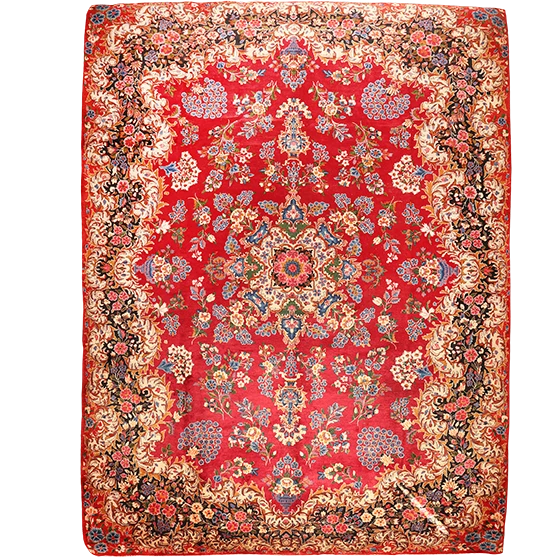
A room-size Kerman rug of about 13.5 by 9.5 feet with a medallion on a crimson field, in cream, navy, gold, green, copper, and pink - Kerman Persian Rug 13x9 ft - Medallion Semi Antique Wool Silk Hand Knotted
3
The Main Designs
Medallion and floral field
A central medallion, often round or lobed, surrounded by a field of flowers, vines, and bouquets, with corners and several borders. In many Kermans, the flowers are drawn naturalistically, almost like botanical illustrations. See our medallion designs.
Vase designs
Some Kermans show flowering vases, sometimes repeated in rows, recalling the famous Safavid vase carpets of the region. See our vase designs.
Garden and tree designs
Garden layouts and trees of life appear in some pieces, with birds and blossoms among the branches. See our tree of life designs.
Boteh designs
The boteh, inherited from Kerman's shawl tradition, appears in fields and borders. See our boteh designs.
Pictorial designs
Kerman weavers are also known for pictorial rugs showing scenes, portraits, or landscapes, a tradition that shows their painterly skill.
4
How Kerman Rugs Are Built
•
Knot - The asymmetric (Persian or Senneh) knot, which allows smooth curves and fine shading.
•
Foundation - Cotton warps and wefts.
•
Wefts - Double-wefted, giving a firm, flat rug.
•
Pile - Soft, glossy local wool, clipped to a medium height in many twentieth-century pieces.
•
Jufti knots - Occasionally used in some areas, as in other Persian city rugs.
•
Sides and ends - Overcast sides and cotton fringes.
The soft, glossy wool gives Kerman rugs their luminous surface. It is pleasant underfoot and reflects light beautifully.
5
The Safavid Legacy of Kerman
Kerman's reputation for fine carpets is very old. Scholars attribute to Kerman many of the famous Safavid vase carpets of the sixteenth and seventeenth centuries, with their lattices of flowering stems and vases, and their unusual structure with several wefts. Fragments of these carpets are treasured by museums around the world. The modern Kerman tradition, with its love of flowers and its many colors, carries an echo of that golden age.
When you look at a Kerman vase design or a dense floral field, you are seeing a style with roots that go back more than four hundred years in the same city.
6
The Pictorial Tradition
Kerman weavers have long shown their painterly skill in pictorial rugs: carpets that depict scenes from Persian poetry and history, portraits, hunting scenes, landscapes, and even copies of European paintings. These rugs require exceptional control of color and shading, and they are among the most technically demanding weavings of Persia. Although our collection focuses on classic medallion rugs, the same skill with shading appears in the flowers of every good Kerman. Read more in our article on tableau and pictorial rugs.
7
Lavar and American Kermans
Two names often come up when people talk about Kerman rugs:
•
Lavar (Ravar) Kerman - A name used for some of the finest antique Kerman rugs, associated with the town of Ravar north of Kerman. These rugs are highly prized for their fine knotting and elegant designs.
•
American Kerman - A name for Kerman rugs woven in the twentieth century for the American market, often with open fields in pastel colors, such as ivory, rose, and light blue, and floral borders. These rugs furnished many American homes from the 1920s onward.
Our Kermans are semi-antique room-size rugs with crimson fields and rich, many-colored floral designs, in the more classic Persian taste.
8
From Cartoon to Carpet
A fine Kerman begins with a designer, who draws the pattern on squared paper and colors each square to show the weavers exactly which shade to use. Because Kerman rugs use so many colors, these cartoons are especially detailed, and the dyers must prepare many carefully matched batches of wool before weaving begins. Weavers then tie the knots row by row on an upright loom, following the cartoon and changing colors constantly. A room-size Kerman can take a team of weavers many months. Finally, the rug is clipped, washed, and stretched. Read more about the people in this chain in our article on the craft from shepherd to dealer.
9
The Wool of Kerman Province
Kerman province is a land of deserts, mountains, and oases, and its flocks graze the highland pastures around Rafsanjan, Bam, and Jiroft. Their wool is known for its natural gloss and softness, qualities that make Kerman rugs shine. Hand-spun wool, still preferred by many weavers, has slight variations in thickness that give the pile a lively texture and help the colors glow.
10
Kerman Compared with Other City Rugs
Kerman and Kashan
Kashan rugs use fewer colors and stronger contrasts, often crimson and navy with ivory. Kermans have more colors and softer blending. See our Kashan collection.
Kerman and Isfahan
Isfahan rugs are often finer, with designs echoing Safavid architecture. Kermans are more floral and painterly. See our Isfahan collection.
Kerman and Tabriz
Tabriz rugs use the symmetric knot and a wide range of designs. Kermans are recognized by their many colors and shaded flowers. See our Tabriz collection.
Kerman and Sirjan
Sirjan, also in Kerman province, is known for tribal weavings and flat-weaves rather than city rugs. See our Sirjan collection.
Kerman and Afshar
The Afshar tribes of Kerman province weave geometric tribal rugs, very different from the city's floral style. See our Afshar collection.
11
Placing a Many-Colored Rug
A Kerman's palette offers many colors to work with, which makes it surprisingly easy to decorate around:
•
Pick one or two accent colors - Choose a rug color, such as turquoise, pink, or gold, for cushions, throws, or art.
•
Keep walls calm - Soft neutral walls let the rug's colors sing.
•
Solid upholstery - Solid fabrics in one of the rug's colors work better than more pattern.
•
Good light - Daylight and warm lamps bring out the gloss of the wool.
In traditional rooms, a Kerman feels luxurious and warm. In modern rooms, it becomes a joyful focal point, like a large painting on the floor.
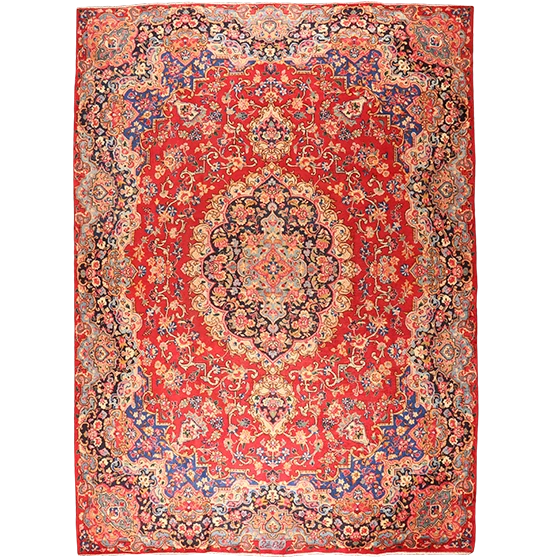
A Kerman rug of about 10.75 by 8 feet with a medallion on a crimson field, in navy, beige, burnt orange, terracotta, forest green, and pink - Kerman Persian Rug 10x7 ft - Medallion Semi Antique Wool Silk Hand Knotted
12
A Kerman in a Modern Room
A many-colored Kerman can be a wonderful choice for a modern home. In a room with white or pale gray walls, simple furniture, and natural wood or concrete floors, a Kerman becomes the single joyful source of color, like a large abstract painting on the floor. Choose one or two of its colors, perhaps turquoise and gold, or pink and green, for a few accessories, and keep everything else simple. The rug will make the room feel warm and alive.
13
Light and Color
A Kerman's colors change with the light. In morning light, the cool turquoises and greens come forward; in warm evening lamplight, the crimsons, golds, and coppers glow. The gloss of the wool also changes the look of the rug as you walk around it: looking with the pile, the colors appear lighter and shinier; looking against the pile, they appear deeper and richer. Before you choose, look at a Kerman from several directions and in different light.
14
Sizes and Room Planning
Our Kerman rugs are room-size, about 10.75 by 8 and 13.5 by 9.5 feet.
•
Living room - A 9 by 12 or 10 by 13 rug holds a full seating group.
•
Dining room - The rug should extend at least 24 inches beyond the table on every side.
•
Bedroom - A room-size Kerman under a king bed creates a luxurious feel.
Measure the room, decide which furniture will sit on the rug, and mark the outline with painter's tape. See our 9x12 rugs and 8x11 rugs.
15
How to Judge a Kerman
•
Color harmony - Many colors, yet balanced and clear, without bleeding.
•
Shading - Smooth transitions in the flowers show skilled dyeing and weaving.
•
Drawing - A centered medallion and mirror-image corners.
•
Wool - Soft, glossy wool with a lustrous surface.
•
Flatness - The rug should lie flat with straight sides.
•
Condition - Even pile, intact sides and ends.
16
Reading the Back
On the back of a Kerman, the design shows clearly in small, regular knots, and the many colors are visible as a soft mosaic. Because the rug is double-wefted, the back looks tight and smooth. Check for any areas of jufti knotting, which appear coarser, and for repairs.
17
The Dyers of Kerman
Kerman's many colors depend on its dyers. Persian accounts note that Kerman's dye-houses once dyed both shawls and rugs, and that colors such as light green, indigo blue, turquoise, pink, orange, and beige were all prepared locally. A single rug may require dozens of carefully matched shades, prepared in advance so the weavers can follow the cartoon exactly. Read more about Persian dyeing in our articles on natural dyes and the dye-house step by step.
18
Soft Wool and Care
Kerman wool is soft and glossy, which gives the rug its luminous surface. Soft wool rewards gentle care: use furniture cups under narrow legs, vacuum without a beater bar, rotate the rug every six months, and keep it out of strong direct sunlight, which can fade the pinks and light colors over time. With these habits, a Kerman will stay beautiful for decades.
19
Kerman in Different Rooms
•
Living rooms - A Kerman's colors bring warmth and joy to the main room of the house.
•
Dining rooms - Its floral field and many colors hide small spills well.
•
Bedrooms - Its soft wool is pleasant underfoot.
•
Studies - Its rich colors suit bookshelves and wood paneling.
20
Signs of a Well-Kept Semi-Antique Kerman
•
Even pile - No bald patches or deep furniture marks.
•
Supple foundation - Bends without cracking when a corner is gently folded.
•
Intact sides and ends - Overcasting and fringes in good condition.
•
Clean colors - No running of red into lighter colors.
•
No moth damage - Check the back and under the edges.
21
Pairs and Matching Rugs
Kerman workshops, like other city workshops, sometimes wove rugs in pairs or matching sets for large houses. Our two Kermans are not a matched pair, but they share crimson fields, navy outlines, and many-colored floral designs, and they could furnish a living room and an adjoining dining room with a pleasing sense of continuity.
22
Combining a Kerman with Other Rugs
Because a Kerman is so colorful, nearby rugs should be calmer. A Kashan or Isfahan in another room shares the city elegance with a quieter palette. A cream-field rug can balance a red Kerman in an adjoining space. Avoid placing two very colorful rugs side by side.
23
Moving and Storing a Large Rug
•
Roll, do not fold - Roll with the pile outward, along the length.
•
Lift with help - Room-size rugs need two or three people.
•
Do not drag - Dragging can damage the sides and fringes.
•
Store dry - Wrap in cotton fabric, never plastic, and store off the floor.
24
Questions to Ask Before You Buy
•
How many colors does it have? - A quick sign of Kerman character.
•
Is it double-wefted? - Check the back.
•
Has it been repaired? - Ask where and how.
•
Has it been washed recently? - A fresh wash shows the true colors.
•
What are the exact measurements? - Check both ends.
25
Semi-Antique Kerman Rugs
Our Kerman rugs are semi-antique, woven roughly forty to sixty years ago. They have settled colors, soft glossy wool, and firm construction, with many years of life ahead. See our semi-antique rugs.
26
What Affects the Price
•
Color and shading - Rich, well-blended palettes are prized.
•
Density - Finer rugs command higher prices.
•
Size - Larger rugs cost more.
•
Attribution - Lavar and other fine antique Kermans are especially valued.
•
Condition - Even pile, intact sides and ends.
27
Caring for a Kerman
Vacuum gently without a beater bar. Rotate every six months. Use a quality pad. Blot spills at once. Have it professionally washed every few years by specialists. See our care instructions and our guide to professional washing.
28
Common Buying Mistakes
•
Adding too many patterns - Let the rug provide the color and pattern.
•
Placing in strong sun - Light colors fade faster.
•
Choosing too small a rug - A Kerman medallion needs room around it.
•
Washing at home - Many-colored rugs need specialist care.
29
Frequently Asked Questions
Where is Kerman?
In south-eastern Persia, on a high plateau at the edge of the desert.
What makes Kerman rugs special?
Their many colors, shaded flowers, soft glossy wool, and painterly designs.
How many colors can a Kerman have?
Often fifteen to thirty.
What knot is used?
The asymmetric or Persian knot.
Are Kerman rugs double-wefted?
Yes, which makes them firm and flat.
What is a Lavar Kerman?
A name for some of the finest antique Kermans, associated with the town of Ravar.
What is an American Kerman?
A twentieth-century Kerman made for the American market, often in pastels with open fields.
How did shawls influence Kerman rugs?
Shawl weavers brought skills in fine wool, many colors, and floral design to carpet weaving.
How do Kerman rugs differ from Kashan rugs?
Kermans use more colors and softer blending; Kashans use fewer colors and stronger contrasts.
How do I decorate around a Kerman?
Choose one or two of its colors for accents and keep walls and upholstery calm.
Will a Kerman fade?
Light colors can fade in strong sun. Rotate it and protect bright windows.
What colors are typical of a Kerman field?
Most are crimson or red; others are cream, ivory, navy, or soft pastels.
What is shading in a Kerman?
Two or three tones of one color in a flower, giving a painterly effect.
How long does a room-size Kerman take to weave?
A team of weavers may work on it for many months.
Can your two Kermans be used together?
Yes. They share crimson fields and floral designs and could furnish two adjoining rooms.
Where does Kerman wool come from?
From Kerman province and nearby districts such as Rafsanjan, Bam, and Jiroft.
Is hand-spun wool still used?
Yes. Many Kerman weavers still prefer hand-spun wool.
What are Kerman vase carpets?
Famous Safavid carpets with lattices of flowering stems and vases, attributed by scholars to Kerman.
Does Kerman weave pictorial rugs?
Yes. Kerman is known for pictorial rugs showing scenes, portraits, and landscapes.
Why does a Kerman look different from different angles?
Its glossy wool reflects light differently with and against the pile.
Does a Kerman suit a modern room?
Yes. It becomes a joyful focal point, like a large painting.
How should I clean a Kerman?
Vacuum gently and have it professionally washed every few years by specialists.
30
Choose Your Kerman Rug
Each Kerman rug in our collection is hand-knotted, one of a kind, and inspected before it is listed. Browse our Kerman collection, compare it with our Kashan and Isfahan rugs, or ask our experts for help.