


Khorasan is the great eastern province of Persia. Its name is usually translated as "the land where the sun rises," and for centuries it was a crossroads between Persia, Central Asia, and the lands to the east. Pilgrims, merchants, and armies passed through it, and its cities, above all Mashad, became centers of trade, learning, and craft. Rug weaving has been part of that story for a very long time.
Under the Khorasan name, the rug trade includes the city rugs of Mashad, the fine rugs of Birjand and Moud, the village rugs of Kashmar, Sabzevar, and Ferdos, and the tribal weaving of the Baluch and of the Kurds of Quchan in the north. This guide explains that variety, how to read a Khorasan rug, and how to choose, place, and care for one. For more history, see our article on weaving in Khorasan.
1
A Province of Many Weaving Centers
Mashad
Mashad, the provincial capital and a great pilgrimage city, has long been the main market and workshop center of Khorasan. Its rugs are usually city rugs with curvilinear floral designs, central medallions, and rich reds. See our Mashad collection.
Birjand and Moud
Birjand, in the south of the province, and the nearby villages around Moud are known for fine rugs with delicate floral drawing, often with a small-scale Herati or Mahi pattern. See our Birjand and Moud collections.
Kashmar, Sabzevar, and Ferdos
These towns produce village and workshop rugs, often with medallion or allover floral designs and soft wool. See our Kashmar, Sabzevar, and Ferdos collections.
Quchan and the North
In the north of Khorasan, the Kurds of Quchan weave sturdy tribal and village rugs with bold geometric designs. See our Quchan collection.
The Baluch
In the east and south, the Baluch weave dark, lustrous tribal rugs with deep reds, browns, and blues. See our Baluch collection.
Khorasan is not one style but a whole region: city rugs from Mashad, fine rugs from Birjand and Moud, village rugs from Kashmar and Sabzevar, and tribal rugs from the Baluch and the Kurds of Quchan.
2
How to Recognize a Khorasan City Rug
•
Curvilinear floral drawing - Flowing vines, palmettes, and rosettes.
•
Soft wool - Khorasan wool is often soft and lustrous.
•
Rich reds - Deep crimson and madder reds, often with cream and navy.
•
Medallion or allover design - A central medallion or an allover pattern such as Herati or Kheshti.
•
Persian knot - The asymmetric knot is typical of Khorasan city rugs.
•
Generous size - Room-size rugs are common.
3
The Kheshti Garden Design
Our Khorasan rug is woven in a Kheshti design. Kheshti means "made of bricks" or "tiles," and the design divides the field into a grid of panels or compartments, each filled with a flower, a tree, a vase, or another small motif. It is one of the classic garden designs of Persian weaving, inspired by the layout of the Persian garden, where beds of flowers and trees are divided by paths and channels of water.
In a Kheshti rug, every panel is a small world, and the eye can wander from one to the next. The overall effect is calm and orderly, yet full of detail. Read more about garden designs in our article on the Persian garden design and see our Kheshti design page.
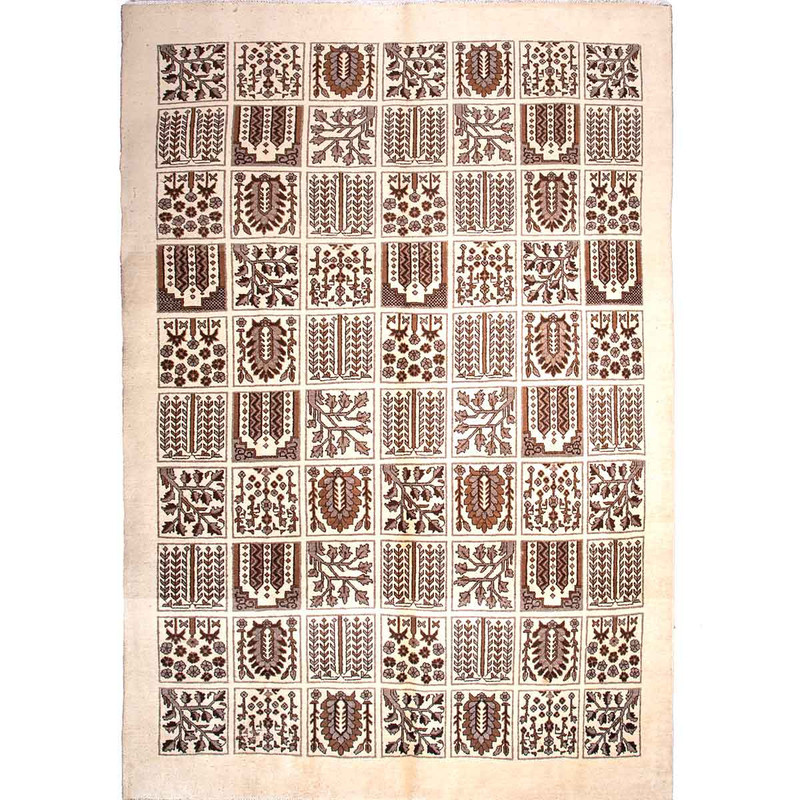
A Khorasan rug of about 11 by 7.5 feet in a Kheshti garden design of panels in cream, brown, and madder red - Khorasan Persian Rug 10x7 ft - Kheshti Semi Antique Wool Silk Hand Knotted
4
The Persian Garden in Wool
The Persian garden, or chahar bagh, was traditionally laid out as a rectangle divided by water channels and paths into beds of flowers and trees. Gardens like this were places of shade, water, and rest in a dry land, and poets often described them as images of paradise. Weavers brought this idea indoors. In a Kheshti rug, each panel can be read as one bed of the garden, and the narrow borders between panels as the paths and channels that divide them. Standing over a Kheshti rug, you look down on a garden that never fades in winter. That is part of the reason the design has stayed popular for so long, in Khorasan and across Persia.
5
Reading the Panels
In a Kheshti rug, look at how the panels are arranged. In some rugs, every panel holds the same motif; in others, two or three motifs alternate in a diagonal or checkerboard rhythm. Colors may also alternate from panel to panel, so that cream, red, and brown grounds create a second, larger pattern across the field. Look for the motif in each panel: a cypress, a flowering tree, a vase of flowers, a willow, or a stylized bush. Each panel is usually framed by a narrow border of its own.
6
The Herati and Other Khorasan Designs
Besides the Kheshti, Khorasan weavers use many classic designs:
•
Herati - The small repeating pattern of a rosette within a diamond, surrounded by curved leaves, named after the city of Herat, once part of greater Khorasan. See our Herati design.
•
Medallion - A central medallion with corner pieces on a floral field.
•
Shah Abbasi - Large palmettes and flowering vines.
•
Boteh - The teardrop or paisley motif. See our Boteh rugs.
•
Tree of life - A single tree rising through the field.
7
How Khorasan Rugs Are Built
•
Knot - The asymmetric (Persian) knot in city rugs.
•
Foundation - Cotton warps and wefts in most city and workshop rugs.
•
Pile - Soft wool, clipped to a medium height.
•
Density - Medium to fine.
•
Sides and ends - Overcast sides and fringes.
Older writers on rugs often mention the jufti or "double" knot in Khorasan, in which each knot is tied over four warps instead of two. It saves time and wool but makes a less durable pile. When judging a Khorasan rug, check the density and the feel of the pile, and favor rugs with a full, even surface.
8
The Wool of Khorasan
Khorasan has long been known for soft wool, raised on the high pastures of the province. Soft wool gives a smooth, lustrous pile that feels pleasant underfoot and shows color well. In semi-antique rugs, the wool has developed a gentle sheen. Read more in our article on Persian rug wool.
9
Colors of Khorasan
Our Khorasan rug uses a warm, balanced palette: cream for many of the panel grounds, brown for outlines and some panels, and madder red for depth and warmth, with smaller touches of navy, green, and gold. Khorasan city rugs in general are known for deep reds, often with a purplish or crimson tone, as well as navy, ivory, and gold.
In semi-antique rugs, these colors have mellowed. The reds have softened, the creams have warmed toward ivory, and the browns have taken on a gentle patina.
10
Sizing a Khorasan Rug
Our Khorasan rug measures about 11 by 7.5 feet. This size suits:
•
Living rooms - A medium living room, with the front legs of the sofa on the rug.
•
Dining rooms - A table for six, with enough room for the chairs.
•
Bedrooms - Under a queen or king bed, extending to each side.
•
Studies - Under a desk and reading chair.
11
Placing a Kheshti Rug
A Kheshti rug works beautifully in rooms where it can be seen from above or from a distance: a living room, a dining room, or a bedroom. Because its design is an even grid of panels, it does not need to be centered under one piece of furniture the way a medallion rug does. That makes it flexible: it looks good under a table, in front of a sofa, or in an open space. In a modern interior, its grid echoes the lines of contemporary furniture. In a traditional home, it pairs naturally with dark wood and garden views.
12
Khorasan and Its Neighbors
Khorasan and Kerman
Kerman rugs, from the south-east, share soft wool and rich floral drawing. See our Kerman collection.
Khorasan and Isfahan
Isfahan rugs are finer and more formal. See our Isfahan collection.
Khorasan and Tabriz
Tabriz rugs, from the north-west, use the symmetric knot. See our Tabriz collection.
Khorasan and Baluch
Baluch rugs are the tribal weaving of the same region. See our Baluch collection.
13
Grades and How to Judge Them
•
Density - Look for a fine, even knot count.
•
Wool - Soft, lustrous wool.
•
Drawing - Clear, well-proportioned panels or medallions.
•
Color - Clear colors without bleeding.
•
Condition - Even pile, intact sides and ends.
14
Reading the Back
On the back of a Khorasan rug, look at the knots. With the asymmetric knot, each knot shows as one larger loop with a smaller one beside it. Check whether each knot covers two warps or four; a full, even back is a good sign. Look at the overall clarity of the design, and check the sides and fringes.
15
Questions to Ask Before You Buy
•
Which town or region is it from? - Mashad, Birjand, Kashmar, or another center.
•
What is the knot density? - A sign of quality.
•
Is the pile even? - Check for worn areas.
•
Has it been repaired? - Especially along the sides and at the ends.
•
Has it been washed recently? - A fresh wash shows the true colors.
16
Semi-Antique Khorasan Rugs
Our Khorasan rug is semi-antique, woven roughly forty to sixty years ago. It has settled colors, good wool, and many years of life ahead. See our semi-antique rugs.
17
What Affects the Price
•
Size - Larger rugs cost more.
•
Density - Finer rugs are worth more.
•
Design - Well-drawn garden and medallion designs add value.
•
Wool - Soft, lustrous wool adds value.
•
Condition - Even pile, intact sides and ends.
18
Caring for a Khorasan Rug
Vacuum regularly without a beater bar. Rotate the rug every six months. Use a non-slip pad. Blot spills at once. Have it professionally washed every few years. Keep it out of strong direct sunlight. See our care instructions and our article on professional washing.
19
Common Buying Mistakes
•
Assuming one style - Khorasan covers many towns and tribes.
•
Ignoring density - Check the knot count.
•
Choosing the wrong size - Measure carefully.
•
Skipping the pad - Rugs slip without one.
20
A Crossroads of Trade and Pilgrimage
For centuries, Khorasan lay on the routes that linked Persia with Central Asia and the lands farther east. Caravans carried silk, spices, metalwork, and textiles through its towns. In later centuries, Mashad grew into one of the great pilgrimage cities of the Muslim world, visited by millions of pilgrims each year. Pilgrims and merchants created a steady demand for fine goods, and rugs were among them. Workshops in the city, and weavers in the surrounding towns and villages, supplied rugs both for local homes and for the markets of Tehran, Europe, and America.
The historic region of greater Khorasan once reached far to the east, including the city of Herat. That is why the Herati pattern, now woven all over Persia, carries the name of a city that belonged to the same cultural world as Mashad. Khorasan weavers have kept that pattern alive for generations.
21
The Workshops of Mashad
In the twentieth century, Mashad was home to several renowned workshops whose masters drew designs on squared paper, called cartoons, for weavers to follow knot by knot. Among them, the workshop of Amoghli is often named as one of the finest in modern Persian weaving, known for very fine knotting and delicate floral drawing. Workshop rugs like these set a standard that influenced weavers across the province. Most Khorasan rugs on the market today come from more modest workshops and village looms, and that is where much of their value lies: sound wool, good color, and classic designs at a reasonable price.
22
The Reds of Khorasan
Khorasan rugs are often admired for their deep reds, which can lean toward crimson, plum, or a warm purple-red. Most reds in Persian rugs come from madder root. Older writers on rugs also note that weavers in eastern Persia sometimes used insect dyes, such as lac and cochineal, for some of their crimsons, which may explain the cooler tone of some older Khorasan reds. In our rug, madder red balances the cream and brown panels. Read more in our articles on natural dyes and traditional dyeing.
23
Kheshti Rugs from Different Regions
The Kheshti design is woven in several parts of Persia, and each region gives it its own character. In the Bakhtiari rugs of central Persia, the panels are often bold and geometric, with strong colors and simple tree or flower motifs. In city rugs, including those of Khorasan, the panels tend to be more refined, with curved flowers and vines drawn in finer detail. Comparing two Kheshti rugs from different regions is a good way to learn how much a shared design can change from one weaving culture to another. See our Bakhtiari collection.
24
Matching a Kheshti Rug to Your Room
Because a Kheshti design is made of many small panels, it reads as texture from a distance and as detail up close. That makes it forgiving: furniture can cover parts of the field without hiding the design. Pick up one of the main colors for cushions or curtains. A cream-ground panel rug lightens a room with dark floors, while the brown and red panels add warmth. In a dining room, the grid sits well under a rectangular table; in a living room, it can anchor a seating group without demanding a centered layout.
25
Caring for Cream Grounds
Cream and ivory areas show dirt sooner than reds and browns. Vacuum often, especially in busy areas, and keep shoes off the rug when you can. Blot spills at once with a clean, white cloth and cold water, working from the outside of the spot toward the center. Avoid strong household cleaners, which can strip the wool or change the colors. When the cream areas begin to look dull, it is time for a professional wash. See our guide to washing at home.
26
Combining a Khorasan with Other Rugs
A Khorasan rug pairs well with other city rugs, such as a Kerman, Isfahan, or Tabriz, and with village rugs that share its colors. In an open space, a Kheshti rug in one area and a medallion rug in another give variety while keeping a common palette. Keep one or two colors in common and vary the scale of the patterns.
27
Living with a Khorasan Rug
A good Khorasan rug becomes more beautiful with use. Its soft wool develops a deeper sheen, its colors settle further, and its panels become a familiar map of the room. Many families keep such a rug for decades, moving it from one room or house to another as their lives change. With ordinary care, a semi-antique Khorasan can stay in daily use for many more years.
28
Photographs and Real Color
Cream, brown, and red can look quite different on screen depending on the light and the camera. Daylight from a north window shows the truest colors; warm lamps make the reds and browns look richer. If color matters for your room, ask us for extra photographs in daylight or a close-up of the pile. We are glad to describe how the rug looks in person.
29
Frequently Asked Questions
What does Khorasan mean?
It is usually translated as "the land where the sun rises."
Where is Khorasan?
In the east of Persia.
Which towns weave Khorasan rugs?
Mashad, Birjand, Moud, Kashmar, Sabzevar, Ferdos, Quchan, and many villages.
What is a Kheshti design?
A garden design with the field divided into panels.
What is a Herati design?
A small repeating pattern of a rosette in a diamond with curved leaves.
What knot is used in Khorasan rugs?
The asymmetric (Persian) knot in most city rugs.
What is a jufti knot?
A knot tied over four warps instead of two.
What colors are typical?
Deep reds, cream, navy, brown, and gold.
What size is your Khorasan rug?
About 11 by 7.5 feet.
Are Khorasan rugs durable?
Yes, when well woven with good wool and a full pile.
How should I care for a Khorasan rug?
Vacuum regularly, rotate it, use a pad, and have it professionally washed every few years.
Is your Khorasan rug from Mashad?
It is sold under the Khorasan name, which covers the whole province. Its design and construction are typical of Khorasan city and workshop weaving.
Does a Kheshti rug need to be centered?
No. Its even grid of panels looks good in many positions.
Will the cream areas stay clean?
With regular vacuuming, prompt blotting of spills, and professional washing every few years, cream areas stay fresh.
Is a Khorasan rug a good choice for a dining room?
Yes. At about 11 by 7.5 feet, it suits a table for six, and its pattern hides small marks well.
Can a Khorasan rug go under a bed?
Yes. At about 11 by 7.5 feet, it can sit under a queen or king bed and extend to each side, leaving soft wool underfoot when you get up.
How long will a Khorasan rug last?
A well-woven rug with good wool can last for generations with ordinary care.
30
Choose Your Khorasan Rug
Each Khorasan rug in our collection is hand-knotted, one of a kind, and inspected before it is listed. Browse our Khorasan collection, compare with our Mashad, Birjand, and Kashmar rugs, or ask our experts for help.