


Washing a New Persian Rug After Weaving: How Rugs Are Finished
Los Angeles Home of Rugs on Nov 17th 2026
When the last row of knots is tied and a Persian rug is cut from the loom, it is not yet finished. It still looks slightly rough, the pile may lean in uneven directions, and countless tiny fragments of clipped wool remain caught between the warps and wefts. Before a rug is ready for a home, it goes through a final transformation: washing. This step is so important that experienced dealers sometimes say a rug is woven on the loom but born in the wash.
This article explains why new rugs are washed, how the traditional process works, and what washing reveals about the quality of a rug's dyes. For cleaning a rug you already own, see our guides to washing at home and professional washing.
1
Why a New Rug Must Be Washed
Washing after weaving does far more than clean the rug. It completes it in several ways:
•
Removing loose fibers - during weaving, the pile is clipped repeatedly. Washing flushes out the dust and small pieces of wool left behind.
•
Bringing out luster - washing relaxes the wool fibers and releases their natural sheen, especially in rugs made from high-quality lanolin-rich wool.
•
Setting the pile direction - water helps the knots settle so that the pile lies smoothly in its natural direction, which makes the surface even and soft.
•
Sharpening the design - once loose fibers are gone and the pile lies flat, motifs look crisper and outlines become more distinct.
•
Settling the colors - washing releases any excess dye left in the yarn and gives the colors a softer, more harmonious tone.
2
Before the Wash - From Loom to Washing Yard
The finishing of a Persian rug begins the moment weaving ends. The weaver ties off the final rows of weft, often weaving a narrow band of flatweave (kilim) at each end to protect the last knots. The warp threads are then cut, and the rug is lifted from the loom for the first time. In many workshops, the ends of the warps are knotted together in small bundles to secure the weave, and these become the fringe.
While still on the loom, the pile has already been trimmed row by row with a knife or shears, but it is uneven. The next step is a first, careful shearing of the whole surface. In traditional workshops this was done entirely by hand with large shears, the craftsman working slowly across the rug to bring the pile to an even height. Today many workshops use shearing machines for this stage, while the final, most delicate trimming is still done by hand. The height of the pile depends on the type of rug: fine city rugs with detailed designs are clipped short so the motifs look sharp, while village and tribal rugs, and many Gabbeh rugs, are left with a longer, softer pile.
Before washing, the back of the rug is also inspected. Any small faults - a missing knot, a loose weft, an uneven edge - are corrected while the rug is still dry. Only then is it ready for the water.
3
The Traditional Washing Process
In Persian weaving regions, post-weaving washing has traditionally been done by hand, often beside rivers or in large washing yards with pools of water. Although modern workshops use machinery for some steps, the core sequence remains similar:
•
Dusting - the rug is beaten or shaken to remove as much loose wool and dust as possible before water is used.
•
Color testing - the washer tests the colors, especially reds and dark blues, by pressing a damp white cloth against them. If the cloth picks up color, special care is needed.
•
Wetting and washing - the rug is soaked and washed with cool to lukewarm water and a mild, pH-neutral soap. Hot water and strong alkaline detergents are avoided because they can damage wool and loosen dyes.
•
Brushing and squeegeeing - washers work the soap through the pile in the direction of the nap, then push the water out with wooden or rubber blades. Traditionally, washers sometimes walked on the rug with bare feet to work the water through it.
•
Rinsing - the rug is rinsed repeatedly until the water runs clear.
•
Drying - the rug is dried flat or stretched in the open air, away from harsh heat, and turned so it dries evenly. Proper drying prevents mold, shrinkage, and color problems.
Washing is a technical process. If a rug is washed carelessly, colors in different areas can bleed into each other. Expert washers can sometimes correct bleeding with chemical treatments, but the safest approach is always to test the dyes before washing begins.
4
Inside a Traditional Washing Yard
In the past, the great weaving cities of Persia had well-known places for washing carpets. In many towns, rugs were washed beside rivers and streams, on sloping stone or concrete platforms where water could run off freely, and then spread out to dry on riverbanks, flat roofs, and open ground. In Isfahan, the banks of the Zayandeh Rud were long associated with carpet washing, and in many other towns, washing yards sat close to reliable sources of water such as rivers, springs, and qanats.
A washing yard was a busy place. Teams of washers worked barefoot on large carpets, pushing soap and water through the pile with brushes and their feet, then forcing the water out with wooden blades. Boys carried water and turned the drying rugs, and experienced foremen watched the colors closely for any sign of bleeding. Large rugs were often dried in the sun for several days, turned regularly so that both sides dried evenly. Gentle sunlight also helped soften very bright colors - an effect that has long been used deliberately in some regions.
Modern washing facilities now use large clean floors, controlled water temperature, centrifuges to remove water quickly, and drying rooms with circulating air. These methods are faster and more consistent, and they reduce the risk of mold or uneven drying. But the principles - cool water, gentle soap, careful rinsing, and slow, even drying - have not changed.
Water Quality and the Wash
Washers have always known that water matters. Soft, clean water rinses soap out easily and leaves wool soft and lustrous, while very hard water can leave mineral deposits that dull the pile. In some regions, the water of particular rivers or springs was believed to give local rugs an especially good finish. Our article on mordants explains how water minerals also influence color during dyeing.
5
Wool, Silk, and Size - Why Every Wash Is Different
No two rugs are washed in exactly the same way. Experienced washers adapt the process to each piece:
•
Wool rugs - most Persian rugs have wool pile, which tolerates careful washing well. Wool from sheep raised in the mountains, rich in natural lanolin, gains a beautiful sheen after its first wash.
•
Silk and silk-highlighted rugs - silk from centers such as Qum and fine Isfahan and Tabriz workshops is more delicate. It is washed with very gentle handling, cooler water, and minimal friction to protect its luster.
•
Tribal rugs on wool foundations - rugs from tribes such as the Qashqai and the Kurds have wool warps and wefts, which can shrink or distort if dried unevenly, so stretching and drying need particular attention.
•
Large carpets - room-size and oversized carpets take far longer to wash, rinse, and dry, sometimes several days, and require a team of washers.
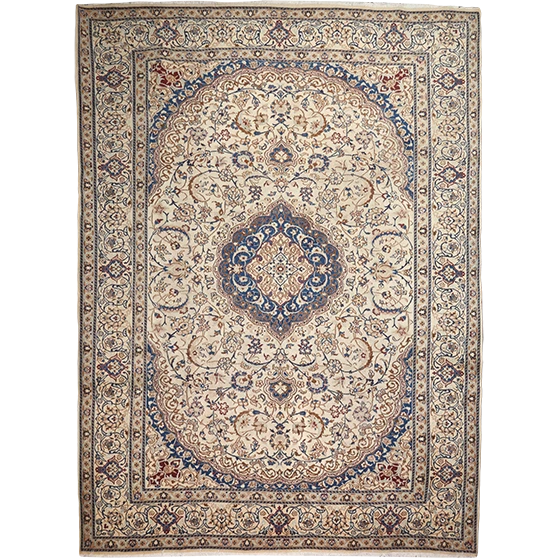
Wool and silk in a Nain, where careful washing brings out the luster - Nain Persian Rug 13x9 ft - Medallion Semi Antique Wool Silk Hand Knotted
6
The Fringe and the Sides
The fringe of a rug is the exposed end of its warp threads. During washing, washers take care not to tangle or break them, and they comb the fringe straight while it dries. Cotton fringes on city rugs are naturally white or cream, and they can absorb dirt and dye quickly, so they receive special attention. For long-term fringe care, see our guide to maintaining antique rug fringes.
7
Stretching and Finishing
After washing, many rugs are stretched to correct small distortions that can occur during weaving, so that the sides are straight and the corners square. The rug is fixed to a frame or floor while it dries so it holds its correct shape. Finally, the pile is given a last light trim, the fringes are combed and secured, and the sides (overcasting) are checked. Some rugs also undergo hand polishing or shaving to even out the surface; we describe that craft in our article on hand polishing and rug shaving.
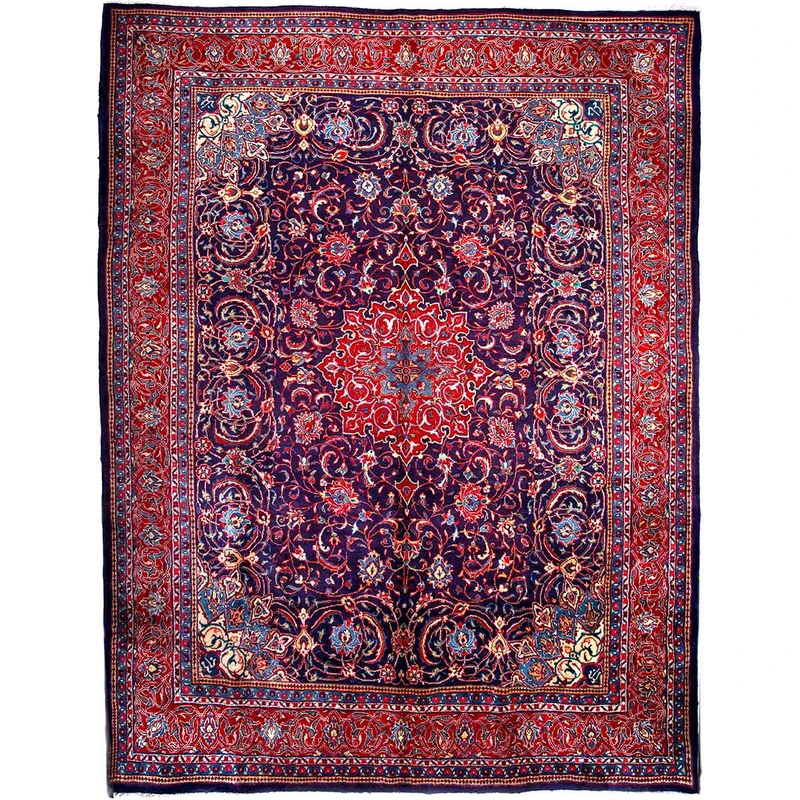
A room-size Arak medallion rug in navy blue, madder red, and ivory - Arak Persian Rug 13x9 ft - Medallion Semi Antique Wool Hand Knotted
8
When a Color Runs - Problems and Remedies
Occasionally, even with careful testing, a dye begins to bleed during washing. This most often affects strong reds and dark blues, and the first sign is usually a faint pink or blue tint spreading into neighboring white or ivory areas. Experienced washers react immediately: they stop the wash, rinse the affected area with cold water, and dry the rug quickly, often with the face down and plenty of air circulation, so that the loose dye does not have time to settle into the lighter wool.
If bleeding has already occurred, specialist washers can sometimes reduce or remove it with careful, targeted treatments. Results depend on the dye, the wool, and how long the stain has had to set, so prevention is always better than cure. This is another reason the first wash after weaving is so valuable: any weakness in a rug's dyes shows itself at the workshop, where it can be dealt with by professionals, rather than years later in a customer's home.
9
How Washing Affects Size and Shape
Water changes textiles, and Persian rugs are no exception. When wool and cotton absorb water, the fibers swell and the whole rug can shrink slightly, especially in length. Rugs with wool foundations, typical of nomadic and some village weaving, are more likely to shrink or develop wavy edges than rugs with cotton foundations. This is one reason rugs are often stretched while drying: the stretching restores the intended dimensions and keeps the sides straight.
For buyers, this has two practical lessons. First, small irregularities in shape, such as slightly uneven sides, are normal in handmade rugs and do not indicate poor quality. Second, any later washing should be done by specialists who understand how to dry and, if needed, block a rug back into shape. Our rug size guide explains how sizes are measured and why handmade rugs vary slightly from their nominal dimensions.
10
Sun Fading, Light Washes, and Aging Treatments
Some finishing treatments are designed to change a rug's appearance. Not all of them are harmful, but buyers should understand the differences:
•
Natural sun fading - leaving rugs in the sun for days or weeks gently softens bright colors. This traditional method is relatively benign when done in moderation.
•
Light washes - gentle washes with mild, wool-safe products that slightly soften colors and increase luster. Reputable workshops use these routinely.
•
Strong chemical washes - harsh bleaching agents that rapidly mute colors or create an artificially aged look. They can weaken wool fibers and shorten a rug's life.
•
Painting and retouching - adding dye or ink to the surface to deepen a color or hide wear. Small professional touches are common in older rugs, but extensive painting reduces value.
If you are considering a rug that looks unusually aged for its stated age, it is reasonable to ask how it was washed. A trustworthy dealer will answer clearly.
11
Signs of a Well-Finished Rug
When you examine a new or recently washed rug, a few signs indicate that the finishing was done well:
•
Even pile - the surface feels smooth and level when you run your hand across it, without bald patches or ridges.
•
Clean, clear colors - no pink or gray halos around red or dark areas, and white areas look clean.
•
Straight sides and square corners - small variations are normal, but the rug should lie flat on the floor without strong ripples.
•
Soft, lustrous wool - well-washed wool feels soft and has a natural sheen rather than a dry, brittle feel.
•
Secure fringes and edges - fringe knots are firm and the side cords (overcasting) are intact.
These are also the same points worth checking on an older rug, together with the condition of the foundation and any repairs.
For the buyer, all of this work is invisible, yet it shapes the rug you bring home. The softness of the pile under your feet, the clean edges between colors, the way the rug lies flat on the floor, and the gentle sheen of the wool in afternoon light are all results of the finishing stage. When you compare two rugs of similar design and quality, the better-finished one will almost always look and feel more refined, and it will age more gracefully over the decades ahead.
12
Washing an Antique Rug Versus a New One
The first wash of a new rug and the cleaning of an antique rug are very different jobs. A new rug is sturdy and can be washed thoroughly to complete its finishing. An antique rug may have fragile areas, worn pile, old repairs, and dyes that have mellowed over a century. Specialists clean antique pieces with much gentler methods, support weak areas, and sometimes clean only by sections. If you own an older rug, always choose a cleaner experienced with antique hand-knotted textiles.
13
Special Washes and Their Risks
In the early and middle 20th century, some rugs exported to Western markets were given chemical washes to soften bright colors and make new rugs look older or more muted. Some were even repainted to deepen the field color, a practice seen in certain Sarouk rugs made for the American market. Strong chemical washes weakened the wool and shortened the life of many rugs. Today, reputable workshops use gentle washes that protect the fiber.
14
The Rug Washers - A Specialized Craft
Carpet washing in Persia is a profession of its own. The washers, known as qalishuy, often learned their trade in family businesses, just as dyers and weavers did. A skilled washer needs to understand wool and silk, recognize different dyes, judge how much water and soap each rug can tolerate, and know how a rug from a particular region is likely to behave. He must also be strong: a wet room-size carpet can weigh several times more than when dry, and moving it without straining the foundation takes experience and teamwork.
In the great weaving and trading centers - Tabriz, Isfahan, Kashan, Kerman, Arak, and Tehran - washing businesses worked closely with weavers, workshop owners, and merchants. Many finished rugs passed through the same few trusted washers before reaching the bazaar, and a washer's reputation for careful work was valuable to everyone in the chain. Washers also became informal quality inspectors: they were often the first to notice a weak dye, a structural fault, or a mismatch in color, and they could warn the workshop before the rug went to market.
15
The Journey from Washing Yard to Your Home
After washing, drying, stretching, and final trimming, a rug begins its journey to the market. Traditionally, finished rugs were taken to the carpet bazaars of major cities, where merchants examined them closely - checking the pile, the colors, the shape, and the back - before buying. Rugs selected for export were then folded or rolled, packed into bales, and sent by caravan, rail, ship, and later by truck and air to Europe, America, and beyond.
Every step of this journey depends on the quality of the finishing. A rug that has been washed and stretched well arrives flat, clean, and ready to use. One that has been finished carelessly may arrive with uneven edges, dull colors, or lingering odors. This is one reason experienced dealers pay so much attention to the washing stage, and why a well-finished rug is a sign of a well-run workshop.
Once a rug reaches your home, its first wash is behind it, but the same principles apply to its future care: cool water, gentle wool-safe cleaning, careful drying, and expert handling for anything more than spot cleaning. Our guides to washing a Persian rug at home and professional rug washing continue the story from here.
16
Frequently Asked Questions
Is a newly washed rug still "new"?
Yes. Washing after weaving is part of making the rug, not a sign of use. Every hand-knotted Persian rug is washed before it is sold.
Why does my new rug shed a little?
Some light shedding is normal in a new wool rug, as short loose fibers left from shearing work their way out. It decreases with regular, gentle vacuuming.
How often should a Persian rug be washed after purchase?
In a typical home, a professional wash every three to five years is enough, depending on traffic. Spot-clean spills promptly in between.
Can washing damage a rug?
Careless washing can cause color bleeding, shrinkage, or mold. Experienced rug washers who test dyes and dry rugs properly avoid these problems.
17
What Washing Tells You About a Rug
The washing stage is the first real test of a rug's dyes. Well-mordanted natural dyes, and good modern dyes, hold firm in the water. Poorly fixed dyes run. That is why our article on mordants matters to anyone buying a rug: proper dyeing shows its value from the very first wash and for every cleaning afterward.
When you buy a new or vintage hand-knotted rug from Los Angeles Home of Rugs, it has already passed through this finishing process. Our care instructions explain how to keep it looking its best for generations.
Care and Resources
Care Instructions
Washing at Home
Professional Washing
Hand-Knotted Rugs
New Arrivals
Persian Rug FAQ