


Baluch rugs have a quiet power. At first glance they can look dark, almost somber. Then the light changes, and the deep reds begin to glow, the blues turn to ink, and small flashes of ivory and camel come alive across the field. Collectors have loved them for more than a century, and today they are prized by decorators who want a rug with depth, texture, and a strong tribal character.
This handbook is written for buyers, especially those looking at the long formats common among Baluch rugs. It explains where Baluch rugs are woven, how to recognize them, how to check their condition, which details affect value, and how to place and care for a dark tribal rug. For the history and life of the Baluch weavers, see our article on weaving in Baluchestan.
1
Where Baluch Rugs Are Woven
Many people assume that Baluch rugs come from Sistan and Baluchestan, the south-eastern province of Persia. In fact, most Baluch rugs in the market were woven far to the north, in Khorasan, by Baluch tribes who settled there over the last few centuries. The main weaving areas lie around Torbat-e Heydarieh, Torbat-e Jam, Sarakhs, Kashmar, and Mashhad, near the borders with Afghanistan and Turkmenistan. Related groups also weave in western Afghanistan.
The Baluch weaving world includes not only Baluch tribes but also neighboring groups, such as Arab and Timuri tribes of Khorasan, who weave in a similar style. In the market, many of these rugs are sold under the Baluch name. What unites them is a shared aesthetic: dark, rich colors, geometric designs, and soft, lustrous wool.
Most Baluch rugs come from Khorasan in north-eastern Persia, around Torbat-e Heydarieh, Torbat-e Jam, and Sarakhs, not from the province of Baluchestan.
2
How to Recognize a Baluch Rug
•
Dark palette - Deep madder red, rust, navy, dark blue, aubergine, and dark brown dominate, lit by small areas of ivory or white.
•
Camel tones - Natural camel hair or camel-colored wool is often used for fields, motifs, or details.
•
Geometric drawing - Motifs are built from steps, diagonals, and hooks.
•
Soft, lustrous wool - The best Baluch wool has a silky shine and a soft handle.
•
Flat-woven ends - Many rugs have wide kilim bands at each end, sometimes with woven stripes or patterns.
•
Goat-hair edges - The sides are often overcast in dark goat hair, which is strong and slightly coarse.
•
Asymmetric knot - Most Baluch rugs use the asymmetric (Persian) knot, often open to the left.
If a rug has a dark, glowing palette, camel accents, geometric designs, soft wool, and kilim ends, it is very likely a Baluch.
3
Designs in Our Baluch Collection
Herati fields
The Herati or mahi design, a small repeating unit of diamond, rosette, and curling leaves, appears in Baluch rugs in a strongly geometric form. It covers the field in a dense lattice, often with a central column of linked medallions. The effect is rich and intricate. See our Herati designs.
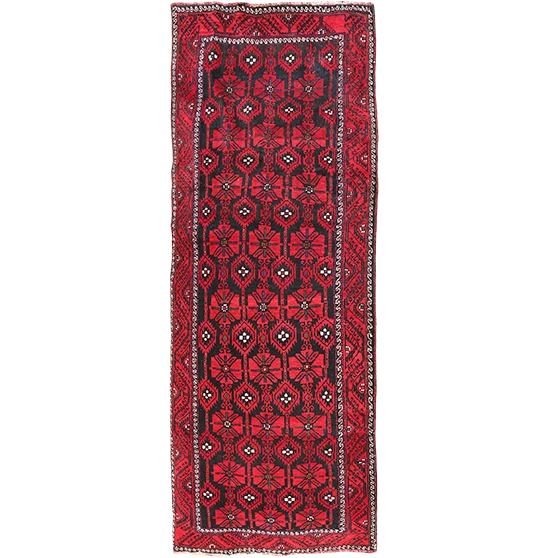
A long Baluch rug of about 13 by 5 feet with a Herati field in madder red, navy, and black, with touches of camel hair - Baluch Persian Rug 13x5 ft - Herati Semi Antique Wool Camel Hair Hand Knotted
Boteh fields
The boteh, the teardrop or paisley form, is repeated in rows across the field, often in alternating colors. Baluch boteh are angular and stylized, sometimes with small hooks. Read more in our article on the boteh.
Diamond lattice
A lattice of diamonds, each holding a small motif, creates a strong graphic pattern. In long rugs, the lattice draws the eye along the length.
Geometric medallions
Many Baluch rugs have a column of stepped or hooked medallions, or a single medallion with corners, set on a field of small motifs.
Prayer rugs and tree of life
Small Baluch prayer rugs, with an arch at one end and often a tree of life in the field, are among the most beloved Baluch formats. They are often woven with camel-colored fields.
4
The Long Baluch Rug
Many Baluch rugs are long and relatively narrow, for example 4 to 5 feet wide and 9 to 13 feet long. These proportions come from tribal and village looms and from the traditional layout of Persian rooms, where long rugs were placed along the sides of the room. They are wider than most runners but longer than standard rugs, a format sometimes called a gallery size.
In modern homes, long Baluch rugs are remarkably useful:
•
Wide hallways and galleries - A 4 or 5 foot width fills a wide hall better than a narrow runner.
•
Long living rooms - Placed in front of a long sofa, a long rug defines the seating area.
•
Bedrooms - Placed at the foot of a king bed, extending to the sides, or along one side of the bed.
•
Kitchens and dining areas - Along a long kitchen island or a farmhouse table.
See our runners for narrower long rugs.
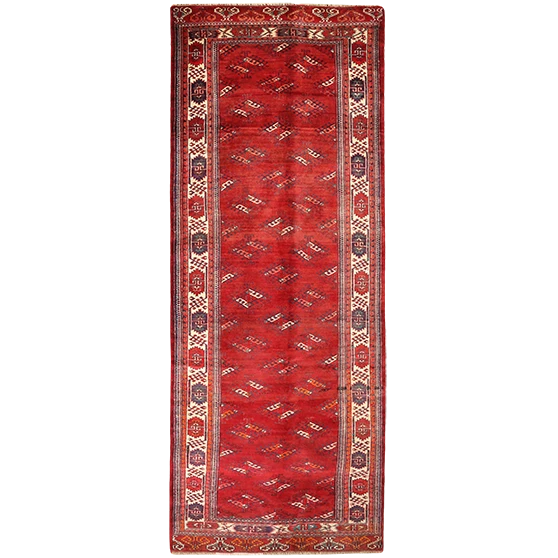
A long Baluch rug of about 12 by 4.5 feet with rows of boteh in madder red, crimson, and camel - Baluch Persian Rug 12x4 ft - Boteh Semi Antique Wool Camel Hair Hand Knotted
5
Camel Hair: What It Is and How to Spot It
Camel hair is one of the special features of Baluch weaving. Weavers use natural, undyed camel hair, or wool dyed to a camel color, in fields, motifs, and borders. Camel hair is soft, warm, and slightly golden, and it takes on a lovely glow with age.
True camel hair is usually used in small amounts, because it is precious. It often appears in the field of prayer rugs or in small details. Look for areas with a soft, golden-tan color and a slightly different texture from the surrounding wool. On the back, camel hair often looks a little fuzzier than wool.
Rugs labeled "wool and camel hair" combine both fibers. The camel tones add warmth and contrast to the dark palette, and they are one reason Baluch rugs look so rich.
6
Reading the Dark Palette
Baluch colors can be hard to see in poor light. Before you choose a rug, look at it in daylight, near a window, and from several angles. Baluch wool is lustrous, and the colors change as the light hits the pile from different directions. Looking with the pile, the rug appears lighter and shinier; looking against the pile, it appears darker and richer.
The main colors are madder red in shades from brick to dark wine, navy and dark blue, aubergine or purple-brown, dark brown or black, and ivory or white for small accents. Camel and rust appear in many pieces. The whites are usually cotton or very bright wool, and they give the design its sparkle.
Many dark browns and blacks in older rugs were dyed with iron-based mordants, which can make the wool brittle over time. In such areas, the pile may be shorter than elsewhere. This "corrosion" is a natural sign of age, not damage, as long as the foundation is sound. Read more in our article on mordants.
Always look at a Baluch rug in daylight and from both directions. Its colors change with the light, and its true beauty appears when the wool catches the sun.
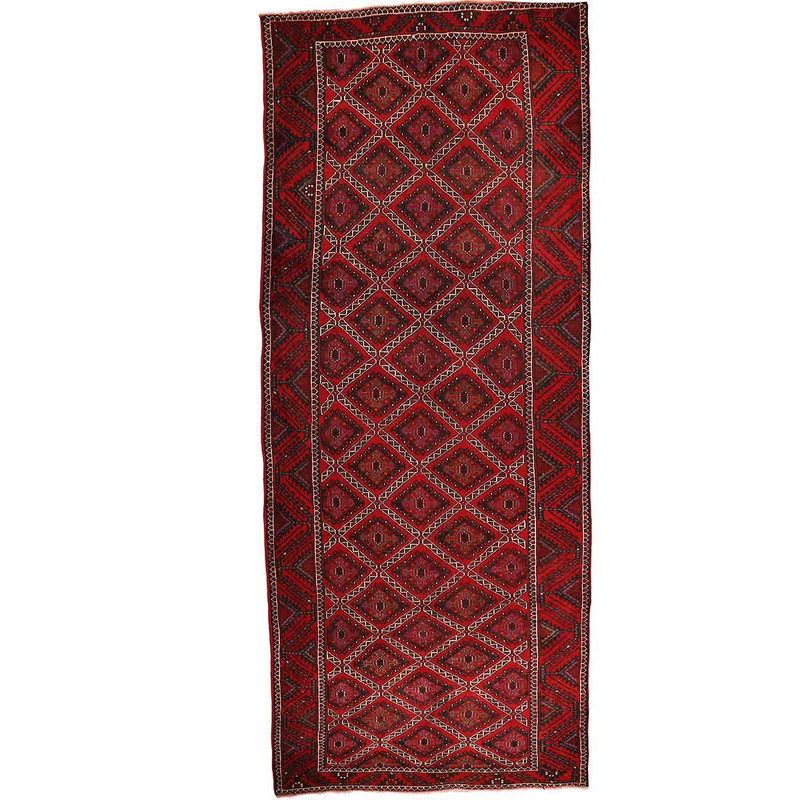
A long Baluch rug of about 13 by 5 feet with a diamond lattice in madder red, burgundy, and navy - Baluch Persian Rug 12x4 ft - Diamond Lattice Semi Antique Wool Camel Hair Hand Knotted
7
How to Check a Baluch Rug's Condition
Baluch rugs are made from soft wool, which gives them their beauty but also means they wear somewhat faster than very hard-wearing rugs such as Bijar or Heriz. When buying, check these points carefully:
•
Pile - Look for even pile without bald spots. Some wear in high-traffic areas is normal in older rugs.
•
Sides - The goat-hair overcasting on the sides should be intact. Worn sides should be renewed before the knots loosen.
•
Ends - The kilim bands at the ends protect the last rows of knots. Check that they are present and secure.
•
Color run - Look at the borders between red and white areas. Any pink staining shows that the red has run.
•
Moth damage - Baluch wool is attractive to moths. Check the back and under the edges for bare patches.
•
Foundation - Fold a corner gently. The foundation should feel supple, not brittle.
•
Shape - Tribal rugs are often slightly irregular in shape. Small variations are normal.
A semi-antique Baluch in good condition has many years of life ahead. With sensible care and placement, it will continue to glow for decades.
8
The Kilim Ends: More Than a Finish
One of the most attractive features of many Baluch rugs is the flat-woven band at each end. In some rugs it is a plain strip a few centimeters wide. In others it is a broad panel of kilim weaving, decorated with colored stripes, small geometric motifs, or rows of tiny knotted details. These bands were not an afterthought. They protected the knotted pile, gave the rug a finished look, and often displayed the weaver's skill in a different technique.
When you buy a Baluch rug, look closely at the ends. Original kilim bands add both beauty and value, and they are a good sign that the rug has not been cut or shortened. If the bands are worn, a restorer can stabilize them with a simple overcast so they do not unravel further. Never trim the fringes or bands to make a rug look tidier; it removes part of the rug's character and can loosen the last rows of knots. Read more in our guide to maintaining rug fringes.
9
Sizing a Long Rug: Worked Examples
Long Baluch rugs are versatile, but their proportions need some planning.
•
In front of a sofa - For a sofa 8 feet long, a rug about 9 to 10 feet long and 4 to 5 feet wide placed parallel to the sofa gives a generous footing without covering the whole room.
•
At the foot of a bed - A king bed is about 6.5 feet wide. A long rug of about 9 by 4.5 feet placed across the foot of the bed extends on both sides.
•
In a wide hallway - For a hallway 6 feet wide, a rug about 4.5 feet wide leaves about 9 inches of floor on each side.
•
Along a kitchen island - For an island 8 feet long, a rug of about 10 by 4 feet gives comfortable footing at the counter.
Measure your space with tape on the floor before you buy. A long rug placed well can transform a space that a standard rug would not fit.
10
Displaying a Baluch Rug
Small Baluch rugs, especially prayer rugs and pieces with camel fields, are often displayed on walls, where their colors can be seen in good light and they are safe from wear. A rug hung on a wall should be supported along its whole width, usually with a sleeve sewn to the back and a wooden or metal rod, never with nails through the rug. Long rugs can also be draped over a sturdy bench or the back of a sofa for a few days to let their colors brighten a room. Rotate displayed rugs regularly so one area is not always exposed to light.
11
How Baluch Rugs Are Built
•
Knot - Mostly the asymmetric knot.
•
Warp - Wool or cotton, depending on the group and period.
•
Weft - Usually wool or cotton, often dark.
•
Pile - Soft, lustrous wool, sometimes with camel hair, clipped short to medium.
•
Sides - Overcast in dark goat hair.
•
Ends - Wide kilim bands, sometimes patterned.
The density of Baluch rugs is usually medium. They are not as finely knotted as city rugs, but their soft wool and short pile give clear, crisp drawing.
Baluch rugs are usually lighter and more pliable than village rugs from western Persia. They drape when lifted and lie flat on the floor.
12
Baluch Rugs Compared with Their Neighbors
Baluch and Turkmen
Turkmen rugs, from further north, use a similar palette of reds but rely on repeated gul motifs and often a brighter red. Baluch rugs use darker blues and browns and more varied designs. See our Turkmen collection.
Baluch and Mashhad
Mashhad rugs are city rugs with curvilinear designs and soft palettes. Baluch rugs are tribal, geometric, and darker. See our Mashhad collection.
Baluch and Afghan
Afghan rugs, including those of the Ersari Turkmen, often use larger guls and brighter reds. Some Afghan Baluch rugs are very similar to Persian Baluch rugs. See our Afghan collection.
Baluch and Kashmar
Kashmar rugs, from western Khorasan, are town rugs with curvilinear designs. Baluch weaving also takes place near Kashmar, but its tribal rugs are quite different in style. See our Kashmar collection.
13
Placing a Dark Rug in a Modern Home
A dark Baluch rug can look striking in a modern room, but it needs a little thought.
•
Contrast - Baluch rugs look best on light floors, such as pale oak, stone, or polished concrete. On very dark floors they can disappear.
•
Light - Place the rug where it catches natural light, so its colors glow.
•
Simple furniture - Light-colored upholstery and simple forms let the rug's pattern stand out.
•
Repeat a color - Pick up the rug's red or camel in a cushion, throw, or artwork.
•
Mix textures - Leather, linen, wood, and metal all suit the rug's tribal character.
In traditional rooms, a Baluch rug pairs well with dark wood, books, and warm lighting, creating a cozy, library-like atmosphere.
14
Caring for a Baluch Rug
Because Baluch wool is soft, gentle care is especially important.
•
Vacuum gently - Use suction only, without a beater bar, and vacuum in the direction of the pile.
•
Rotate - Turn the rug every six months to even out wear and light.
•
Avoid strong sun - Dark colors can fade in strong direct sunlight.
•
Use a pad - A good pad reduces wear and keeps the rug in place.
•
Watch for moths - Vacuum under furniture and check the back of the rug regularly.
•
Professional washing - Have the rug washed by a specialist who knows tribal rugs, as some reds may run.
See our care instructions and our guide to professional washing.
15
Semi-Antique Baluch Rugs
Most Baluch rugs in our collection are semi-antique, woven roughly forty to sixty years ago. They combine the soft, glowing wool of the Baluch tradition with practical condition. Their colors have mellowed, their wool has developed a lovely patina, and they still have many years of life ahead. See our semi-antique rugs.
16
What Affects the Price of a Baluch Rug
•
Wool quality - Soft, lustrous wool is highly valued.
•
Camel hair - Rugs with true camel hair are often more sought after.
•
Design - Unusual or finely drawn designs add value.
•
Size - Long and large rugs cost more than small ones.
•
Condition - Even pile, intact sides and ends, and no moth damage raise value.
•
Age - Older rugs with natural dyes are especially prized.
Baluch rugs offer excellent value. They bring the depth and character of tribal weaving at prices well below many city rugs.
17
Common Buying Mistakes
•
Judging in poor light - Always look at a Baluch rug in daylight.
•
Mistaking corrosion for damage - Shorter pile in dark brown areas is a natural sign of age.
•
Placing on a dark floor - The rug may disappear.
•
Using a beater bar - It can damage soft wool.
•
Ignoring the sides and ends - These areas need regular care.
18
Frequently Asked Questions
Where are Baluch rugs woven?
Mostly in Khorasan, around Torbat-e Heydarieh, Torbat-e Jam, and Sarakhs, and in western Afghanistan.
Who weaves Baluch rugs?
Baluch tribes and neighboring groups of Khorasan.
What colors are typical?
Deep red, navy, aubergine, dark brown, with ivory, white, and camel accents.
Do Baluch rugs contain camel hair?
Many do, in small amounts, especially in fields and details.
What knot is used?
Mostly the asymmetric knot.
What is a gallery-size rug?
A long rug wider than a runner, often 4 to 5 feet wide and 9 to 13 feet long.
Why do Baluch rugs look different in different light?
Because their lustrous wool reflects light differently depending on the direction of the pile.
What is corrosion?
Natural wear of dark brown or black wool dyed with iron mordants, which shortens the pile in those areas.
Are Baluch rugs durable?
Yes, with gentle care. Their soft wool wears somewhat faster than very hard-wearing rugs.
Do Baluch rugs suit modern interiors?
Yes, especially on light floors with simple furniture.
How should I clean a Baluch rug?
Vacuum gently, avoid strong sun, and have it professionally washed by a tribal rug specialist.
Should I trim worn kilim ends?
No. Have them stabilized by a restorer instead. Trimming removes character and can loosen the last rows of knots.
Can a Baluch rug be hung on a wall?
Yes, if it is supported along its whole width with a sewn sleeve and a rod.
What size long rug suits a king bed?
A rug of about 9 by 4.5 feet across the foot of the bed works well.
Why are the sides overcast in goat hair?
Goat hair is strong and resists wear, so it protects the edges of the rug.
19
Choose Your Baluch Rug
Each Baluch rug in our collection is hand-knotted, one of a kind, and inspected before it is listed. Browse our Baluch collection, compare it with our Turkmen and Afghan rugs, or ask our experts for help.